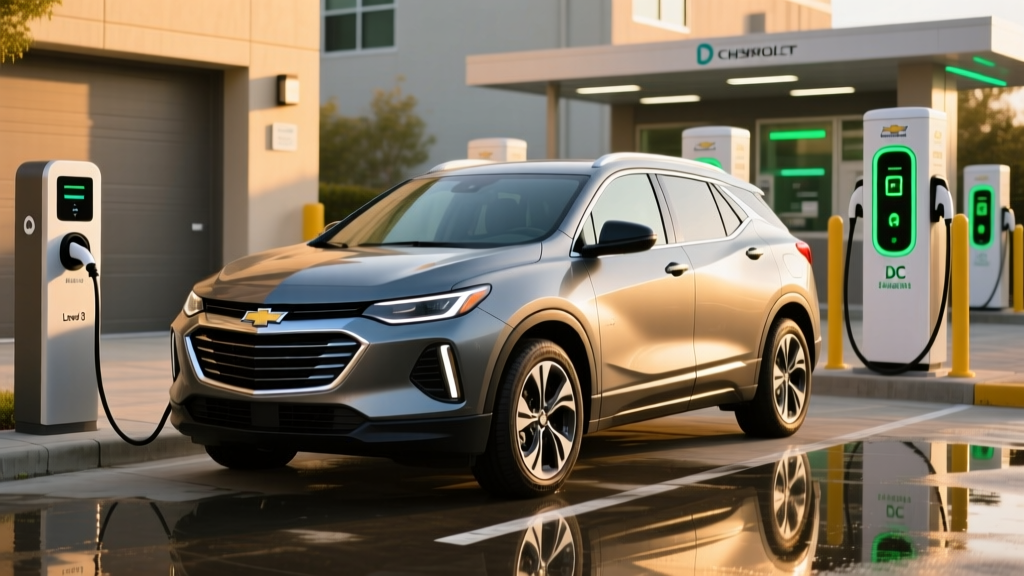
The 2025–2026 Chevrolet Equinox EV pairs a usable 85 kWh Ultium battery with up to 319 miles of EPA range, but how quickly you can replenish that pack depends entirely on which charging level you use. Whether you're plugging into a standard wall outlet, a home Level 2 station, or a highway DC fast charger, the Chevy Equinox EV charging speed varies from a trickle to 70 miles of range in ten minutes. This guide maps every charging scenario with exact numbers, install costs, and equipment picks so you can plan realistically.
Equinox EV Battery and Charging Architecture
Before examining speeds, here's the hardware under the floor. The Equinox EV uses an 85 kWh usable lithium-ion (NMC) Ultium battery pack. It charges via a native NACS (North American Charging Standard) port on 2025+ models, giving it direct access to Tesla Superchargers without an adapter. The onboard charger is rated at 11.5 kW for Level 2 AC charging, and the pack supports up to 150 kW peak DC fast charging.
Charging Levels: kW Speeds and Miles Per Hour
The single biggest source of confusion for new EV owners is the difference between kW (kilowatts — the rate of energy flow, like water pressure from a hose) and kWh (kilowatt-hours — the total energy stored, like gallons in a tank). Charging speed is measured in kW. Battery capacity is measured in kWh. They are not interchangeable.
| Level | Voltage / Amps | Max kW | Miles of Range Added Per Hour | 10–80% Time (85 kWh Pack) |
|---|---|---|---|---|
| Level 1 (Standard Outlet) | 120V / 12A | ~1.4 kW | ~3–4 mi/hr | ~50+ hours (not practical for full charge) |
| Level 2 (Home / Public AC) | 240V / 48A | 11.5 kW | ~34–38 mi/hr | ~6.5–7 hours |
| DC Fast Charging | 400V+ architecture | 150 kW peak | Up to ~420 mi/hr (at peak) | ~30 minutes (10–80%) |
DC fast charging reality check: The 150 kW figure is a peak, not a sustained rate. The Equinox EV will pull maximum power between roughly 10–40% state of charge, then taper progressively. Expect an average of 90–110 kW across the full 10–80% session, which is why a 30-minute estimate is more honest than the "10 minutes for 70 miles" marketing claim — that figure applies only to the initial burst at low SoC.
Home Charger Installation: Requirements and Cost Breakdown
To unlock the Equinox EV's full 11.5 kW Level 2 speed at home, you need a 240-volt circuit rated for at least 60 amps (which delivers 48 amps continuous to the vehicle, per the National Electrical Code's 80% rule for continuous loads). Here's what that actually costs.
| Component | Low-End Estimate | High-End Estimate | Notes |
|---|---|---|---|
| Level 2 Charger (Equipment) | $400 | $750 | 48A smart charger, NACS connector, 25-ft cable |
| Electrician Labor (240V/60A circuit) | $600 | $1,500 | Varies by run length from panel to garage |
| Electrical Permit | $50 | $200 | Required in most jurisdictions |
| Panel Upgrade (if needed) | $1,500 | $3,500 | 100A → 200A service; older homes may need this |
| Total (No Panel Upgrade) | $1,050 | $2,450 | Most homes with 200A panels fall here |
| Total (With Panel Upgrade) | $2,550 | $5,950 | Homes built before ~1990 often need upgrades |
Panel upgrade reality: If your home has a 100-amp electrical panel — common in houses built before 1990 — adding a 60-amp EV circuit may exceed your panel's capacity. An electrician will perform a load calculation. If you're over the limit, a panel upgrade to 200A is mandatory. Budget for this possibility before committing to a charger purchase.
Safety and Electrical Code Considerations
- Dedicated circuit: A Level 2 charger must have its own dedicated breaker — never share the circuit with other appliances.
- GFCI protection: The NEC requires ground-fault circuit interrupter protection for outdoor EV outlets. Many hardwired chargers have built-in GFCI; if you use a NEMA 14-60 receptacle outdoors, the breaker must be GFCI-rated.
- Outdoor rating: If your charger mounts outside, verify it carries a NEMA 4 or IP65 weather rating. All major chargers listed below meet this standard.
- Wire gauge: A 60A circuit typically requires 6 AWG copper wire for runs up to 50 feet; longer runs may need 4 AWG to prevent voltage drop. Your electrician will spec this.
Connector Compatibility: NACS, CCS, and Adapters
The 2025–2026 Equinox EV ships with a NACS charge port, aligning with GM's transition away from CCS1. This is a significant practical advantage: you can plug directly into any of the 25,000+ Tesla Supercharger stalls across North America without an adapter.
| Network / Charger Type | Connector | Direct Plug? | Adapter Needed? |
|---|---|---|---|
| Tesla Supercharger | NACS | Yes | None |
| Electrify America | CCS1 → NACS adapter | No | CCS1-to-NACS adapter (included by GM or ~$200 aftermarket) |
| EVgo | CCS1 or NACS (varies) | Depends on station | Check station listing |
| ChargePoint (Level 2) | J1772 → NACS adapter | No | J1772-to-NACS adapter (~$100–150) |
| Home Level 2 Charger | NACS (if buying new) | Yes | None — buy a NACS-terminated charger |
Adapter note: GM has provided CCS-to-NACS adapters to early Equinox EV buyers; check with your dealer. For J1772 public Level 2 chargers (still common at workplaces and shopping centers), a compact J1772-to-NACS adapter lives in your frunk and takes 5 seconds to connect.
Cost to Charge: Per-Mile Economics vs. Gas
The Equinox EV averages roughly 3.0 miles per kWh (approximately 112 MPGe combined for FWD trims per fueleconomy.gov). Here's what that translates to in dollars across common charging scenarios.
| Scenario | Cost per kWh | Cost per Mile | Notes |
|---|---|---|---|
| Home Off-Peak (utility time-of-use) | $0.08–$0.12 | $0.03–$0.04 | Best-case; overnight charging |
| Home Standard Rate | $0.14–$0.18 | $0.05–$0.06 | National average residential |
| Public Level 2 (ChargePoint, etc.) | $0.25–$0.40 | $0.08–$0.13 | Varies widely by location |
| DC Fast Charging (EA, EVgo) | $0.35–$0.55 | $0.12–$0.18 | Peak pricing at highway stops |
| Tesla Supercharger (NACS) | $0.25–$0.40 | $0.08–$0.13 | Varies by time and location |
| Gas Vehicle (28 MPG avg, $3.40/gal) | — | $0.12/mi | Comparable compact gas SUV |
The bottom line: Charging at home on off-peak rates costs roughly one-quarter what gasoline does per mile. Even DC fast charging on the road is often comparable to or cheaper than gas. The savings compound: at 12,000 miles/year, home charging saves $900–$1,100 annually vs. a 28 MPG gas SUV at $3.40/gallon.
Recommended Home Chargers for the Equinox EV
Since the Equinox EV uses NACS, buy a charger with a native NACS plug to avoid daily adapter fumbling. All picks below support 48-amp continuous output (the max the Equinox's 11.5 kW onboard charger can accept) and include 25-foot cables.
Emporia Vue 2 (NACS) — Best Value
- Power Output: 48A / 11.5 kW (240V, hardwired on 60A circuit)
- Connector: Native NACS
- Cable Length: 24 ft
- Smart Features: Wi-Fi, app scheduling, energy monitoring, solar integration
- Price: ~$400
- Best For: Budget-conscious owners who want smart scheduling for off-peak utility rates
ChargePoint Home Flex (NACS) — Best Smart Features
- Power Output: Up to 50A / 12 kW (adjustable down to match circuit)
- Connector: Native NACS (2025+ model)
- Cable Length: 25 ft
- Smart Features: Wi-Fi, Alexa/Google integration, detailed app analytics, scheduled charging
- Price: ~$650
- Best For: Owners who want detailed energy data and flexible amperage settings
WallConnector (Tesla, NACS) — Best Reliability
- Power Output: 48A / 11.5 kW (240V, 60A circuit)
- Connector: Native NACS
- Cable Length: 24 ft
- Smart Features: Wi-Fi, power sharing (daisy-chain two units on one circuit), OTA updates
- Price: ~$475
- Best For: Multi-EV households; rock-solid build quality
Important: Do not buy a 32A or 40A charger — the Equinox EV can accept 48A, and undersizing your charger means slower overnight fills. A 48A charger adds roughly 35 miles of range per hour; a 32A unit drops to about 23 miles per hour.
Public DC Fast Charging: What to Expect on Road Trips
The Equinox EV's 150 kW peak DC rate is competitive for its class, though it trails the Hyundai Ioniq 5's 240 kW capability. Here's a realistic road-trip framework:
- 10–80% in ~30 minutes at a functioning 150 kW+ charger (Tesla V3 Supercharger, Electrify America 150+ stall)
- Plan stops every 200–230 miles in real highway driving to keep charge sessions under 30 minutes and avoid deep discharges
- Precondition the battery by navigating to a Supercharger in the infotainment system — this warms the pack and can cut your 10–80% time by 5–8 minutes in cold weather
- Charging curve taper: Above 80% SoC, speed drops sharply to ~40–50 kW. On road trips, charge to 80% and drive on; charging 80–100% takes nearly as long as 10–80%
Access to the Tesla Supercharger network via NACS is the Equinox EV's biggest road-trip advantage. Superchargers remain the most reliable DC fast-charging network in the U.S. by uptime percentage, meaning fewer broken-stall surprises on long drives.
Federal Tax Credit and Charger Incentives
The Equinox EV may qualify for the §30D federal clean vehicle credit of up to $7,500, available as a point-of-sale price reduction through participating dealers. Eligibility depends on:
- MSRP cap: Vehicle base price must not exceed $80,000 for SUVs (Equinox EV clears this easily at ~$33,000–$43,000)
- Buyer income limits: AGI must not exceed $150,000 (single), $225,000 (head of household), or $300,000 (joint) — check current-year IRS thresholds
- Battery sourcing: Critical minerals and battery components must meet phased-in domestic-content requirements that tighten annually through 2030
For your home charger, the Alternative Fuel Vehicle Refueling Property Credit (§30C) covers 30% of equipment and installation costs, up to $1,000 for residential installations, provided you live in an eligible census tract. Consult a tax professional to confirm eligibility, as tract-level qualification varies.
Frequently Asked Questions
How much does it cost to install a home EV charger for the Equinox EV?
Expect $1,050–$2,450 total for a 48A Level 2 charger with a 60A/240V circuit if your electrical panel has spare capacity. If your home needs a panel upgrade from 100A to 200A service, total costs rise to $2,550–$5,950. Always get a load calculation from a licensed electrician before purchasing equipment.
How fast will each charging level add range to the Equinox EV?
Level 1 (120V wall outlet): roughly 3–4 miles per hour — fine for overnight top-ups if you drive under 40 miles daily. Level 2 (240V home charger at 48A): about 34–38 miles per hour, fully replenishing the pack overnight. DC fast charging at 150 kW peak: up to 70 miles in 10 minutes at low state of charge, averaging about 420 miles per hour at peak rate.
Which connector does the Equinox EV use, and will I need adapters?
The 2025–2026 Equinox EV uses a native NACS connector. This plugs directly into Tesla Superchargers and any new NACS-equipped public charger. For older CCS1 public DC chargers (Electrify America, some EVgo stations), you'll need a CCS-to-NACS adapter. For J1772 public Level 2 chargers, a J1772-to-NACS adapter is required. GM has provided adapters to many early buyers.
How much does charging cost per mile compared to gas?
At home on average residential electricity rates ($0.14–$0.18/kWh), the Equinox EV costs roughly $0.05–$0.06 per mile. A comparable gas SUV at 28 MPG and $3.40/gallon costs about $0.12 per mile. Home charging saves roughly $700–$1,100 per year at 12,000 miles driven. Public DC fast charging ($0.35–$0.55/kWh) costs $0.12–$0.18 per mile — comparable to gas, which is why home charging is the economic sweet spot.
What electrical upgrades might my home need for a Level 2 charger?
The most common upgrade is a panel replacement from 100A to 200A service, costing $1,500–$3,500. You may also need a new conduit run if your panel is far from the garage (adds $300–$800 in labor and materials). Homes with modern 200A panels and a short run to the garage typically need nothing beyond the new 60A breaker and wiring. Always have an electrician perform a load calculation first.
Does cold weather affect Equinox EV charging speed?
Yes. In temperatures below 32°F, a cold battery will accept DC fast charge power more slowly until it warms up — potentially adding 10–15 minutes to a 10–80% session. Use the Equinox EV's battery preconditioning feature (activate by setting a Supercharger or DC fast charger as your navigation destination) to warm the pack before arrival. Range also drops 20–30% in sustained cold, so adjust your trip planning accordingly.