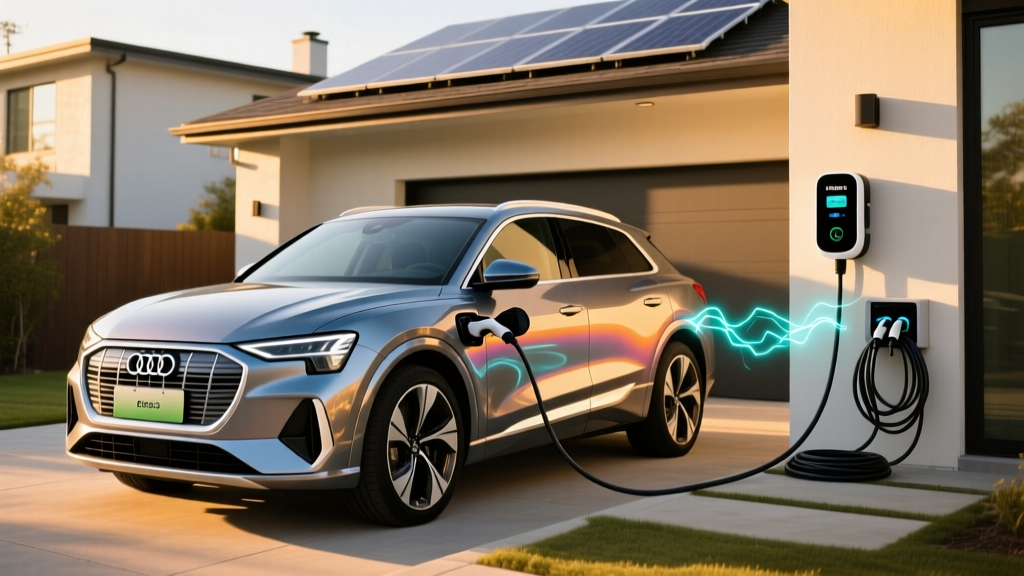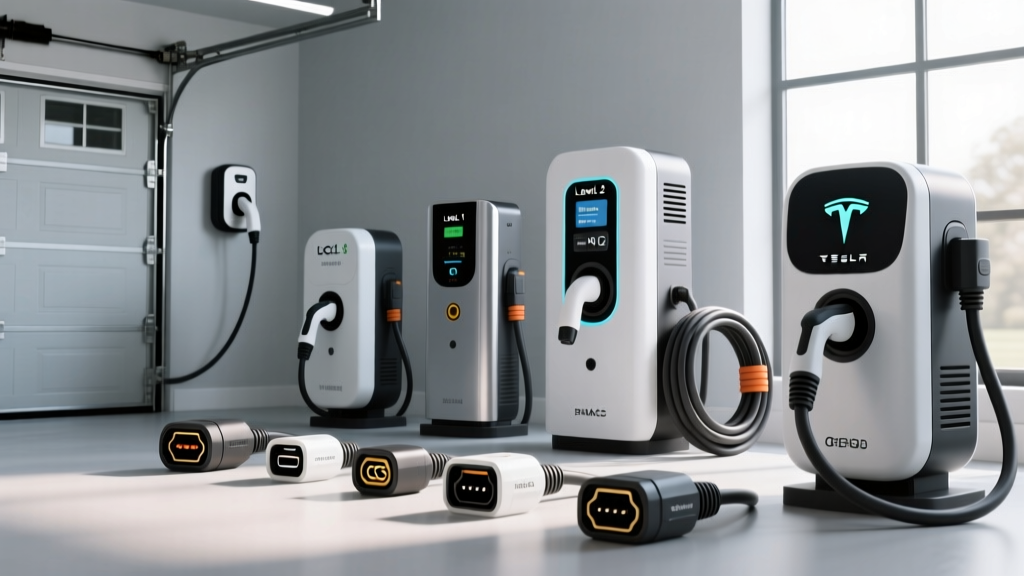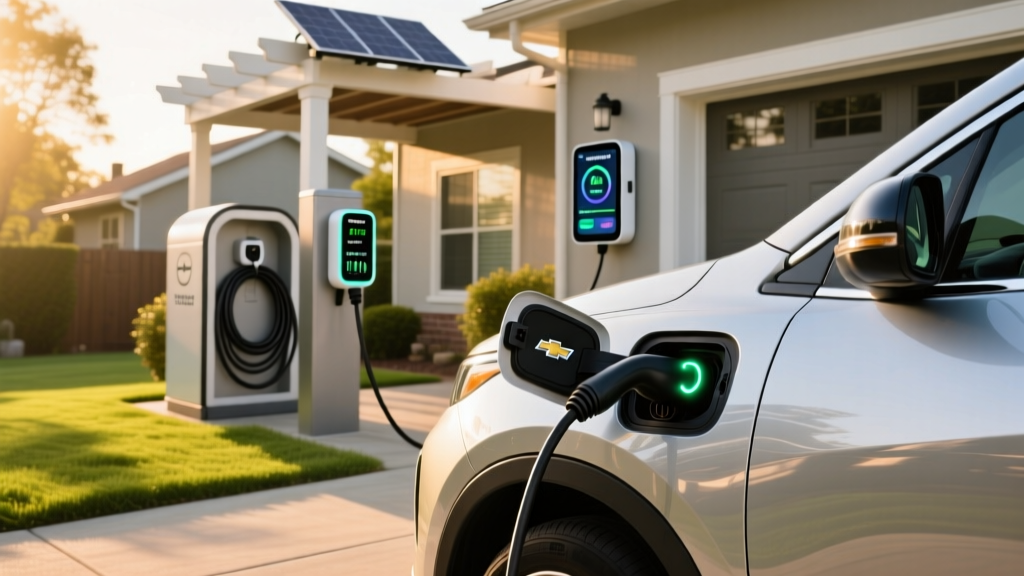
The Chevrolet Equinox EV is one of the most affordable long-range electric SUVs on the market, but its 85 kWh (usable) battery demands a deliberate charging strategy. Whether you're plugging into a standard 120V outlet, installing a 240V home charger, or relying on DC fast charging for road trips, understanding the Equinox EV's charging architecture will save you time, money, and frustration.
This guide covers every aspect of Chevy Equinox EV charging — from real-world charging speeds and home installation costs to connector compatibility and per-mile energy costs compared to gasoline. All figures reflect the current model year as sold in 2026.
Equinox EV Charging Levels: What Speed to Expect
Before we break down each charging level, a critical distinction: kW (kilowatts) measures power — the rate at which energy flows into the battery. kWh (kilowatt-hours) measures energy capacity — how much the battery holds. The Equinox EV's battery stores roughly 85 kWh of usable energy; your charger's kW rating determines how quickly that capacity refills.
| Charging Level | Voltage / Amperage | Power (kW) | Miles of Range Added per Hour | Typical Use Case |
|---|---|---|---|---|
| Level 1 (120V) | 120V / 12A | ~1.4 kW | ~4–5 mi/hr | Overnight trickle, emergency top-off |
| Level 2 (240V) | 240V / 32–48A | 7.7–11.5 kW | ~25–37 mi/hr | Daily home charging |
| DC Fast Charging | 400V+ DC | Up to 150 kW peak | ~200+ mi in 30 min (10–80%) | Road trips, quick stops |
Level 1: The Included Cord
The Equinox EV ships with a dual-level mobile charging cord that handles both 120V (Level 1) and 240V (Level 2, with a NEMA 14-50 plug adapter). On a standard 120V household outlet at 12 amps, you'll recover approximately 1.4 kW — enough to add about 4 to 5 miles of range per hour. For the full 315-mile EPA range, a Level 1 charge from empty would take roughly 60+ hours. This is practical only for overnight top-offs of 30–50 miles or as a backup.
Level 2: The Home Charging Sweet Spot
A dedicated 240V Level 2 charger is where Equinox EV ownership becomes practical. At the vehicle's maximum 11.5 kW acceptance rate, a full charge from 10% to 100% takes approximately 8–9 hours — ideal for overnight charging. Most owners plug in upon arriving home and wake up to a full battery every morning. A 48A charger on a 60A dedicated circuit maximizes the Equinox EV's onboard capability.
DC Fast Charging: Road-Trip Reality
The Equinox EV supports DC fast charging at up to 150 kW peak via its CCS1 connector (or NACS on newer trims). In real-world testing at Electrify America and EVgo 150+ kW stations, the Equinox EV typically charges from 10% to 80% in approximately 30–35 minutes. However, the charge curve tapers steeply above 80% — going from 80% to 100% can add another 25–30 minutes. On road trips, plan to charge to 80% and drive on; the time penalty for topping off is rarely worth it.
Home Charger Installation: Costs and Electrical Requirements
Installing a Level 2 home charger is the single biggest upfront cost of EV ownership beyond the vehicle itself — but it's also the investment that makes daily EV life effortless. Here's what's involved for a Chevy Equinox EV home charging setup.
Electrical Requirements
To achieve the Equinox EV's maximum 11.5 kW Level 2 rate, you need:
- Circuit: 60-amp dedicated breaker (NEC code requires chargers to use no more than 80% of circuit capacity, so 48A continuous draw requires a 60A circuit)
- Wiring: 6 AWG copper wire (or 4 AWG aluminum) run from your electrical panel to the charger location
- Outlet option: NEMA 14-50 receptacle (if using the mobile cord) or hardwired connection (preferred for wall-mounted units)
- Panel capacity: Your main electrical panel must have sufficient spare amperage. Most modern 200A panels can accommodate a 60A EV circuit; older 100A or 150A panels may require an upgrade
Panel Upgrade: The Hidden Cost
If your home has a 100A or 150A main panel with limited spare slots, adding a 60A EV circuit may require a panel upgrade to 200A. This is especially common in homes built before 1990 or homes that have added significant electrical loads (electric HVAC, hot tubs, workshops). A panel upgrade typically costs $1,500–$3,500 and adds 1–3 days to the project timeline. Some utilities offer rebates for panel upgrades tied to EV adoption — check with your local provider.
Installation Cost Breakdown
| Component | Low-End Estimate | High-End Estimate | Notes |
|---|---|---|---|
| Level 2 Charger (Equipment) | $350 | $700 | Smart Wi-Fi chargers, 40–48A |
| Electrician Labor | $400 | $1,200 | Varies by wire run distance and complexity |
| Materials (wire, conduit, breaker) | $100 | $400 | Longer runs = more wire and conduit |
| Permit & Inspection | $50 | $250 | Varies by municipality |
| Panel Upgrade (if needed) | $1,500 | $3,500 | Only if existing panel lacks capacity |
| Total (no panel upgrade) | $900 | $2,550 | Typical suburban installation |
| Total (with panel upgrade) | $2,400 | $6,050 | Older homes with limited panel capacity |
According to the U.S. Department of Energy, the national average for a basic Level 2 home installation (no panel upgrade, short wire run) falls between $1,000 and $2,500 including equipment. Always hire a licensed electrician and pull a permit — unpermitted EV charger installations can void homeowner's insurance and create fire hazards.
Connector Compatibility: NACS, CCS1, and What You Need
The EV charging connector landscape has shifted dramatically. General Motors transitioned its North American vehicles to the North American Charging Standard (NACS) — the Tesla-designed connector — beginning with the 2025 model year. Here's what that means for Equinox EV owners.
| Model Year | Built-In Connector | Tesla Supercharger Access | CCS1 Network Access | Adapter Needed? |
|---|---|---|---|---|
| 2024 (early build) | CCS1 | Yes (via GM-approved NACS adapter) | Native | NACS adapter for Superchargers |
| 2025–2026 | NACS | Native | Yes (via CCS1 adapter) | CCS1 adapter for Electrify America, EVgo CCS stalls |
Key takeaway: If you're buying a 2025 or 2026 Equinox EV, your vehicle has a NACS port natively. You can plug directly into any Tesla Supercharger (V3 and V4 stalls). For Electrify America and other CCS1-only stations, you'll need a CCS1-to-NACS adapter — GM provides or offers one. If you have a 2024 model with CCS1, GM sells a NACS adapter that unlocks Tesla Supercharger access.
For home charging, most Level 2 chargers are now available with either a NACS or CCS1 plug. When purchasing a home charger, match the connector to your vehicle's built-in port. Hardwired chargers with a J1772 connector (the legacy Level 2 standard) will also work with a simple J1772-to-NACS adapter included with most new GM EVs.
Charging Cost: Equinox EV Per-Mile Cost vs. Gasoline
One of the strongest arguments for the Equinox EV is fuel cost savings. Here's how the numbers break down across different charging scenarios, compared to a gasoline equivalent (a gas-powered Equinox averaging 26 MPG combined per fueleconomy.gov).
| Scenario | Cost per kWh | Cost per Mile (EV) | Cost per Mile (Gas, 26 MPG) | Annual Savings (12,000 mi/yr) |
|---|---|---|---|---|
| Home Off-Peak (utility rate) | $0.08–$0.12 | $0.024–$0.036 | $0.131 (at $3.40/gal) | $1,140–$1,284 |
| Home Standard Rate | $0.13–$0.18 | $0.039–$0.054 | $0.131 | $924–$1,104 |
| Public Level 2 (ChargePoint, etc.) | $0.25–$0.40 | $0.075–$0.120 | $0.131 | $132–$672 |
| DC Fast Charging (EA, EVgo) | $0.35–$0.55 | $0.105–$0.165 | $0.131 | -$408 to $312 (may cost more) |
The math is clear: home charging delivers massive savings, while exclusive reliance on DC fast charging can erode or even reverse the cost advantage. Equinox EV owners who charge at home 80%+ of the time typically save $900–$1,300 annually on fuel compared to the gas Equinox.
Recommended Home Chargers for the Equinox EV
Based on the Equinox EV's 11.5 kW maximum Level 2 acceptance rate, here are chargers that maximize charging speed, reliability, and smart features.
ChargePoint Home Flex
- Power Output: Up to 12 kW (50A), configurable down to 16A
- Connector: Available with NACS or J1772 plug
- Cable Length: 23 feet
- Smart Features: Wi-Fi, app scheduling, energy tracking, Alexa integration
- Price: ~$550–$650
- Why it works: Configurable amperage means you can set it to 48A to match the Equinox EV's max acceptance even on a 60A circuit. NEMA 14-50 plug or hardwired.
Emporia Level 2 Smart Charger
- Power Output: Up to 11.5 kW (48A)
- Connector: J1772 (use included adapter for NACS)
- Cable Length: 24 feet
- Smart Features: Wi-Fi, app control, solar integration, energy monitoring
- Price: ~$350–$400
- Why it works: Best value on the market. Hardwired installation. Solar-aware scheduling lets you charge when your panels produce excess energy.
Wall Connector (Tesla)
- Power Output: Up to 11.5 kW (48A)
- Connector: NACS native
- Cable Length: 24 feet
- Smart Features: Wi-Fi, OTA updates, power sharing between units
- Price: ~$475
- Why it works: If your Equinox EV has a NACS port (2025+), this is a native plug match — no adapter needed. Excellent build quality and power sharing for two-EV households.
For Equinox EV owners with a NACS-equipped vehicle (2025–2026 models), the Tesla Wall Connector is the most seamless home option. For CCS1-equipped 2024 models or owners who want brand flexibility, the ChargePoint Home Flex remains the most versatile choice. Budget-conscious buyers should strongly consider the Emporia — it delivers full 48A output at the lowest price point with robust smart features.
DC Fast Charging Time Examples
Here are approximate DC fast charging times for the Equinox EV's 85 kWh battery at commonly available charger power levels. These assume a starting State of Charge (SoC) of 10% and optimal battery temperature (preconditioned).
| Charger Rating | 10% → 50% | 10% → 80% | 10% → 100% | Network Examples |
|---|---|---|---|---|
| 50 kW | ~55 min | ~90 min | ~140 min | Older EA, some ChargePoint |
| 100 kW | ~30 min | ~50 min | ~85 min | EVgo, some EA stalls |
| 150 kW | ~20 min | ~33 min | ~65 min | Tesla Supercharger V3, EA 150 |
| 250–350 kW | ~18 min | ~30 min | ~60 min | EA 350, Tesla V4 (vehicle caps at 150 kW) |
Note that even at a 350 kW Electrify America stall, the Equinox EV can only accept up to 150 kW — so charging speeds plateau at the vehicle's limit. The 250–350 kW row shows only marginal improvement over 150 kW because the vehicle's battery management system restricts peak intake. Don't go out of your way to find a 350 kW stall; a 150 kW charger delivers nearly identical real-world performance for this vehicle.
Safety and Electrical Code Considerations
A Level 2 EV charger draws significant continuous current — often for 6–10 hours at a stretch. Proper installation is not optional. Here's what the National Electrical Code (NEC) and best practices require:
- Dedicated circuit: Your EV charger must be on its own dedicated breaker — it cannot share a circuit with other appliances or outlets.
- GFCI protection: NEC 2020 and later requires GFCI (Ground Fault Circuit Interrupter) protection for all EV charging receptacles. Hardwired chargers with built-in ground fault detection typically satisfy this requirement, but outdoor NEMA 14-50 receptacles require a GFCI breaker.
- Outdoor rating: If your charger is installed outdoors (garage-less homes, driveway parking), the unit must carry a NEMA 4 or NEMA 4X weather-resistance rating. All three chargers recommended above are outdoor-rated.
- Wire gauge: Undersized wire creates fire risk. A 48A charger on a 60A circuit requires 6 AWG copper minimum. Your electrician will verify this based on run length and local code amendments.
- Permit and inspection: Most jurisdictions require an electrical permit for EV charger installation. The inspection ensures the work meets code and protects your insurance coverage. Typical permit fees range from $50 to $250.
Never use an extension cord with an EV charger. Never plug a Level 2 charger into a circuit shared with high-draw appliances (dryers, ranges, HVAC). If your installation feels like a shortcut, it probably is — get a second opinion from a licensed electrician.
Frequently Asked Questions
How much does it cost to install a home EV charger for the Equinox EV?
A typical Level 2 home charger installation costs between $900 and $2,550 including equipment, electrician labor, materials, and permit — assuming your electrical panel has sufficient capacity. If a panel upgrade from 100A/150A to 200A is required, add $1,500–$3,500. The total investment usually pays for itself within 1.5–3 years through fuel savings compared to gasoline.
How fast will each charging level add range to my Equinox EV?
Level 1 (120V) adds approximately 4–5 miles per hour. Level 2 (240V, 48A) adds approximately 37 miles per hour at the Equinox EV's 11.5 kW maximum acceptance rate. DC fast charging at 150 kW can add roughly 200 miles in 30 minutes (10–80% SoC). Actual speeds vary based on battery temperature, State of Charge, and charger availability.
Which connector is compatible with my Equinox EV?
The 2024 Equinox EV (early builds) uses a CCS1 connector natively and requires a GM-approved NACS adapter for Tesla Supercharger access. The 2025 and 2026 Equinox EV uses a NACS connector natively, providing direct Tesla Supercharger compatibility; a CCS1 adapter is needed for Electrify America and some other networks. Check your specific vehicle's build date and port to confirm.
How much does charging the Equinox EV cost per mile compared to gas?
At the national average residential electricity rate of ~$0.16/kWh and the Equinox EV's efficiency of ~3.0 miles per kWh, home charging costs approximately $0.053 per mile. A gasoline Equinox at 26 MPG combined and $3.40/gallon costs $0.131 per mile. That's roughly $930 in annual fuel savings for a driver covering 12,000 miles per year. DC fast charging at $0.40–$0.55/kWh narrows or eliminates this advantage.
What electrical upgrades might I need for a home charger?
The most common upgrade is a panel replacement from 100A or 150A to 200A service, which costs $1,500–$3,500 and is necessary when your existing panel lacks the spare amperage or breaker slots for a dedicated 60A EV circuit. Other potential upgrades include adding a sub-panel (if the charger is far from the main panel), trenching conduit for detached garages, or upgrading the utility service drop. Your electrician will assess panel capacity during the initial site visit — ask for a load calculation before committing to the project.