If you're still driving—or recently retired—a 2006 Chevy Cobalt Supercharged, you already know what forced induction feels like in a lightweight, tossable chassis. That Eaton M62 supercharger pushed the 2.0L Ecotec to 205 horsepower, delivering a visceral, analog driving experience that modern EVs replicate with instant torque instead of boost. But making the jump from a 19-year-old gasoline car to a battery-electric vehicle means learning an entirely new fueling paradigm: kilowatts, charge curves, connectors, and home electrical infrastructure.
This guide is built for that exact transition. We'll walk through every charging level, what home installation actually costs (including the panel-upgrade scenario many older homes face), which connector your next EV will use, and how charging cost per mile compares to filling that Cobalt's 13.2-gallon tank at today's gas prices.
Charging Levels Explained: kW, Miles Per Hour, and Real-World Times
The single most important distinction in EV charging is between kW (kilowatts) and kWh (kilowatt-hours). A kilowatt measures the rate of power delivery—think of it as the diameter of a hose. A kilowatt-hour measures the total energy delivered—think of it as the bucket you're filling. Your EV's battery is measured in kWh (capacity), and your charger's output is measured in kW (speed).
| Level | Voltage / Amperage | Max Power (kW) | Miles of Range Added Per Hour | Typical Use Case |
|---|---|---|---|---|
| Level 1 | 120V / 12A | ~1.4 kW | 3–5 mi/hr | Overnight trickle; PHEVs or low-mileage drivers |
| Level 2 (Home) | 240V / 32–48A | 7.7–11.5 kW | 25–44 mi/hr | Daily home charging; full overnight replenishment |
| Level 2 (Public) | 208–240V / 30–80A | 6.6–19.2 kW | 22–70 mi/hr | Workplace, shopping centers, destination charging |
| DC Fast Charge | 400–800V DC | 50–350 kW | 150–1,200+ mi/hr (peak) | Road trips; 10–80% in 15–35 minutes |
A few real-world charging time examples for common 2025–2026 EV battery sizes:
- Tesla Model Y (75 kWh usable, NMC): Level 2 at 11.5 kW, 10–80% in roughly 5.5 hours. DC fast charge at a V4 Supercharger (250 kW peak), 10–80% in approximately 22 minutes.
- Hyundai Ioniq 5 (77.4 kWh usable, NMC, 800V architecture): Level 2 at 10.9 kW, 10–80% in about 6 hours. DC fast charge at 350 kW ( Electrify America), 10–80% in approximately 18 minutes.
- Chevrolet Equinox EV (85 kWh usable, NMC): Level 2 at 11.5 kW, 10–80% in about 6 hours. DC fast charge at 150 kW peak, 10–80% in roughly 35 minutes.
One critical caveat: DC fast charging follows a charge curve. A vehicle that peaks at 250 kW may only sustain that rate between 10–40% state of charge (SoC), then taper progressively. The 10–80% time is a more honest metric than peak kW alone. Above 80%, charging slows dramatically to protect battery longevity—plan your road-trip stops to 80%, not 100%.
Home Charger Installation: Electrical Requirements, Costs, and Panel Upgrades
Coming from a 2006 Cobalt, your home's electrical panel may be original to the house—or at least not designed with a continuous 40-amp, 240-volt load in mind. Here's what a Level 2 home charger installation actually involves.
Electrical Requirements
A typical Level 2 home charger requires a dedicated 240V circuit at 40, 50, or 60 amps, depending on the charger's maximum draw. The National Electrical Code (NEC) requires that continuous loads (anything running 3+ hours, which EV charging does) use only 80% of a circuit's rated capacity. So a 48A charger needs a 60A circuit; a 40A charger needs a 50A circuit.
Panel Upgrade: The Hidden Cost
Many homes built before 2010 have 100A or 150A main panels. Adding a 60A EV circuit to an already-loaded 100A panel may exceed capacity—especially if you also run electric heat, a dryer, and an oven. A panel upgrade to 200A is common and costs $1,500–$3,500 on top of the charger circuit itself. Some utilities offer rebates for panel upgrades tied to EV adoption; check with your local provider.
An alternative for panel-constrained homes: a smart load-management system (like the Emporia V2 with load shedding or a Span smart panel) that dynamically limits charger draw when other appliances are running. This can avoid a panel upgrade entirely.
| Cost Component | Simple Install (Panel Has Capacity) | Complex Install (Panel Upgrade Needed) |
|---|---|---|
| Level 2 Charger Equipment | $350–$700 | $350–$700 |
| Electrician Labor (circuit + outlet/hardwire) | $500–$1,500 | $800–$2,000 |
| Permit & Inspection | $50–$250 | $100–$350 |
| Panel Upgrade (100A→200A) | N/A | $1,500–$3,500 |
| Conduit / Wiring Run (long runs add cost) | $100–$500 | $200–$800 |
| Total Estimated Cost | $1,000–$2,950 | $2,950–$7,350 |
Always hire a licensed electrician and pull a permit. EV chargers draw sustained high current for hours; improper wiring is a genuine fire risk. The National Electrical Contractors Association can help you find certified installers in your area.
Safety and Code Considerations
- Dedicated circuit: Your EV charger must have its own breaker—never share a circuit with other appliances.
- GFCI protection: NEC 2020 and later require GFCI protection for outdoor receptacles; hardwired chargers often avoid this requirement and are generally recommended for reliability.
- NEMA 14-50 vs. hardwired: A 14-50 outlet gives you portability (take the charger when you move), but hardwired installations are more reliable and allow higher amperage (48A+). Many electricians now recommend hardwired for permanent installations.
- Outdoor rating: If your charger mounts outside, ensure it carries a NEMA 4 or IP65 rating for weather resistance.
Connector Compatibility: NACS, CCS1, CHAdeMO, and Adapters
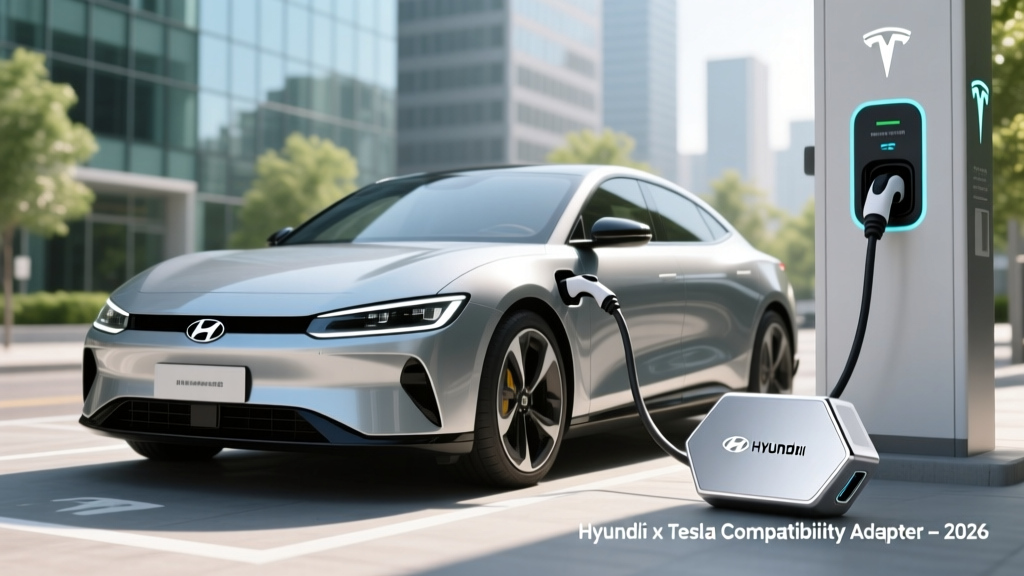
The connector landscape has shifted dramatically. As of 2025–2026, the North American Charging Standard (NACS)—originally Tesla's proprietary connector—is now the dominant standard. Nearly every major automaker (Ford, GM, Rivian, Volvo, BMW, Hyundai/Kia, and others) has adopted NACS for new vehicles. Here's where things stand:
| Connector | Brands Using It (2025–2026 Models) | Public Network Access | Adapter Needed? |
|---|---|---|---|
| NACS (Tesla / SAE J3400) | Tesla, Ford, GM, Rivian, Volvo, Polestar, BMW, Hyundai, Kia, Mercedes | Tesla Superchargers + growing CCS networks with NACS cables | CCS-to-NACS adapter for legacy CCS chargers (~$200) |
| CCS1 (Combined Charging System) | Older VW ID.4, Audi e-tron, Porsche Taycan, Stellantis models, some remaining 2024–2025 inventory | Electrify America, EVgo, ChargePoint, most non-Tesla DC networks | NACS-to-CCS adapter for Tesla Superchargers (if vehicle supports it) |
| CHAdeMO | Nissan Leaf (legacy); effectively discontinued for new models | Declining availability; some Electrify America and EVgo stations | No practical adapter to NACS/CCS for DC fast charging |
Practical advice: If you're buying a new EV in 2025–2026, prioritize NACS-equipped vehicles for the broadest charging network access, especially Tesla Superchargers. If you buy a remaining CCS vehicle, confirm adapter availability and compatibility with your target charging networks.
Cost to Charge: Per-Mile Comparison vs. Your Cobalt's Gas Bill
Let's put real numbers to this. The 2006 Chevy Cobalt SS Supercharged was EPA-rated at roughly 22 city / 30 highway / 25 combined MPG. At 25 MPG combined and $3.40/gallon gas (a reasonable 2025–2026 national average), your fuel cost is about $0.136 per mile.
Now compare that to common EV charging scenarios, using a typical efficiency of 3.0 miles per kWh (representative of a Tesla Model Y, Hyundai Ioniq 5, or Chevrolet Equinox EV):
| Charging Scenario | Cost per kWh | Cost per Mile (at 3.0 mi/kWh) | Savings vs. Cobalt (per mile) |
|---|---|---|---|
| Home, off-peak utility rate | $0.08–$0.12 | $0.027–$0.040 | $0.096–$0.109 |
| Home, average blended rate | $0.14–$0.18 | $0.047–$0.060 | $0.076–$0.089 |
| Home, high-cost state (CA, HI, Northeast) | $0.25–$0.35 | $0.083–$0.117 | $0.019–$0.053 |
| Public Level 2 (ChargePoint, workplace) | $0.20–$0.35 | $0.067–$0.117 | $0.019–$0.069 |
| DC Fast Charge (Electrify America, EVgo) | $0.35–$0.55 | $0.117–$0.183 | -$0.047 to $0.019 |
| 2006 Cobalt SS (gas, $3.40/gal, 25 MPG) | — | $0.136 | — |
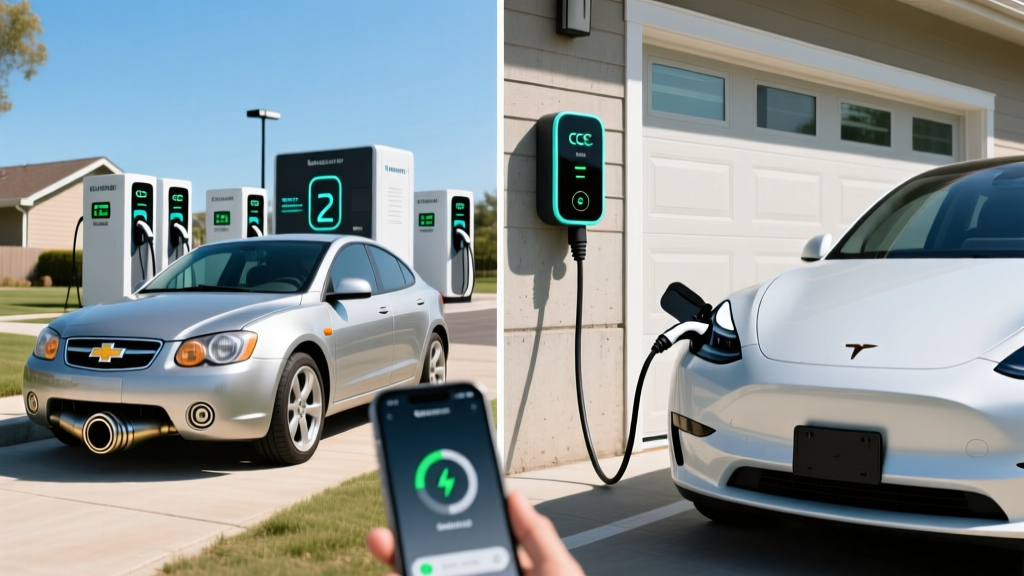
The takeaway: Home charging is dramatically cheaper than gas—typically one-quarter to one-third the per-mile cost. Public DC fast charging, however, can actually exceed gasoline costs on a per-mile basis. The economics strongly favor home charging. If you can't charge at home, a PHEV (plug-in hybrid) may be a more cost-effective bridge.
For annual savings: driving 12,000 miles/year with home off-peak charging at $0.10/kWh costs roughly $480 in electricity. That same mileage in the Cobalt at $3.40/gallon costs $1,632. That's a $1,152/year fuel savings—and EVs also eliminate oil changes, spark plugs, and supercharger belt replacements (yes, the Eaton M62 had a coupler that wore out).
Recommended Home Level 2 Chargers for 2025–2026
ChargePoint Home Flex (NACS)
- Power Output: Up to 11.5 kW (48A) on a 60A circuit; configurable down to 16A
- Connector: NACS (J3400) native; CCS adapter available
- Cable Length: 23 feet
- Smart Features: Wi-Fi, app scheduling, utility demand-response integration, Alexa/Google Home
- Price: ~$599 (NACS version)
- Best For: Flexible amperage adjustment for panel-constrained homes; strong app ecosystem
Tesla Wall Connector (NACS)
- Power Output: Up to 11.5 kW (48A) on a 60A circuit
- Connector: NACS native
- Cable Length: 24 feet
- Smart Features: Wi-Fi, over-the-air updates, power sharing between multiple units, Tesla app integration
- Price: ~$450
- Best For: Tesla owners and NACS-adopting vehicles (Ford, GM, Rivian); best value at 48A
Emporia Level 2 EV Charger
- Power Output: Up to 11.5 kW (48A) on a 60A circuit
- Connector: J1772 (NACS adapter included with some bundles)
- Cable Length: 24 feet
- Smart Features: Wi-Fi, integration with Emporia Vue energy monitor, solar-aware charging, load management
- Price: ~$399
- Best For: Budget-conscious buyers; solar homes; whole-home energy monitoring
Grizzl-E Smart (United Chargers)
- Power Output: Up to 10 kW (40A) on a 50A circuit
- Connector: J1772 or NACS (select at purchase)
- Cable Length: 24 feet
- Smart Features: OCPP-compatible, works with multiple apps, adjustable amperage via DIP switches
- Price: ~$449
- Best For: Extreme cold climates (rated to -40°F); Canadian-made; robust build quality
Public Charging Networks: What to Expect in 2025–2026
The public charging landscape has improved substantially since the early 2020s, but reliability still varies by network:
- Tesla Supercharger Network: Now open to NACS-equipped Ford, GM, Rivian, and other vehicles via the Tesla app. Over 25,000 stalls in the US. Consistently the most reliable network, with uptime above 97% per J.D. Power studies.
- Electrify America: The largest non-Tesla DC network (~4,500 stalls). Pricing averages $0.43–$0.52/kWh. Reliability has improved but still trails Tesla; expect occasional out-of-service stalls at older sites.
- EVgo: Growing rapidly with partnerships (GM, Toyota). Pricing around $0.38–$0.48/kWh. Good urban coverage.
- ChargePoint: Dominant in Level 2 (workplace, retail, apartments). DC fast locations are fewer. App-based activation is standard.
Preconditioning matters: Most modern EVs (Tesla, Hyundai/Kia E-GMP, BMW, GM Ultium) will warm the battery when you navigate to a DC fast charger. A preconditioned battery charges significantly faster—sometimes 20–40% quicker in cold weather. Always use the vehicle's built-in navigation to a charger rather than just driving there.
Frequently Asked Questions
How much does it cost to install a home EV charger?
A straightforward Level 2 installation on an existing 200A panel with a short wiring run typically costs $1,000–$2,950 all-in (charger, electrician, permit). If your home needs a panel upgrade from 100A to 200A—which is common in older homes—expect $2,950–$7,350 total. Get at least three quotes from licensed electricians and ask specifically about available breaker spaces and panel capacity calculations.
How fast will each charging level add range?
Level 1 (120V standard outlet) adds 3–5 miles per hour—adequate only for PHEVs or very low daily mileage. Level 2 (240V home charger) adds 25–44 miles per hour, fully replenishing most EVs overnight. DC fast charging adds 150–1,200+ miles per hour at peak rates, delivering a 10–80% charge in 15–35 minutes depending on the vehicle and charger power.
Which connector/charger is compatible with my EV?
For 2025–2026 model-year EVs, most new vehicles use the NACS (J3400) connector—this includes Tesla, Ford, GM, Rivian, Hyundai, Kia, BMW, and Volvo. Remaining CCS1 vehicles (older VW, Audi, Porsche, Stellantis) can often use adapters for Tesla Superchargers. CHAdeMO is effectively discontinued for new vehicles (Nissan Leaf only). Check your specific vehicle's charge port before purchasing a home charger.
How much does charging cost per mile vs gas?
Home charging at off-peak utility rates ($0.08–$0.12/kWh) costs roughly $0.03–$0.04 per mile for a typical EV at 3.0 mi/kWh. Your 2006 Cobalt SS at 25 MPG and $3.40/gallon costs $0.136 per mile. That's a 70–75% fuel cost reduction with home charging. However, DC fast charging at $0.40–$0.55/kWh can cost $0.13–$0.18 per mile—sometimes more than gasoline. The savings depend heavily on home charging access.
What electrical upgrades might I need?
The most common upgrade is a panel capacity increase from 100A or 150A to 200A, costing $1,500–$3,500. You may also need additional breaker spaces, a new conduit run from the panel to the garage or driveway, and potentially a utility service upgrade if your main service drop is undersized. Some homes can avoid a panel upgrade by using a smart load-management device that dynamically shares amperage between the EV charger and other large loads. Your electrician will perform a load calculation per NEC Article 220 to determine what's required.
Can I use the federal tax credit for a home charger?
The IRS §30C Alternative Fuel Vehicle Refueling Property Credit covers 30% of home charger equipment and installation costs, up to $1,000. However, eligibility depends on your home being in a qualifying census tract (generally rural or low-income areas). Check the IRS guidance and consult a tax professional to confirm eligibility for your specific address.
Making the Switch: Your Cobalt-to-EV Charging Checklist
Transitioning from a supercharged gasoline car to an EV is a genuine lifestyle shift—but one that pays dividends in daily convenience and operating cost. Here's a practical checklist:
- Assess your electrical panel: Find your main breaker amperage (100A, 150A, 200A). Check for open breaker spaces. Photograph the panel for electrician quotes.
- Get 3 electrician quotes: Specify the charger model, circuit amperage, and whether you want a NEMA 14-50 outlet or hardwired. Ask about panel load calculations.
- Choose a NACS charger if your next EV uses the NACS connector (increasingly likely for 2025–2026 models).
- Set up utility time-of-use rates: Many utilities offer off-peak EV charging plans at $0.06–$0.10/kWh overnight. This dramatically reduces your cost per mile.
- Download charging apps: PlugShare, A Better Routeplanner (ABRP), and your vehicle manufacturer's app for route planning and charger status.
- Plan your first road trip conservatively: Target chargers with multiple stalls, plan to charge to 80% (not 100%), and add a 20% range buffer for highway speeds and weather.
The 2006 Cobalt SS Supercharged was a brilliant hot rod for its era—light, tossable, and punchy. Modern EVs deliver that same spirit with instant torque, zero tailpipe emissions, and the convenience of refueling in your own garage. The charging infrastructure is here. The economics favor it. Now you know exactly what it takes.