If you own a Chevrolet Bolt EV or Bolt EUV, one question dominates every road-trip plan: can I use a Tesla Supercharger? The short answer is yes — but with important caveats around adapters, charging speed, and which Supercharger stalls actually work. This guide walks through exactly how Chevy Bolt owners can access the Tesla Supercharger network, what hardware you need, and how to set up fast, affordable charging at home.
Chevy Bolt Charging Basics: Battery, Range, and Connector
Before tackling Supercharger access, let's ground the discussion in hard specs. The 2025 Chevy Bolt EV (and the upcoming next-gen Bolt expected for the 2026 model year) carries a 65 kWh usable lithium-ion battery pack (NMC chemistry). The EPA rates the Bolt EV at 259 miles of range, while the longer-wheelbase Bolt EUV achieves 247 miles (fueleconomy.gov). In real-world highway driving at 70 mph, expect roughly 220–235 miles; in cold weather (below 30°F), that can drop to 190–210 miles.
| Battery (usable) | 65 kWh (NMC) |
| EPA Range | 259 mi (EV) / 247 mi (EUV) |
| Max DC Fast Charge | ~55 kW peak (CCS1) |
| 10–80% DCFC Time | ~45–50 minutes |
| Level 2 Acceptance Rate | 11.5 kW (48A) |
| Native Connector | CCS1 (J1772 + DC pins) |
| Starting MSRP | ~$26,500 (EV) / ~$28,200 (EUV) |
The Bolt's native charge port is CCS1 — the Combined Charging System standard used by most non-Tesla automakers in North America. This matters because Tesla Superchargers originally used a proprietary connector (now called NACS, the North American Charging Standard). Bridging that gap requires an adapter.
Can a Chevy Bolt Use a Tesla Supercharger? The NACS Adapter Answer
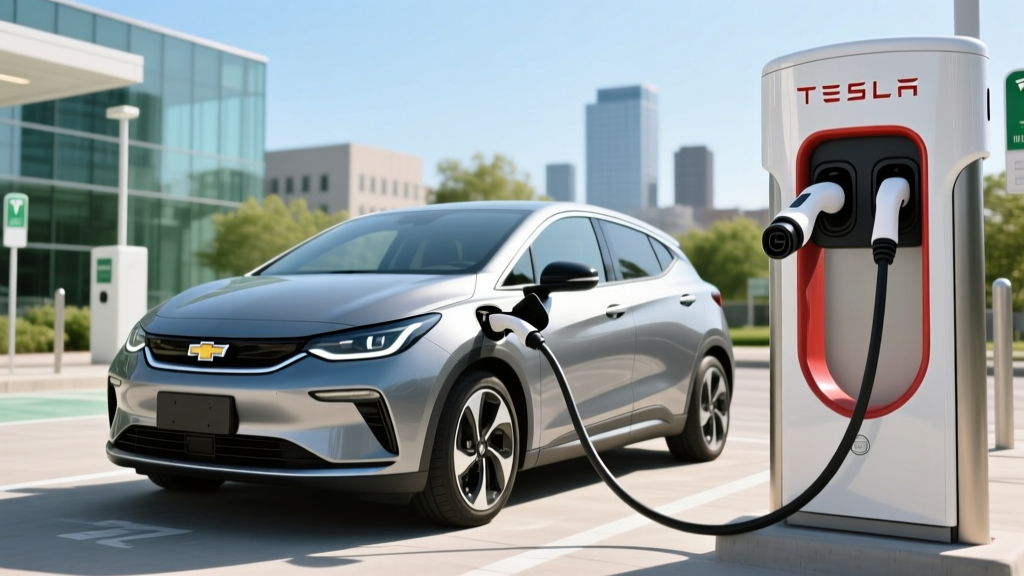
Starting in 2024, Tesla opened its Supercharger network to non-Tesla EVs equipped with CCS connectors, using Tesla's Magic Dock adapter built into select stalls. But the bigger development for Bolt owners is the availability of NACS-to-CCS adapters — devices that plug into the Tesla (NACS) side of a Supercharger cable and convert to the CCS1 port on your Bolt.
| Network | Connector | Adapter Needed? | Notes |
|---|---|---|---|
| Electrify America, EVgo, ChargePoint | CCS1 | No — native plug | Bolt plugs in directly |
| Tesla Supercharger (NACS) | NACS | Yes — NACS-to-CCS adapter | GM-approved adapter available; ~$200–$400 |
| Tesla Supercharger (Magic Dock) | CCS1 built-in | No — dock converts | Limited to select stalls; check Tesla app |
| CHAdeMO stations | CHAdeMO | Not compatible | Bolt does not support CHAdeMO |
Key reality check: The Bolt's DC fast-charging hardware maxes out around 55 kW peak. Even when connected to a 250 kW Tesla V3 Supercharger, the Bolt will only draw what its onboard systems allow. Expect a 10–80% session to take roughly 45–50 minutes, with the charge rate tapering significantly above 80% State of Charge (SoC). This is a vehicle limitation, not a Supercharger limitation — and it's the single biggest factor in Bolt road-trip planning.
Charging Levels Explained: Speeds, Power, and Miles Per Hour
Understanding EV charging means understanding three tiers. Power is measured in kW (kilowatts) — the rate at which energy flows. Energy is measured in kWh (kilowatt-hours) — the total amount stored in your battery. Think of kW as the width of a hose and kWh as the size of the bucket.
| Level | Voltage / Amps | Power (kW) | Miles of Range Added Per Hour | Best For |
|---|---|---|---|---|
| Level 1 | 120V / 12A | ~1.4 kW | 3–5 miles/hr | Overnight trickle; emergency top-off |
| Level 2 | 240V / 40–48A | 9.6–11.5 kW | 25–37 miles/hr | Daily home charging; full charge overnight |
| DC Fast | 400–800V DC | 50–350 kW | 150–1,000+ miles/hr (peak) | Road trips; rapid top-ups |
For the Bolt specifically, a Level 2 home charger at 11.5 kW will add roughly 37 miles of range per hour, meaning a full 0–100% charge takes about 7 hours — perfect for overnight. On a DC fast charger, the Bolt's 55 kW ceiling means you'll add roughly 150–170 miles in 30 minutes under ideal conditions, tapering as the battery fills.
Home Charger Installation: Electrical Requirements and Real Costs
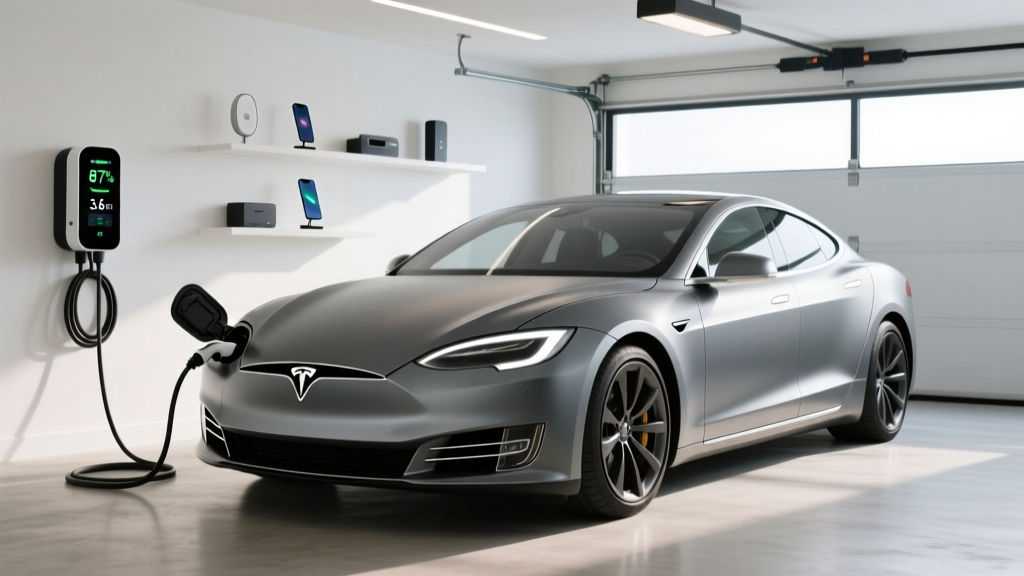
Installing a Level 2 home charger is the single highest-impact upgrade a Bolt owner can make. Here's what's involved electrically and financially.
Electrical requirements: A typical Level 2 charger delivering 11.5 kW needs a 240-volt, 60-amp dedicated circuit (the charger draws 48A continuously; the National Electrical Code requires circuits rated at 125% of continuous load). Your charger should be hardwired or connected via a NEMA 14-60 outlet installed by a licensed electrician.
Panel upgrade reality: Many homes built before 2000 have 100-amp electrical panels. Adding a 60-amp EV circuit may push total load beyond the panel's capacity, requiring an upgrade to 200 amps. This is the single biggest cost variable — a panel upgrade can add $1,500–$3,500 to your project. Have an electrician perform a load calculation before committing.
| Component | Low End | High End | Notes |
|---|---|---|---|
| Level 2 Charger (hardware) | $300 | $700 | Smart Wi-Fi chargers cost more |
| Electrician labor + wiring | $400 | $1,500 | Depends on run length, wall type |
| Permit + inspection | $50 | $250 | Varies by municipality |
| Electrical panel upgrade (if needed) | $1,500 | $3,500 | 100A → 200A; not always required |
| Total (no panel upgrade) | $750 | $2,450 | Most common scenario |
| Total (with panel upgrade) | $2,250 | $5,950 | Older homes with 100A service |
Federal incentive note: The IRS §30D credit does not cover home charger installation for most taxpayers in 2026. However, the Alternative Fuel Vehicle Refueling Property Credit (IRC §30C) may offer up to $1,000 for home charging equipment if you live in an eligible census tract. Check IRS guidelines and consult a tax professional for your specific eligibility.
Recommended Home Chargers for the Chevy Bolt
The Bolt accepts up to 11.5 kW on Level 2 (48 amps at 240V). You'll want a charger rated at 48A or higher to maximize that capability. Here are three proven options:
Power: Up to 12 kW (50A)
Connector: J1772 (CCS compatible)
Cable: 23 ft
Smart features: Wi-Fi, app scheduling, Alexa
Price: ~$549
Best for: Flexible amperage settings; works with any circuit from 20A–60A.
Power: Up to 11.5 kW (48A)
Connector: J1772
Cable: 24 ft
Smart features: Wi-Fi, energy monitoring, solar integration
Price: ~$399
Best for: Budget-conscious buyers who want energy tracking.
Power: Up to 10 kW (40A)
Connector: J1772
Cable: 24 ft
Smart features: OCPP, app control, extreme cold rated (-40°F)
Price: ~$449
Best for: Cold-climate owners; rugged outdoor build.
All three use the J1772 connector, which plugs directly into the Bolt's charge port for Level 2 AC charging. The J1772 is the AC portion of the CCS1 connector — no adapter needed at home.
Cost to Charge: Home vs. Public vs. Gas Comparison
One of the Bolt's strongest ownership arguments is cost per mile. Let's compare real scenarios using the Bolt's efficiency of roughly 3.5 miles per kWh (120 MPGe combined per the EPA).
| Scenario | Cost per kWh / Gallon | Cost per Mile | Annual Cost (12,000 mi) |
|---|---|---|---|
| Home Level 2 (off-peak) | $0.12/kWh | $0.034 | $411 |
| Home Level 2 (standard rate) | $0.18/kWh | $0.051 | $617 |
| Public DC Fast (average) | $0.40/kWh | $0.114 | $1,371 |
| Tesla Supercharger (avg) | $0.35/kWh | $0.100 | $1,200 |
| Gas car (30 MPG, $3.50/gal) | $3.50/gallon | $0.117 | $1,400 |
The takeaway: charging at home on off-peak rates costs roughly one-quarter of what you'd spend on gas. Even public DC fast charging is competitive with gasoline on a per-mile basis. The Bolt's low efficiency penalty compared to larger EVs makes it one of the cheapest vehicles to fuel in America.
Safety, Electrical Code, and Installation Best Practices
A Level 2 charger draws significant current for hours at a time. Cutting corners here risks fire, equipment damage, or insurance claim denials. Non-negotiable safety requirements include:
- Dedicated circuit: Your EV charger must be on its own breaker — never shared with other appliances. A 48A charger requires a 60A breaker.
- GFCI protection: The 2020 NEC (and subsequent updates) requires GFCI protection for outdoor EV receptacles. Hardwired installations may have different requirements depending on jurisdiction — your electrician will confirm.
- Outdoor rating: If your charger is installed outside (garage exterior, carport, driveway), it must carry a NEMA 4 or NEMA 4X rating for weather resistance. All three chargers recommended above meet this standard.
- Permit and inspection: Most municipalities require an electrical permit for a new 240V circuit. The inspection verifies wire gauge, breaker sizing, grounding, and code compliance. Skipping this step can void homeowner's insurance coverage for related incidents.
- Wire gauge: A 60A circuit typically requires 6 AWG copper wire (or 4 AWG aluminum) for runs up to about 100 feet. Longer runs may need thicker wire to minimize voltage drop.
Road-Trip Charging Strategy: Bolt + Supercharger + CCS Networks
The practical reality of road-tripping a Bolt in 2026 is that you'll likely use multiple networks. Here's a strategy that works:
Primary: Electrify America, EVgo, and ChargePoint DC fast stations along your route — the Bolt plugs in natively with CCS1, no adapter needed. Use the PlugShare app or your vehicle's built-in navigation to locate stations.
Backup: Tesla Superchargers equipped with the Magic Dock (built-in CCS adapter) or accessed via your own NACS-to-CCS adapter. The advantage: Tesla's network has the highest reliability and uptime in the industry. The limitation: at 55 kW peak, you'll spend 45–50 minutes per session at 10–80% SoC, which is noticeably longer than vehicles capable of 150+ kW.
Pro tip: The Bolt's charge curve is relatively flat between 10–55% SoC (holding near 55 kW), then tapers to ~38 kW through 70%, and drops further to ~20 kW above 85%. Plan to charge to 80% and move on — the time spent waiting for the last 20% is rarely worth it on a road trip.
Frequently Asked Questions
How much does it cost to install a home EV charger for my Chevy Bolt?
Expect $750–$2,450 for a standard installation (charger + electrician + permit) if your electrical panel has sufficient capacity. If your home needs a panel upgrade from 100A to 200A, total costs can reach $2,250–$5,950. Always get a load calculation from a licensed electrician first.
How fast will each charging level add range to the Bolt?
Level 1 (120V) adds 3–5 miles per hour. Level 2 (240V, 48A) adds roughly 37 miles per hour. DC fast charging at the Bolt's 55 kW peak can add approximately 150–170 miles in 30 minutes under ideal conditions, though the rate tapers significantly above 80% SoC.
Which connector does the Chevy Bolt use, and do I need an adapter for Tesla Superchargers?
The Bolt uses a CCS1 connector natively. For Tesla Superchargers, you'll need a NACS-to-CCS adapter (approximately $200–$400 from GM-approved suppliers) or you must find a Supercharger stall equipped with Tesla's Magic Dock, which has a built-in CCS adapter. Not all Supercharger locations have Magic Dock.
How much does charging the Bolt cost per mile compared to gas?
Charging at home on off-peak electricity ($0.12/kWh) costs about $0.034 per mile — roughly one-third the cost of a 30 MPG gas car at $3.50/gallon ($0.117/mile). Even public DC fast charging at $0.40/kWh ($0.114/mile) is competitive with gasoline.
What electrical upgrades might I need for a home charger?
The most common upgrade is a new 240V/60A dedicated circuit with appropriate wire gauge and breaker. Older homes with 100-amp panels may need a full panel upgrade to 200 amps ($1,500–$3,500). Your electrician will perform a load calculation to determine if your existing panel can handle the additional draw alongside your other household circuits.
Is a NACS-to-CCS adapter safe for my Bolt's battery?
Yes, provided you use a GM-approved or reputable third-party adapter (such as those from Lectron or the official GM accessory). The adapter simply bridges the physical connector difference — the Bolt's onboard charge controller still regulates power draw, and it will never pull more than its 55 kW maximum regardless of the Supercharger's rated capacity.