Owners searching for ways to maximize the range in a Chevy Bolt often overlook the single biggest factor in daily EV satisfaction: how you charge at home. The 2026 Chevrolet Bolt EV returns with an EPA-estimated 259 miles of range from its 65 kWh (usable) lithium-ion battery, while the Bolt EUV delivers 247 miles. But those sticker numbers are only the starting point. Real-world range depends heavily on charging habits, battery preconditioning, and whether you're relying on a slow Level 1 trickle or a properly installed Level 2 home station.
This guide breaks down exactly what it takes to set up home charging for a Chevy Bolt, what each charging level delivers in real miles per hour, what you'll pay versus gasoline, and which equipment earns our recommendation for 2026.
Understanding the Chevy Bolt's Charging Architecture
Before selecting equipment, you need to know what the Bolt can actually accept. The 2026 Chevy Bolt EV and EUV share critical charging specs:
- Battery capacity: 65 kWh usable (NMC chemistry)
- Onboard charger (Level 2): 11.5 kW maximum acceptance
- DC fast charging: Up to 55 kW peak (CCS1 connector)
- EPA range: 259 mi (Bolt EV) / 247 mi (Bolt EUV)
- Efficiency: 120 MPGe combined (~28 kWh/100 mi)
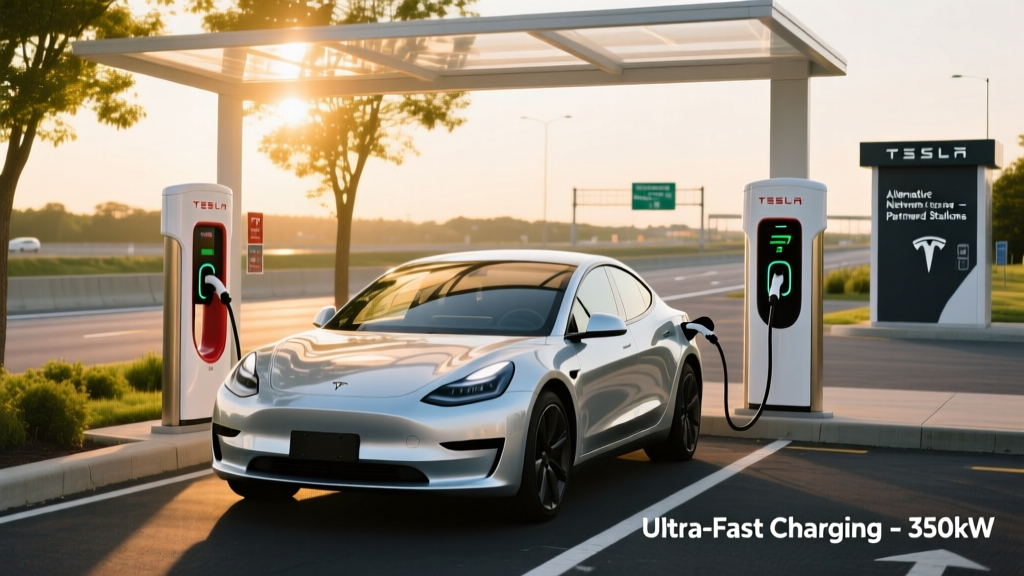
The Bolt's 55 kW DC fast-charge ceiling is modest by 2026 standards — many competitors accept 150–350 kW. This means the Bolt is optimized for home Level 2 charging and overnight replenishment rather than frequent road-trip fast charging. Plan accordingly.
Charging Levels Explained: Speeds and Range Added Per Hour
EV charging operates at three primary levels. Here's what each delivers specifically for the Chevy Bolt's 65 kWh battery:
| Level | Power (kW) | Voltage / Amps | Miles of Range Per Hour | 10–80% Time (Bolt) |
|---|---|---|---|---|
| Level 1 (120V) | ~1.4 kW | 120V / 12A | ~4 mi/hr | ~38 hours |
| Level 2 (240V) | Up to 11.5 kW | 240V / 48A | ~34 mi/hr | ~4.5 hours |
| DC Fast (CCS1) | Up to 55 kW | 400V DC | ~160 mi/hr (peak) | ~60 minutes |
Key distinction — kW vs. kWh: Kilowatts (kW) measure the rate of power flow — how fast energy moves into the battery. Kilowatt-hours (kWh) measure total energy capacity — the size of the battery itself. Think of kW as the width of a hose and kWh as the size of the bucket. The Bolt's 65 kWh battery fills fastest when the hose is widest (Level 2 or DC fast).
Home Level 2 Installation: Electrical Requirements and Costs
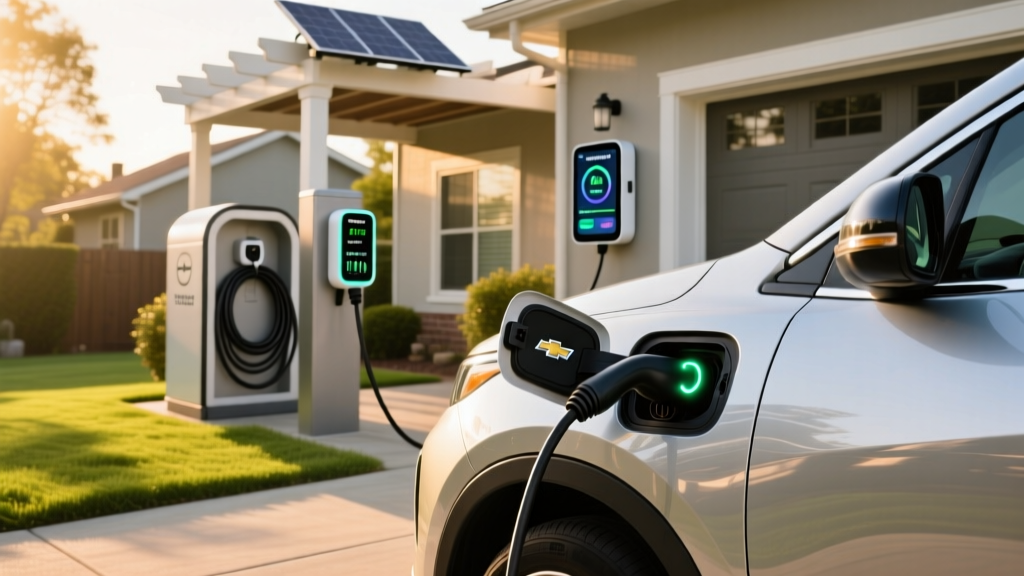
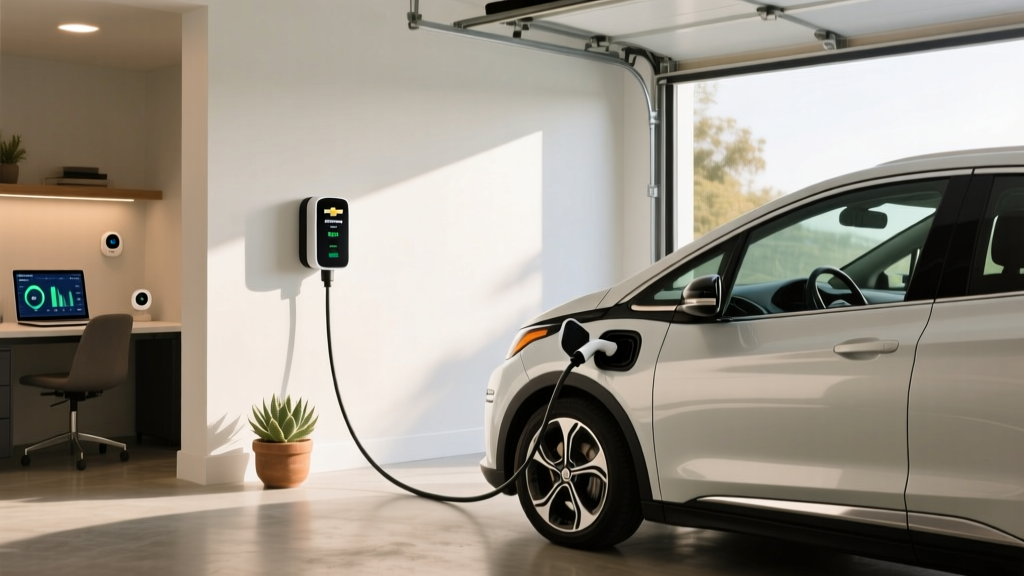
Level 2 home charging is the practical sweet spot for Bolt owners. To achieve the full 11.5 kW acceptance rate, you need a 240-volt circuit rated for at least 60 amps (the charger will draw a continuous 48A, and electrical code requires circuits rated at 125% of continuous load).
Electrical Panel Considerations
Most modern homes with a 200-amp service panel can accommodate a 60A EV circuit without a panel upgrade. However, older homes with 100A service or panels already near capacity may require:
- Panel upgrade to 200A: $1,500–$3,500
- Heavy-up (service upgrade from utility): $2,000–$5,000+ in coordination with the local utility
- Load management device: $300–$600 — an alternative to panel upgrade that throttles charger amperage when household demand is high
A licensed electrician should perform a load calculation per NEC Article 220 before confirming your panel can handle the additional draw.
Installation Cost Breakdown
| Component | Simple Install (panel nearby) | Complex Install (long run / panel upgrade) |
|---|---|---|
| Level 2 charger (hardware) | $350–$700 | $350–$700 |
| Electrician labor (2–6 hrs) | $400–$900 | $1,200–$2,500 |
| Materials (conduit, wire, breaker) | $100–$300 | $400–$1,000 |
| Permit and inspection | $50–$200 | $100–$350 |
| Panel upgrade (if needed) | — | $1,500–$3,500 |
| Total | $900–$2,100 | $3,550–$8,050 |
The IRS Residential Clean Energy Credit (IRC §25C) covers up to 30% of charger hardware and installation costs, capped at $1,000 annually. Confirm eligibility with a tax professional, as income and sourcing requirements apply.
Connector Compatibility: What Fits the Chevy Bolt?
The 2026 Chevy Bolt uses the CCS1 (Combined Charging System) connector for both Level 2 AC charging and DC fast charging. However, the North American charging landscape has shifted heavily toward the NACS (North American Charging Standard), originally developed by Tesla and now adopted by most major automakers for 2025+ models.
| Connector | Bolt Native? | Adapter Required? | Notes |
|---|---|---|---|
| J1772 (Level 2 AC) | Yes (upper portion of CCS1) | No | Standard for all home/public Level 2 |
| CCS1 (DC Fast) | Yes | No | Electrify America, EVgo, ChargePoint DC |
| NACS / Tesla | No | Yes — CCS-to-NACS adapter ($150–$250) | Required for Tesla Supercharger access |
| CHAdeMO | No | Not practical | Legacy standard, largely discontinued |
Adapter note: GM offers an official CCS-to-NACS adapter enabling Bolt owners to access the Tesla Supercharger network. This is a worthwhile $200 investment for road trips, but verify that the adapter supports the Bolt's 55 kW DC charge rate — some third-party adapters cap at lower thresholds.
Cost to Charge: Electric vs. Gas Per Mile
One of the strongest arguments for the Bolt is operating cost. Here's how charging expenses compare to gasoline for an equivalent compact vehicle getting 30 MPG combined:
| Scenario | Rate | Bolt Cost/Mile | Gas Car (30 MPG) Cost/Mile |
|---|---|---|---|
| Home (off-peak utility rate) | $0.09/kWh | $0.025 | $0.117 (at $3.50/gal) |
| Home (average national rate) | $0.16/kWh | $0.045 | $0.117 |
| Public Level 2 (ChargePoint, etc.) | $0.30/kWh | $0.084 | $0.117 |
| DC Fast Charging (public) | $0.48/kWh | $0.134 | $0.117 |
The Bolt uses approximately 28 kWh per 100 miles (per fueleconomy.gov). At home off-peak rates, that translates to roughly 2.5 cents per mile — less than a quarter of the gasoline equivalent. However, frequent reliance on DC fast charging at premium public rates can actually exceed gasoline costs per mile. The economics strongly favor home charging.
Recommended Level 2 Chargers for the Chevy Bolt
Since the Bolt accepts up to 11.5 kW on Level 2, you want a charger that can deliver at least that — ideally a 48A unit on a 60A circuit to avoid bottlenecking the onboard charger.
Emporia Vue Level 2
- Power output: 48A / 11.5 kW (240V)
- Connector: J1772 (CCS1 compatible)
- Cable length: 24 ft
- Smart features: Wi-Fi, scheduling, energy monitoring, solar integration
- Price: ~$399
- Best for: Budget-conscious owners who want app control and energy tracking
ChargePoint Home Flex
- Power output: Up to 50A / 12 kW (240V, adjustable)
- Connector: J1772
- Cable length: 23 ft
- Smart features: Wi-Fi, Alexa, scheduling, amperage dial adjustment
- Price: ~$649
- Best for: Owners wanting flexible amperage to match panel capacity
Grizzl-E Smart
- Power output: 40A / 9.6 kW (240V)
- Connector: J1772
- Cable length: 24 ft
- Smart features: Bluetooth, OCPP support, extreme cold rated (-40°F)
- Price: ~$449
- Best for: Cold-climate owners; rugged outdoor installs
Wallbox Pulsar Plus
- Power output: 48A / 11.5 kW (240V)
- Connector: J1772
- Cable length: 25 ft
- Smart features: Wi-Fi + Bluetooth, Power Sharing for dual units
- Price: ~$599
- Best for: Compact form factor, two-EV households
Our pick for Bolt owners: The Emporia Vue delivers the full 11.5 kW the Bolt can accept at the lowest price point, with robust energy monitoring that helps track charging costs precisely.
Safety, Code, and Installation Best Practices
A Level 2 charger installation is a permanent electrical modification subject to the National Electrical Code (NEC) and local building codes. Key requirements:
- Dedicated circuit: The charger must have its own breaker — no shared circuits with other appliances.
- GFCI protection: NEC 2023+ requires ground-fault circuit interrupter protection for all EV supply equipment (built into most modern chargers).
- Outdoor rating: If installing outside, the charger must carry a NEMA 4 or NEMA 4X rating for weather resistance. All four units above qualify.
- Permit and inspection: Most jurisdictions require an electrical permit ($50–$350) and a post-install inspection. Skipping this can void homeowner's insurance coverage for electrical fires.
- Wire gauge: A 60A circuit typically requires 6 AWG copper wire (THHN in conduit) or 4 AWG if the run exceeds 100 feet to account for voltage drop.
Always hire a licensed electrician. DIY electrical work on 240V circuits carries serious shock and fire risk and is illegal without permits in most jurisdictions.
Charging Strategy: Maximizing Bolt Range and Battery Longevity
The Bolt's NMC battery chemistry benefits from specific charging habits that preserve long-term State of Health (SoH):
- Daily charging limit: Set to 80% for routine commuting. GM's battery management system includes a buffer, but consistently charging to 100% accelerates NMC degradation.
- 100% for road trips: Charge to full only when you'll drive immediately — don't let the battery sit at 100% SoC for extended periods.
- Avoid frequent DC fast charging: The Bolt's 55 kW peak is gentle compared to 350 kW chargers, but repeated fast charging still generates more heat than Level 2, contributing to faster capacity loss over years.
- Cold-weather preconditioning: Use the Bolt's scheduled departure feature to warm the battery while still plugged in. A preconditioned battery recovers more range via regenerative braking and charges faster at public stations.
GM covers the Bolt's battery with an 8-year / 100,000-mile warranty guaranteeing at least 60% capacity retention. In practice, NMC packs in the Bolt have shown degradation of approximately 8–12% over 100,000 miles based on owner-reported data, meaning most owners will retain 88–92% of original capacity at the 8-year mark.
Frequently Asked Questions
How much does it cost to install a home EV charger for a Chevy Bolt?
A straightforward Level 2 installation with the electrical panel nearby typically costs $900–$2,100 including hardware, electrician labor, materials, and permit. Complex installations requiring long wire runs or a panel upgrade can reach $3,500–$8,000+. The federal §25C Residential Clean Energy Credit can offset up to $1,000 (30% of costs).
How fast will each charging level add range to my Bolt?
Level 1 (120V standard outlet) adds roughly 4 miles of range per hour — adequate only for plug-in hybrids or very low-mileage drivers. Level 2 (240V home charger) adds approximately 34 miles per hour, fully replenishing the Bolt overnight. DC fast charging at 55 kW peak adds roughly 160 miles per hour but tapers significantly above 80% SoC.
Which connector does the Chevy Bolt use, and do I need an adapter?
The Bolt uses CCS1 natively for both AC Level 2 and DC fast charging. No adapter is needed for most public networks (Electrify America, EVgo, ChargePoint). To access Tesla Superchargers, you'll need a CCS-to-NACS adapter, available from GM or third-party suppliers for $150–$250.
How much does charging the Bolt cost per mile compared to gas?
At the national average home electricity rate of $0.16/kWh, the Bolt costs approximately $0.045 per mile to fuel — roughly 60% less than a 30 MPG gas car at $3.50/gallon. Off-peak home rates can drop this to $0.025/mile. However, DC fast charging at $0.48/kWh can exceed gas costs at $0.134/mile.
What electrical upgrades might I need for a Level 2 charger?
You need a dedicated 240V circuit rated for 60 amps. If your home has a 200A service panel with available capacity, no upgrade is typically needed. Homes with 100A panels or panels near capacity may require a panel upgrade ($1,500–$3,500) or a load-management device ($300–$600) that dynamically limits charger draw.