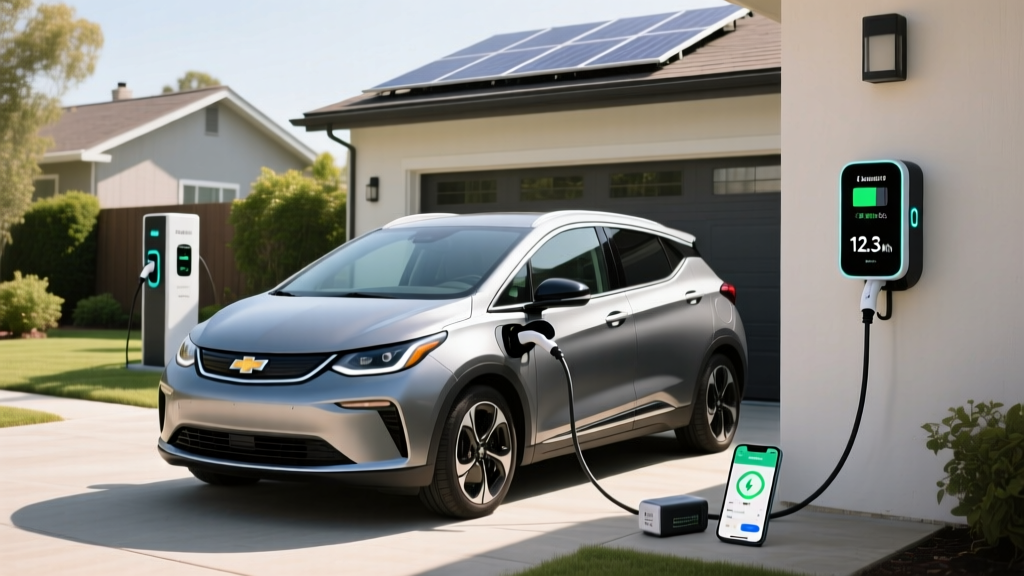
The Chevrolet Bolt EV and its longer-wheelbase sibling, the Bolt EUV, remain among the most efficiency-dense, affordable electric vehicles on the used and new market. For owners and prospective buyers, the single most important ownership metric isn't 0–60 time — it's miles per kWh. That number dictates your real-world range, your charging cost, and how often you'll visit a public charger.
This guide breaks down the Bolt's real-world efficiency, what each charging level actually delivers in miles per hour, what it costs to install a Level 2 charger at home, and how the Bolt's per-mile cost stacks up against a comparable gas car. All figures reference the final production specs (the Bolt EV/EUV was discontinued after the 2023 model year but remains widely available on the used market and is relevant through 2026 ownership).
Understanding Miles Per kWh in the Chevy Bolt
Miles per kWh (mi/kWh) is the EV equivalent of miles per gallon. It tells you how far the car travels on one kilowatt-hour of battery energy. A higher number means better efficiency — you go farther on less electricity, which means lower charging costs and longer range from the same battery size.
The Chevy Bolt EV (2020–2023) carries a 65 kWh usable lithium-ion NMC battery and is EPA-rated at 259 miles of range. Do the math: 259 ÷ 65 = roughly 3.98 mi/kWh, which the EPA window sticker rounds to an efficiency of 120 MPGe combined (or about 28 kWh/100 mi). The Bolt EUV, with its longer wheelbase and slightly heavier body, is rated at 247 miles EPA from the same pack — about 3.8 mi/kWh.
In mixed driving at moderate temperatures (60–75°F), expect the Bolt EV to deliver close to its EPA rating — roughly 3.8–4.0 mi/kWh. On sustained highway runs at 75 mph, efficiency drops to approximately 3.2–3.5 mi/kWh, yielding 210–230 real miles. In freezing weather (below 32°F), cabin heating and battery thermal losses can reduce range by 20–30%, bringing effective range down to 180–210 miles. The Bolt lacks a heat pump, relying on resistive PTC heating, which is a significant efficiency penalty in cold climates.
According to fueleconomy.gov, the 2023 Bolt EV achieves 131 MPGe city / 109 MPGe highway / 120 MPGe combined. The city-highway split is notable: EVs are more efficient in stop-and-go traffic thanks to regenerative braking, unlike gas cars.
Charging Levels Explained: kW, Miles Per Hour, and Bolt Charge Times
Before discussing charging speeds, a critical distinction: kW (kilowatts) measures power — how fast energy flows into the battery. kWh (kilowatt-hours) measures energy — the total capacity of the battery. Think of kW as the width of the hose and kWh as the size of the bucket.
The Chevy Bolt EV and EUV accept a maximum DC fast-charge rate of 55 kW via its CCS1 connector. On Level 2 AC, the onboard charger handles up to 11.5 kW (48 amps at 240V). On Level 1 (standard 120V outlet), you'll see roughly 1.2–1.4 kW.
| Level | Voltage | Max Power (kW) | Miles of Range Added Per Hour | Typical Use Case |
|---|---|---|---|---|
| Level 1 (120V) | 120V AC | ~1.4 kW | ~4–5 miles/hr | Overnight top-up, low-mileage drivers |
| Level 2 (240V) | 240V AC | 11.5 kW | ~39 miles/hr | Home daily charging, workplace |
| DC Fast Charge | 400V DC | 55 kW (peak) | ~150–190 miles/hr (at peak) | Road trips, public stations |
At 55 kW peak, the Bolt's DC fast charging is modest by 2026 standards. The charge curve holds near peak only between roughly 10–40% state of charge, then tapers progressively. A 10–80% DC fast charge takes approximately 45–55 minutes at a 50+ kW CCS station. This is the Bolt's most-cited limitation for road-trip use.
On a Level 2 home charger at the Bolt's maximum 11.5 kW acceptance rate, a full 0–100% charge takes roughly 7 hours. Most owners charging from 20–80% daily will see a session time of about 4 hours — easily accomplished overnight.
Home Charger Installation: Electrical Requirements and Costs
To unlock the Bolt's full 11.5 kW Level 2 charging capability at home, you need a 240-volt, 60-amp dedicated circuit with a hardwired EVSE (Electric Vehicle Supply Equipment) rated for 48 amps continuous. The National Electrical Code requires that continuous loads (like EV charging) use only 80% of a circuit's rated capacity — hence 48A continuous on a 60A breaker.
If your home has a 200-amp electrical panel with available capacity, a straightforward install involves running conduit and wire from the panel to your garage or driveway. However, older homes with 100-amp panels, or panels already near capacity (electric range, dryer, HVAC), may require a panel upgrade to 200 amps — a significant added cost.
| Component | Low Estimate | High Estimate | Notes |
|---|---|---|---|
| Level 2 EVSE (40A–48A charger) | $400 | $750 | Quality smart chargers; Wi-Fi enabled |
| Electrician labor (run 240V/60A circuit) | $600 | $2,000 | Depends on distance from panel, conduit type |
| Permit and inspection | $50 | $300 | Varies by municipality |
| Electrical panel upgrade (if needed) | $1,500 | $4,000 | 100A → 200A service upgrade |
| Total (no panel upgrade) | $1,050 | $3,050 | Typical garage install |
| Total (with panel upgrade) | $2,550 | $7,050 | Older homes |
Always hire a licensed electrician and pull a permit. Unpermitted EV charger installs can void home insurance claims and create fire risk. The circuit should be GFCI-protected (many EVSEs have built-in GFCI; if hardwired, the breaker may need GFCI per NEC 2020+ code). For outdoor installs, ensure the EVSE carries a NEMA 4 or NEMA 4X rating for weather resistance.
Recommended Level 2 Chargers for the Chevy Bolt
The Bolt uses the CCS1 (J1772 + DC pins) connector for all AC charging. Every Level 2 charger sold in North America ships with a J1772 plug, so compatibility is universal — no adapter needed for home Level 2.
Emporia Vue Level 2 EV Charger
- Power Output: 48A / 11.5 kW (hardwired, 60A circuit)
- Connector: J1772 (compatible with Bolt CCS1 inlet)
- Cable Length: 24 feet
- Smart Features: Wi-Fi, app scheduling, solar integration, energy monitoring
- Price: ~$400
- Best For: Budget-conscious Bolt owners who want smart scheduling and energy tracking
ChargePoint Home Flex
- Power Output: Up to 50A / 12 kW (adjustable, NEMA 14-50 or hardwired)
- Connector: J1772
- Cable Length: 23 feet
- Smart Features: Wi-Fi, Alexa, app-based scheduling, charge history
- Price: ~$550–$700
- Best For: Flexible amperage settings; works with 40A or 60A circuits
Grizzl-E Smart
- Power Output: 40A / 9.6 kW (NEMA 14-50 plug)
- Connector: J1772
- Cable Length: 24 feet
- Smart Features: OCPP-compatible, app control, OTA updates
- Price: ~$450
- Best For: Cold-climate durability (rated to -40°F), rugged build
Editor's note: The Bolt's 11.5 kW onboard charger means you'll benefit from a 48A charger (Emporia or ChargePoint hardwired). If you plug into a NEMA 14-50 outlet (50A circuit), you're limited to 40A continuous — yielding 9.6 kW, or about 33 miles of range per hour. For maximum charge speed, hardwire on a 60A circuit.
Connector Compatibility: CCS1, NACS, and the Bolt's Future Access
As of 2026, the North American charging landscape has largely standardized around NACS (Tesla's connector, now SAE J3400). However, the Chevy Bolt was built with the CCS1 inlet. Here's what that means in practice:
| Connector Type | Bolt Compatibility | Where You'll Find It | Adapter Needed? |
|---|---|---|---|
| J1772 (Level 2 AC) | ✅ Native | Home chargers, workplaces, public Level 2 | No |
| CCS1 (DC Fast) | ✅ Native | Electrify America, EVgo, older public stations | No |
| NACS / Tesla Supercharger | ⚠️ Adapter required | Tesla Supercharger network (open to CCS via adapter) | Yes — CCS-to-NACS adapter (~$200–$250) |
| CHAdeMO | ❌ Not compatible | Largely deprecated in North America | N/A |
GM has confirmed that Bolt owners can access Tesla Superchargers using an approved CCS-to-NACS adapter. However, because the Bolt's peak DC charge rate is 55 kW, you won't take advantage of the Supercharger network's 250 kW capability — you'll charge at the Bolt's maximum rate regardless of the station's capability. The adapter is still valuable for expanding your route options on road trips.
Cost to Charge the Chevy Bolt: Per-Mile vs. Gas
The Bolt's ~4 mi/kWh efficiency makes it one of the cheapest vehicles to fuel in America. Here's how charging costs break down across scenarios, compared to a gas car averaging 30 MPG on $3.50/gallon regular.
| Charging Scenario | Price per kWh | Bolt Cost/Mile (at 4 mi/kWh) | Gas Car Cost/Mile (at 30 MPG, $3.50/gal) | Savings per 1,000 Miles |
|---|---|---|---|---|
| Home Level 2 — off-peak utility rate | $0.08 | $0.020 | $0.117 | $97 |
| Home Level 2 — standard residential rate | $0.16 | $0.040 | $0.117 | $77 |
| Public Level 2 (ChargePoint, etc.) | $0.25 | $0.063 | $0.117 | $54 |
| DC Fast Charge (Electrify America, etc.) | $0.40 | $0.100 | $0.117 | $17 |
| DC Fast Charge (peak pricing) | $0.55 | $0.138 | $0.117 | -$21 (gas cheaper) |
Home charging is where the Bolt shines economically. At an off-peak rate of $0.08/kWh, fueling a Bolt costs roughly 2 cents per mile — nearly 6× cheaper than gas. Even at standard residential rates, you're at 4 cents per mile. A driver covering 12,000 miles/year on home charging spends approximately $240–$480 annually on electricity, versus $1,400 on gasoline.
The economics flip on expensive public DC fast chargers. At $0.55/kWh peak pricing, the Bolt actually costs more per mile than a 30 MPG gas car. This is why home charging access is the single biggest financial factor in EV ownership. Use DC fast charging for road trips, not daily fueling.
What Electrical Upgrades Might Your Home Need?
Not every home can accommodate a 60-amp, 240-volt circuit without upgrades. Here's what to assess before calling an electrician:
- Panel capacity: Check your main breaker. A 200-amp panel with room for a double-pole 60A breaker is ideal. A 100-amp panel likely needs upgrading.
- Available breaker slots: You need two adjacent slots for a 240V breaker. Full panels may need a sub-panel added.
- Wire run distance: Longer runs from panel to charger location require thicker (more expensive) copper wire — typically 6 AWG for 60A. Runs over 100 feet may need 4 AWG.
- Conduit requirements: Outdoor runs and garage installs may require EMT or PVC conduit per local code.
- Utility service: Some utilities offer free or discounted panel upgrades for EV owners, or offer time-of-use (TOU) rates that make off-peak charging dramatically cheaper.
Get at least two quotes from licensed electricians. Ask specifically whether your panel has adequate spare capacity (load calculation per NEC Article 220). A reputable electrician will perform this calculation before recommending a panel upgrade.
Frequently Asked Questions
How many miles per kWh does the Chevy Bolt actually get in real driving?
In moderate temperatures with mixed city/highway driving, expect 3.8–4.0 mi/kWh — close to the EPA rating. Highway-only driving at 75+ mph drops this to 3.2–3.5 mi/kWh. In freezing weather with cabin heat, expect 2.8–3.3 mi/kWh. Driving style matters: aggressive acceleration and high speeds are the biggest efficiency killers.
Can I charge the Chevy Bolt on a regular 120V outlet?
Yes. Level 1 charging on a standard 120V/15A household outlet delivers roughly 1.4 kW, adding about 4–5 miles of range per hour. A full charge from empty takes over 40 hours. Level 1 is viable if you drive fewer than 40 miles per day and can plug in every night, but Level 2 is strongly recommended for daily usability.
Does the Chevy Bolt qualify for any tax credits in 2026?
The Bolt EV/EUV was discontinued after 2023, so it is no longer eligible for the new-vehicle §30D federal tax credit. However, used Bolt EVs and EUVs may qualify for the up-to-$4,000 used clean vehicle credit (30% of sale price, capped at $4,000) if purchased from a licensed dealer, the sale price is $25,000 or less, and buyer income falls within IRS limits ($75,000 single / $150,000 joint). Verify current rules at irs.gov.
How long does it take to charge the Bolt from 10% to 80% on a DC fast charger?
At a CCS station delivering 50+ kW, expect approximately 45–55 minutes for a 10–80% charge. The Bolt's 55 kW peak charge rate and relatively flat curve in the mid-SoC range make this consistent, but it's slower than most modern EVs (many competitors charge 10–80% in 18–25 minutes). Plan road-trip stops accordingly.
Is it safe to leave the Bolt plugged in overnight every night?
Yes. Modern EVs, including the Bolt, have sophisticated battery management systems that stop charging at the target state of charge. GM recommends setting the charge target to 80% for daily use to prolong battery longevity, and charging to 100% only when you need full range. A properly installed, permitted Level 2 charger on a dedicated circuit is extremely safe for nightly use.
What is the Bolt's battery warranty, and how long will it last?
GM provided an 8-year/100,000-mile battery warranty covering defects and capacity loss below 60% of original capacity. For a 2023 Bolt, that warranty extends through 2031. Real-world data from Bolt owners shows typical degradation of 5–10% over 100,000 miles, meaning most Bolts retain 90%+ battery health well within the warranty period. Avoid frequent DC fast charging and regular 100% charges to maximize longevity.