The Chevrolet Bolt EV (and its longer-range sibling, the Bolt EUV) remains one of the most affordable ways to get into a practical electric vehicle. But the Bolt's charging hardware has always been its Achilles' heel. With an EPA-estimated 259 miles of range (Bolt EV) or 247 miles (Bolt EUV), the real question owners and prospective buyers face isn't just "how far can I go?" — it's "how long will it take to recharge, and what do I need at home to make this work?"
This guide breaks down exactly how to charge a Chevy Bolt EV or EUV, what equipment you need, what your home electrical panel can handle, and what you'll actually spend per mile compared to a gas car. Whether you're shopping for a used Bolt or optimizing your current setup, these numbers will shape your daily ownership experience.
Bolt EV Range and Battery Specs: The Starting Point
Before discussing charging infrastructure, you need to know what you're filling. The final-generation Chevy Bolt EV (2022–2023 model years) carries a 65 kWh usable lithium-ion NMC battery pack and is rated by the EPA at 259 miles on a full charge. The Bolt EUV, which rides a slightly stretched wheelbase, holds the same pack but is rated at 247 miles due to higher weight and aerodynamic drag.
EPA 259 mi (Bolt EV) / 247 mi (Bolt EUV). Expect approximately 220–235 miles in mixed highway driving at 70 mph. In cold weather (below 30°F), plan for 175–200 miles of usable range. The Bolt lacks a heat pump, so cabin heating draws directly from the traction battery — a meaningful hit in winter climates.
| Spec | Bolt EV (2022–2023) | Bolt EUV (2022–2023) |
|---|---|---|
| EPA Range | 259 mi | 247 mi |
| Battery (usable) | 65 kWh (NMC) | 65 kWh (NMC) |
| Efficiency | 120 MPGe (28 kWh/100mi) | 115 MPGe (29 kWh/100mi) |
| Max DC Fast Charge | 55 kW (CCS1) | 55 kW (CCS1) |
| Max AC Level 2 | 11.5 kW (48A) | 11.5 kW (48A) |
| Onboard Charger | 11.5 kW | 11.5 kW |
| 0–60 mph | 6.5 sec / 200 HP | 7.0 sec / 200 HP |
Chevrolet discontinued the Bolt EV and EUV after the 2023 model year to retool for next-generation Ultium-based EVs. However, the used market is flush with well-maintained examples, and understanding their charging behavior remains critical for current and prospective owners.
Charging Levels Explained: How Fast Can a Bolt Recharge?
EV charging happens at three distinct levels. The critical distinction every owner must internalize: kW (kilowatts) measures power — the rate of energy flow, like water pressure from a hose. kWh (kilowatt-hours) measures energy — the total amount stored, like gallons in a tank. Your Bolt's battery holds 65 kWh. How fast you refill it depends on the kW rate of your charger.
| Level | Voltage / Amps | Power (kW) | Miles of Range Added per Hour | Full Charge Time (0–100%) |
|---|---|---|---|---|
| Level 1 (Standard Outlet) | 120V / 12A | ~1.4 kW | ~4 mi/hr | ~46+ hours |
| Level 2 (Home / Public AC) | 240V / 48A | 11.5 kW (max) | ~39 mi/hr | ~7 hours |
| DC Fast Charging | 400V DC | 55 kW (peak) | ~140 mi/hr (at peak) | N/A (10–80% ~55 min) |
Level 1 is the emergency fallback. Plugging into a standard 120V household outlet with the Bolt's included mobile cord adds roughly 4 miles of range per hour. If you drive 30 miles round-trip daily and plug in every night for 10 hours, you'll recover about 40 miles — enough for most commutes. But a full recharge from empty takes nearly two days.
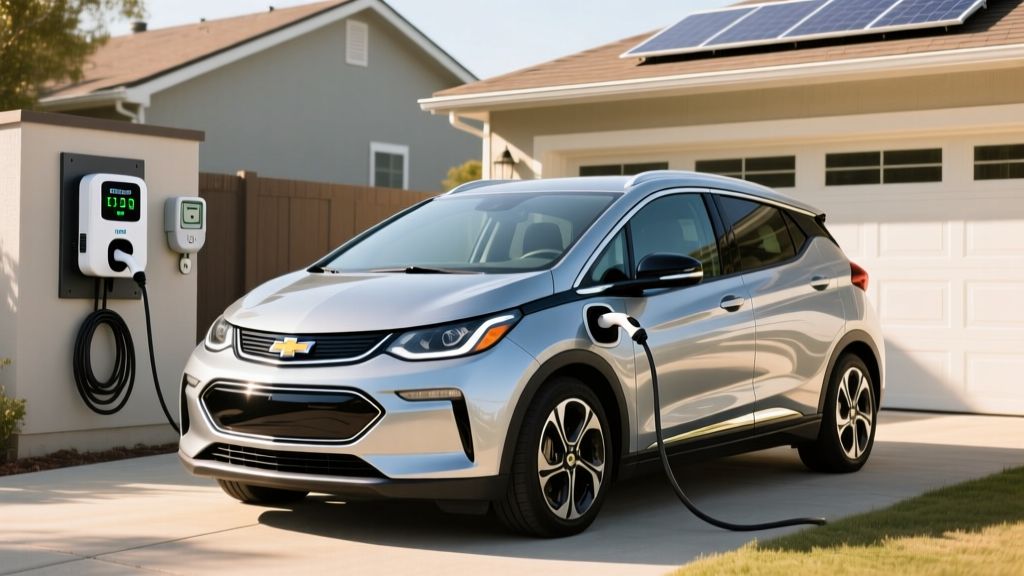
Level 2 is where daily Bolt ownership actually works. At the Bolt's maximum AC acceptance rate of 11.5 kW (48 amps on a 240V circuit), you add roughly 39 miles of range per hour. Plug in overnight and you'll wake up with a full battery every morning. This is the standard home charging solution.
DC Fast Charging is the Bolt's known limitation. The vehicle maxes out at 55 kW peak on a CCS1 connector — far below the 150–350 kW rates of newer EVs. A 10–80% session takes approximately 55 minutes, and the charge curve tapers significantly above 60% State of Charge. On a road trip, this means longer stops, but it's manageable with planning via PlugShare or the EVgo app.
Home Charger Installation: Requirements, Costs, and Panel Upgrades
Installing a Level 2 home charger is the single biggest quality-of-life upgrade a Bolt owner can make. But the cost varies dramatically depending on your home's electrical infrastructure.
Electrical Requirements for the Bolt EV
To get the Bolt's full 11.5 kW AC charging rate, you need a 240V circuit rated for at least 60 amps (EV chargers are considered continuous loads under the National Electrical Code, so the circuit must be rated 125% above the charger's max draw — 48A × 1.25 = 60A). This requires a dedicated double-pole breaker in your electrical panel.
If you're willing to charge slightly slower, a 40A circuit (delivering 32A / 7.7 kW to the car) still adds roughly 26 miles per hour — plenty for overnight replenishment — and is easier on older panels.
Panel Upgrade Considerations
Many homes built before 2000 have 100A or 150A electrical service. Adding a 60A EV circuit may push total calculated load beyond your panel's capacity, especially if you already run electric dryers, ovens, or HVAC on the same service. A licensed electrician will perform a NEC Article 220 load calculation to determine if your panel can handle the addition.
If an upgrade is needed, moving from a 100A to a 200A panel typically costs between $1,500 and $3,500 depending on your utility's requirements, local permit fees, and whether new service conductors must be pulled from the street. This is the single biggest variable in home charging cost and the reason you should get a professional assessment before buying equipment.
| Component | Low-End Estimate | High-End Estimate | Notes |
|---|---|---|---|
| Level 2 Charger (Equipment) | $300 | $700 | Hardwired or NEMA 14-50 plug |
| Electrician Labor | $400 | $1,500 | Depends on run distance, conduit, panel location |
| Permit & Inspection | $50 | $300 | Varies by municipality |
| Panel Upgrade (if needed) | $1,500 | $3,500 | 100A → 200A service upgrade |
| Total (no panel upgrade) | $750 | $2,500 | Most homes with 200A service |
| Total (with panel upgrade) | $2,250 | $6,000 | Older homes with 100A service |
The federal Residential Clean Energy Credit covers 30% of home EV charger equipment and installation costs (up to $1,000) for equipment placed in service through 2032, subject to IRS eligibility rules. Some utilities and states offer additional rebates — check your local provider.
Connector Compatibility: CCS1, NACS, and the Bolt's Adapter Situation
The Chevy Bolt EV and EUV use the CCS1 (Combined Charging System) connector for both Level 2 AC and DC fast charging. This was the dominant North American standard when the Bolt was designed, but the industry is rapidly shifting toward Tesla's NACS (North American Charging Standard), which major automakers began adopting in 2024–2025.
| Connector | Bolt EV/EUV Native? | Used For | Adapter Needed? |
|---|---|---|---|
| J1772 (AC) | Yes (CCS1 includes J1772) | Level 1 & Level 2 AC | No |
| CCS1 (DC) | Yes | DC Fast Charging | No |
| NACS (Tesla) | No | Tesla Superchargers | Yes — CCS1-to-NACS adapter (~$200–$250) |
| CHAdeMO | No | Nissan Leaf, older Japanese EVs | Not available for Bolt |
As of 2025–2026, Chevrolet owners can purchase a GM-approved CCS-to-NACS adapter that enables Bolt EV and EUV drivers to access Tesla Supercharger stations (V2 stalls, which support CCS communication via the adapter). This dramatically expands the Bolt's road-trip charging network, since Tesla's Supercharger network exceeds 6,000 U.S. stations. Expect to pay approximately $200–$250 for an OEM-quality adapter.
At home, any J1772-connector Level 2 charger will work natively with the Bolt. If you install a Tesla Wall Connector (NACS), you'll need the adapter for every charging session — functional but inconvenient for daily use. Most Bolt owners are better served by a native J1772 home charger.
Cost to Charge: Per-Mile Economics vs. Gasoline
One of the strongest arguments for the Bolt is its running cost. At 28 kWh per 100 miles (Bolt EV), charging costs are a fraction of gasoline — but the exact savings depend on where and when you charge.
| Charging Scenario | Cost per kWh | Cost per 100 Miles | Cost per Mile | Equivalent Gas MPG at $3.50/gal |
|---|---|---|---|---|
| Home (off-peak utility rate) | $0.08 | $2.24 | $0.022 | 159 MPG |
| Home (national avg. residential) | $0.16 | $4.48 | $0.045 | 78 MPG |
| Public Level 2 (network average) | $0.30 | $8.40 | $0.084 | 42 MPG |
| DC Fast Charging (EVgo, Electrify America) | $0.40–$0.55 | $11.20–$15.40 | $0.11–$0.15 | 23–32 MPG |
| Gas Car Baseline (28 MPG combined) | N/A | $12.50 | $0.125 | 28 MPG |
At the national average residential electricity rate of approximately $0.16/kWh (per EIA data), charging the Bolt at home costs about 4.5 cents per mile. A comparable gas car averaging 28 MPG at $3.50/gallon costs about 12.5 cents per mile. That's a per-mile savings of roughly 64% when charging at home.
However, if you rely exclusively on DC fast charging at $0.48/kWh (a common rate on Electrify America or EVgo networks), your cost jumps to about 13 cents per mile — essentially breaking even with gasoline. This is why home charging access is the single most important economic factor in Bolt ownership.
Recommended Level 2 Chargers for the Chevy Bolt
Since the Bolt accepts up to 11.5 kW (48A) on Level 2, you want a charger that can deliver at least that rate to avoid leaving performance on the table. Here are three proven options across different budgets:
ChargePoint Home Flex (Best Overall)
- Power: Up to 12 kW (50A) — matches Bolt's max acceptance
- Connector: J1772 (native Bolt compatibility)
- Cable Length: 23 feet
- Smart Features: Wi-Fi, app scheduling, Alexa integration, energy tracking
- Installation: Hardwired or NEMA 14-50 plug
- Price: ~$550–$650
The Home Flex is the default recommendation for most Bolt owners. Its adjustable amperage (16A–50A) means you can dial it down if your panel can't support a full 60A circuit, and the app provides detailed charging logs.
Emporia Vue Level 2 Charger (Best Value)
- Power: Up to 11.5 kW (48A)
- Connector: J1772
- Cable Length: 24 feet
- Smart Features: Wi-Fi, app control, solar integration, TOU scheduling
- Installation: Hardwired or NEMA 14-50
- Price: ~$350–$400
Emporia's charger punches well above its price point. If you have solar panels, the integration with Emporia's energy monitoring ecosystem is a genuine advantage for optimizing self-consumption.
Grizzl-E Smart (Most Durable)
- Power: Up to 10 kW (40A)
- Connector: J1772
- Cable Length: 24 feet
- Smart Features: OCPP-compatible, app scheduling, load sharing
- Installation: Hardwired or NEMA 14-50
- Price: ~$450–$550
Built in Canada with an IP67 weatherproof rating and a heavy-duty aluminum enclosure, the Grizzl-E is the pick for unheated garages, outdoor installs, and harsh climates. Its 40A output means slightly slower charging (~32 mi/hr) but works on a more common 50A circuit.
Safety, Code, and Installation Best Practices
EV charging is a high-draw, continuous electrical load that runs for hours — often unattended overnight. Cutting corners on installation is a fire risk and a code violation. Here's what a proper install requires:
- Dedicated circuit: Your Level 2 charger must have its own dedicated double-pole breaker. Sharing a circuit with other appliances violates NEC and creates a tripping hazard.
- GFCI protection: The 2020 NEC (Article 625.54) requires GFCI protection for all EV receptacles rated 150V or less to ground and 50A or less. Many newer EVSE units include built-in ground-fault protection, but your electrician should verify compliance.
- Outdoor rating: If your charger is installed outdoors (driveway, exterior wall), both the EVSE unit and the receptacle must carry an appropriate weatherproof rating (NEMA 4 or IP65 minimum). Use an in-use cover for NEMA 14-50 receptacles.
- Wire gauge: A 60A circuit requires 6 AWG copper wire (THHN in conduit) or 4 AWG aluminum. Undersizing wire is a common DIY mistake that creates heat buildup.
- Permit and inspection: Most jurisdictions require an electrical permit for EV charger installation. The inspection ensures the work meets NEC and local amendments. Skipping this can void homeowner's insurance coverage in the event of an electrical fire.
- NEMA 14-50 receptacle quality: If using a plug-in charger rather than hardwiring, invest in an industrial-grade NEMA 14-50 receptacle (Hubbell, Bryant, or Cooper — not the cheapest big-box option). EV charging cycles a receptacle at near-max load for hours; cheap receptacles have been known to melt under sustained use.
Charging Time Examples: What to Expect With the Bolt's 65 kWh Battery
Here are practical charge-time scenarios for the Bolt EV's 65 kWh pack, assuming typical efficiency losses (~10% for AC charging):
- Level 1 (1.4 kW, 120V outlet): 0–100% in approximately 52 hours. Useful only for overnight top-ups of 30–50 miles.
- Level 2 at 7.7 kW (32A / 40A circuit): 0–100% in approximately 9.5 hours. A full overnight charge with a modest circuit.
- Level 2 at 11.5 kW (48A / 60A circuit): 0–100% in approximately 6.5 hours. The Bolt's maximum — wake up fully charged every morning.
- DC Fast Charge at 55 kW (peak): 10–80% in approximately 55 minutes. The charge curve tapers heavily above 60% SoC; 80–100% adds another 40+ minutes. Plan road-trip stops around the 10–80% window.
One important note on the Bolt's DC charging curve: unlike many modern EVs that sustain peak charge rates up to 50–60% SoC, the Bolt begins tapering relatively early. You'll see close to 55 kW only in the 10–30% SoC window, dropping to 40–45 kW by 50% and falling to 25–30 kW by 70%. This is a hardware limitation of the Bolt's older charging architecture and won't improve with software updates.
Frequently Asked Questions
How much does it cost to install a home EV charger for a Chevy Bolt?
Expect $750–$2,500 for a standard installation on an existing 200A panel, including equipment ($300–$700), electrician labor ($400–$1,500), and permits ($50–$300). If your home has a 100A panel that needs upgrading to 200A, add $1,500–$3,500. The federal Residential Clean Energy Credit covers 30% of charger costs (up to $1,000).
How fast will each charging level add range to the Bolt EV?
Level 1 (120V): approximately 4 miles of range per hour. Level 2 at 11.5 kW (240V/48A): approximately 39 miles per hour. DC fast charging at 55 kW peak: approximately 140 miles per hour at peak, but the Bolt's charge curve tapers significantly, so a 10–80% session takes about 55 minutes.
Which connector and charger is compatible with my Chevy Bolt?
The Bolt EV and EUV use the CCS1 connector natively, which incorporates the J1772 standard for AC charging. Any J1772 Level 2 charger works without adapters. For Tesla Supercharger access, you'll need a GM-approved CCS1-to-NACS adapter (~$200–$250). CHAdeMO chargers are not compatible.
How much does charging the Bolt cost per mile compared to gas?
At the national average residential rate of $0.16/kWh, the Bolt costs about $0.045 per mile to charge at home — roughly 64% less than a 28 MPG gas car at $3.50/gallon ($0.125/mile). However, DC fast charging at $0.48/kWh pushes cost to ~$0.13/mile, essentially matching gasoline. Home charging access is critical to realizing EV savings.
What electrical upgrades might I need for a home Level 2 charger?
You'll need a dedicated 240V circuit — either 50A (for 40A/9.6 kW charging) or 60A (for the Bolt's full 48A/11.5 kW rate). Homes with 100A electrical service may need a panel upgrade to 200A ($1,500–$3,500) to accommodate the additional continuous load alongside existing appliances. A licensed electrician should perform an NEC Article 220 load calculation before you commit to equipment.
Can I use a Tesla Wall Connector with my Chevy Bolt?
Tesla Wall Connectors use the NACS connector, which is not native to the Bolt. You can use one with a CCS1-to-NACS adapter, but plugging and unplugging an adapter for every home session is impractical. A native J1772 charger like the ChargePoint Home Flex or Emporia Vue is the more convenient daily solution.
Is the Chevy Bolt still worth buying in 2026?
As a used EV, the Bolt offers exceptional value — examples with 20,000–40,000 miles routinely sell for $18,000–$24,000. The 259-mile EPA range and 200 HP powertrain remain competitive. The main trade-off is the slow 55 kW DC fast charging rate, which makes road trips slower than in newer EVs. If your driving is primarily commuting and local errands with reliable home charging, the Bolt remains one of the best cost-per-mile vehicles on the road.