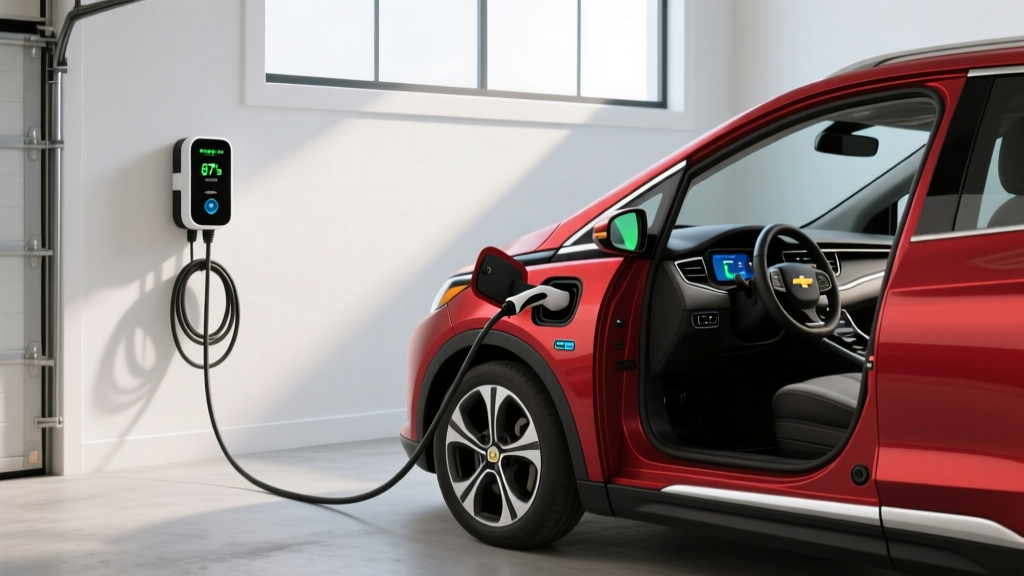
The Chevrolet Bolt EUV packs 259 miles of EPA-estimated range into one of the most affordable electric crossovers on the market, but extracting every one of those miles depends heavily on how you charge. Whether you are plugging into a standard 120V outlet overnight or wiring up a dedicated 48-amp Level 2 station, the difference between convenient daily driving and frustrating range management comes down to matching your charging setup to the Bolt EUV's 65 kWh (usable) lithium-ion battery.
This guide breaks down exactly how fast each charging level replenishes the Bolt EUV's battery, what a home installation actually costs in 2026, which connectors you need, and how charging expenses compare to gasoline per mile. We will use the Bolt EUV as our reference vehicle, but the principles apply broadly across battery-electric vehicles.
Understanding Charging Levels: How Fast Does Each Add Range?
EV charging is measured in kilowatts (kW), which represents the rate of power delivery. The energy stored in your battery is measured in kilowatt-hours (kWh) — the total capacity. Think of kW as how fast water flows from a hose, and kWh as the size of the bucket you are filling. The Bolt EUV's bucket holds 65 kWh of usable energy.
| Level | Voltage / Amperage | Max Power (kW) | Miles of Range per Hour | 0–100% Time (Bolt EUV) |
|---|---|---|---|---|
| Level 1 (120V) | 120V / 12A | 1.4 kW | ~4 mi/hr | ~60+ hours |
| Level 2 (240V) | 240V / 32–48A | 7.7–11.5 kW | 22–35 mi/hr | 7–9 hours |
| DC Fast Charge | 400V+ DC | 55 kW peak | ~100 mi in 30 min | 10–80% in ~45 min |
The Bolt EUV's onboard charger maxes out at 11.5 kW on Level 2, meaning even a 48-amp charger delivering 11.5 kW will fully utilize the vehicle's acceptance rate. On DC fast charging, the Bolt EUV peaks at approximately 55 kW — modest compared to vehicles with 800V architectures (like the Hyundai Ioniq 5 at 240 kW), but sufficient for highway stops when you plan around a 30-minute break.
Home Charger Installation: Costs, Electrical Requirements, and Panel Upgrades
Installing a Level 2 home charger is the single most impactful upgrade for daily EV ownership. For the Bolt EUV, a 240V/48A circuit delivers a full overnight charge in roughly 7–8 hours, meaning you wake up to 259 miles every morning.
Electrical Requirements
A 48-amp Level 2 charger requires a dedicated 60-amp circuit (NEC code mandates circuits be rated at 125% of continuous load). This means:
- Wire gauge: 6 AWG copper (or 4 AWG aluminum) for runs up to 50 feet
- Breaker: 60-amp double-pole breaker in your main panel
- Panel capacity: Your main service panel must have at least 60 amps of spare capacity. Most modern 200-amp panels can accommodate this; older 100-amp panels often cannot.
Do You Need a Panel Upgrade?
If your home has a 100-amp main service, or your panel is already near capacity (running electric range, dryer, HVAC, and water heater), you may need a service upgrade to 200 amps. This is the single largest variable in installation cost.
| Component | Cost Range | Notes |
|---|---|---|
| Level 2 Charger (hardware) | $350–$700 | 40A–48A smart charger, NEMA 14-50 or hardwired |
| Electrician labor (standard install) | $500–$1,500 | Depends on run length, conduit, and panel proximity |
| Permit and inspection | $50–$250 | Varies by municipality; required for code compliance |
| Panel upgrade (if needed) | $1,500–$4,000 | 100A to 200A service upgrade; not always required |
| Total (without panel upgrade) | $900–$2,450 | Typical scenario for most 200A-panel homes |
| Total (with panel upgrade) | $2,400–$6,450 | Older homes with 100A service |
The IRS residential clean energy credit covers 30% of charger hardware and installation costs (up to $1,000) through 2032, which can offset $270–$735 of a standard install. Confirm eligibility with a tax professional, as income and location-based phase-outs may apply.
Connector Compatibility: CCS1, NACS, and the Bolt EUV
The Chevy Bolt EUV uses the CCS1 (Combined Charging System) connector for both Level 2 AC charging and DC fast charging. However, the charging landscape shifted significantly in 2024–2025 when most major automakers adopted Tesla's NACS (North American Charging Standard) connector.
| Connector | Brands Using It (Native) | Bolt EUV Compatibility |
|---|---|---|
| CCS1 | GM (Bolt, older Ultium), VW, Hyundai/Kia (pre-2025), BMW | Native — no adapter needed |
| NACS (Tesla) | Tesla, Ford, GM (2025+ Ultium), Rivian, Volvo, most 2025+ models | Requires CCS-to-NACS adapter (~$150–$250) |
| CHAdeMO | Nissan Leaf (legacy) | Not compatible; largely discontinued |
For Bolt EUV owners, the good news is that most public DC fast-charging networks (Electrify America, EVgo, ChargePoint) still maintain CCS1 connectors alongside NACS. However, if you plan to use Tesla Superchargers — which now welcome non-Tesla vehicles at select locations — you will need a CCS-to-NACS adapter. GM officially sells an adapter through Chevrolet dealers, and third-party options from Lectron and A2Z are widely available.
Charging Cost: Per-Mile Expense vs. Gasoline
One of the strongest arguments for the Bolt EUV is its low operating cost. Let's compare charging expenses to a gasoline equivalent using real-world energy prices.
| Scenario | Price per kWh | Cost for Full Charge (65 kWh) | Cost per Mile (259 mi range) |
|---|---|---|---|
| Home (off-peak utility rate) | $0.08–$0.12 | $5.20–$7.80 | $0.02–$0.03 |
| Home (standard residential rate) | $0.13–$0.18 | $8.45–$11.70 | $0.03–$0.05 |
| Public Level 2 (workplace/retail) | $0.20–$0.30 | $13.00–$19.50 | $0.05–$0.08 |
| DC Fast Charge (Electrify America, EVgo) | $0.35–$0.55 | $22.75–$35.75 | $0.09–$0.14 |
| Gasoline equivalent (30 MPG at $3.50/gal) | — | — | $0.12/mile |
At home off-peak rates, the Bolt EUV costs roughly $0.03 per mile to "fuel" — about one-quarter the cost of a 30 MPG gasoline car. Even at public DC fast-charging rates, the per-mile cost is comparable to or slightly below gasoline. The EPA rates the Bolt EUV at 115 MPGe combined, translating to roughly 3.0 miles per kWh.
Recommended Level 2 Chargers for the Bolt EUV
Since the Bolt EUV accepts up to 11.5 kW on Level 2, you want a charger that delivers at least 48 amps (11.5 kW at 240V) to avoid leaving performance on the table. Here are three proven options in 2026:
ChargePoint Home Flex
- Power: Up to 50 amps (12 kW) — adjustable via DIP switches
- Connector: CCS1 (J1772 + CCS combo), 23-foot cable
- Smart features: Wi-Fi, app scheduling, energy tracking, Alexa integration
- Installation: NEMA 14-50 plug or hardwired
- Price: ~$550–$650
Emporia Vue Level 2 Charger
- Power: 48 amps (11.5 kW)
- Connector: CCS1, 24-foot cable
- Smart features: Wi-Fi, app control, load management with Emporia energy monitor
- Installation: NEMA 14-50 or hardwired
- Price: ~$350–$450 (budget pick)
Grizzl-E Smart
- Power: 40 amps (9.6 kW) — slightly below Bolt EUV max
- Connector: CCS1, 24-foot cable
- Smart features: Wi-Fi, OCPP compatibility, extreme cold rated (-40°F)
- Installation: NEMA 14-50 or hardwired; built in Canada
- Price: ~$450–$550
For the Bolt EUV specifically, the ChargePoint Home Flex and Emporia Vue both deliver the full 11.5 kW the vehicle can accept. The Grizzl-E is a durable, cold-weather workhorse but caps at 9.6 kW, adding roughly 28 miles per hour of charging instead of 35.
Safety, Permits, and Code Considerations
EV charging draws sustained high current for hours — this is not the same as plugging in a dryer for 45 minutes. Key safety and code requirements include:
- Dedicated circuit: Your Level 2 charger must be on its own dedicated breaker. Sharing a circuit with other appliances is a code violation and a fire risk.
- GFCI protection: NEC 2020 and later require Ground Fault Circuit Interrupter protection for outdoor receptacles. Many modern chargers have built-in GFCI; if yours does not, your electrician will install a GFCI breaker.
- Outdoor rating: If your charger is installed outside (garage exterior, carport, driveway), it must carry a NEMA 4 or IP65 weather-resistance rating. All three chargers recommended above meet this standard.
- Permit and inspection: Most jurisdictions require an electrical permit for a new 240V circuit. The inspection ensures wire gauge, breaker sizing, and grounding meet code. Skipping this step can void homeowner insurance coverage in the event of a fire.
- Load management: If your panel is near capacity but you want to avoid a full upgrade, consider a smart charger with load-management capability (like the Emporia Vue paired with an Emporia monitor). These devices dynamically reduce charging amperage when other household loads spike.
Charging Time Examples: 10–80% for Common Scenarios
Most EV owners charge between 10% and 80% state of charge for daily use — this preserves battery longevity and avoids the slow taper that occurs above 80%. Here is what that looks like for the Bolt EUV's 65 kWh battery (52 kWh used in a 10–80% cycle):
- Level 1 (120V, 1.4 kW): ~37 hours — impractical for daily use; reserve for emergencies or topping off
- Level 2 (240V, 48A, 11.5 kW): ~4.5 hours — perfect for overnight charging; start at bedtime, wake up full
- DC Fast Charge (55 kW peak): ~45 minutes — note that the Bolt EUV sustains ~45 kW from 10–50%, then tapers to ~30 kW through 80%. Expect roughly 100 miles of range added in 30 minutes.
Frequently Asked Questions
How much does it cost to install a home EV charger for the Bolt EUV?
A typical Level 2 installation (48-amp charger, 240V/60A circuit) costs $900–$2,450 if your electrical panel has sufficient capacity. If you need a panel upgrade from 100A to 200A service, add $1,500–$4,000. The federal residential clean energy credit can offset 30% of hardware and labor (up to $1,000).
How fast will each charging level add range to the Bolt EUV?
Level 1 (120V) adds roughly 4 miles per hour. Level 2 (240V, 48A) adds 32–35 miles per hour. DC fast charging adds approximately 100 miles in 30 minutes, though speed tapers significantly above 50% state of charge.
Which connector does the Bolt EUV use, and do I need an adapter?
The Bolt EUV uses the CCS1 connector natively. No adapter is needed for Electrify America, EVgo, or ChargePoint stations. To use Tesla Superchargers (where non-Tesla access is available), you will need a CCS-to-NACS adapter ($150–$250).
How much does charging the Bolt EUV cost per mile vs. gas?
At home off-peak rates ($0.10/kWh), the Bolt EUV costs about $0.03 per mile. A comparable 30 MPG gasoline car at $3.50/gallon costs $0.12 per mile. Even at public DC fast-charging rates ($0.45/kWh), the Bolt EUV costs roughly $0.12 per mile — comparable to gasoline.
What electrical upgrades might I need for a home charger?
You need a dedicated 60-amp, 240V circuit. If your main service panel is 200 amps with spare capacity, no upgrade is needed. If your home has 100-amp service or your panel is already near capacity, you may need a $1,500–$4,000 service upgrade. A licensed electrician can perform a load calculation to determine this.
Can I charge the Bolt EUV on a regular 120V outlet?
Yes, but Level 1 charging adds only about 4 miles of range per hour — a full charge takes over 60 hours. This works for overnight top-offs if you drive less than 40 miles daily, but a Level 2 installation is strongly recommended for regular use.
Does fast charging degrade the Bolt EUV battery?
Occasional DC fast charging has minimal impact on battery health. Chevrolet warranties the Bolt EUV battery for 8 years/100,000 miles with a capacity retention threshold of 60%. For daily use, Level 2 home charging and keeping state of charge between 20–80% will maximize longevity. GM's battery management system includes a buffer that protects against extreme degradation.