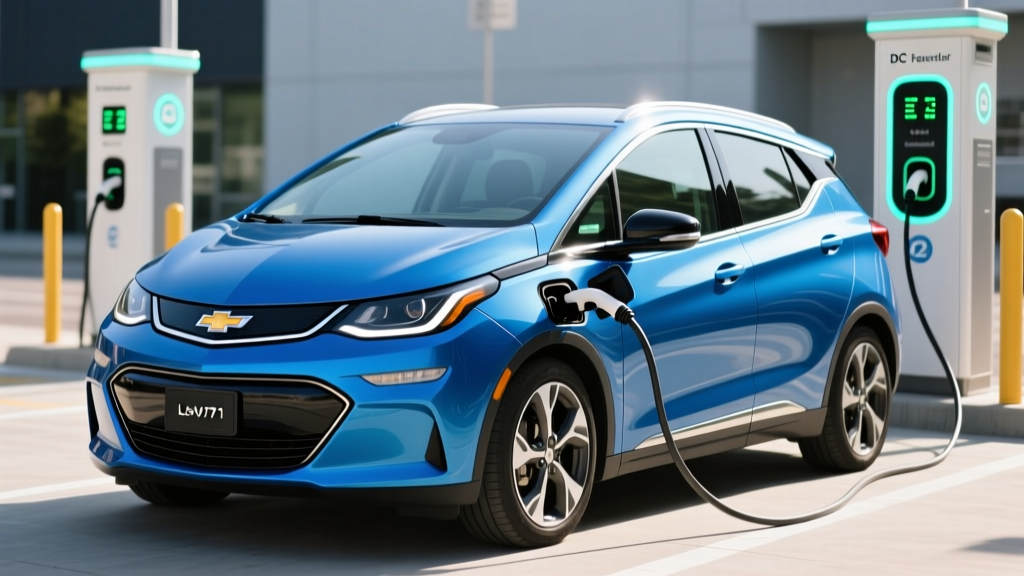
The Chevrolet Bolt EV and Bolt EUV remain some of the most affordable long-range electric vehicles on the used and new-equivalent market, with up to 259 miles of EPA range (Bolt EV) and 247 miles (Bolt EUV). But owning one means understanding exactly how long it takes to recharge that 65 kWh battery pack — and how to set up your home for the fastest, cheapest charging possible.
This guide breaks down Chevy Bolt charging times across every charging level, the real-world speeds you can expect, what it costs to install a Level 2 home charger, and which equipment we recommend for Bolt owners in 2026.
Understanding kW vs kWh: The Most Common EV Charging Mistake
Before we get into Bolt charging times, let's clear up the single most common confusion in EV ownership:
- kW (kilowatts) = the rate of power delivery. Think of it as the width of the pipe. A 11.5 kW charger delivers energy faster than a 1.4 kW outlet.
- kWh (kilowatt-hours) = the total amount of energy stored. The Chevy Bolt EV has a 65 kWh battery pack. That's the size of the tank.
Charging time is simply the battery capacity (kWh) divided by the charge rate (kW) — with real-world losses of roughly 10-15% due to heat, battery management, and tapering above 80% state of charge.
Chevy Bolt Charging Times by Level: What to Expect
The Bolt EV and EUV share the same 65 kWh usable battery capacity and the same onboard charger hardware. Here's how each charging level performs:
| Charging Level | Voltage / Amperage | Power (kW) | Miles of Range per Hour | 0-100% Time (65 kWh) | 10-80% Time |
|---|---|---|---|---|---|
| Level 1 (standard 120V outlet) | 120V / 12A | ~1.4 kW | ~4 mi/hr | ~50-55 hours | N/A (impractical) |
| Level 2 (240V home/public) | 240V / 48A | 11.5 kW (max onboard) | ~39 mi/hr | ~7 hours | ~4.5 hours |
| Level 2 (240V / 32A circuit) | 240V / 32A | 7.7 kW | ~26 mi/hr | ~9.5 hours | ~6 hours |
| DC Fast Charging (CCS) | 400V DC | 55 kW peak | ~100 mi in 30 min | N/A | ~45-55 min (10-80%) |
The Bolt's DC Fast Charging Limitation
The Chevy Bolt's most discussed weakness is its DC fast charging speed. While competitors like the Hyundai Ioniq 5 (peaking at 240 kW) or Tesla Model 3 (250 kW) can add 10-80% in 18-25 minutes, the Bolt caps at roughly 55 kW on CCS connectors. This means:
- 10-80% takes approximately 45-55 minutes at a compatible DC fast charger
- The charge curve stays relatively flat — you won't see dramatic taper until above 80% SoC
- Adding 100 miles of range takes roughly 30 minutes at peak rate
For daily driving and overnight home charging, this limitation is irrelevant. It only matters on road trips exceeding the Bolt's single-charge range. If you regularly drive 300+ miles in a day, the Bolt's DC charging speed will add meaningful time to your stops.
Home Charger Installation: Costs, Electrical Requirements & Panel Upgrades
To unlock the Bolt's full 11.5 kW Level 2 charging capability, you need a 240V circuit rated for at least 60 amps (which supports continuous 48A draw — the electrical code requires circuits to be rated at 125% of continuous load).
Electrical Requirements for Bolt Level 2 Charging
- Circuit: Dedicated 60A double-pole breaker (for 48A continuous charger output)
- Wire: 6 AWG copper (THHN in conduit) or 4 AWG aluminum
- Outlet: NEMA 14-50 receptacle (if using a plug-in charger) or hardwired connection
- Panel capacity: Your main electrical panel must have room for the additional 60A load
What If I Only Have a 50A Circuit?
A 50A circuit supports 40A continuous draw, which delivers roughly 9.6 kW to the Bolt. That's still excellent — roughly 33 miles of range per hour and a full charge in about 8 hours. Many Bolt owners run a 50A circuit with a 40A charger and are perfectly satisfied.
Panel Upgrade Reality
Homes built before 1990 often have 100A or even 60A main service panels. Adding a 60A EV circuit to a 100A panel that's already near capacity (electric dryer, range, central AC) may require a panel upgrade to 200A service. This is the single biggest cost variable in home EV charging installation.
| Component | Simple Install (panel has capacity) | Complex Install (panel upgrade needed) |
|---|---|---|
| Level 2 EVSE equipment (charger) | $350 – $700 | $350 – $700 |
| Electrician labor (2-4 hrs typical) | $500 – $1,200 | $800 – $1,500 |
| Electrical permit | $50 – $200 | $50 – $200 |
| Panel upgrade (100A → 200A) | N/A | $1,500 – $3,500 |
| Conduit/wire run (long distances) | $100 – $400 | $200 – $800 |
| Total estimated cost | $1,000 – $2,500 | $2,900 – $6,700 |
Always get at least two quotes from licensed electricians. Ask specifically whether your panel has capacity for a new 60A circuit — a good electrician will do a load calculation before quoting. Some utilities offer rebates of $250-$500 for Level 2 charger installation; check with your local provider.
Connector Compatibility: CCS, NACS & Adapter Options for the Bolt
The Chevy Bolt EV and EUV (model years 2017-2025) use the CCS1 (Combined Charging System) connector for DC fast charging and the J1772 connector for Level 1 and Level 2 AC charging. This matters because the North American charging landscape is shifting toward Tesla's NACS connector.
| Connector Type | AC Charging (Level 1/2) | DC Fast Charging | Brands Using It (2026) |
|---|---|---|---|
| J1772 | Yes (standard) | No | All non-Tesla EVs (AC inlet) |
| CCS1 | Via J1772 upper portion | Yes | Chevrolet Bolt, Hyundai, Kia, VW, Ford (pre-2025) |
| NACS (Tesla) | Yes | Yes | Tesla (all), Ford (2025+), GM (2025+), Rivian, others |
| CHAdeMO | No | Yes (legacy) | Nissan Leaf (discontinued connector) |
Can the Bolt Use Tesla Superchargers?
Starting in 2025, GM began transitioning new EV models to the NACS connector. However, existing Bolt EV and EUV models (which ended production in late 2023) retain the CCS1 inlet. To access Tesla Superchargers with a Bolt, you need a NACS-to-CCS adapter. GM has offered approved adapters, and third-party options from brands like Lectron are available for roughly $200-$300.
Important caveat: Not all Supercharger stalls support non-Tesla vehicles even with an adapter. Use the Tesla app or PlugShare to confirm stall compatibility before relying on Superchargers for travel.
Charging Cost: Bolt vs Gas — What You'll Actually Spend Per Mile
The Bolt EV achieves roughly 120 MPGe combined (EPA), which translates to about 28-30 kWh per 100 miles driven. Let's compare real charging costs against a gas equivalent.
| Charging/Fueling Scenario | Cost per kWh / Gallon | Cost per 100 Miles | Cost per Mile |
|---|---|---|---|
| Home charging (off-peak utility rate) | $0.10/kWh | $2.90 | $0.029 |
| Home charging (national avg residential) | $0.17/kWh | $4.93 | $0.049 |
| Public Level 2 (ChargePoint, EVgo) | $0.25-$0.35/kWh | $7.25 – $10.15 | $0.073 – $0.102 |
| DC Fast Charging (Electrify America, EVgo) | $0.35-$0.55/kWh | $10.15 – $15.95 | $0.102 – $0.160 |
| Gas (35 MPG, $3.40/gal national avg) | $3.40/gallon | $9.71 | $0.097 |
The takeaway: home charging makes the Bolt dramatically cheaper to fuel than any gas car — roughly $0.03-$0.05 per mile versus $0.10 for a 35 MPG compact. Even public DC fast charging is often comparable to or slightly more expensive than gas, which is why home Level 2 charging is the economic backbone of EV ownership.
For a Bolt owner driving 12,000 miles per year with home charging at the national average residential rate, annual fuel cost is roughly $590 — compared to $1,165 for the gas equivalent. That's about $575 in annual savings, or roughly $2,875 over five years.
Best Level 2 Chargers for the Chevy Bolt: Equipment Picks
The Bolt's 11.5 kW onboard charger means you can take full advantage of a 48A Level 2 charger. Here are our top recommendations, each compatible with the Bolt's J1772 inlet:
Emporia Vue Level 2 EVSE
- Power: 48A / 11.5 kW (240V)
- Connector: J1772 (NACS adapter available)
- Cable length: 24 ft
- Smart features: Wi-Fi, app scheduling, solar integration, energy monitoring
- Price: ~$400
- Best for: Budget-conscious Bolt owners who want smart scheduling and energy tracking
ChargePoint Home Flex
- Power: Up to 50A / 12 kW (adjustable via DIP switches)
- Connector: J1772 (NACS version also available)
- Cable length: 23 ft
- Smart features: Wi-Fi, app control, Alexa integration, flexible amperage
- Price: ~$550-$650
- Best for: Bolt owners who may upgrade to a higher-power EV later — the Flex adapts to 16A-50A circuits
Grizzl-E Smart
- Power: 40A / 9.6 kW (240V)
- Connector: J1772
- Cable length: 24 ft
- Smart features: OCPP-compatible, app scheduling, OTA updates
- Price: ~$450
- Best for: Outdoor installs in cold climates — rated to -40°F, rugged aluminum enclosure
Our pick for most Bolt owners: The Emporia Vue at 48A maxes out the Bolt's onboard charger at the lowest price point, and its energy monitoring helps you track exactly what you're spending on charging vs. other household loads.
Safety, Electrical Code & Installation Best Practices
EV charging is a continuous high-draw electrical load — often running for 6-8 hours straight. This demands proper installation per the National Electrical Code (NEC Article 625):
- Dedicated circuit: Your EVSE must be on its own dedicated breaker — never shared with other appliances
- GFCI protection: NEC 2020 and later requires GFCI protection for outdoor receptacles used for EV charging. Hardwired installations may not require an additional GFCI breaker if the EVSE has built-in ground-fault protection (most do)
- Outdoor rating: If your charger is installed outdoors or in an unconditioned garage, ensure it carries a NEMA 4 (or IP65+) rating for weather resistance
- Permit required: Virtually all jurisdictions require an electrical permit for a new 240V circuit. Your electrician should pull this — unpermitted work can void insurance and cause issues at home sale
- Cable management: Use a wall-mounted cable organizer or retractor to keep the charging cable off the garage floor and protected from damage
A licensed electrician familiar with NEC Article 625 is essential. Don't DIY a 240V/60A circuit — the arc flash and fire risk from improper wire sizing or torque is serious.
Frequently Asked Questions: Chevy Bolt Charging
How long does it take to charge a Chevy Bolt from empty to full on a regular outlet?
Using a standard 120V household outlet (Level 1), the Bolt EV's 65 kWh battery takes approximately 50-55 hours for a full charge, adding about 4 miles of range per hour. Level 1 is practical only for topping off overnight if your daily driving is under 30-40 miles. For anything beyond that, a 240V Level 2 installation is strongly recommended.
Does the Chevy Bolt support faster DC charging with a software update?
No. The Bolt's 55 kW DC fast charging cap is a hardware limitation tied to its battery thermal management system and onboard power electronics. GM has not offered any software update to increase this. The 2025+ GM Ultium-based vehicles (Equinox EV, Blazer EV) support significantly faster DC charging (up to 190 kW), but the Bolt platform predates that architecture.
Can I charge the Bolt at Tesla Superchargers?
Yes, but only with a NACS-to-CCS adapter, and only at Supercharger stalls that GM has enabled for non-Tesla access through the Tesla app. Availability varies by station. For reliable DC fast charging on road trips, the Electrify America and EVgo networks (which natively support CCS1) remain the Bolt's primary options. Check PlugShare for real-time station status.
Is it safe to leave the Bolt plugged in overnight every night?
Yes — this is the intended use case for Level 2 home charging. The Bolt's battery management system will stop drawing power once the battery reaches your target state of charge (configurable in the vehicle settings). For long-term battery health, many Bolt owners set the charge limit to 80% for daily use and only charge to 100% before longer trips. The Bolt's battery carries an 8-year/100,000-mile warranty covering capacity loss below 60% of original.
What's the cheapest way to charge a Chevy Bolt at home?
Set your Level 2 charger (or the Bolt's built-in delayed charging) to charge during off-peak utility hours — typically 10 PM to 6 AM. Many utilities offer time-of-use (TOU) rates that drop to $0.06-$0.10/kWh overnight, compared to $0.17-$0.25 during peak hours. At $0.08/kWh, a full Bolt charge costs roughly $5.20 — versus $35-$45 to fill a comparable gas car's tank.
How much does it cost to install a home charger for a Chevy Bolt?
A straightforward Level 2 installation (panel has capacity, short wire run) typically costs $1,000-$2,500 total, including the charger ($350-$700), electrician labor ($500-$1,200), and permit ($50-$200). If your home needs a panel upgrade from 100A to 200A service, expect $2,900-$6,700 total. Always get a load calculation from a licensed electrician before committing.