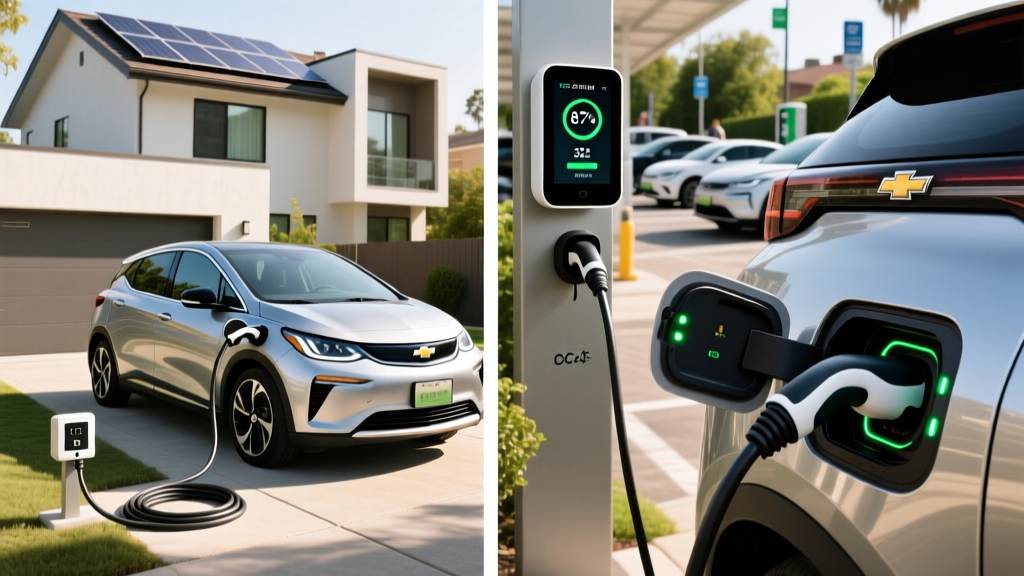
The Chevrolet Bolt EV and Bolt EUV remain some of the most affordable long-range electric vehicles on the market, but their charging capabilities require a clear-eyed look before you plug in. Whether you're evaluating a new 2026 Bolt or optimizing your current ownership experience, understanding the real Chevy Bolt charging speed across every charging level is essential for daily driving and road-trip planning alike.
This guide covers exactly how fast the Bolt charges at Level 1, Level 2, and DC fast charging stations, what home charger installation actually costs, which connectors and adapters you need, and how charging expenses compare to gasoline. We'll also recommend specific Level 2 chargers that pair well with the Bolt's onboard charger limitations.
Chevy Bolt Battery and Charging Specs at a Glance
Before breaking down charging speeds, here are the core specs that determine how quickly the Bolt replenishes. The current-generation Bolt EV uses a 65 kWh usable lithium-ion NMC battery pack (nickel-manganese-cobalt chemistry), delivering an EPA-estimated 259 miles of range for the EV and 247 miles for the EUV variant.
| Specification | Bolt EV | Bolt EUV |
|---|---|---|
| Usable Battery Capacity | 65 kWh (NMC) | 65 kWh (NMC) |
| EPA Range | 259 miles | 247 miles |
| Max DC Fast Charge Rate | 55 kW (peak) | 55 kW (peak) |
| Onboard Charger (Level 2) | 11.5 kW (48A) | 11.5 kW (48A) |
| DC 10–80% Charge Time | ~45 minutes | ~45 minutes |
| Level 2 0–100% Time | ~7 hours | ~7 hours |
| Connector (DC Fast) | CCS1 | CCS1 |
| Efficiency | 120 MPGe combined | 115 MPGe combined |
Key limitation: The Bolt's 55 kW peak DC fast-charging rate is the single biggest constraint owners face on road trips. While competitors like the Hyundai Ioniq 5 peak at 240 kW and the Tesla Model 3 at 250 kW, the Bolt's charge curve stays relatively flat at roughly 40–55 kW from 10% to about 60% State of Charge (SoC), then tapers significantly above 80%. This is not a defect — it's a deliberate engineering choice to preserve battery longevity on an NMC pack without active liquid cooling during DC charging — but it means highway road trips require more patience.
Real-World Range Note: The EPA sticker says 259 miles, but expect roughly 220–240 miles in mixed highway driving at 70+ mph, and as low as 175–195 miles in sub-freezing winter conditions. The Bolt's resistive cabin heater (no heat pump) draws significant energy from the pack in cold weather. Source: fueleconomy.gov.
Charging Levels: How Fast Each Adds Range to the Bolt
Understanding the three charging levels is foundational to EV ownership. Here's the critical distinction: kW (kilowatts) measures power — the rate at which energy flows into your battery. kWh (kilowatt-hours) measures energy — the total capacity of your battery, like gallons in a fuel tank. Charging speed is measured in kW; battery size in kWh.
| Charging Level | Power Source | Max kW to Bolt | Miles of Range Added Per Hour | Best Use Case |
|---|---|---|---|---|
| Level 1 | 120V household outlet | ~1.4 kW | ~4 miles/hr | Overnight top-up, low daily mileage |
| Level 2 | 240V dedicated circuit | 11.5 kW (Bolt's onboard limit) | ~39 miles/hr | Daily home charging, full overnight recharge |
| DC Fast Charge | Public 50–350 kW station | 55 kW (Bolt's peak) | ~150 miles/hr (at peak) | Road trips, emergency top-ups |
Level 1 Charging: The Emergency Backup
Every Bolt ships with a dual-level portable charge cord capable of Level 1 charging from a standard 120V household outlet. At roughly 1.4 kW, you'll gain about 4 miles of range per hour — or approximately 48 miles over a 12-hour overnight session. For drivers with short commutes under 30 miles round-trip, Level 1 can technically suffice, but it's painfully slow for replenishing a depleted 65 kWh pack (a full 0–100% charge takes over 48 hours).
Level 2 Charging: The Daily Workhorse
The Bolt's 11.5 kW onboard AC charger is the real star for daily ownership. Connect to a 240V Level 2 station rated at 48 amps or higher, and you'll add approximately 39 miles of range per hour. A full 0–100% charge completes in roughly 7 hours — perfect for overnight replenishment. Even a 40-amp Level 2 circuit (delivering ~9.6 kW to the Bolt) adds about 32 miles per hour, still sufficient for most daily needs.
Important nuance: If you install a 32-amp charger (7.7 kW), the Bolt will only charge at that rate, adding roughly 26 miles per hour. To maximize the Bolt's 11.5 kW onboard capability, you need a charger rated at 48 amps on a 60-amp dedicated circuit.
DC Fast Charging: Road-Trip Reality
At a CCS1 DC fast charger, the Bolt peaks at approximately 55 kW between 10% and 55% SoC. In practice, a 10–80% session takes about 45 minutes. Above 80%, the charge rate tapers sharply — often dropping below 20 kW — making it inefficient to charge past 80% on road trips unless absolutely necessary.
At a 150 kW or 350 kW station, the Bolt still only draws 55 kW. Paying a premium for ultra-fast chargers provides no benefit to Bolt owners. Seek out 50 kW stations where pricing may be lower; you won't sacrifice meaningful speed.
Home Charger Installation: Costs, Electrical Requirements, and Gotchas
Installing a Level 2 home charger is the single highest-impact upgrade any Bolt owner can make. Here's what it actually involves and what it costs.
Electrical Requirements for the Bolt
To unlock the Bolt's full 11.5 kW Level 2 charging speed, you need:
- Circuit: 60-amp dedicated breaker (NEC requires circuits to be rated 125% above continuous load, so a 48-amp charger needs a 60-amp breaker)
- Wire: 6 AWG copper (or 4 AWG aluminum) THHN/THWN run in conduit
- Outlet: NEMA 14-50 (if using a plug-in charger) or hardwired connection (often preferred for 48A+ chargers)
- Voltage: 240V single-phase
If you opt for a 40-amp charger (9.6 kW), a 50-amp breaker with 8 AWG copper wire suffices — potentially saving on wire costs for longer runs.
Panel Upgrade: The Cost That Catches Owners Off Guard
Many homes built before 2000 have 100-amp electrical panels. Adding a 60-amp EV circuit to an already-loaded 100-amp panel may exceed capacity, requiring a panel upgrade to 200 amps. This is the single most expensive variable in home charger installation.
| Installation Component | Low Estimate | High Estimate | Notes |
|---|---|---|---|
| Level 2 Charger (Equipment) | $350 | $700 | 40A–48A smart charger, 25-ft cable |
| Electrician Labor (standard install) | $500 | $1,500 | Short run from panel to garage; longer runs cost more |
| Permit and Inspection | $50 | $250 | Varies by municipality; some waive EV permits |
| Electrical Materials (wire, conduit, breaker) | $150 | $500 | Depends on run length and wire gauge |
| Panel Upgrade (if needed) | $1,500 | $4,000 | 200A service upgrade; not always required |
| Total (no panel upgrade) | $1,050 | $2,950 | Most common scenario |
| Total (with panel upgrade) | $2,550 | $6,950 | Older homes with 100A service |
Pro tip: Before hiring an electrician, locate your panel and check its amperage rating (printed on the main breaker). Then add up existing major loads (HVAC, electric range, dryer, water heater). If total existing loads plus a 48A (11.5 kW) EV charger approach or exceed your panel rating, you'll need an upgrade. A licensed electrician can perform a formal load calculation per NEC Article 220.
Some utilities offer rebates of $250–$1,000 for Level 2 charger installation — check with your local provider. Additionally, the federal Residential Clean Energy Credit does not cover EV chargers under current IRS rules (that credit expired for charging equipment after 2021), though some state and local incentives remain.
Connector Compatibility: CCS1, NACS, and the Adapter Question
The Chevrolet Bolt EV and EUV use the CCS1 (Combined Charging System) connector for DC fast charging and the J1772 connector for Level 1 and Level 2 AC charging. This matters significantly as the industry shifts toward Tesla's NACS (North American Charging Standard).
| Connector Type | Used For | Bolt Compatible? | Adapter Needed? |
|---|---|---|---|
| J1772 | Level 1 & Level 2 AC charging | Yes (native) | No |
| CCS1 | DC fast charging | Yes (native) | No |
| NACS (Tesla) | Tesla Superchargers (DC) & destination chargers (AC) | With adapter | Yes — CCS-to-NACS adapter (~$200–$300) |
| CHAdeMO | Legacy DC fast charging (Nissan Leaf) | No | N/A — CHAdeMO stations are declining |
The Tesla Supercharger Adapter Situation for Bolt Owners
General Motors has transitioned to NACS for future models, and current Chevy Bolt owners can access Tesla Superchargers using a CCS1-to-NACS adapter. GM has offered these adapters to eligible Bolt owners, and aftermarket options are available from approved manufacturers. With an adapter, Bolt owners gain access to the largest DC fast-charging network in North America — over 25,000 Supercharger stalls as of 2026.
Caveat: The adapter does not increase the Bolt's 55 kW peak charge rate. You'll still charge at the Bolt's maximum speed, but Supercharger reliability and availability are generally superior to third-party networks like Electrify America or EVgo.
Charging Cost Per Mile: Bolt vs. Gasoline
One of the strongest arguments for the Bolt is its low operating cost. Here's how charging expenses break down across different scenarios compared to a gasoline vehicle achieving 30 MPG combined.
| Charging Scenario | Rate ($/kWh) | Cost to Charge 65 kWh (0–100%) | Cost Per Mile (259 mi range) |
|---|---|---|---|
| Home off-peak (utility time-of-use) | $0.08–$0.12 | $5.20–$7.80 | $0.020–$0.030 |
| Home standard rate | $0.14–$0.18 | $9.10–$11.70 | $0.035–$0.045 |
| Public Level 2 (workplace, shopping) | $0.20–$0.35 | $13.00–$22.75 | $0.050–$0.088 |
| DC Fast Charging (public) | $0.30–$0.55 | $19.50–$35.75 | $0.075–$0.138 |
| Gasoline (30 MPG, $3.40/gal) | — | $29.35 (equiv. 8.6 gal) | $0.113 |
Bottom line: Home-charged Bolt owners pay roughly $0.03–$0.045 per mile, compared to $0.113 per mile for a 30 MPG gas car at $3.40/gallon. Over 15,000 annual miles, that's a fuel savings of approximately $1,050–$1,250 per year by charging at home. Even exclusive DC fast charging is competitive with gasoline on a per-mile basis, though it erodes the Bolt's cost advantage.
Maximize savings by enrolling in your utility's time-of-use (TOU) rate plan and scheduling charging sessions for overnight off-peak hours (typically 11 PM–6 AM), when rates drop to $0.08–$0.12/kWh in many markets.
Best Level 2 Home Chargers for the Chevy Bolt
To take full advantage of the Bolt's 11.5 kW onboard charger, you need a Level 2 station rated at 48 amps. Here are three proven options that balance power, reliability, smart features, and value.
ChargePoint Home Flex
- Power Output: Up to 50 amps (12 kW) — adjustable via DIP switches
- Connector: J1772 (NACS version also available)
- Cable Length: 23 feet
- Smart Features: Wi-Fi, app scheduling, energy tracking, Alexa integration
- Price: ~$599 (often $549 on sale)
- Why for Bolt: 50A setting fully saturates the Bolt's 48A onboard charger; flexible amperage lets you match your circuit capacity
Emporia Vue Level 2 Charger
- Power Output: 48 amps (11.5 kW)
- Connector: J1772
- Cable Length: 24 feet
- Smart Features: Wi-Fi, app control, energy monitoring, solar integration with Emporia Vue panel monitor
- Price: ~$399
- Why for Bolt: Best value 48A charger; pairs with Emporia's whole-home energy monitor for detailed cost tracking
Wallbox Pulsar Plus
- Power Output: 48 amps (11.5 kW)
- Connector: J1772
- Cable Length: 25 feet
- Smart Features: Wi-Fi + Bluetooth, app scheduling, load balancing, Power Sharing (dual-charger on one circuit)
- Price: ~$549
- Why for Bolt: Compact form factor, excellent app, Power Sharing feature ideal for two-EV households sharing a 60A circuit
What about 32-amp chargers? Budget options like the Lectron 32A ($249) or Amazon Basics 32A ($299) will work with the Bolt but limit charging to 7.7 kW (~26 miles/hr). For the Bolt's 65 kWh pack, that means roughly 9 hours for a full charge instead of 7. If your daily driving exceeds 60 miles, the slower rate may not fully replenish overnight on a standard sleep schedule. We recommend 48-amp chargers for Bolt owners unless budget is the overriding constraint.
Safety, Electrical Code, and Installation Best Practices
EV charging is a continuous high-load electrical draw — your charger will pull maximum current for 6–8 hours straight, night after night. This is fundamentally different from intermittent loads like a dryer or oven. Proper installation is non-negotiable for safety.
Code Requirements and Best Practices
- Dedicated circuit: Your Level 2 charger must be on its own dedicated breaker — never shared with other appliances.
- GFCI protection: NEC 2020 and later require GFCI (Ground Fault Circuit Interrupter) protection for outdoor EV outlets. Many modern chargers include built-in GFCI, which may satisfy this requirement — confirm with your electrician and local inspector.
- Outdoor rating: If installing outdoors, the charger must carry a NEMA 4 (or IP65+) weather rating. All three chargers recommended above are outdoor-rated.
- Wire sizing: Undersized wire on a long run causes voltage drop, heat buildup, and fire risk. Your electrician should calculate voltage drop for runs exceeding 50 feet and upsize wire accordingly.
- Permit and inspection: Most jurisdictions require an electrical permit for new 240V circuits. The inspection ensures code compliance and protects your homeowner's insurance coverage in the event of an electrical fire.
Never use extension cords with Level 2 chargers, and never plug a Level 2 charger into a standard 120V outlet via an adapter. If your charger's cable doesn't reach your parking spot, have an electrician relocate the outlet or install a longer-cable charger model.
DC Fast Charging on Road Trips: Practical Tips for Bolt Owners
The Bolt's 55 kW DC fast-charging speed defines the road-trip experience. Here's how to make it work:
- Plan stops at 30–40% SoC: Arriving at a charger with a very low battery (below 15%) means a longer wait at the slower initial ramp-up. The Bolt charges fastest between 20% and 55% SoC.
- Don't bother charging past 80%: The charge curve tapers sharply above 80%. A session from 80–100% can take nearly as long as 20–80%. Plan shorter, more frequent stops instead.
- Preconditioning: The Bolt does not have active battery preconditioning for DC charging (unlike Tesla or Hyundai). In cold weather, expect slower initial charge rates until the pack warms from charging current. Plan for 10–15 extra minutes at the first stop in winter.
- Use PlugShare or A Better Routeplanner: Filter for CCS1 stations with at least 50 kW capability. Avoid 25 kW DC chargers — they'll take over 2 hours for a 10–80% session.
- Tesla Supercharger adapter: If you have a CCS-to-NACS adapter, Superchargers offer superior uptime and availability. Set your navigation to Supercharger locations in the Tesla app.
Frequently Asked Questions
How much does it cost to install a home charger for the Chevy Bolt?
A standard Level 2 installation (48-amp charger, 60-amp circuit, short wire run, no panel upgrade) typically costs $1,050–$2,950 including equipment, electrician labor, permits, and materials. If your home needs a 200-amp panel upgrade, add $1,500–$4,000. Always get at least two quotes from licensed electricians and confirm they include permit costs.
How fast will each charging level add range to my Bolt?
Level 1 (120V) adds about 4 miles per hour. Level 2 (240V, 48A) adds approximately 39 miles per hour, fully charging the 65 kWh pack in about 7 hours. DC fast charging at 55 kW adds roughly 150 miles per hour at peak rate, completing a 10–80% session in about 45 minutes.
Which connector and charger is compatible with my Chevy Bolt?
The Bolt uses J1772 for AC charging (Level 1 and Level 2) and CCS1 for DC fast charging — both are native, no adapter needed. To use Tesla Superchargers, you need a CCS1-to-NACS adapter (approximately $200–$300). Any J1772 Level 2 charger will work; choose a 48-amp model to maximize the Bolt's 11.5 kW onboard charger.
How much does charging the Bolt cost per mile versus gasoline?
Charging at home on off-peak rates costs approximately $0.02–$0.045 per mile. A comparable 30 MPG gasoline car at $3.40/gallon costs about $0.113 per mile. Over 15,000 miles per year, home charging saves roughly $1,050–$1,250 annually in fuel costs. Even public DC fast charging at $0.35–$0.55/kWh is competitive with gasoline at $0.075–$0.138 per mile.
What electrical upgrades might I need for a home charger?
You'll need a dedicated 60-amp, 240V circuit with 6 AWG copper wire for a 48-amp charger. If your home has a 100-amp electrical panel with significant existing loads (electric HVAC, range, dryer, water heater), you may need a panel upgrade to 200 amps — adding $1,500–$4,000. Homes with existing 200-amp service rarely need a panel upgrade for a single EV charger. A licensed electrician can perform a load calculation to determine your specific needs.
Can I charge the Bolt faster with a more powerful home charger?
No. The Bolt's onboard charger is limited to 11.5 kW (48 amps). Even if you install a 64-amp or 80-amp charger, the Bolt will only draw 48 amps. However, installing a higher-amperage charger now could future-proof your setup if you later purchase a vehicle with a larger onboard charger (e.g., Ford F-150 Lightning at 19.2 kW).
Does the Chevy Bolt qualify for the federal EV tax credit?
Federal tax credit eligibility under IRS §30D depends on current-year rules including MSRP caps ($55,000 for cars), buyer income limits ($150K single / $300K joint), battery critical-mineral sourcing, and North American assembly requirements. Credit amounts and eligibility change frequently — consult the IRS Clean Vehicle Provisions page and a tax professional before purchasing. The Bolt's MSRP (starting around $28,000) is well within the cap, but sourcing requirements may affect eligibility.
Sources: EPA fuel economy data from fueleconomy.gov; Chevrolet Bolt specifications from chevrolet.com; federal tax credit rules from irs.gov. All pricing and specifications reflect 2026 model year data where available. Verify current incentives and credit eligibility before purchase.