If you own a Chevy Bolt EV or the newer Bolt EUV, or you're considering one on the used market, understanding your actual charge time is the single most practical ownership question you'll face. The Bolt's 65 kWh battery (2022–2026 model years) delivers an EPA-estimated 259 miles of range (247 miles for the EUV), but how quickly you replenish that energy depends entirely on which charging level you use — and the difference spans from 54 hours on a wall outlet to roughly 30 minutes at a DC fast charger.
This guide breaks down exactly how long a Chevy Bolt takes to charge at every level, what equipment you need, what a home installation actually costs, and how charging economics compare to gasoline. We'll also address the Bolt's well-known DC fast-charging limitation honestly, because it's a factor many buyers overlook.
Charging Levels and Speeds: What Each Adds Per Hour
Before diving into Bolt-specific numbers, let's clarify the terminology that trips up many new EV owners. kW (kilowatts) measures power — the rate at which electricity flows into your car. kWh (kilowatt-hours) measures energy — the total capacity of your battery. Think of kW as the width of a hose and kWh as the size of the bucket you're filling. The Bolt EV and EUV both carry a 65 kWh usable battery pack (NMC chemistry).
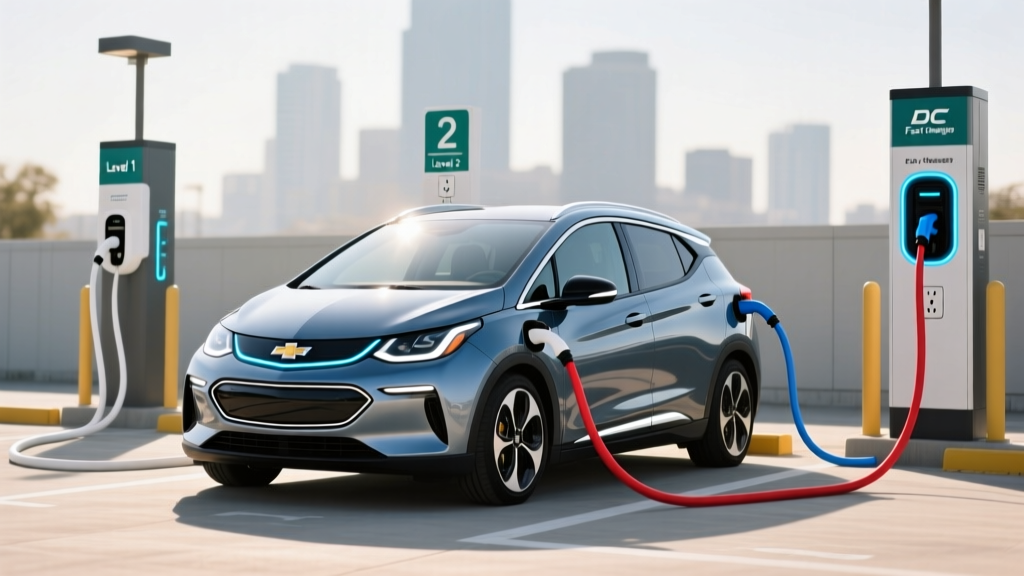
| Charging Level | Voltage / Amperage | Power (kW) | Miles of Range Added Per Hour | Estimated 10–80% Charge Time |
|---|---|---|---|---|
| Level 1 (standard outlet) | 120V / 12A | ~1.4 kW | ~4 miles/hr | ~54 hours |
| Level 2 (home / public AC) | 240V / 48A | 11.5 kW (Bolt onboard max) | ~39 miles/hr | ~7 hours |
| DC Fast Charging (CCS) | 400V architecture | 55 kW peak | ~100 miles in 30 min | ~50 minutes (10–80%) |
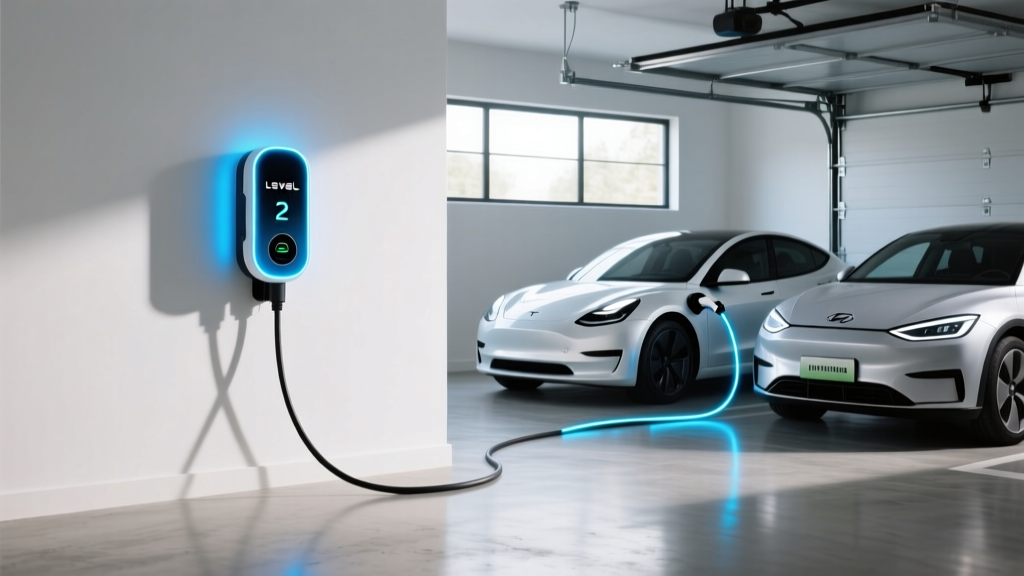
The Bolt's onboard charger accepts up to 11.5 kW on Level 2 AC power. This means even if you plug into a 19.2 kW public AC charger, the Bolt will only draw 11.5 kW. That's still strong for overnight home charging — a full 10–80% session takes roughly 7 hours, which aligns perfectly with an overnight schedule.
The Bolt's DC Fast-Charging Limitation: What You Must Know
Here's where honest reporting matters. The Chevy Bolt's DC fast-charging speed peaks at approximately 55 kW — and that peak only holds between roughly 10% and 40% state of charge. Above 40%, the charge rate tapers significantly, often dropping below 30 kW. A 10–80% DC fast-charge session takes roughly 50 minutes to an hour.
For context, competitors like the Hyundai Ioniq 5 and Tesla Model 3 peak at 200–250 kW and complete 10–80% in 18–25 minutes. If you frequently take road trips exceeding 200 miles, this taper curve is a meaningful limitation. The Bolt is best understood as a commuter EV that charges overnight at home — not a road-trip champion.
GM has indicated that the next-generation Bolt (expected for the 2027 model year on the Ultium platform) will feature substantially faster DC charging, but as of early 2026, all current Bolt EV and EUV models carry this 55 kW ceiling. According to Chevrolet's official Bolt EV specs, maximum DC charge rate remains listed at 55 kW.
Home Charger Installation: Costs, Electrical Requirements, and Gotchas
To unlock the Bolt's full 11.5 kW Level 2 capability at home, you'll need a 240-volt circuit rated for at least 50 amps (which allows a continuous 40-amp draw, per electrical code). Some chargers and configurations support up to 48 amps continuous, which requires a 60-amp breaker.
Here's what that installation actually costs in 2026:
| Component | Low Estimate | High Estimate | Notes |
|---|---|---|---|
| Level 2 charger (hardware) | $350 | $700 | Varies by brand, smart features, cable length |
| Electrician labor (standard install) | $500 | $1,500 | Depends on panel proximity, conduit run length |
| Electrical permit | $50 | $200 | Varies by municipality |
| Panel upgrade (if needed) | $1,500 | $4,000+ | Required if existing panel lacks capacity or space for a new 50–60A breaker |
| Total (no panel upgrade) | $900 | $2,400 | Most homes with 200A service fall here |
| Total (with panel upgrade) | $2,400 | $6,600+ | Older homes with 100A service often need this |
The panel-upgrade scenario is the surprise cost that catches many homeowners off guard. If your home has a 100-amp electrical panel — common in homes built before the 1990s — adding a 50-amp EV circuit may exceed your panel's capacity. A licensed electrician will perform a load calculation to determine whether an upgrade to 200-amp service is required. Always get a written quote that includes the load calculation before committing.
On the positive side, the IRS Residential Clean Energy Credit (§25D) offers a 30% tax credit on the cost of home EV charging equipment and installation, up to $1,000, through 2032. This applies to the charger hardware and electrician labor, but not to a panel upgrade. Consult a tax professional for your specific eligibility.
Connector Compatibility: NACS, CCS1, and the Adapter Landscape
The 2022–2026 Chevy Bolt EV and EUV come equipped with a CCS1 (Combined Charging System) connector for both Level 2 AC and DC fast charging. However, the charging landscape has shifted dramatically since Tesla opened its Supercharger network to non-Tesla vehicles and the industry adopted NACS (North American Charging Standard) as the dominant connector.
| Connector Type | Native on Bolt? | Adapter Available? | Network Access |
|---|---|---|---|
| CCS1 | Yes (built-in) | N/A | Electrify America, EVgo, ChargePoint, most public DC networks |
| NACS (Tesla) | No | Yes — GM-approved CCS-to-NACS adapter (~$225) | Tesla Supercharger network (15,000+ stalls in North America) |
| CHAdeMO | No | Not practically available | Largely deprecated in North America |
| J1772 (Level 2 AC public) | Yes (CCS1 includes J1772) | N/A | All public Level 2 stations |
The GM-approved CCS-to-NACS adapter is a significant unlock for Bolt owners. It grants access to Tesla Supercharger stalls, which are generally the most reliable DC fast-charging network in North America. However, remember the Bolt's 55 kW DC charge ceiling — even at a 250 kW Supercharger stall, your Bolt will still peak at 55 kW. The adapter expands where you can charge, not how fast.
For home Level 2 charging, if you install a NACS-wall-connector-style charger, you'll need the adapter on the car end. Most Bolt owners opt for a CCS-native home charger (J1772 connector) to avoid daily adapter use.
Level 2 Home Charger Recommendations for the Chevy Bolt
Since the Bolt caps at 11.5 kW on Level 2, you don't need the most powerful charger on the market — but you do want reliability, a quality cable, and smart features for scheduling off-peak charging. Here are three strong options:
ChargePoint Home Flex
- Power: Up to 12 kW (50A) / configurable down to 16A
- Connector: J1772 (CCS-compatible)
- Cable: 23 feet
- Smart features: Wi-Fi, app scheduling, Alexa, energy tracking
- Price: ~$550–$650
- Best for: Bolt owners wanting flexible amperage and robust app control
Emporia Level 2 EV Charger
- Power: Up to 11.5 kW (48A)
- Connector: J1772 (CCS-compatible)
- Cable: 24 feet
- Smart features: Wi-Fi, app, solar integration, energy monitoring
- Price: ~$350–$400
- Best for: Budget-conscious buyers who still want smart scheduling
Tesla Wall Connector
- Power: Up to 11.5 kW (48A)
- Connector: NACS (requires adapter for Bolt)
- Cable: 24 feet
- Smart features: Wi-Fi, power sharing, OTA updates
- Price: ~$425
- Best for: Multi-EV households with both Tesla and GM vehicles
For a Bolt-only household, the ChargePoint Home Flex or Emporia charger is the most practical choice — native J1772 connector, no adapter needed, and enough power to max out the Bolt's 11.5 kW onboard charger.
Charging Cost Per Mile: Bolt EV vs. Gasoline Car
The Bolt EV's efficiency is one of its strongest ownership advantages. The EPA rates it at approximately 28 kWh per 100 miles (about 120 MPGe combined). Let's translate that into real dollars.
| Scenario | Rate / Cost | Cost Per Mile (Bolt EV) | Cost Per Mile (Gas, 30 MPG) |
|---|---|---|---|
| Home charging (off-peak utility rate) | $0.10/kWh | $0.028 | $0.117 (at $3.50/gal) |
| Home charging (average US rate) | $0.16/kWh | $0.045 | $0.117 |
| Public Level 2 (network pricing) | $0.30/kWh | $0.084 | $0.117 |
| DC fast charging (public) | $0.45/kWh | $0.126 | $0.117 |
The math is clear: home charging on an off-peak rate delivers fuel costs roughly 75% lower than a comparable gasoline car. Even at average residential rates, the Bolt costs less than half per mile to fuel. The one scenario where charging can exceed gasoline cost is frequent DC fast charging at premium public rates — another reason the Bolt excels as a home-charged commuter rather than a road-trip vehicle.
According to fueleconomy.gov, the Bolt EV's annual fuel cost is estimated at approximately $550 based on 15,000 miles of driving and average electricity rates — compared to roughly $1,750 for a 30 MPG gasoline compact.
Safety, Electrical Code, and Installation Best Practices
EV charging involves sustained high-current draw — often 8+ hours continuously. This is fundamentally different from most household circuits, which see intermittent loads. Proper installation is non-negotiable:
- Dedicated circuit: Your Level 2 charger must be on its own dedicated breaker — not shared with other appliances. A 50-amp breaker (40A continuous) or 60-amp breaker (48A continuous) is standard.
- GFCI protection: The 2020 NEC (National Electrical Code) and later revisions require GFCI protection for EV charging outlets. Hardwired chargers with built-in ground-fault protection may satisfy this requirement without an external GFCI breaker, depending on your jurisdiction.
- Outdoor rating: If your charger is installed outdoors, ensure the unit carries a NEMA 4 or NEMA 4X rating for weather resistance. The ChargePoint Home Flex and Tesla Wall Connector are both rated for outdoor use.
- Wire gauge: A 50-amp circuit typically requires 6 AWG copper wire; a 60-amp circuit requires 4 AWG. Your electrician will size this correctly, but verify it's in the written quote.
- Permit and inspection: Most municipalities require an electrical permit and post-installation inspection for EV charger circuits. This typically costs $50–$200 and protects your home insurance coverage.
Never use an extension cord for EV charging, and avoid plugging a Level 1 charger into a power strip or multi-outlet adapter. Level 1 charging through a standard 120V outlet draws near the circuit's maximum capacity continuously — any additional load on that circuit creates a fire risk.
Frequently Asked Questions
How long does it take to fully charge a Chevy Bolt at home?
On a 240V Level 2 charger delivering the Bolt's maximum 11.5 kW, a full 0–100% charge takes approximately 7.5 to 8 hours. Most owners charge from 20–80% overnight, which takes roughly 4 hours. On a standard 120V Level 1 outlet, a full charge takes approximately 54 hours — practical only for emergency trickle charging or very low daily mileage.
Can I charge my Chevy Bolt at a Tesla Supercharger?
Yes, with GM's approved CCS-to-NACS adapter (approximately $225). This grants access to Tesla's Supercharger network. However, the Bolt's 55 kW DC charge ceiling means you won't see the speeds Tesla vehicles achieve — expect 10–80% in roughly 50 minutes regardless of the stall's rated power.
Does the Chevy Bolt support fast charging?
It supports DC fast charging, but at a modest rate compared to competitors. The Bolt peaks at approximately 55 kW, which adds about 100 miles in 30 minutes under ideal conditions. The charge rate tapers significantly above 40% state of charge. For road trips, plan for longer stops than you would in a vehicle with 150+ kW charging capability.
What size breaker do I need for a home Level 2 charger?
A 50-amp breaker is standard for a 40-amp continuous Level 2 charger, which is sufficient to max out the Bolt's 11.5 kW onboard charger. A 60-amp breaker allows 48-amp continuous charging. Your electrician will determine the correct size based on your panel's available capacity and a proper load calculation.
Is it cheaper to charge at home or at public stations?
Home charging is almost always cheaper. Residential electricity averages $0.10–$0.16/kWh, translating to $0.028–$0.045 per mile in the Bolt. Public DC fast chargers often charge $0.35–$0.55/kWh, bringing cost per mile to $0.10–$0.15 — comparable to or exceeding gasoline. Maximize home charging for the best economics.
Will charging my Bolt every night damage the battery?
No. The Bolt's NMC battery is managed by an active thermal management system and a built-in buffer (you never truly charge to 100% or discharge to 0% at the cell level). For daily use, setting your charge limit to 80% via the vehicle's settings reduces long-term degradation. Charging nightly from 40–80% is well within the battery's design parameters. GM provides an 8-year/100,000-mile battery warranty covering defects and excessive capacity loss.