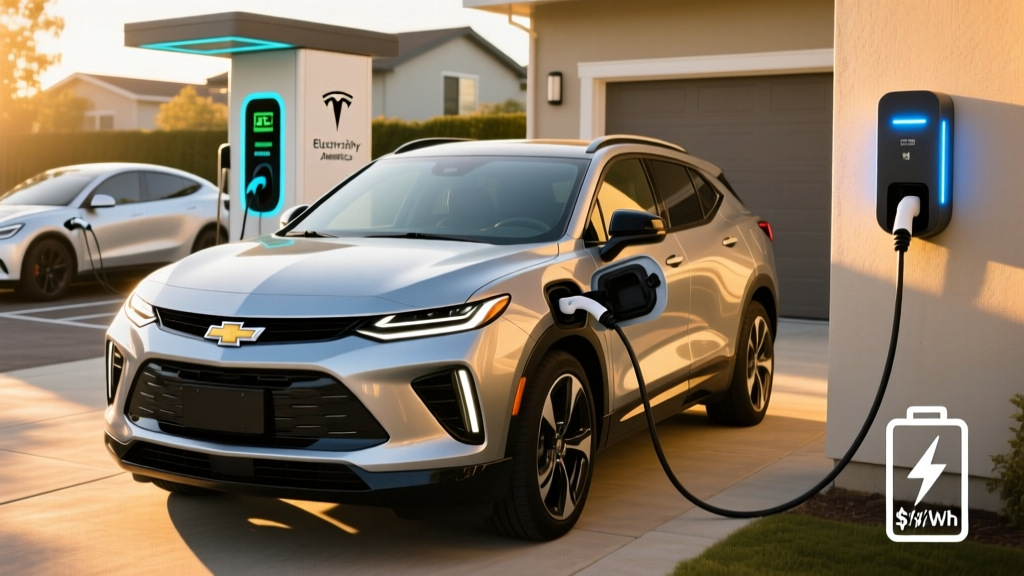
The 2025 Chevy Blazer EV delivers an EPA-estimated range of up to 324 miles in the 2LT trim with front-wheel drive and the larger 102 kWh (usable) Ultium battery pack. But range is only half the ownership equation — how you charge that battery dictates your daily convenience, your monthly electricity bill, and whether a 300-mile road trip feels effortless or stressful. This guide breaks down exactly how to charge a Blazer EV at home and on the road, with real numbers on installation costs, charging speeds, connector compatibility, and per-mile economics.
Real-World Chevy Blazer EV Range vs. EPA Sticker
Real-World Highway (70-75 mph): ~260–285 miles
Cold Weather (below 30°F): ~220–250 miles
SS AWD (85 kWh battery): EPA 279 miles; expect ~230–250 miles highway
The Blazer EV's range varies significantly by trim and drivetrain. The EPA's fueleconomy.gov listings show the FWD 2LT achieving 324 miles, while the sporty SS AWD drops to 279 miles due to its smaller 85 kWh battery and dual-motor powertrain drawing more energy.
Expect to lose 12–18% of EPA range on sustained highway driving above 70 mph. Cold weather compounds this — GM's Ultium pack lacks a dedicated heat pump in the 2024-2025 Blazer EV, meaning cabin heating draws directly from the traction battery, slicing range further. If you live in a northern climate and commute long distances, plan around ~240 miles of usable winter range on the larger battery.
Charging Levels Explained: Speeds in kW and Miles Per Hour
Before comparing equipment, the single most important distinction in EV charging: kW (kilowatts) measures power — how fast energy flows into the battery. kWh (kilowatt-hours) measures energy capacity — how much the battery holds. A 19.2 kW Level 2 charger fills a 102 kWh battery in roughly 5.3 hours from empty. Conflating these two units is the most common EV literacy mistake.
| Level | Voltage | Max Power (kW) | Miles Added/Hour | Best Use Case |
|---|---|---|---|---|
| Level 1 | 120V AC | 1.2–1.4 kW | 3–5 mi/hr | Overnight top-up, emergency |
| Level 2 (Home/Public) | 240V AC | 7.2–19.2 kW | 22–55 mi/hr | Daily home charging, workplace |
| DC Fast Charge | 400V+ DC | Up to 190 kW | ~180–240 mi in 30 min | Road trips, highway corridors |
The Blazer EV supports AC Level 2 charging at up to 11.5 kW (48A) on most trims, with the SS capable of 19.2 kW (80A) when equipped with the available dual-level charging cord and a compatible hardwired station. DC fast charging peaks at approximately 190 kW on the 102 kWh battery, though real-world sustained rates taper significantly above 80% state of charge.
Charging Time: 10-80% Scenarios for the Blazer EV
The "10-80%" metric matters more than 0-100% because most owners rarely charge to full (it's slower and unnecessary for daily driving), and lithium batteries charge fastest in the mid-range of their state of charge. Here's what to expect:
- Level 1 (120V, 1.4 kW): 10-80% takes approximately 50+ hours. Practical only for PHEVs or very low-mileage days.
- Level 2 (240V, 11.5 kW): 10-80% on the 102 kWh pack takes roughly 6 hours. Plug in at 10 PM, wake up to a full battery by 6 AM.
- Level 2 (240V, 19.2 kW — SS trim): 10-80% in approximately 3.5 hours on the 85 kWh pack.
- DC Fast Charge (190 kW peak): 10-80% in approximately 30 minutes on the 102 kWh battery. Note: peak rate holds only in the 20-60% SoC window; above 80%, the charge curve tapers sharply to protect cell health.
On a road trip, plan for 25-35 minute stops at DC fast chargers every 200-250 miles. Preconditioning the battery (navigating to a fast charger in the Blazer EV's infotainment system) warms the pack for faster charging speeds — skipping this step in cold weather can add 10-15 minutes to your stop.
Home Charger Installation: Electrical Requirements and Costs
Installing a Level 2 home charger is the single biggest quality-of-life upgrade for any Blazer EV owner. But costs vary wildly depending on your home's electrical panel, the distance from panel to charger location, and local permit requirements.
Electrical Requirements
- Standard Level 2 (11.5 kW / 48A): Requires a dedicated 240V/60A circuit (NEC code requires circuits rated at 125% of continuous load, so a 48A charger needs a 60A breaker).
- High-power Level 2 (19.2 kW / 80A): Requires a dedicated 240V/100A circuit — many older 100A or 150A home panels cannot support this without a panel upgrade.
- NEMA 14-50 outlet vs. hardwired: A 14-50 outlet (50A circuit) supports up to 40A continuous (9.6 kW) and offers portability. Hardwired installations support higher amperage and avoid the GFCI breaker issues that plague some 14-50 installations.
Panel Upgrade Reality
If your home has a 100A or 150A main panel — common in homes built before 2000 — adding a 60A EV circuit may exceed your panel's capacity, especially if you already run electric HVAC, a dryer, and an electric range. A panel upgrade to 200A typically costs $1,500–$3,000. Some utilities offer rebates that offset this. Always have a licensed electrician perform a load calculation before committing to a charger.
| Item | Low Estimate | High Estimate |
|---|---|---|
| Level 2 Charger Equipment (48A) | $350 | $700 |
| Electrician Labor (standard install, <50ft run) | $500 | $1,200 |
| Permit & Inspection | $50 | $300 |
| Electrical Panel Upgrade (if needed) | $1,500 | $3,000 |
| Total (no panel upgrade) | $900 | $2,200 |
| Total (with panel upgrade) | $2,400 | $5,200 |
Get at least three quotes. Some installers bundle the charger and labor; others charge separately. Ask specifically about conduit type (EMT vs. PVC), whether the run requires trenching, and if the permit includes a final inspection — unpermitted work can void homeowner's insurance claims.
Connector Compatibility: NACS, CCS, and the Adapter Landscape
The 2025 Chevy Blazer EV ships with a CCS1 (Combined Charging System) port for DC fast charging and a J1772 inlet for AC Level 2. However, GM has committed to transitioning to the NACS (North American Charging Standard) — the Tesla-designed connector — across its EV lineup starting with the 2025 model year for some vehicles and 2026 for others.
What this means for Blazer EV owners right now:
| Network/Connector | Native Support | Adapter Needed? | Notes |
|---|---|---|---|
| Tesla Supercharger (NACS) | No (CCS1 port) | Yes — GM-approved NACS adapter (~$225) | Access to 25,000+ Supercharger stalls |
| Electrify America (CCS1) | Yes | No | Largest non-Tesla DC network |
| EVgo (CCS1/NACS) | Yes (CCS1) | No for CCS1 stalls | Expanding NACS stalls; adapter for those |
| ChargePoint / Blink (J1772 AC) | Yes | No | Public Level 2 standard |
| CHAdeMO | No | Not available | Legacy Nissan/Mitsubishi standard; irrelevant for Blazer EV |
The GM-approved NACS adapter is the most important accessory a Blazer EV owner can buy. It unlocks Tesla Supercharger access — the most reliable and geographically complete DC fast-charging network in the US. Without it, you're limited to CCS networks, which have improved but still trail Tesla in uptime and coverage along rural corridors.
Cost to Charge: Home Electricity vs. Public DC Fast vs. Gas
The Blazer EV 2LT FWD achieves an EPA-rated 87 MPGe combined, translating to roughly 35 kWh per 100 miles driven. Here's what that costs across different charging scenarios:
| Scenario | Rate | Cost per 100 Miles | Cost per Mile |
|---|---|---|---|
| Home (off-peak utility rate) | $0.11/kWh | $3.85 | $0.039 |
| Home (avg US residential) | $0.17/kWh | $5.95 | $0.060 |
| Public Level 2 (ChargePoint/EVgo) | $0.30/kWh | $10.50 | $0.105 |
| DC Fast (Electrify America) | $0.48/kWh | $16.80 | $0.168 |
| DC Fast (Tesla Supercharger avg) | $0.35/kWh | $12.25 | $0.123 |
| Gas equivalent (25 MPG, $3.40/gal) | — | $13.60 | $0.136 |
Home charging at off-peak rates is roughly 70% cheaper per mile than gasoline. Even public DC fast charging at Electrify America's peak rates is competitive with gas on a per-mile basis. The economics strongly favor home charging — if you can install a Level 2 station, your annual "fuel" cost for 12,000 miles drops to approximately $460–$715, versus $1,632 for a comparable gas SUV at 25 MPG.
Recommended Home Chargers for the Blazer EV
Based on the Blazer EV's 11.5 kW onboard charger (standard trims) and 19.2 kW capability (SS), here are chargers matched to each scenario:
Best Overall: ChargePoint Home Flex
- Power: Up to 12 kW (50A) on a 60A circuit; configurable down to 16A
- Connector: J1772 (native Blazer EV AC compatibility)
- Cable Length: 23 feet
- Smart Features: Wi-Fi, scheduling, Alexa/Google integration, energy tracking
- Price: ~$550 (equipment only)
- Why: Flexible amperage works with older panels; UL-listed; excellent app
Best Value: Emporia Level 2 EV Charger
- Power: Up to 11.5 kW (48A) on a 60A circuit
- Connector: J1772
- Cable Length: 24 feet
- Smart Features: Wi-Fi, solar integration, load management, energy monitoring
- Price: ~$399
- Why: Lowest-cost smart charger with full energy monitoring; pairs well with solar panels
Best for SS Trim (High Power): Wallbox Pulsar Plus 80A
- Power: Up to 19.2 kW (80A) — requires 100A dedicated circuit, hardwired
- Connector: J1772
- Cable Length: 25 feet
- Smart Features: Wi-Fi, Bluetooth, Power Sharing (two chargers on one circuit)
- Price: ~$850
- Why: Maximizes the SS trim's 19.2 kW onboard charger for fastest home fill
Best Portable/Dual-Use: GM Dual-Level Charge Cord
- Power: 1.4 kW (120V) or up to 7.7 kW (240V with NEMA 14-50)
- Connector: J1772
- Cable Length: 20 feet
- Smart Features: None (basic cord)
- Price: ~$595 (available through GM dealer)
- Why: Included with some Blazer EV trims; useful for travel and outlets at destinations
Safety, Code, and Installation Best Practices
EV charging draws sustained high current for hours — this is fundamentally different from a dryer or oven that cycles on and off. The National Electrical Code (NEC) treats EV charging as a continuous load, requiring specific safety margins:
- Dedicated circuit: Your EV charger must be on its own breaker — no shared circuits with other appliances.
- 125% rule: A 48A charger requires a 60A breaker (48 × 1.25 = 60). Never undersize the breaker.
- GFCI protection: NEC 2020+ requires GFCI protection for outdoor receptacles. Hardwired installations avoid nuisance tripping that plagues some GFCI breakers on NEMA 14-50 outlets.
- Outdoor rating: If your charger mounts outside, ensure the unit carries a NEMA 4 (weatherproof) rating. All recommended chargers above qualify.
- Wire gauge: 6 AWG copper for 48A circuits; 4 AWG or 3 AWG for 80A circuits. Your electrician will spec this based on run length and local code.
- Permit and inspection: Most jurisdictions require an electrical permit for EV charger installation. Skipping this risks insurance denial in the event of an electrical fire.
One often-overlooked consideration: if you plan to add solar panels, a heat pump, or a hot tub in the future, factor those loads into your panel capacity now. Upgrading to a 200A or 400A panel during your charger install avoids paying for a second upgrade later.
Frequently Asked Questions
How much does it cost to install a home EV charger for my Chevy Blazer EV?
A standard Level 2 installation (48A hardwired, under 50 feet from panel) typically costs $900–$2,200 including equipment, electrician labor, and permit. If your home needs a panel upgrade from 100A/150A to 200A, add $1,500–$3,000. Always get a load calculation from a licensed electrician before committing.
How fast will each charging level add range to the Blazer EV?
Level 1 (120V) adds roughly 3–5 miles per hour. Level 2 (240V at 48A/11.5 kW) adds approximately 35 miles per hour. DC fast charging at peak rate (190 kW) can add roughly 150 miles in 20 minutes, though the charge curve tapers above 60% SoC.
Which connector does the Chevy Blazer EV use?
The 2025 Blazer EV uses CCS1 for DC fast charging and J1772 for AC Level 2. To access Tesla Superchargers, you'll need GM's approved NACS adapter (approximately $225). CHAdeMO is not supported and not relevant for this vehicle.
How much does charging the Blazer EV cost per mile compared to gas?
At home on an average US electricity rate of $0.17/kWh, the Blazer EV costs about $0.06 per mile (35 kWh/100 mi). A comparable gas SUV at 25 MPG with $3.40/gallon fuel costs $0.136 per mile — more than double. Public DC fast charging ranges from $0.12–$0.17 per mile, roughly competitive with gasoline.
What electrical upgrades might I need for a Level 2 charger?
The most common upgrade is a panel capacity increase from 100A or 150A to 200A, required if your existing panel is near capacity with current appliances. You'll also need a dedicated 60A double-pole breaker and appropriate-gauge wiring (6 AWG copper minimum for 48A). Homes with 200A+ panels and short wire runs may need nothing beyond the breaker and conduit.
Does the Blazer EV qualify for the federal EV tax credit?
Under current IRS §30D rules, eligibility depends on MSRP caps (SUVs must be under $80,000), buyer income limits ($150K single / $300K joint AGI), and battery critical-mineral and component sourcing requirements that tighten annually. Some Blazer EV trims may qualify for up to $7,500, potentially transferable at point of sale. Consult a tax professional and verify current-year sourcing compliance before relying on the credit.
Should I charge my Blazer EV to 100% every night?
No. The Ultium battery's NMC chemistry lasts longest when daily charging is limited to 80% SoC. Use the Blazer EV's built-in charge-limit setting to cap at 80% for daily driving, and set 100% only when you need maximum range for a road trip. This practice significantly slows long-term degradation.