If you own or are considering a Chevrolet Bolt EV or Bolt EUV, understanding exactly how long it takes to charge—and what equipment you need—is the single most practical thing you can research before plugging in. The Bolt family has earned its reputation as one of the most affordable long-range EVs on the market, but its charging architecture has specific quirks that directly affect your daily routine and road-trip planning.
This guide breaks down Chevrolet Bolt charging time across all three charging levels, the real-world costs of home installation, connector compatibility, and exactly what you'll pay per mile compared to a gas car. All figures reflect the final Bolt EV/EUV production specs and the refreshed 2026 Bolt EV built on the Ultium platform.
Bolt Battery Specs: What You're Filling Up
Before calculating charging times, you need to know the battery capacity you're working with. The kWh (kilowatt-hour) is the unit of energy stored in the battery—think of it as the "gallons" in your tank. The kW (kilowatt) is the rate of power flowing into the battery—think of it as the "gallons per minute" from the pump. Confusing these two is the most common EV literacy mistake, so keep them separate.
| Model | Usable Battery (kWh) | Chemistry | EPA Range | Real-World Range (Highway/Cold) |
|---|---|---|---|---|
| Bolt EV (2023 final gen) | 65 kWh (NMC) | LG NMC | 259 mi | ~210–230 mi highway; ~175–195 mi in freezing temps |
| Bolt EUV (2023 final gen) | 65 kWh (NMC) | LG NMC | 247 mi | ~200–220 mi highway; ~170–185 mi in freezing temps |
| Bolt EV (2026 Ultium refresh) | ~65–70 kWh (NMC/LMR) | Ultium NMC | ~260–280 mi (est.) | Preliminary — expect ~215–240 mi highway |
Chevrolet Bolt Charging Time by Level
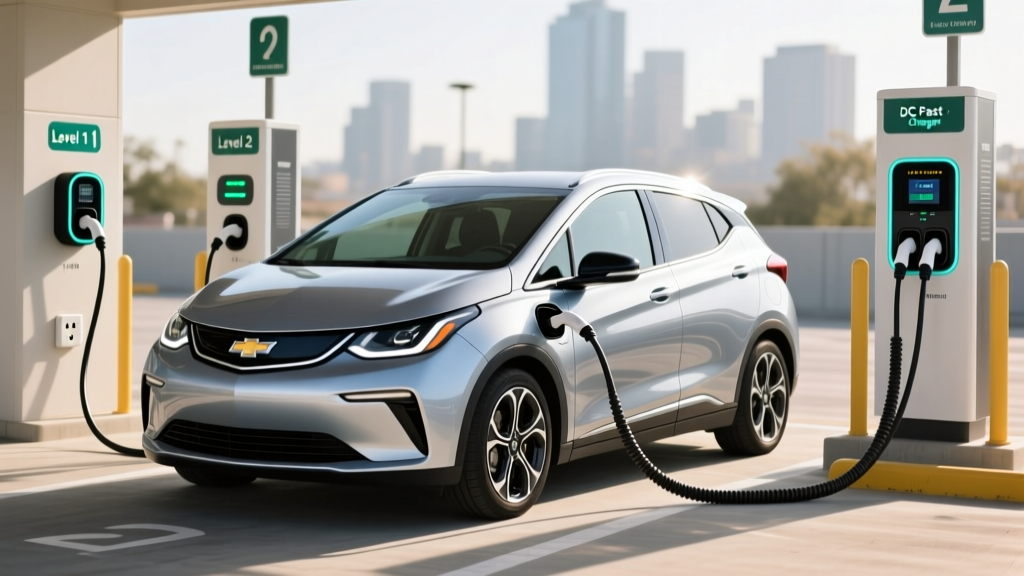
EV charging falls into three tiers. Each delivers power at a different rate, and the Bolt's onboard hardware determines how fast it can accept that power. Here's the full breakdown:
| Level | Power Source | Max kW to Bolt | Miles of Range Added Per Hour | 0–100% Time (65 kWh) | 10–80% Time |
|---|---|---|---|---|---|
| Level 1 | 120V household outlet | ~1.2 kW | ~4 mi/hr | ~54 hours | N/A (impractical) |
| Level 2 | 240V (home/public) | 11.5 kW (Bolt's onboard limit) | ~39 mi/hr | ~6.5 hours | ~4.5 hours |
| DC Fast Charge | 480V+ public station | 55 kW peak (pre-2024) ~115 kW peak (2026 Ultium est.) | ~180 mi/hr (at peak) | N/A (tapers above 80%) | ~55 min (pre-2024) ~30 min (2026 est.) |
Key insight for pre-2024 Bolt owners: The Bolt EV and EUV's DC fast-charging cap of 55 kW was widely criticized. On a 150 kW or 350 kW Electrify America or EVgo station, the Bolt will only pull 55 kW at peak—and that peak only holds between roughly 10–40% state of charge (SoC). Above 60%, the charge curve tapers significantly, dropping to ~30 kW and then ~15 kW above 80%. A 10–80% session takes roughly 55 minutes, which is slower than competitors like the Hyundai Ioniq 5 (18 min) or Tesla Model 3 (~25 min).
2026 Ultium Bolt update: GM has confirmed the Ultium-platform Bolt will support significantly faster DC charging, estimated at 115 kW or higher. This would cut 10–80% time to approximately 30 minutes, bringing it in line with segment expectations. These figures remain preliminary until EPA certification and independent testing confirm them.
The Charge Curve Reality
Manufacturers advertise "peak" kW, but no EV sustains peak rate for an entire session. The Bolt's DC fast-charging curve looks roughly like this:
- 10–40% SoC: ~50–55 kW (peak window)
- 40–60% SoC: ~40–45 kW (first taper)
- 60–80% SoC: ~25–30 kW (significant taper)
- 80–100% SoC: ~10–15 kW (trickle — avoid DC fast charging above 80%)
This is why you'll see 10–80% quoted as the standard fast-charging benchmark. Charging from 80–100% on DC fast can take as long as the 10–80% portion due to the taper. For daily driving, charge to 80% on DC fast and finish the last 20% at home on Level 2.
Home Charger Installation: Costs and Electrical Requirements
The sweet spot for Bolt ownership is Level 2 home charging. At 11.5 kW, the Bolt can accept the full output of a 48-amp dedicated circuit, refilling from near-empty to full overnight. But installation costs vary enormously depending on your home's electrical panel.
Electrical Requirements for Bolt Level 2 Charging
- Voltage: 240V (same as a dryer or oven circuit)
- Amperage: 48-amp charger requires a 60-amp dedicated breaker (National Electrical Code requires circuits to be rated at 125% of continuous load)
- Wire gauge: 6 AWG copper (or 4 AWG aluminum) for a 60-amp circuit
- Outlet type: NEMA 14-50 (if using a plug-in charger) or hardwired connection
- Panel capacity: Minimum 100-amp service; 200-amp strongly recommended
Installation Cost Breakdown
| Component | Low End | High End | Notes |
|---|---|---|---|
| Level 2 charger (hardware) | $350 | $700 | 40A–48A smart charger, 25-ft cable |
| Electrician labor (run + install) | $400 | $1,800 | Depends on distance from panel to garage/driveway |
| Permit and inspection | $50 | $300 | Varies by municipality; some waive EV permits |
| Panel upgrade (if needed) | $1,500 | $3,500 | 100A → 200A upgrade; not always required |
| Additional materials (conduit, wire) | $100 | $500 | Longer runs = more wire and conduit |
| TOTAL (no panel upgrade) | $900 | $3,300 | Most homes with 200A panels |
| TOTAL (with panel upgrade) | $2,400 | $6,800 | Older homes with 100A service |
Utility rebates can offset $200–$1,000 of these costs depending on your provider. Check with your local utility before scheduling work—some require pre-approval to qualify. The federal Residential Clean Energy Credit (25C) covers 30% of charger hardware and installation costs up to $1,000, subject to eligibility and annual caps. Verify current-year rules on IRS.gov or with a tax professional.
Which Connector and Charger Works with the Bolt?
Connector compatibility has become more complex since Tesla opened its Supercharger network to non-Tesla EVs. Here's where the Bolt stands:
| Connector Standard | Bolt EV/EUV (Pre-2024) | Bolt EV (2026 Ultium) | Notes |
|---|---|---|---|
| CCS1 (Combo) | ✅ Native port | ⚠️ Varies by trim/market | Standard on all pre-2024 Bolts; most public DC fast chargers |
| NACS (Tesla/J3400) | ❌ Adapter required | ✅ Expected native | GM began transitioning to NACS in 2025; adapter needed for older Bolts at Superchargers |
| CHAdeMO | ❌ Not compatible | ❌ Not compatible | Legacy standard; largely retired in the US |
| J1772 (Level 1/2) | ✅ Native port | ✅ Native or NACS with adapter | Standard for all AC Level 1 and Level 2 charging |
For pre-2024 Bolt owners wanting Supercharger access: GM provides a Tesla-approved NACS adapter (or one can be purchased for ~$200–$300 from authorized dealers). This allows DC fast charging at Tesla Supercharger stalls equipped with the Magic Dock or via the adapter cable. Confirm adapter availability for your specific model year on Chevrolet's EV page.
For 2026 Ultium Bolt buyers: GM has adopted NACS as its standard charging port across the Ultium lineup. Your Bolt will natively plug into Tesla Superchargers and NACS-equipped public stations. For CCS1 stations that haven't retrofitted, a CCS-to-NACS adapter may be needed—GM has indicated one will be included or available at purchase.
Charging Cost Per Mile: Bolt vs. Gas Car
The financial case for the Bolt hinges on how much you pay per mile to "fuel" it. Electricity prices vary by region, time of day, and charging location. Here are realistic scenarios for a Bolt EV averaging 3.5 miles per kWh (roughly 115 MPGe combined, per fueleconomy.gov):
| Scenario | Cost per kWh | Cost per Mile (Bolt) | Equivalent Gas Car (30 MPG @ $3.50/gal) |
|---|---|---|---|
| Home charging (off-peak utility rate) | $0.09/kWh | $0.026/mi | $0.117/mi |
| Home charging (national avg. residential) | $0.16/kWh | $0.046/mi | $0.117/mi |
| Public Level 2 (ChargePoint, EVgo L2) | $0.30/kWh | $0.086/mi | $0.117/mi |
| DC Fast Charge (Electrify America, EVgo) | $0.48/kWh | $0.137/mi | $0.117/mi |
The takeaway: At home on off-peak rates, the Bolt costs roughly 78% less per mile than a 30 MPG gas car. Even at the national residential average, you save about 60%. However, if you rely exclusively on DC fast charging at public rates above $0.45/kWh, your cost per mile can actually exceed a gas car. This is why home charging access is the single biggest economic factor in EV ownership.
For a driver covering 12,000 miles per year, home charging at $0.12/kWh yields an annual fuel cost of roughly $412—compared to $1,400 for a 30 MPG gas car at $3.50/gallon. That's nearly $1,000 in annual savings before any maintenance differences (no oil changes, fewer brake replacements due to regenerative braking).
Recommended Home Chargers for the Chevrolet Bolt
Because the Bolt accepts up to 11.5 kW on Level 2, you want a charger rated at 48 amps on a 60-amp circuit to unlock its full charging speed. Here are three proven options:
Emporia Vue Level 2 Charger
- Power output: 48 amps / 11.5 kW (240V)
- Connector: J1772 (NACS version available)
- Cable length: 24 feet
- Smart features: Wi-Fi, app scheduling, solar integration, energy monitoring
- Price: ~$399
- Why for Bolt: Budget-friendly 48A option with excellent energy tracking; maxes out the Bolt's onboard charger
ChargePoint Home Flex
- Power output: Up to 50 amps / 12 kW (configurable 16A–50A)
- Connector: J1772 (NACS adapter available)
- Cable length: 23 feet
- Smart features: Wi-Fi, app scheduling, Alexa integration, flexible amperage for older panels
- Price: ~$549
- Why for Bolt: Adjustable amperage means you can dial it to 40A on a 50-amp circuit if your panel is tight—still delivers ~9.6 kW to the Bolt
Tesla Wall Connector (Universal / J1772 variant)
- Power output: 48 amps / 11.5 kW (240V, 60A circuit)
- Connector: NACS native; J1772 adapter included in universal version
- Cable length: 24 feet
- Smart features: Wi-Fi, firmware updates, power sharing (two units on one circuit), load management
- Price: ~$475 (Universal Wall Connector)
- Why for Bolt: Premium build quality; the Universal version includes a J1772 adapter for pre-2024 Bolts, or plug directly into the 2026 NACS-native Bolt
All three chargers are NEMA 4-rated for outdoor installation and UL-listed for safety. Choose a hardwired installation over a NEMA 14-50 plug if your charger location is permanent—hardwired connections are more reliable and eliminate the GFCI breaker compatibility issues that some plug-in setups encounter.
Safety, Permits, and Code Requirements
EV charging is a high-draw, continuous electrical load. Cutting corners here is a fire risk. Here's what proper installation requires:
- Dedicated circuit: Your EV charger must have its own breaker—no sharing with other appliances.
- GFCI protection: NEC 2023 and later require GFCI protection for EV charging outlets. Hardwired chargers typically handle GFCI internally, which avoids nuisance tripping that some breaker-level GFCIs cause.
- Outdoor rating: If your charger is mounted outside or in an unsealed garage, it must be rated NEMA 4 (weatherproof). All three chargers recommended above meet this standard.
- Permit and inspection: Most jurisdictions require an electrical permit for a new 240V circuit. The inspection ensures wire gauge, breaker sizing, and grounding meet code. Skipping the permit can void your homeowner's insurance in the event of an electrical fire.
- Load calculation: A licensed electrician will calculate your home's total electrical load before adding a 60-amp circuit. This is not optional—it's a code requirement and a safety necessity.
Always hire a licensed electrician experienced with EV charger installations. Ask for their load calculation in writing before work begins, and confirm they'll pull the required permit.
Frequently Asked Questions
How much does it cost to install a home EV charger for my Chevrolet Bolt?
Most homeowners spend between $900 and $3,300 for a complete Level 2 installation (charger, electrician labor, permit, and materials) if no panel upgrade is needed. Homes with older 100-amp electrical panels may need a $1,500–$3,500 panel upgrade, pushing total cost to $2,400–$6,800. Utility rebates and the federal 25C credit (30% up to $1,000) can reduce your out-of-pocket expense.
How fast will each charging level add range to the Bolt?
Level 1 (120V) adds about 4 miles of range per hour—barely enough for overnight top-ups. Level 2 (240V at 11.5 kW) adds roughly 39 miles per hour, fully recharging a depleted 65 kWh battery in about 6.5 hours. DC fast charging adds up to 180 miles per hour at peak (55 kW on pre-2024 models), but the charge curve tapers significantly above 60% SoC.
Which connector and charger is compatible with my Bolt?
Pre-2024 Bolt EV and EUV models use a CCS1 port for DC fast charging and a J1772 port for Level 1/Level 2 AC charging. A NACS adapter is available for Tesla Supercharger access. The 2026 Ultium-based Bolt is expected to ship with a native NACS port, with a CCS adapter available for older public stations.
How much does charging a Bolt cost per mile compared to gas?
At the national residential average of $0.16/kWh, the Bolt costs about $0.046 per mile to charge at home—roughly 60% less than a 30 MPG gas car at $3.50/gallon ($0.117/mi). Off-peak utility rates can drop that to $0.026/mi. However, DC fast charging at $0.48/kWh costs $0.137/mi, which exceeds gas costs. Home charging access is essential to realizing EV savings.
What electrical upgrades might I need for a Bolt home charger?
You'll need a dedicated 60-amp, 240V circuit with 6 AWG copper wire. If your home has a 200-amp electrical panel with available capacity, the upgrade is straightforward. Homes with 100-amp panels—common in pre-1990 construction—may require a panel upgrade to 200 amps, adding $1,500–$3,500. A licensed electrician will perform a load calculation to determine your specific needs.
Can I use a Tesla Supercharger with my Chevrolet Bolt?
Pre-2024 Bolt owners can access Tesla Superchargers using a GM-approved NACS adapter (approximately $200–$300). The 2026 Ultium Bolt is expected to include a native NACS port, enabling direct Supercharger access without an adapter. Always check Chevrolet.com or the myChevrolet app for adapter availability and Supercharger network compatibility updates.