Why Charging Electric Trucks Is a Different Challenge
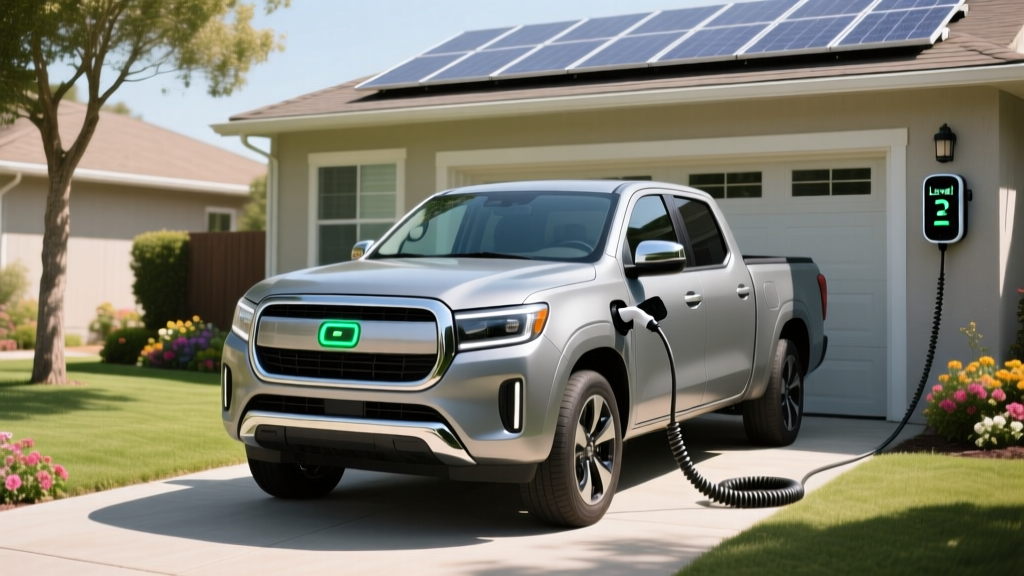
Electric pickups pack some of the largest battery packs on the road. The Ford F-150 Lightning carries a 131 kWh extended-range pack; the Chevrolet Silverado EV 4WT tops out at a massive 200+ kWh; the Rivian R1T Dual-Motor Max uses a 141 kWh pack. When you're charging trucks with batteries this large, the standard advice that works for a compact EV simply doesn't scale. A Level 1 outlet that overnight-charges a commuter hatchback will leave a full-size electric truck barely topped up after 12 hours.
This guide breaks down exactly what it takes to charge an electric truck at home, what you'll pay at public stations, which connectors you need, and what electrical upgrades your garage might demand — with hard numbers for the trucks you can actually buy in 2026.
Charging Levels Explained: Speeds That Matter for Large Truck Batteries
Understanding charging speed starts with the difference between kW (kilowatts — the rate of power delivery, like water pressure from a hose) and kWh (kilowatt-hours — the total energy stored in your battery, like the size of the tank). When charging trucks, you care about kW because it determines how long you're plugged in, and kWh because your truck's battery is enormous.
| Level | Voltage / Amperage | Power (kW) | Miles of Range Added per Hour | 10–80% Time (131 kWh Pack)* |
|---|---|---|---|---|
| Level 1 (120V household) | 120V / 12A | ~1.4 kW | ~2–3 mi/hr | ~65+ hours |
| Level 2 (240V home) | 240V / 48A | ~11.5 kW | ~18–24 mi/hr | ~8 hours |
| Level 2 (240V high-power) | 240V / 80A | ~19.2 kW | ~30–38 mi/hr | ~5 hours |
| DC Fast Charging | 400V–800V DC | 150–350 kW peak | ~150–300+ mi/hr (peak) | ~20–45 min (varies) |
*Estimated based on an F-150 Lightning Extended Range (131 kWh usable). Actual times vary by state of charge, battery temperature, and charge curve taper above 80%.
The takeaway for anyone charging trucks at home: Level 1 is impractical for daily use unless your daily drive is under 20 miles and you can plug in for 10+ hours nightly. A properly installed Level 2 station is essentially mandatory. DC fast charging is your road-trip lifeline but is not designed for daily use — frequent DC fast charging accelerates battery degradation and costs significantly more per kWh than home power.
Home Charger Installation: Electrical Requirements and Real Costs
Most electric truck owners need a 240V Level 2 charger on a dedicated circuit. Here's what that actually involves and what you'll spend.
Electrical Requirements
A standard high-output Level 2 charger for a truck requires a 240V, 60-amp dedicated circuit (delivering up to 48 amps continuous to the vehicle, per the 80% NEC rule for continuous loads). If you opt for an 80A charger like the Ford Charge Station Pro — important for the F-150 Lightning's onboard dual-charger capability — you'll need a 100-amp dedicated circuit.
Your home's electrical panel is the bottleneck. Most homes built before 2010 have 100-amp or 150-amp main service panels. Adding a 60A or 100A circuit to an already-loaded panel may require a panel upgrade to 200A service, which is one of the most expensive line items in EV charger installation.
Installation Cost Breakdown
| Component | Basic Install (48A, panel has capacity) | Complex Install (80A or panel upgrade needed) |
|---|---|---|
| Level 2 charger equipment | $400–$750 | $600–$1,300 |
| Electrician labor (2–6 hrs) | $500–$1,200 | $1,500–$3,500 |
| Electrical permit | $50–$200 | $50–$300 |
| Panel upgrade (if needed) | N/A | $1,500–$4,000 |
| Conduit, wiring, misc. | $100–$400 | $300–$800 |
| Total estimated cost | $1,050–$2,550 | $3,950–$9,900 |
These figures assume a licensed electrician pulls permits and the work meets NEC Article 625 (EV charging system requirements). Always get at least two quotes and confirm your electrician has specific EV charger installation experience — the wiring gauge, breaker sizing, and GFCI requirements are specific and mistakes can create fire hazards.
The IRS §30D tax credit does not cover home charger equipment directly under current rules (the former §30C alternative fuel infrastructure credit expired for most residential installations), though some states and utilities offer rebates. Check your local utility — many offer $250–$500 rebates for Level 2 installations or off-peak rate plans that significantly cut charging costs.
Connector Compatibility: NACS, CCS, and What Your Truck Needs
The connector landscape has consolidated significantly by 2026, but it still matters when you're charging trucks from different manufacturers or using public networks.
| Truck | Native Connector | Tesla Supercharger Access | CCS Network Access | Adapter Needed? |
|---|---|---|---|---|
| Ford F-150 Lightning | CCS1 (2022–2024); NACS (2025+) | Yes (native NACS on 2025+, adapter for earlier) | Yes (native on pre-2025, adapter for 2025+) | Depends on model year |
| Chevrolet Silverado EV | CCS1 (2024); NACS (2025+) | Yes (adapter or native) | Yes (native on 2024) | Depends on model year |
| Rivian R1T | NACS | Yes (native) | Yes (with NACS-to-CCS adapter) | CCS adapter for non-Tesla DCFC |
| Tesla Cybertruck | NACS | Yes (native) | Yes (with NACS-to-CCS adapter) | CCS adapter included |
As of 2026, the NACS (North American Charging Standard) connector — originally Tesla's proprietary design — has been adopted by Ford, GM, Rivian, and most major automakers. If you're buying a new electric truck today, it likely ships with NACS or has a manufacturer-supplied CCS-to-NACS adapter. The critical thing to verify: which DC fast-charging networks near you support your truck's connector. Tesla Superchargers now accept non-Tesla NACS vehicles at many locations, but not all. Electrify America and EVgo have added NACS cables at new stations, but legacy CCS-only stalls remain common.
For home Level 2 charging, the connector is less of an issue — J1772 (the legacy standard) and NACS both work with widely available adapters, and most new home chargers ship with NACS or offer it as an option.
Cost to Charge Electric Trucks: Per-Mile Comparison vs. Gas
The economics of charging trucks depend heavily on where and when you plug in. Large truck batteries make the per-kWh price especially impactful.
| Scenario | Price per kWh | Cost per Mile | Full 0–100% Cost (131 kWh) |
|---|---|---|---|
| Home, off-peak utility rate | $0.08–$0.13 | $0.16–$0.26 | $10.50–$17.00 |
| Home, standard residential rate | $0.14–$0.20 | $0.28–$0.40 | $18.35–$26.20 |
| Public Level 2 (workplace, shopping) | $0.20–$0.35 | $0.40–$0.70 | $26.20–$45.85 |
| DC Fast Charging (Electrify America, EVgo) | $0.35–$0.55 | $0.70–$1.10 | $45.85–$72.05 |
Gas truck comparison: A 2026 Ford F-150 with the 3.5L EcoBoost averaging 20 MPG combined at $3.40/gallon costs $0.17 per mile in fuel. This means home off-peak charging matches or beats gas on per-mile cost, but exclusive reliance on DC fast charging can actually cost more than gasoline per mile.
The economic case for an electric truck hinges on home charging. If you cannot install a Level 2 charger at home, the cost advantage erodes substantially. According to fueleconomy.gov, electric trucks achieve between 66 and 77 MPGe combined depending on the model and configuration — but MPGe is an efficiency comparison metric, not a cost metric. Your actual cost depends entirely on your local electricity rate.
DC Fast Charging Reality: Charge Curves and 10–80% Times
When charging trucks on road trips, the peak kW number on the spec sheet tells only part of the story. Battery temperature, state of charge, and the charge curve taper all determine how long you actually sit at a station.
Here's what to expect at a DC fast charger for popular electric trucks:
- Ford F-150 Lightning Extended Range (131 kWh): Peaks at ~150 kW on a 350 kW-capable CCS/NACS station. The 10–80% charge takes approximately 38–42 minutes. The charge rate tapers significantly above 80% — going from 80% to 100% can add another 30+ minutes. On a 400V architecture, sustained rates average closer to 100–110 kW over the full 10–80% session.
- Chevrolet Silverado EV (200+ kWh pack, Ultium platform): GM's Ultium architecture supports up to 350 kW peak on compatible stations, though sustained rates are lower. Expect 10–80% in roughly 45 minutes on an optimal 350 kW stall, longer on 150 kW stations. The enormous battery means even at high kW, the session is long.
- Rivian R1T Max Pack (141 kWh): Rivian's NACS-equipped R1T can access Tesla V4 Superchargers (up to 250 kW) and third-party CCS stations with an adapter. 10–80% takes approximately 28–35 minutes depending on station output and battery preconditioning.
- Tesla Cybertruck (123 kWh): On Tesla V4 Superchargers, the Cybertruck peaks around 250 kW with preconditioning. 10–80% in approximately 25–30 minutes under optimal conditions.
Preconditioning matters. If your truck's navigation is set to a charging station, the thermal management system will warm or cool the battery to the optimal temperature for fast charging before you arrive. Skipping preconditioning — for instance, driving to a charger without routing through the nav — can add 5–10 minutes to your session as the battery reaches optimal temperature at the station.
According to NHTSA safety data and manufacturer testing, DC fast charging within normal operating parameters does not create safety concerns, but habitual use of DC fast charging (daily or multiple times per week) can accelerate long-term battery capacity loss by 2–5% over the battery's lifetime compared to predominantly Level 2 charging.
Recommended Home Chargers for Electric Trucks
Not all Level 2 chargers are equal. When charging trucks with large batteries, you want maximum power output, a long cable, and reliable smart features. Here are top picks for 2026:
ChargePoint Home Flex (NACS)
- Power: Up to 11.5 kW (48A on 60A circuit)
- Connector: NACS (also available in J1772)
- Cable length: 23 ft
- Smart features: Wi-Fi, app scheduling, utility demand-response integration, Alexa
- Price: ~$550–$650
- Best for: Most truck owners who don't need 80A. Reliable, well-supported app, UL-listed.
Ford Charge Station Pro
- Power: Up to 19.2 kW (80A on 100A circuit)
- Connector: NACS (2025+ models)
- Cable length: 25 ft
- Smart features: FordPass integration, Intelligent Backup Power (V2H with Home Integration System)
- Price: ~$1,100–$1,300 (charger only; Home Integration System additional ~$3,900 installed)
- Best for: F-150 Lightning Extended Range owners who want fastest possible home charging and backup power capability.
Wallbox Pulsar Max
- Power: Up to 11.5 kW (48A on 60A circuit)
- Connector: NACS or J1772
- Cable length: 20 ft
- Smart features: Wi-Fi + Bluetooth, app scheduling, load balancing, Power Sharing (daisy-chain two units)
- Price: ~$450–$550
- Best for: Budget-conscious truck owners with two EVs (Power Sharing splits one circuit between two chargers).
For any of these chargers, confirm the NACS connector matches your truck. If you drive a pre-2025 CCS-equipped truck, either choose a J1772/CCS charger or ensure you have a reliable adapter. For the Ford Charge Station Pro's 80A output, your electrician must confirm your panel can support a 100A dedicated circuit — this is where panel upgrades become common.
Safety, Code Compliance, and Installation Best Practices
EV charger installation falls under NEC Article 625 and your local building code. Key requirements when charging trucks at home:
- Dedicated circuit: Your Level 2 charger must be on its own dedicated breaker — no sharing with other outlets or appliances.
- GFCI protection: The 2023 NEC update requires GFCI protection for EV charging outlets (not hardwired units). Hardwiring your charger avoids the GFCI breaker requirement and reduces nuisance trips, which is why most professional installers recommend hardwired over plug-in (NEMA 14-50 outlet) installations.
- Outdoor rating: If your charger is mounted outside or in an open carport, it must carry a NEMA 4 or IP55+ weather rating. All three chargers recommended above meet this standard.
- Cable management: With a 23–25 ft cable on a truck parked in a driveway, plan cable routing to avoid trip hazards. Wall-mounted cable organizers or retractors ($30–$60) are a practical add.
- Permit and inspection: Most jurisdictions require an electrical permit and post-installation inspection. Skipping this can void your homeowner's insurance coverage for electrical fires. Budget $50–$300 for the permit depending on your locality.
Frequently Asked Questions
How much does it cost to install a home EV charger for a truck?
A straightforward Level 2 installation on an existing 200A panel with a 60A circuit runs $1,050–$2,550 including equipment, electrician labor, and permit. If your panel needs upgrading from 100A or 150A to 200A service, total costs range from $3,950 to $9,900. The panel upgrade is the single biggest variable.
How fast will each charging level add range to my electric truck?
Level 1 (120V) adds roughly 2–3 miles of range per hour — essentially useless for a truck with a 130+ kWh battery. Level 2 at 48A adds 18–24 miles per hour, enough to fully recharge overnight for most daily driving. Level 2 at 80A adds 30–38 miles per hour. DC fast charging adds 150–300+ miles per hour at peak but tapers significantly after 80% SoC.
Which connector is compatible with my electric truck?
Most 2025–2026 electric trucks use the NACS connector natively (Ford, GM, Rivian, Tesla). Pre-2025 Ford and GM trucks use CCS1. Rivian switched to NACS for 2025+. Check your truck's model year and verify with the manufacturer. For home Level 2, most chargers now offer NACS; for public DC fast charging, confirm network compatibility before your trip.
How much does charging an electric truck cost per mile versus gas?
At home on off-peak rates ($0.08–$0.13/kWh), an F-150 Lightning costs $0.16–$0.26 per mile — comparable to or cheaper than a gas F-150 at $0.17/mi (20 MPG, $3.40/gal). On DC fast charging at $0.35–$0.55/kWh, cost jumps to $0.70–$1.10 per mile, making it more expensive than gas. Home charging is where the savings live.
What electrical upgrades might I need before installing a truck charger?
The most common upgrade is a panel upgrade from 100A or 150A to 200A service, costing $1,500–$4,000. Homes with older wiring (aluminum branch circuits, knob-and-tube, or ungrounded outlets) may need additional remediation. If you want the Ford Charge Station Pro at 19.2 kW, you need a 100A dedicated circuit, which almost certainly requires a 200A+ panel. Have an electrician perform a load calculation before committing to a charger.