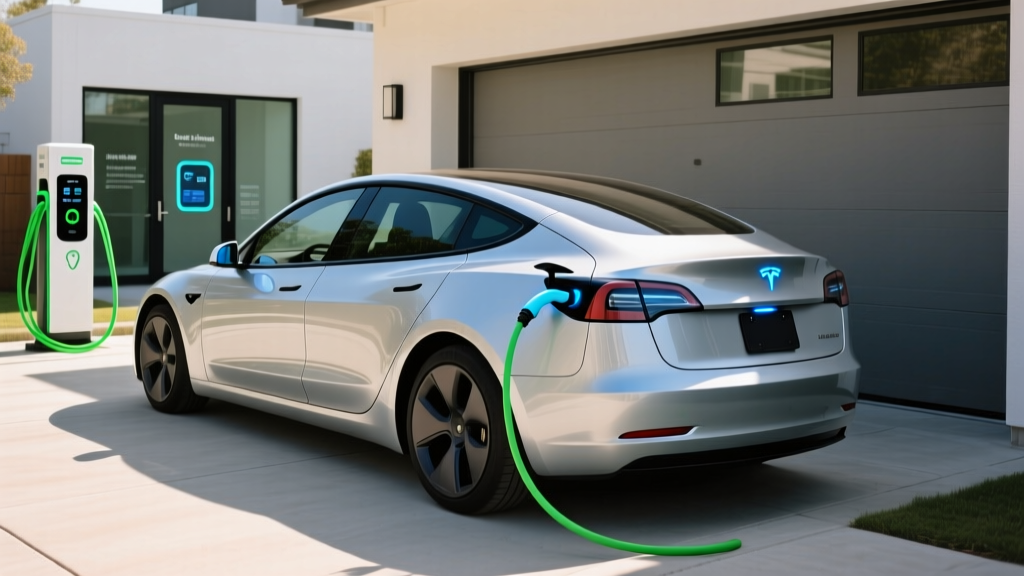
If you own or are shopping for a Tesla Model 3, understanding the real charging time across every method — from a standard wall outlet to a 250 kW Supercharger — is the single most practical ownership skill you can develop. The EPA rates the 2025 Model 3 Long Range AWD at 341 miles of range with a ~75 kWh usable battery (LFP chemistry on the RWD trim, NMC on Long Range/Performance). But how long it actually takes to replenish that battery depends entirely on the power source you plug into.
This guide breaks down every charging scenario with exact numbers: kilowatts (kW, the rate of power flow), kilowatt-hours (kWh, the energy stored in the battery), real-world 10–80% times, home installation costs, and per-mile fuel cost versus gasoline. No marketing fluff — just the data you need to plan your driving and your budget.
Charging Levels Explained: How Fast Each Adds Range to Your Model 3
EV charging falls into three tiers. The critical distinction: kW measures power (how fast energy flows into the car), while kWh measures energy (how much the battery holds). Think of kW as the width of a hose and kWh as the size of the bucket. A Model 3 Long Range holds roughly 75 kWh usable; a Model 3 RWD with LFP chemistry holds about 57.5 kWh usable.
| Level | Voltage / Amps | Max Power (kW) | Miles of Range Added per Hour | Typical Use Case |
|---|---|---|---|---|
| Level 1 (120V) | 120V / 12A | ~1.4 kW | ~3–5 mi/hr | Overnight trickle, emergencies |
| Level 2 (240V) | 240V / 32–48A | 7.7–11.5 kW | ~25–44 mi/hr | Home daily charging, workplaces |
| DC Fast Charging | 400V+ architecture | Up to 250 kW (V3 Supercharger) | ~170 mi in 15 min (peak) | Road trips, rapid top-ups |
Exact Charging Time for Tesla Model 3: 10–80% and Full Charge Scenarios
Tesla's onboard charger accepts up to 11.5 kW on Level 2 AC power (48A at 240V). On DC fast charging, the Model 3 Long Range and Performance can peak at 250 kW at a V3 Supercharger, though the RWD (LFP) trim peaks closer to 170 kW. Remember that DC fast charging follows a charge curve — peak power is only sustained at low state of charge (SoC), tapering significantly above 80% to protect battery health.
| Charging Method | Model 3 RWD (57.5 kWh, LFP) | Model 3 LR AWD (75 kWh, NMC) |
|---|---|---|
| Level 1 (120V, 1.4 kW) | ~29 hours (full 0–100%) | ~38 hours (full 0–100%) |
| Level 2 (240V, 11.5 kW / 48A) | ~5 hours (0–100%) | ~6.5 hours (0–100%) |
| Level 2 (240V, 7.7 kW / 32A) | ~7 hours (0–100%) | ~9.5 hours (0–100%) |
| DC Fast — V3 Supercharger (250 kW peak) | ~25 min (10–80%) | ~22 min (10–80%) |
| DC Fast — 150 kW station | ~32 min (10–80%) | ~30 min (10–80%) |
| DC Fast — 50 kW CHAdeMO (w/ adapter) | ~60 min (10–80%) | ~75 min (10–80%) |
For daily driving, most Model 3 owners charge at home on Level 2 overnight, adding 200–300 miles in a typical 8-hour sleep window — more than enough for a 40-mile round-trip commute with margin to spare. DC fast charging is best reserved for road trips; frequent use accelerates battery degradation slightly due to sustained high thermal loads.
How Much Does It Cost to Install a Home EV Charger for Your Model 3?
A Level 2 home charger is the single highest-impact upgrade for EV ownership. Installation cost varies enormously based on your electrical panel's capacity, the distance from panel to charger location, and local permit fees. Here's the realistic breakdown:
| Component | Low Estimate | High Estimate | Notes |
|---|---|---|---|
| Level 2 Charger Hardware | $350 | $700 | Tesla Wall Connector, ChargePoint, Emporia, etc. |
| Electrician Labor (240V/50A circuit) | $500 | $1,500 | Depends on run length from panel to garage/driveway |
| Electrical Permit | $50 | $300 | Varies by municipality |
| Panel Upgrade (if needed) | $1,500 | $4,000+ | Required if panel is 100A or near capacity; upgrade to 200A |
| Total (no panel upgrade) | $900 | $2,500 | Most homes with 200A service |
| Total (with panel upgrade) | $2,400 | $6,500+ | Older homes with 100A or 125A panels |
What Electrical Upgrades Might You Need?
A Level 2 charger delivering 11.5 kW requires a dedicated 240V/60A circuit (the charger draws a continuous 48A; electrical code requires circuits rated at 125% of continuous load, so 48A × 1.25 = 60A). If you opt for a 32A charger (7.7 kW), a 40A circuit suffices.
The panel-upgrade question is the biggest cost wildcard. If your home has a 200-amp main panel with available breaker slots and spare capacity, the installation is straightforward. Homes with 100A service — common in builds before the 1990s — will likely need a panel upgrade to 200A before adding a 60A EV circuit. A licensed electrician should perform a load calculation per NEC Article 220 before quoting the job. Never skip the permit; unpermitted electrical work voids insurance coverage and creates fire risk.
Safety requirements to confirm with your electrician:
- Dedicated circuit — the EV charger must not share a breaker with other appliances
- GFCI protection — required by NEC 2020+ for outdoor receptacles and recommended for indoor EV circuits
- NEMA 14-50 receptacle (if using a plug-in charger) or hardwired connection (Tesla Wall Connector is hardwired)
- Outdoor-rated enclosure and conduit if the charger is mounted outside
- Proper wire gauge: 6 AWG copper for a 60A circuit, 8 AWG for a 40A circuit
Connector Compatibility: NACS, CCS, and CHAdeMO for Tesla Model 3
The Tesla Model 3 uses the North American Charging Standard (NACS) connector natively — Tesla's proprietary design that has been adopted by Ford, GM, Rivian, Volvo, and most major automakers as the North American standard going forward. This gives Model 3 owners the broadest charging network access in the US.
| Connector Type | Native on Model 3? | Adapter Needed? | Network Access |
|---|---|---|---|
| NACS (Tesla) | Yes — native | No | Tesla Superchargers (17,000+ V3/V4 stalls in North America), Tesla Destination Chargers |
| CCS1 | No | Tesla CCS Adapter (~$175) or third-party | Electrify America, EVgo, ChargePoint DC stations |
| CHAdeMO | No | Setec CHAdeMO-to-Tesla adapter (~$250+) | Limited; mostly legacy Nissan Leaf infrastructure |
| J1772 (Level 2 AC) | No | Tesla J1772 adapter (included with car) | Public Level 2 stations, non-Tesla workplace chargers |
The Tesla CCS adapter is worth purchasing if you travel in areas where Electrify America or EVgo stations outnumber Superchargers. According to the Tesla CCS adapter support page, it supports up to 150 kW on CCS stations. For most owners, the native NACS connector plus the included J1772 adapter covers 95%+ of charging scenarios.
How Much Does Charging a Tesla Model 3 Cost Per Mile vs. Gas?
Charging cost depends entirely on your electricity rate, which varies by location, time of day, and whether you're at home or on a public network. The Model 3 Long Range AWD achieves roughly 25 kWh/100 mi (or ~4 mi/kWh) in mixed driving according to fueleconomy.gov.
| Charging/Fuel Scenario | Rate | Cost Per Mile (Model 3 LR) | Cost Per Mile (30 MPG Gas Sedan at $3.50/gal) |
|---|---|---|---|
| Home — off-peak utility rate | $0.10/kWh | $0.025 | $0.117 |
| Home — average US residential | $0.17/kWh | $0.043 | $0.117 |
| Home — peak/TOU high rate | $0.30/kWh | $0.075 | $0.117 |
| Public Level 2 (ChargePoint, etc.) | $0.25–$0.49/kWh | $0.063–$0.123 | $0.117 |
| Tesla Supercharger (average US) | $0.30–$0.45/kWh | $0.075–$0.113 | $0.117 |
| Electrify America DC Fast | $0.43–$0.56/kWh | $0.108–$0.140 | $0.117 |
Best Level 2 Chargers for Tesla Model 3: Equipment Picks for 2025–2026
Since the Model 3 uses NACS natively, you want a charger with a built-in NACS plug to avoid adapter hassle. Here are the top picks based on power output, build quality, smart features, and price:
Tesla Wall Connector (Best Overall)
- Power: Up to 11.5 kW (48A at 240V)
- Connector: NACS (native Tesla plug)
- Cable Length: 24 ft
- Smart Features: Wi-Fi, OTA updates, power-sharing between two units, Tesla app integration
- Price: ~$425
- Best For: Tesla-only households; cleanest integration with the car's app and scheduling
Emporia Vue Level 2 Charger (Best Value)
- Power: Up to 11.5 kW (48A at 240V)
- Connector: NACS (2025+ model) or J1772 with adapter
- Cable Length: 24 ft
- Smart Features: Wi-Fi, scheduling, energy monitoring, solar integration, load management
- Price: ~$399
- Best For: Budget-conscious buyers who want smart load management and solar pairing
ChargePoint Home Flex (Most Versatile)
- Power: Up to 12 kW (50A at 240V) — adjustable via DIP switches
- Connector: NACS (2025+ models) or J1772 with Tesla adapter
- Cable Length: 23 ft
- Smart Features: Wi-Fi, Alexa, ChargePoint app, detailed session history, flexible amperage
- Price: ~$599
- Best For: Multi-EV households (non-Tesla + Tesla); adjustable amperage suits older panels
Grizzl-E Smart (Most Rugged)
- Power: Up to 10 kW (40A at 240V)
- Connector: NACS or J1772 (select at purchase)
- Cable Length: 24 ft
- Smart Features: Wi-Fi, OCPP-compatible, adjustable 16–40A
- Price: ~$449
- Best For: Outdoor installations in extreme climates; IP67 rated, built in Canada
For most Model 3 owners, the Tesla Wall Connector at $425 is the obvious default — native plug, full 11.5 kW, and seamless app integration. If you have solar panels and want to charge only on excess solar production, the Emporia Vue offers that feature natively.
DC Fast Charging on the Road: Supercharger Network Realities
Tesla's Supercharger network remains the most reliable public DC fast-charging ecosystem in North America, with over 17,000 V3 (250 kW) and growing V4 stalls. Here's what to expect at a Supercharger stop with a Model 3:
- Preconditioning: When you navigate to a Supercharger in the Tesla navigation system, the car automatically preconditions (warms) the battery to optimize charge speed. This is critical in cold weather — without preconditioning, a cold battery may accept only 50–80 kW instead of the 250 kW peak, adding 10–15 minutes to your stop.
- Charge curve taper: The Model 3 LR peaks near 250 kW between 10–20% SoC, then steps down progressively: ~180 kW at 30%, ~120 kW at 50%, ~60 kW at 70%, and ~25 kW above 85%. This is why 10–80% takes ~22 minutes but 80–100% can take an additional 25+ minutes.
- V3 vs. V4 stalls: V3 stalls deliver up to 250 kW. V4 stalls (rolling out 2024–2026) feature a CCS-compatible cable with a NACS adapter built into the cabinet, plus longer cables for easier parking. Both support the Model 3 natively.
- Stall sharing: Unlike older V2 Superchargers, V3 stalls do not share power with adjacent stalls — you get full 250 kW regardless of how many cars are charging.
For non-Tesla DC networks (Electrify America, EVgo), you'll need the Tesla CCS adapter. These stations are improving in reliability, and the NHTSA and federal Joint Office of Energy and Transportation now require 97% uptime for NEET-funded stations, but real-world uptime on older stations still hovers around 85–90% based on driver surveys.
Model 3 Battery Health: Degradation, Warranty, and Charging Best Practices
Tesla warranties the Model 3 battery for 8 years / 100,000 miles (RWD) or 8 years / 120,000 miles (Long Range/Performance), guaranteeing a minimum of 70% capacity retention. Real-world data from Tesla's 2024 Impact Report shows Model 3/Y batteries retain approximately 85% capacity after 200,000 miles.
Charging habits that minimize degradation:
- NMC (Long Range/Performance): Set daily charge limit to 80%. Reserve 100% for road trips. Avoid sustained storage below 20% or above 90%.
- LFP (RWD): Tesla recommends charging to 100% at least once per week for LFP chemistry, as it helps the BMS calibrate. LFP degrades less from high-SoC storage than NMC.
- Minimize DC fast charging frequency: Occasional Supercharging is fine; daily DC fast charging accelerates degradation due to sustained high temperatures.
- Use Scheduled Charging: Set your Wall Connector to finish charging just before you leave — this avoids the battery sitting at high SoC for hours.
Frequently Asked Questions
Can I charge a Tesla Model 3 on a regular 120V household outlet?
Yes, using the Tesla Mobile Connector with the NACS 120V adapter (included with the car). Expect ~1.4 kW and roughly 3–5 miles of range per hour. A full charge from empty would take 30+ hours. This works for low-mileage drivers (under 20 miles/day) or as a backup, but it is not practical as a primary charging method for most owners.
Do I need a Tesla Wall Connector, or will any Level 2 charger work?
Any Level 2 charger with a NACS plug will work directly. Older J1772 chargers work with the included J1772-to-NACS adapter. The Tesla Wall Connector is the most seamless option, but ChargePoint, Emporia, and Grizzl-E all offer NACS-compatible units with comparable performance.
How fast will each charging level add range to my Model 3?
Level 1 (120V) adds 3–5 miles per hour. Level 2 (240V, 48A) adds ~44 miles per hour on the Long Range. DC fast charging at a V3 Supercharger adds up to 170 miles in 15 minutes at peak rate, though the average rate over a full session is lower due to charge curve taper.
Is it cheaper to charge at home or at a Supercharger?
Home charging is almost always cheaper. At the US average residential rate of $0.17/kWh, home charging costs ~$0.043 per mile. Supercharger rates average $0.30–$0.45/kWh, or ~$0.075–$0.113 per mile. The gap widens further if your utility offers off-peak TOU rates below $0.10/kWh.
What happens if my home doesn't have a 240V outlet or a 200A panel?
You'll need an electrician to install a dedicated 240V circuit. If your panel is 100A or near capacity, a panel upgrade to 200A may be required, adding $1,500–$4,000 to the project. Some homeowners opt for a lower-amperage charger (32A / 7.7 kW on a 40A circuit) to avoid a panel upgrade — this still adds ~25 miles per hour, sufficient for most daily needs. The IRS §30D credit does not cover home charger installation for most taxpayers after 2022; however, the separate §30C Alternative Fuel Vehicle Refueling Property Credit may cover up to $1,000 of home charger installation costs if you live in a qualifying census tract. Consult a tax professional for eligibility.
Does cold weather affect Tesla Model 3 charging time?
Significantly. In temperatures below 32°F, a cold-soaked battery may accept DC fast charge rates 40–60% below peak until it warms up. Always use Tesla's built-in navigation to route to a Supercharger — this triggers automatic battery preconditioning, which can cut cold-weather charging time by 10–15 minutes. Range also drops 20–30% in winter due to cabin heating and increased battery resistance.
How much does charging cost per mile vs. gas?
At home on an average US electricity rate ($0.17/kWh), the Model 3 LR costs about $0.043 per mile. A comparable 30 MPG gasoline sedan at $3.50/gallon costs $0.117 per mile — nearly three times more. On public DC fast chargers at premium rates ($0.45–$0.56/kWh), the Model 3 cost rises to $0.11–$0.14 per mile, roughly matching or slightly exceeding the gas car.
Sources: EPA fuel economy data via fueleconomy.gov, Tesla Model 3 specifications via tesla.com, IRS clean vehicle credits via irs.gov. Prices and rates reflect 2025–2026 data; utility rates vary by jurisdiction. Consult a licensed electrician for home installation specifics and a tax professional for credit eligibility.