If you own a Tesla—or are about to buy one—the single most practical question is how long it takes to charge. The answer depends entirely on which charging level you use, the size of your Tesla's battery pack, and whether you're charging at home or on the road. Below, we break down the exact charging time for Tesla vehicles across every scenario you'll encounter, from a standard wall outlet to a 325 kW V4 Supercharger.
We'll also cover what it costs to install a home charger, which equipment we recommend in 2026, and how Tesla charging costs compare to gasoline on a per-mile basis. All figures reflect current 2025–2026 model-year Tesla vehicles (Model 3, Model Y, Model S, Model X, and Cybertruck).
Charging Levels Explained: kW, Miles Per Hour, and What They Mean
Before we get into specific times, let's establish the critical distinction between kW (kilowatts) and kWh (kilowatt-hours). kW measures power—the rate at which energy flows into your car. kWh measures energy—the total capacity of your battery. Think of kW as the width of a hose and kWh as the size of the bucket. A wider hose (more kW) fills the bucket faster.
Tesla vehicles in the current lineup use battery packs ranging from roughly 57.5 kWh (Model 3 Rear-Wheel Drive) to approximately 123 kWh (Cybertruck). The charging time for your Tesla depends on dividing the energy you need to add (kWh) by the power available (kW), adjusted for real-world charging-curve losses.
| Level | Voltage | Power (kW) | Miles of Range Added Per Hour | Best For |
|---|---|---|---|---|
| Level 1 (Standard Outlet) | 120V | 1.0–1.4 kW | 3–5 mi/hr | Overnight topping, emergencies, PHEVs |
| Level 2 (Home/Public AC) | 240V | 7.2–19.2 kW | 25–65 mi/hr | Daily home charging, workplace, destinations |
| DC Fast Charging | 400–500V DC | 50–325 kW | 150–1,000+ mi/hr (peak) | Road trips, rapid top-ups |
A few things to note: "miles per hour" figures assume an efficiency of roughly 3.5–4.0 miles per kWh, which is typical for a Model 3 or Model Y. Larger, heavier vehicles like the Cybertruck or Model X will see fewer miles per hour of charging at the same kW rate because they consume more energy per mile.
Exact Charging Time for Tesla Models at Every Level
Below are real-world charging times based on each current Tesla model's battery capacity and maximum charge acceptance rate. All DC fast-charging times reflect a 10% to 80% state of charge (SoC), which is the practical range most drivers use on road trips. Charging slows significantly above 80% to protect battery health—a phenomenon called the charge curve taper.
| Model | Battery (kWh, usable approx.) | Level 1 (120V, ~1.2 kW) | Level 2 (240V, 11.5 kW / 48A) | DC Fast Charge (Peak kW / 10–80% time) |
|---|---|---|---|---|
| Model 3 RWD | ~57.5 kWh (LFP) | ~48 hrs (0–100%) | ~5.5 hrs (0–100%) | 170 kW peak / ~25 min |
| Model 3 Long Range AWD | ~75 kWh (NMC) | ~63 hrs | ~7 hrs | 250 kW peak / ~22 min |
| Model Y Long Range AWD | ~75 kWh (NMC) | ~63 hrs | ~7 hrs | 250 kW peak / ~24 min |
| Model Y Rear-Wheel Drive | ~57.5 kWh (LFP) | ~48 hrs | ~5.5 hrs | 170 kW peak / ~25 min |
| Model S Long Range | ~95 kWh (NMC) | ~79 hrs | ~9 hrs | 250 kW peak / ~28 min |
| Model X Long Range | ~95 kWh (NMC) | ~79 hrs | ~9 hrs | 250 kW peak / ~30 min |
| Cybertruck AWD | ~123 kWh (NMC) | ~103 hrs | ~11.5 hrs | 325 kW peak / ~30 min |
Home Charger Installation: Requirements, Costs, and Panel Upgrades
For most Tesla owners, a Level 2 home charger is the backbone of daily charging. Here's exactly what's involved in getting one installed.
Electrical Requirements
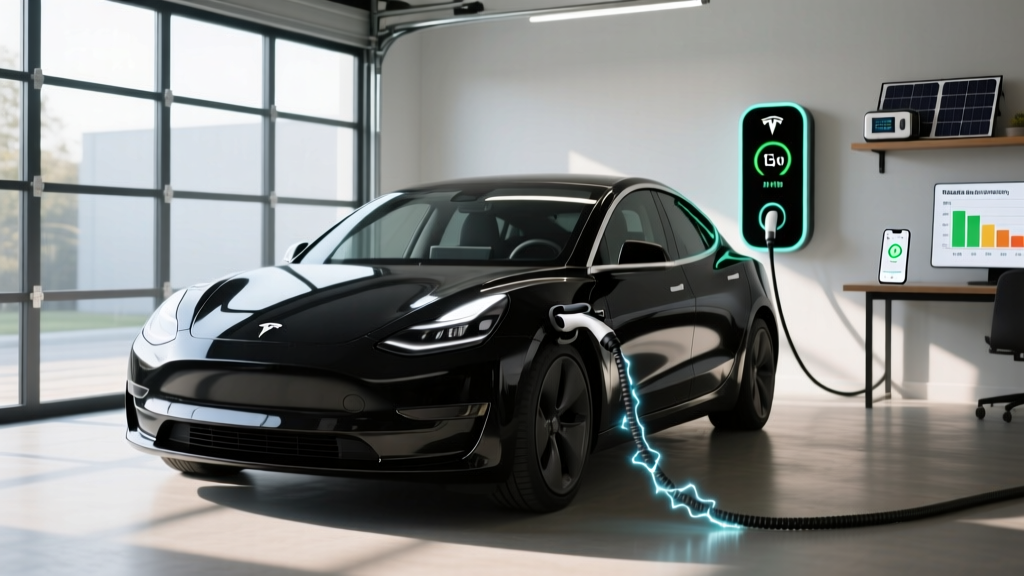
Tesla's Wall Connector (Gen 3) supports up to 48 amps continuous draw, which requires a dedicated 60-amp circuit breaker on a 240V line. This delivers up to 11.5 kW of charging power—enough to fully recharge a Model 3 Long Range overnight in about 7 hours.
If your electrical panel doesn't have capacity for a 60-amp breaker, you have options:
- Reduce the charge rate: The Tesla Wall Connector can be configured during setup to draw less current (e.g., 32A on a 40A circuit, delivering 7.7 kW). This still adds roughly 30 miles of range per hour—plenty for most daily needs.
- Panel upgrade: Homes with older 100-amp service panels often need an upgrade to 200 amps to safely support a 60-amp EV circuit alongside existing loads (HVAC, electric dryer, oven). This is the single biggest cost variable.
Installation Cost Breakdown
| Component | Low End | High End | Notes |
|---|---|---|---|
| Level 2 Charger (Equipment) | $400 | $700 | Tesla Wall Connector, ChargePoint, Emporia, etc. |
| Electrician Labor | $500 | $2,000 | Depends on run length, conduit, wall type |
| Permit & Inspection | $50 | $300 | Varies by municipality |
| Electrical Panel Upgrade (if needed) | $1,500 | $4,000 | Only if existing panel lacks capacity |
| Total (no panel upgrade) | $950 | $3,000 | Typical for modern homes with 200A service |
| Total (with panel upgrade) | $2,450 | $7,000 | Older homes with 100A service |
The federal residential clean energy credit (IRS Form 5695) covers 30% of the cost of EV charging equipment installation, up to $1,000, for equipment placed in service through 2032. This applies to the charger and installation labor but not panel upgrades. Always verify current-year eligibility with a tax professional.
Safety and Code Considerations
- Dedicated circuit: Your EV charger must be on its own dedicated breaker—never shared with other appliances.
- GFCI protection: NEC 2020 and later require GFCI protection for outdoor receptacles and some jurisdictions extend this to hardwired EV chargers. Your electrician will ensure compliance.
- Outdoor rating: If mounting outside, confirm the charger has a NEMA 4 or IP56 rating. The Tesla Wall Connector is rated for indoor and outdoor use.
- Hardwired vs. plug: Hardwired installations (no plug) are more reliable and avoid the 80% derating rule that applies to plug-in receptacles under NEC. We recommend hardwiring for 48A+ setups.
Connector Compatibility: NACS, CCS, and CHAdeMO
All Tesla vehicles built for the North American market use the NACS (North American Charging Standard) connector—what was formerly called the Tesla connector. As of 2025, Tesla opened its Supercharger network to non-Tesla EVs equipped with NACS ports or CCS-to-NACS adapters.
| Connector Type | Compatible with Tesla? | Notes |
|---|---|---|
| NACS (Tesla native) | Yes — all models, all years | Standard on every Tesla sold in North America |
| CCS1 | Yes — via Tesla CCS adapter (~$175) | Needed for Electrify America, some non-Tesla DC networks. Limits charge rate to ~150 kW on some adapters. |
| CHAdeMO | No — no adapter available | CHAdeMO is effectively discontinued in North America. Tesla has never supported it. |
| J1772 (Level 2 AC) | Yes — Tesla includes a J1772 adapter | Useful for public Level 2 chargers (ChargePoint, Blink, etc.) |
If you plan to use non-Tesla public chargers, keep the Tesla CCS adapter and the included J1772 adapter in your frunk or trunk. On road trips, Tesla's built-in navigation routes you to Superchargers by default, which require no adapter.
How Much Does Charging a Tesla Cost vs. Gasoline?
Charging cost depends on where and when you charge. Here are realistic 2026 scenarios for a Model Y Long Range (approximately 3.5 miles per kWh efficiency):
| Scenario | Rate | Cost per kWh | Cost per Mile (Model Y) | Comparable Gas Vehicle (28 MPG, $3.40/gal) |
|---|---|---|---|---|
| Home charging (off-peak utility rate) | Time-of-use plan | $0.08–$0.14 | $0.025–$0.04 | $0.12/mi |
| Home charging (standard rate) | Flat rate | $0.13–$0.18 | $0.04–$0.05 | $0.12/mi |
| Tesla Supercharger | Per-kWh pricing | $0.28–$0.42 | $0.08–$0.12 | $0.12/mi |
| Third-party DC fast (Electrify America, EVgo) | Per-kWh pricing | $0.35–$0.55 | $0.10–$0.16 | $0.12/mi |
| Solar-charged (owned system, net cost) | Amortized | $0.04–$0.07 | $0.01–$0.02 | $0.12/mi |
The takeaway: if you charge primarily at home on an off-peak rate, your "fuel" cost is roughly one-third to one-quarter of what a comparable gas car costs per mile. Even at Supercharger prices, Tesla charging is typically on par with or slightly cheaper than gasoline. The economics shift against EVs only when you rely exclusively on expensive public DC fast chargers.
According to fueleconomy.gov, the 2025 Tesla Model Y Long Range achieves 111 MPGe combined, which translates to roughly 30 kWh per 100 miles of driving. Use that figure as your baseline for calculating personalized costs with your local electricity rates.
Recommended Home Charging Equipment for Tesla Owners
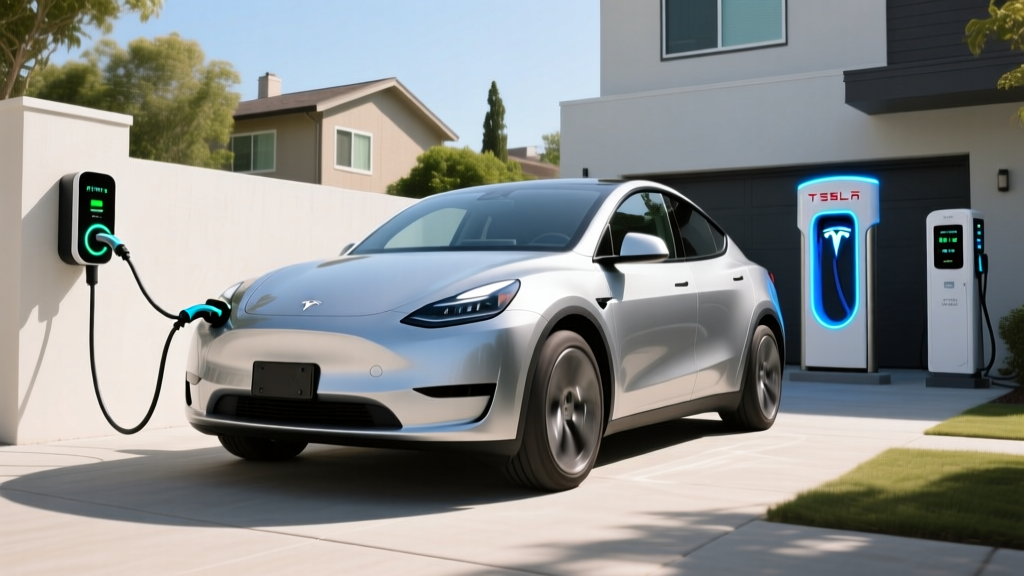
Tesla Wall Connector (Gen 3)
- Power output: Up to 11.5 kW (48A at 240V)
- Connector: NACS (native Tesla)
- Cable length: 24 ft
- Smart features: Wi-Fi, OTA updates, load sharing with other Wall Connectors, access control
- Price: ~$475
- Best for: Tesla-only households. Cleanest integration, fastest Level 2 charge for Tesla vehicles.
Emporia Vue + Level 2 Charger
- Power output: Up to 11.5 kW (48A)
- Connector: J1772 (use Tesla's included adapter) or NACS version available
- Cable length: 24 ft
- Smart features: Energy monitoring, solar integration, scheduling, circuit-level tracking
- Price: ~$400 (charger only)
- Best for: Homes with solar panels or those wanting detailed energy data.
ChargePoint Home Flex (NACS)
- Power output: Up to 12 kW (50A at 240V)
- Connector: NACS (2025+ version) or J1772
- Cable length: 23 ft
- Smart features: App scheduling, Alexa integration, flexible amperage (16A–50A configurable)
- Price: ~$550–$650
- Best for: Mixed-EV households or those wanting flexible amperage without reconfiguring the unit.
For most Tesla-only homes, the Tesla Wall Connector is the obvious choice: native plug, full 48A support, and the lowest price among premium units. If you have non-Tesla EVs or anticipate getting one, the ChargePoint Home Flex with NACS gives you flexibility.
Tesla Supercharger Network: What to Expect in 2026
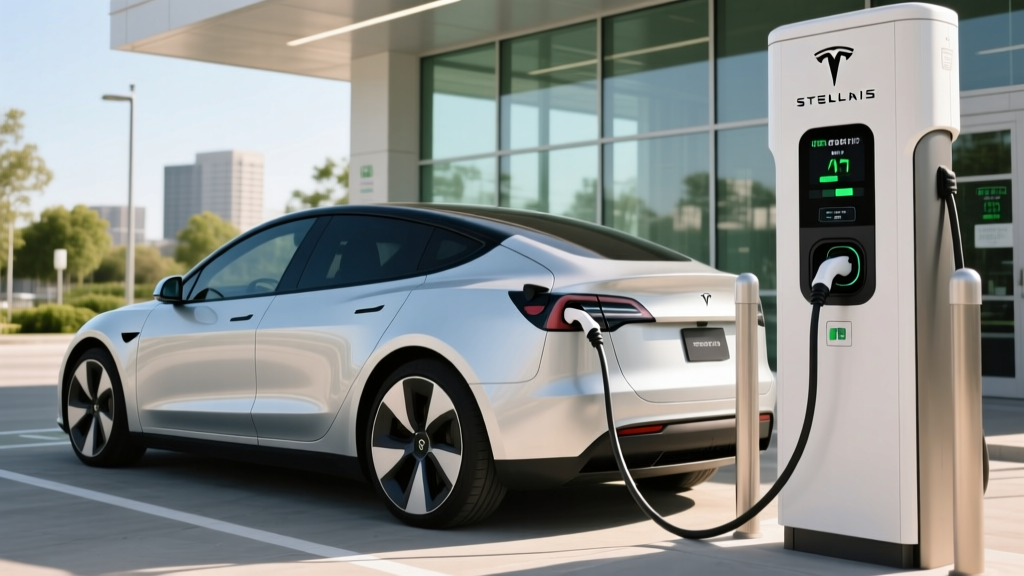
Tesla's Supercharger network now includes V3 stalls (up to 250 kW) and V4 stalls (up to 325 kW, currently deployed at select high-traffic corridors). The Cybertruck is the first Tesla to take full advantage of V4's higher charge rate; Model 3 and Model Y are hardware-limited to 250 kW at V3/V4 stalls alike.
Real-world Supercharger speeds follow a predictable curve:
- 10–30% SoC: Near peak rate (200–250 kW for Model 3/Y LR)
- 30–60% SoC: Gradual taper (150–200 kW)
- 60–80% SoC: Significant taper (80–120 kW)
- Above 80% SoC: Slow trickle (under 50 kW) — avoid charging past 80% on road trips unless necessary
This is why we quote 10–80% times rather than 0–100%. The last 20% can take as long as the first 70%. On road trips, the most time-efficient strategy is to charge to 80% and move on to the next Supercharger rather than waiting for a full charge.
Tesla's in-car navigation automatically preconditions the battery when you navigate to a Supercharger—warming or cooling it to the optimal temperature for fast charging. If you drive to a Supercharger without using navigation (e.g., following a third-party app), preconditioning won't activate, and your charging speed may be significantly reduced, especially in cold weather.
Frequently Asked Questions
How much does it cost to install a home EV charger for my Tesla?
Expect $950–$3,000 for a standard installation in a home with adequate electrical panel capacity (200A service). If your home requires a panel upgrade from 100A to 200A, total costs can reach $2,450–$7,000. The federal residential clean energy credit covers 30% of equipment and installation costs up to $1,000 through 2032. Always get a detailed quote from a licensed electrician before committing.
How fast will each charging level add range to my Tesla?
Level 1 (120V standard outlet): roughly 3–5 miles of range per hour. Level 2 (240V, 48A): approximately 35–44 miles per hour for a Model 3 or Model Y. DC fast charging at a Supercharger: up to 200 miles added in 15 minutes at peak rate, though the average rate over a 10–80% session is closer to 130–150 miles per 15 minutes due to the charge curve taper.
Which connector do I need for my Tesla?
All Tesla vehicles in North America use the NACS connector natively. For Superchargers and Tesla Wall Connectors, no adapter is needed. For public Level 2 chargers with J1772 plugs, use the adapter Tesla includes with every vehicle. For non-Tesla DC fast chargers (Electrify America, EVgo), you'll need Tesla's CCS-to-NACS adapter, sold separately for approximately $175.
How much does charging a Tesla cost per mile compared to gas?
Home charging on an off-peak rate costs roughly $0.03–$0.05 per mile for a Model Y. A comparable gas vehicle at 28 MPG and $3.40/gallon costs about $0.12 per mile. Even at Supercharger rates ($0.28–$0.42/kWh), the Tesla costs $0.08–$0.12 per mile—roughly equal to or cheaper than gas. The biggest savings come from consistent home charging.
What electrical upgrades might my home need for a Tesla charger?
The most common upgrade is a panel capacity increase from 100A to 200A service, which costs $1,500–$4,000 and is typically needed in homes built before 1990 or those already running multiple high-draw electric appliances (heat pump, electric range, dryer). If your panel has capacity but the charger location is far from the panel, expect higher labor costs for longer conduit runs. A licensed electrician can assess your panel's available amperage during a site visit—many offer free or low-cost evaluations.
Can I charge my Tesla on a regular 120V outlet?
Yes, using the Tesla Mobile Connector with the NEMA 5-15 adapter (included). You'll get roughly 1.0–1.4 kW and 3–5 miles of range per hour. This is practical only if you drive fewer than 30–40 miles per day and can leave the car plugged in for 10+ hours overnight. For anything beyond minimal daily driving, a Level 2 installation is strongly recommended.