If you own a Tesla—or are about to buy one—you've likely seen the warning: "For daily use, set charge limit to 80%." That guidance leaves many owners wondering about charging Tesla to 100 percent: Is it ever okay? Will it damage the battery? And how long does a full charge actually take on different charging levels?
This guide answers those questions with real data on Tesla's battery chemistries, charging speeds, and costs. We'll also cover the home charging setup you need to make regular charging practical, because the best way to manage battery health is to make 80% your effortless default—then top up to 100% only when you genuinely need it.
Why Tesla Recommends Stopping at 80% (and When 100% Is Fine)
The recommendation to limit daily charging to 80% applies specifically to Tesla models equipped with NMC (nickel manganese cobalt) or NCA (nickel cobalt aluminum) battery chemistries. These include most Long Range and Performance variants of the Model 3, Model Y, Model S, and Model X.
NMC/NCA cells experience accelerated degradation when held at high states of charge for extended periods. The chemistry simply doesn't like sitting at 100% SoC (state of charge). Tesla's own battery management system (BMS) includes a top-end buffer—typically 2-3 kWh that the car never actually uses—to protect the pack, but regularly charging to 100% and letting it sit still stresses the cells.
When charging Tesla to 100% makes sense (NMC/NCA models):
- Road trips where you'll be driving through the full charge within a few hours
- Days when you anticipate unusually high mileage needs
- Before preconditioning for a Supercharger stop on a long trip
When to avoid it:
- Daily commuting where 80% provides more than enough range
- Leaving the car parked at 100% for days or weeks
- Hot weather, where high SoC combined with heat accelerates degradation
Charging Levels Explained: Speeds, Times, and Range Added
Understanding how fast each charging level replenishes your Tesla's battery is essential for planning both daily routines and road trips. Here's the critical distinction: kW (kilowatts) measures charging power—the rate of energy delivery—while kWh (kilowatt-hours) measures battery capacity, the total energy stored. A 75 kWh battery charged at 7 kW takes roughly 10 hours from empty; at 11 kW, roughly 7 hours.
| Level | Voltage / Amperage | Power (kW) | Miles of Range/Hour | Best For |
|---|---|---|---|---|
| Level 1 (120V) | 120V / 12A | ~1.4 kW | 3–5 mi/hr | Emergency / overnight trickle |
| Level 2 (240V) | 240V / 32–48A | 7.7–11.5 kW | 25–44 mi/hr | Daily home charging |
| DC Fast (Supercharger) | 400V+ / up to 670A | 150–250 kW peak | Up to 200+ mi in 15 min | Road trips, rapid top-ups |
Real-world charging times for common Tesla batteries (10–80% SoC):
- Model 3 RWD (57.5 kWh LFP): ~30 min at V3 Supercharger (250 kW peak); ~8 hours on Level 2 at 7.7 kW
- Model Y Long Range (75 kWh NMC): ~25 min at V3 Supercharger; ~7.5 hours on Level 2 at 11.5 kW
- Model S (100 kWh NMC): ~30 min at V3 Supercharger; ~10 hours on Level 2 at 11.5 kW
Home Charger Installation: Electrical Requirements and Costs
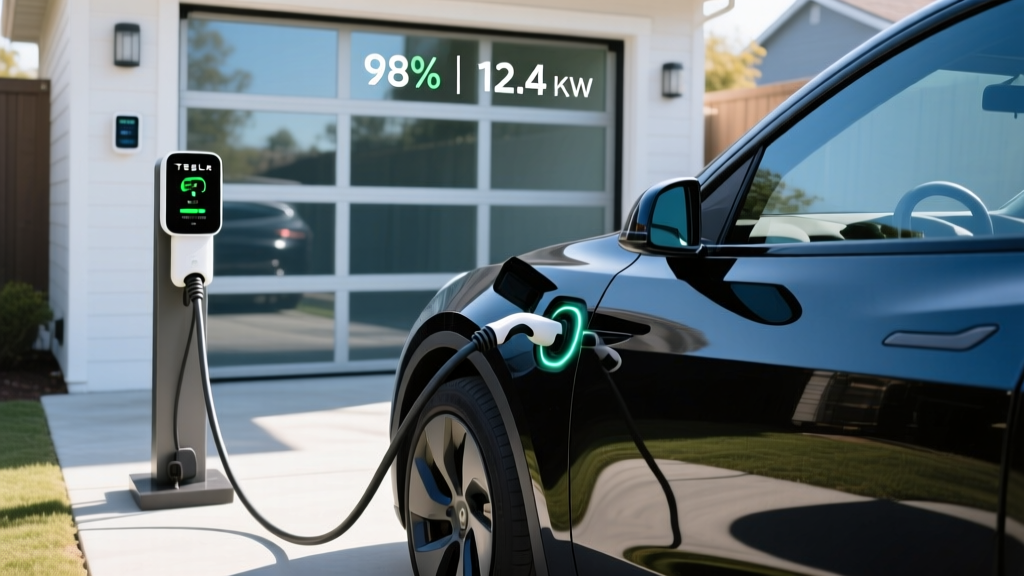
Installing a Level 2 home charger is the single most impactful upgrade for Tesla ownership. It transforms daily charging from a chore into something that happens automatically overnight, making the 80% daily limit effortless.
Electrical Requirements
A Level 2 Tesla charger requires a 240-volt dedicated circuit. The specific amperage depends on your charger and your Tesla's onboard charger capacity:
- 32A circuit (7.7 kW): Minimum practical Level 2; charges most Teslas overnight. Requires a 40A breaker (circuits must be rated at 125% of continuous load per NEC).
- 48A circuit (11.5 kW): Maximum for most current Teslas (Model 3/Y accept 11.5 kW AC; Model S/X accept up to 11.5 kW). Requires a 60A breaker.
- 60A circuit (14.4 kW): For future-proofing or non-Tesla EVs with larger onboard chargers. Requires a 70–80A breaker and likely heavier-gauge wire.
Wire gauge matters: A 60A breaker typically requires 6 AWG copper wire (or 4 AWG aluminum). A 40A breaker needs 8 AWG copper. Longer wire runs may require upsizing to minimize voltage drop—your electrician will calculate this.
Does Your Electrical Panel Need an Upgrade?
This is where costs can escalate significantly. Most homes built after 1990 have a 200A main panel, which usually accommodates a 60A EV circuit without issue. However, older homes with 100A or 150A panels may need a panel upgrade to 200A before adding a high-amperage EV circuit.
Your electrician will perform a load calculation per NEC Article 220, adding up your home's existing loads (HVAC, water heater, dryer, oven, etc.) to determine if there's headroom. If your panel is already running near capacity—common in homes with electric heat, electric water heaters, and an EV—a panel upgrade or a load-management device becomes necessary.
| Component | Low Estimate | High Estimate | Notes |
|---|---|---|---|
| Level 2 Charger (hardware) | $350 | $650 | Tesla Wall Connector or equivalent |
| Electrician labor | $500 | $2,000 | Depends on wire run length, wall type |
| Electrical materials (wire, conduit, breaker) | $100 | $500 | Longer runs = more wire cost |
| Permit and inspection | $50 | $300 | Varies by municipality |
| Panel upgrade (if needed) | $1,500 | $4,000 | 100A to 200A service upgrade |
| Total (no panel upgrade) | $1,000 | $3,450 | Typical scenario for newer homes |
| Total (with panel upgrade) | $2,500 | $7,450 | Older homes with limited capacity |
Get at least three quotes from licensed electricians. Ask specifically whether their quote includes the permit, inspection, and any necessary drywall repair. Some utilities offer rebates of $250–$500 for Level 2 installation—check with your local provider before scheduling work.
Connector Compatibility: NACS, CCS, and Adapters
Tesla pioneered its own connector—now officially called NACS (North American Charging Standard, SAE J3400)—and as of 2025–2026, nearly every major automaker has adopted it for new EVs. This means Tesla owners have the simplest connector situation in the market: your car's charge port matches the native connector at every Tesla Supercharger and an expanding number of third-party networks.
| Connector | Used By | Tesla Compatibility |
|---|---|---|
| NACS (J3400) | All Teslas; Ford, GM, Rivian, Hyundai, and others (2025+) | Native—no adapter needed |
| CCS1 (Combo) | Most non-Tesla EVs (pre-2025 models) | Requires CCS-to-NACS adapter (~$200–$250) for Tesla vehicles to use CCS stations |
| CHAdeMO | Nissan Leaf, Mitsubishi (legacy) | No practical adapter available; network is declining |
| J1772 (Level 2 AC) | All non-Tesla EVs for Level 2 | Tesla includes a J1772-to-NACS adapter with every vehicle |
Practical advice: If you drive a Tesla and travel frequently, the CCS adapter is worth owning. While Tesla's Supercharger network is the most reliable DC fast-charging network in the U.S. (with over 6,000 stations and 60,000+ stalls nationally), having CCS access opens up Electrify America, EVgo, and other networks as backup options. Tesla sells the official CCS adapter for approximately $250 through its shop.
Charging Cost Per Mile: Home vs. Public vs. Gas
One of the strongest arguments for EV ownership is lower fueling cost—but the savings depend heavily on where you charge. Let's compare real-world costs using a Model Y Long Range with an EPA-estimated 320 miles of range and approximately 28 kWh/100 mi efficiency (about 3.6 mi/kWh).
| Scenario | Rate | Cost per kWh | Cost per Mile | Cost for 320-mi "Tank" |
|---|---|---|---|---|
| Home (national avg. residential) | $0.16/kWh | $0.16 | $0.045 | $14.40 |
| Home (off-peak TOU rate) | $0.09/kWh | $0.09 | $0.025 | $8.00 |
| Tesla Supercharger (avg.) | $0.28/kWh | $0.28 | $0.078 | $24.90 |
| Third-party DC fast (avg.) | $0.38/kWh | $0.38 | $0.106 | $33.90 |
| Gas car (28 MPG, $3.40/gal) | $3.40/gallon | — | $0.121 | $38.86 |
Key takeaway: Home charging at off-peak rates delivers fueling costs at roughly one-fifth the cost of a comparable gas vehicle. Even at public DC fast chargers, the Tesla Supercharger network undercuts gasoline on a per-mile basis. The economics flip unfavorably only at the most expensive third-party DC chargers—another reason home Level 2 installation pays for itself.
According to the U.S. Energy Information Administration, the national average residential electricity rate hovers around $0.16/kWh, but time-of-use (TOU) plans can drop overnight rates to $0.07–$0.10/kWh in many states. If your utility offers an EV-specific TOU rate, enroll immediately—it's the easiest way to cut your fueling costs in half.
Recommended Home Chargers for Tesla Owners
The home charger (officially called EVSE—Electric Vehicle Supply Equipment) you choose affects charging speed, convenience, and long-term reliability. Here are three proven options for Tesla owners:
Tesla Wall Connector
- Power output: Up to 11.5 kW (48A) on a 60A circuit
- Connector: Native NACS—no adapter needed
- Cable length: 18 ft or 24 ft options
- Smart features: Wi-Fi for OTA updates, Power Sharing (link two units on one circuit), access control, Tesla app integration
- Price: ~$425 (18 ft) / ~$475 (24 ft)
- Verdict: Best choice for Tesla-only households. Cleanest integration, fastest Level 2 speeds, and competitive pricing.
ChargePoint Home Flex
- Power output: Up to 12 kW (50A) on a 60A circuit; configurable from 16A–50A via DIP switches
- Connector: J1772 (NACS version now available)
- Cable length: 23 ft
- Smart features: Wi-Fi, ChargePoint app with scheduling, energy tracking, Alexa integration
- Price: ~$550–$650
- Verdict: Excellent for multi-EV households (Tesla + non-Tesla). The amperage configurability is useful for older panels.
Emporia Vue Level 2 Charger
- Power output: Up to 11.5 kW (48A) on a 60A circuit
- Connector: J1772 (NACS adapter included)
- Cable length: 24 ft
- Smart features: Wi-Fi, Emporia app, detailed energy monitoring, solar integration for solar-home owners
- Price: ~$350–$400
- Verdict: Best budget smart charger. Excellent energy monitoring. Ideal if you have solar panels and want to charge on excess production.
Safety, Code Compliance, and Installation Best Practices
EV charging is a high-draw, continuous electrical load—defined by the National Electrical Code (NEC) as running for three hours or more. This classification triggers specific safety requirements that go beyond a typical household circuit.
Dedicated circuit: Your Level 2 charger must be on its own dedicated circuit. Sharing the circuit with other appliances is a code violation and a fire risk.
Continuous load derating: Per NEC 210.20(A), a continuous load cannot exceed 80% of the circuit breaker rating. A 60A breaker supports a maximum continuous load of 48A (11.5 kW). A 40A breaker supports 32A (7.7 kW). Never install a charger rated higher than 80% of the breaker.
GFCI protection: The 2020 NEC (Article 625.54) requires GFCI (Ground Fault Circuit Interrupter) protection for all receptacles used for EV charging. Hardwired installations—where the charger is directly wired to the panel without a plug—are exempt from this requirement and are generally preferred by electricians for reliability (eliminates nuisance GFCI trips).
Outdoor rating: If your charger is installed outdoors (garage-adjacent, driveway, carport), the EVSE must carry a NEMA 4 or NEMA 4X weather-resistance rating. The Tesla Wall Connector, ChargePoint Home Flex, and Emporia charger all meet this standard.
Permit and inspection: Virtually all jurisdictions require an electrical permit for EV charger installation. The inspection verifies correct wire gauge, breaker sizing, grounding, and GFCI compliance. Skipping the permit risks insurance coverage denial in the event of an electrical fire—and it's often discovered when you sell the home.
Frequently Asked Questions
Will charging my Tesla to 100% damage the battery?
A single charge to 100% won't cause meaningful harm. The concern is habitually charging to 100% and letting the car sit at full SoC for hours or days. For NMC/NCA batteries, this accelerates capacity loss over time—potentially reducing total range by several percentage points over 5–8 years. For LFP batteries (Model 3/Y RWD), regular 100% charges are recommended. The best practice for NMC owners: set the daily limit to 80% and only slide it to 100% the morning of a road trip.
How much range do I lose by charging to 80% instead of 100%?
On a Model Y Long Range with an EPA-estimated 320 miles, 80% gives you approximately 256 miles of displayed range. In real-world highway driving (70+ mph, moderate temperatures), expect about 230–240 usable miles from an 80% charge. That's sufficient for most daily driving and even many day trips. For reference, the average American drives roughly 37 miles per day according to FHWA data.
Should I charge to 100% before a road trip?
Yes—this is exactly the scenario Tesla designed 100% charging for. Set your charge limit to 100% the night before departure, and plan to leave within a few hours of the charge completing. This minimizes the time the battery sits at high SoC. Use your Tesla's scheduled departure feature so the charge completes right before you leave, which also ensures the battery is preconditioned for maximum efficiency.
How fast will a Level 2 home charger charge my Tesla from 20% to 80%?
At 11.5 kW (48A), a Model Y Long Range (75 kWh battery) adds roughly 44 miles of range per hour. Charging from 20% (64 mi) to 80% (256 mi) means adding ~192 miles, which takes approximately 4.5 to 5 hours. At 7.7 kW (32A), the same session takes about 6.5 to 7 hours. Both easily complete overnight while you sleep.
Do I need a Tesla Wall Connector, or can I use a third-party charger?
Any Level 2 EVSE with a NACS connector (or a J1772 charger with Tesla's included adapter) will charge your Tesla. The Tesla Wall Connector offers the tightest integration—automatic charge-port opening, native app controls, and Power Sharing for dual-charger setups—but third-party options like ChargePoint and Emporia work perfectly for charging functionality. Choose based on your household's needs: Tesla-only or mixed-EV.
What happens if I charge to 100% and don't drive for a few days?
Tesla's BMS manages this better than older EVs, but it's still not ideal for NMC chemistry. The battery management system will slowly bleed off the very top of the charge to reduce stress, but the cells still spend time at elevated voltage. If you accidentally charge to 100%, simply drive the car normally—the first few miles will bring the SoC down to a healthier range quickly. Just avoid making it a regular habit.
For official guidance on your specific Tesla model's battery care, consult the owner's manual in your vehicle's touchscreen under Controls > Manuals, or visit Tesla's battery support page. For electrical installation requirements, always defer to a licensed electrician familiar with your local codes and your home's specific panel capacity.