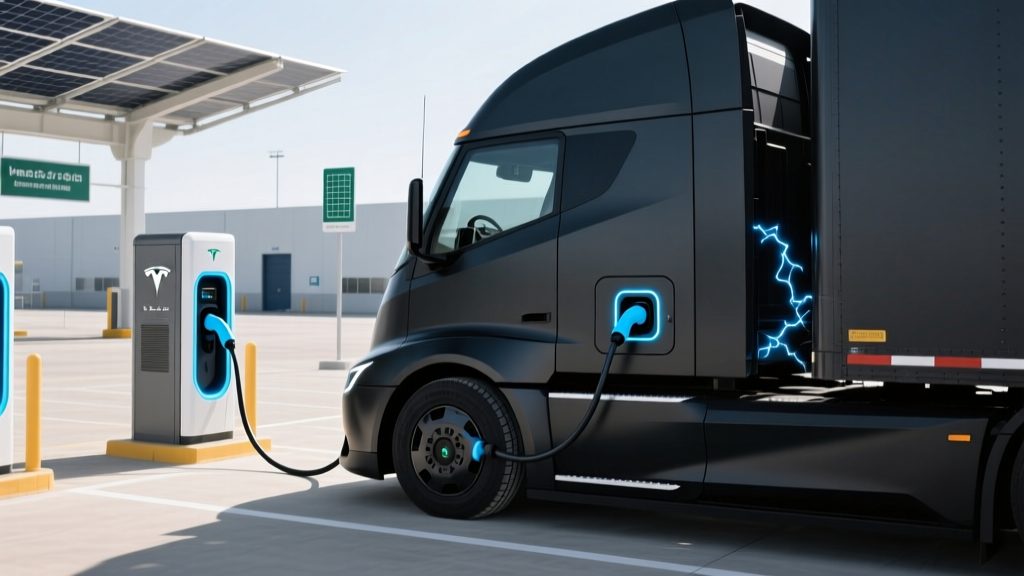
The Tesla Semi is not a scaled-up passenger car—it is a Class 8 electric truck with a battery pack estimated at 500–900 kWh, and charging it requires infrastructure that most fleets have never dealt with before. If you are researching charging Tesla Semi trucks for a depot, a long-haul corridor, or a drayage operation, this guide breaks down the power levels, connector realities, electrical requirements, and per-mile energy costs you will actually face in 2026.
Understanding Charging Levels for a Class 8 Electric Truck
Before diving into Semi-specific hardware, let's establish the three charging levels and what they mean for a battery this large. The distinction between kW (power—the rate of energy delivery) and kWh (energy—the battery's total capacity) is critical. The Semi's estimated 500–900 kWh battery is 5 to 10 times larger than a Tesla Model Y's 75 kWh pack. That means even "fast" Level 2 charging is an overnight affair.
| Level | Voltage / Amperage | Power (kW) | Miles of Range Added Per Hour | Semi Use Case |
|---|---|---|---|---|
| Level 1 | 120V / 12–16A | 1.4–1.9 kW | ~0.5–1 mi/hr | Not viable for Semi |
| Level 2 | 208–240V / 30–80A | 7–19.2 kW | ~3–8 mi/hr | Overnight depot top-up, supplemental |
| DC Fast (CCS) | 200–1000V DC | 50–350 kW | ~20–150 mi/hr | Public corridor charging, partial fills |
| Megacharger (DC) | Up to 1000V DC | Up to ~1,000 kW (est.) | ~400+ mi/hr (peak) | Tesla's dedicated Semi corridor charging |
For a Semi with a ~900 kWh battery, a 19.2 kW Level 2 charger adds roughly 2% of battery capacity per hour—meaning a full charge from empty would take approximately 47 hours. This is why Megacharger infrastructure is non-negotiable for any fleet planning highway operations.
Megacharger: Tesla's Semi-Specific DC Fast Charging Network
Tesla developed the Megacharger specifically for the Semi. Unlike passenger-car Superchargers that peak around 250–350 kW, Megachargers are designed to deliver substantially higher power. While Tesla has not published a finalized peak kW specification as of early 2026, industry analysis and Tesla's own statements at Semi delivery events point to a target of approximately 1,000 kW (1 megawatt) per stall.
Tesla has demonstrated that the Semi can recover 70% of its range in approximately 30 minutes at a Megacharger. For a 500-mile rated range truck, that translates to roughly 350 miles of range in half an hour—a charge rate that requires sustained power well above 500 kW during the bulk-charging phase.
Charging Time Estimates: 10–80% SoC
| Charging Method | Peak Power | Estimated 10–80% Time (~900 kWh pack) | Notes |
|---|---|---|---|
| Tesla Megacharger | ~1,000 kW | ~45–60 minutes | 70% range in ~30 min per Tesla; taper above 80% |
| 350 kW CCS (public) | 350 kW | ~2.5–3 hours | Limited by public CCS station output; may need adapter |
| Depot Level 2 (48A, 11.5 kW) | 11.5 kW | ~55+ hours | Not practical for full recharge; maintenance/trickle only |
| Depot DC (150 kW) | 150 kW | ~5–6 hours | Typical fleet depot DC charger; good for overnight |
Charge curve reality: Like all lithium-ion batteries, the Semi's pack charges fastest between roughly 10% and 50% State of Charge (SoC). Above 60%, the charge rate tapers to protect cell health. Above 80%, it slows dramatically. Fleet operators should plan routes around 10–80% charging windows rather than attempting full charges on the road.
Connector Compatibility: NACS, CCS, and the Megacharger Standard
The Tesla Semi uses a proprietary Megacharger connector at Tesla's dedicated Semi charging stations. For public charging or depot-level DC fast charging, compatibility depends on what connector the truck is equipped with at delivery.
| Connector | Standard | Max DC Power | Semi Compatibility |
|---|---|---|---|
| Megacharger (proprietary) | Tesla | ~1,000 kW | Native—only at Tesla Semi stations |
| NACS (J3400) | SAE / Tesla | Up to 350 kW (current public) | Expected for depot/public; may require adapter |
| CCS1 | SAE J1772 Combo | Up to 350 kW | Adapter required; limited by CCS cable amperage |
| CHAdeMO | Tokyo Electric Power | Up to 62.5 kW (typical) | Not recommended—too slow for a pack this size |
Tesla has been transitioning its passenger vehicles to the North American Charging Standard (NACS), now formalized as SAE J3400. For the Semi, the Megacharger connector is physically larger to handle the current required for megawatt-class charging. Fleets planning depot charging with third-party DC equipment (e.g., ABB, Tritium, or BTC Power units) should confirm NACS or CCS1 inlet availability with their Tesla fleet representative and budget for any necessary adapters.
Depot Charging Infrastructure: Electrical Requirements and Installation Costs
Most fleet operators will need depot-based charging—whether Level 2 for overnight maintenance or DC fast chargers (50–350 kW) for daily turnaround. This is where electrical planning becomes the single largest variable in your total infrastructure cost.
What Electrical Upgrades Might You Need?
A single 350 kW DC fast charger draws roughly the same power as 30–40 residential homes. Most commercial sites will require:
- Utility service upgrade: A dedicated medium-voltage feed or transformer upgrade. Costs vary enormously—$50,000 to $500,000+ depending on distance to existing utility infrastructure.
- Switchgear and distribution panels: Commercial-grade panels rated for continuous high-amperage DC charger loads.
- Dedicated circuits: Each charger requires its own dedicated circuit with appropriate overcurrent protection.
- Permits and inspections: Commercial electrical permits, utility interconnection agreements, and in some jurisdictions, demand-response or smart-charging compliance.
For Level 2 depot chargers (more modest but still significant), here is a typical installation cost breakdown for a single 19.2 kW hardwired unit:
| Component | Cost Range | Notes |
|---|---|---|
| Level 2 charger unit (commercial) | $1,500–$4,000 | e.g., ChargePoint CT4000, ABB Terra AC |
| Electrical panel capacity check | $500–$2,000 | Engineering assessment for load capacity |
| Wiring and conduit (up to 100 ft run) | $2,000–$8,000 | Varies with distance, trenching, concrete work |
| Electrician labor (commercial rate) | $3,000–$10,000 | 240V/80A dedicated circuit; commercial rates $100–$200/hr |
| Permits and inspections | $500–$3,000 | Varies by municipality |
| Total (per L2 stall) | $7,500–$27,000 | Before any utility upgrades or incentives |
For DC fast charging at a depot (150–350 kW), expect total installed costs of $100,000–$350,000+ per stall, heavily dependent on utility upgrade requirements. Many fleets are leveraging federal and state incentives—the IRS §30C Alternative Fuel Vehicle Refueling Property Credit offers up to $100,000 per item of qualifying commercial charging equipment, subject to prevailing-wage and census-tract requirements.
How Much Does Charging a Tesla Semi Cost Per Mile vs. Diesel?
The economic case for the Semi hinges on energy cost per mile. Here is how electricity stacks up against diesel for a Class 8 truck averaging 6.5 mpg (a reasonable loaded figure for a modern diesel day cab).
| Scenario | Energy Cost | Cost Per Mile (Semi, ~2 kWh/mi) | Cost Per Mile (Diesel, 6.5 mpg) |
|---|---|---|---|
| Depot charging (commercial off-peak) | $0.08–$0.12/kWh | $0.16–$0.24 | $0.58 (at $3.80/gal diesel) |
| Depot charging (commercial peak) | $0.15–$0.22/kWh | $0.30–$0.44 | $0.58 (at $3.80/gal diesel) |
| Public DC fast charging | $0.30–$0.55/kWh | $0.60–$1.10 | $0.58 (at $3.80/gal diesel) |
| Tesla Megacharger (projected fleet rate) | $0.20–$0.35/kWh (est.) | $0.40–$0.70 | $0.58 (at $3.80/gal diesel) |
The Semi's energy consumption is estimated at approximately 1.7–2.0 kWh per mile under loaded highway conditions—Tesla has stated the truck achieves under 2 kWh/mi. At depot off-peak electricity rates, this translates to fuel savings of roughly 50–70% per mile compared to diesel. However, at public DC fast charging rates, the Semi can actually cost more per mile than diesel. This is why depot charging is economically essential—public fast charging should be treated as a road-trip premium, not a daily fueling strategy.
• Choose depot DC (150–350 kW) if: Your trucks return to base nightly, you have predictable routes under 300 miles, and you can negotiate off-peak utility rates.
• Choose Megacharger corridor reliance if: You run long-haul routes exceeding 400 miles between stops and Tesla has confirmed Megacharger availability on your corridor.
• Choose Level 2 depot if: Your trucks operate short drayage routes under 150 miles daily and have 10+ hour dwell times for overnight charging.
Commercial Charging Equipment Recommendations for Semi Depots
While Megachargers are Tesla-provided and installed at designated locations, fleet depots will typically need to source their own Level 2 or DC fast charging equipment. Here are three categories of chargers relevant to Semi depot operations:
ABB Terra 360 (DC Fast)
- Power Output: Up to 360 kW (dual dynamic split)
- Connector: CCS1 + NACS (configurable)
- Cable Length: ~13 ft (4 m)
- Smart Features: OCPP 1.6/2.0, remote management, load balancing
- Estimated Price: $85,000–$130,000 (unit only, before install)
- Best For: High-throughput fleet depots needing fast turnaround
ChargePoint Express 250 (DC Fast)
- Power Output: Up to 250 kW per CCS connector
- Connector: CCS1, NACS adapter available
- Cable Length: ~15 ft (4.6 m)
- Smart Features: ChargePoint Cloud, fleet management API, demand-response ready
- Estimated Price: $70,000–$110,000 (unit only)
- Best For: Fleets already in the ChargePoint ecosystem
ABB Terra AC Wallbox (Level 2, Depot)
- Power Output: Up to 22 kW (48A at 240V)
- Connector: J1772 (NACS adapter available)
- Cable Length: 20–25 ft
- Smart Features: OCPP, RFID access, energy metering
- Estimated Price: $1,200–$2,500 (unit only)
- Best For: Overnight top-up and maintenance charging at depot
Safety, Code, and Installation Considerations for Fleet Chargers
Commercial EV charging installations must comply with the National Electrical Code (NEC), specifically Article 625 (Electric Vehicle Charging System Equipment) and local amendments. Key requirements for Semi depot installations include:
- Dedicated circuits: Every charger must have its own dedicated overcurrent protection device. Shared circuits are not permitted for continuous loads like EV charging.
- GFCI protection: NEC 2023 and later require GFCI protection for all EV charging outlets and hardwired connections under 60A. Higher-amperage DC installations require ground-fault protection per Article 625.
- Outdoor rating: Any charger installed outdoors must carry a NEMA 3R or NEMA 4/4X enclosure rating. For fleet yards with wash-down areas, NEMA 4X (corrosion-resistant) is recommended.
- Ventilation and thermal management: DC fast chargers generate significant heat. Indoor installations require adequate ventilation per the manufacturer's specifications and local fire code.
- Bollard protection: Commercial installations should include concrete-filled steel bollards to protect chargers from vehicle impact—a common requirement for insurance and municipal permits.
- ADA compliance: Public-facing or employee-accessible charging stations must meet Americans with Disabilities Act requirements for clear floor space, reach ranges, and accessible routes.
Work with a licensed commercial electrician and, for DC fast charging, a firm experienced in medium-voltage utility coordination. The NFPA 70 (NEC) is your baseline reference, but local jurisdictions may have additional requirements for commercial EVSE.
Where Are Tesla Megachargers Located, and What Is the Rollout Plan?
As of 2026, Tesla has deployed Megacharger stations at select locations along major freight corridors, with initial sites concentrated in California (supporting the PepsiCo, Martin Brower, and other early Semi fleet deployments in the Inland Empire and Central Valley). Tesla has announced plans to expand Megacharger infrastructure along key interstate corridors, but the network remains far smaller than the Supercharger network for passenger vehicles.
Fleet operators should not assume Megacharger availability on arbitrary routes. Before committing the Semi to a long-haul lane, confirm with Tesla's fleet sales team that Megacharger stations exist or are planned with confirmed timelines along your specific corridor. In the interim, many early Semi deployments are operating as regional or drayage trucks with depot-based charging and limited public DC fast charging as a backup.
Frequently Asked Questions
How much does it cost to install a home or depot EV charger for a Tesla Semi?
For a commercial Level 2 depot charger, expect $7,500–$27,000 per stall installed. For DC fast charging (150–350 kW), budget $100,000–$350,000+ per stall, heavily dependent on whether your site needs a utility transformer upgrade. Megachargers are installed by Tesla at designated locations; fleet costs are negotiated as part of vehicle purchase agreements.
How fast will each charging level add range to the Semi?
Level 2 at 19.2 kW adds roughly 3–8 miles of range per hour. A 350 kW public DC fast charger adds approximately 150 miles per hour. Tesla's Megacharger, at an estimated ~1,000 kW, can recover 70% of the Semi's range in about 30 minutes—roughly 350 miles in half an hour.
Which connector is compatible with the Tesla Semi?
The Semi uses Tesla's proprietary Megacharger connector at Tesla Semi stations. For third-party depot or public DC chargers, the Semi is expected to support NACS (SAE J3400) and potentially CCS1 with an adapter. Confirm with Tesla's fleet team before purchasing third-party charging equipment.
How much does charging the Semi cost per mile compared to diesel?
At depot off-peak rates ($0.08–$0.12/kWh), the Semi costs approximately $0.16–$0.24 per mile—roughly 50–70% cheaper than diesel at $3.80/gallon. At public DC fast charging rates ($0.30–$0.55/kWh), costs can equal or exceed diesel. Depot charging is essential for the economic case.
What electrical upgrades might my depot need?
Most commercial sites will need a utility service upgrade (new transformer or medium-voltage feed), new switchgear and distribution panels, dedicated circuits for each charger, and permits. The utility upgrade is often the most expensive component—$50,000 to $500,000+—and lead times for utility work can be 6–18 months.
Does the Tesla Semi battery degrade, and what is the warranty?
Tesla has not published full battery warranty details specific to the Semi as of early 2026, but the truck's battery is expected to use a high-cycle-life cell chemistry optimized for commercial duty. Tesla's passenger vehicles carry 8-year/100,000–150,000-mile battery warranties with a 70% capacity retention threshold. Fleet operators should negotiate battery warranty terms directly with Tesla as part of the purchase agreement. The NHTSA maintains safety and compliance records for commercial vehicles.