How the EV Charging Station Tax Credit Works in 2026
Buying a Level 2 home charger is one of the smartest investments an EV owner can make — and the IRS wants to help pay for it. Under the Alternative Fuel Vehicle Refueling Property Credit (IRC §30C), homeowners can claim a federal tax credit worth 30% of the cost of qualified charging equipment and installation, up to $1,000. This is distinct from the §30D new-EV purchase credit and applies specifically to the hardware and the electrical work required to install it.
However, the credit comes with strings attached that disqualify many buyers. The most restrictive: your home must be located in an eligible census tract — generally rural areas or low-income communities as defined by the IRS. If you live in a suburban or urban census tract that doesn't meet the criteria, you won't qualify for the federal credit, regardless of your income or the charger you buy.
§30C Charging Station Tax Credit — Eligibility Checklist
- Credit amount: 30% of equipment + installation cost, capped at $1,000 per property
- Eligible property: Your principal residence (not rental properties or second homes for personal credit)
- Census tract requirement: Home must be in a qualifying low-income or rural census tract (check via the IRS eligibility tool or your tax professional)
- Equipment requirement: Must be new, UL-listed (or equivalent), and meet NEC electrical code
- Placed in service: Equipment must be installed and operational in the current tax year
- Nonrefundable credit: Reduces your tax liability dollar-for-dollar but won't generate a refund beyond what you owe
- State/local incentives: Many states and utilities offer additional rebates that stack with the federal credit — check your utility's EV program
Practical example: If your charger and installation total $2,400 and you're in an eligible census tract, you'd claim 30% × $2,400 = $720. If the total is $3,500, you'd claim the $1,000 maximum. Always confirm eligibility with a tax professional — census tract designations and IRS guidance can shift year to year.
Charging Levels Explained: Speed, Power, and Real-World Range Added
Before spending money on equipment or electrical work, you need to understand the three charging tiers and what each delivers. The key distinction: kW (kilowatts) measures charging power — how fast energy flows into your battery. kWh (kilowatt-hours) measures energy capacity — how much your battery holds. A 48-amp Level 2 charger delivering 11.5 kW will refill a 75 kWh battery much faster than a 1.4 kW Level 1 outlet.
| Level | Voltage | Max Power (kW) | Miles of Range Added Per Hour | Typical Use Case |
|---|---|---|---|---|
| Level 1 | 120V AC | 1.2–1.9 kW | 3–5 mi/hr | Overnight trickle; PHEVs or low-mileage commuters |
| Level 2 (Home) | 240V AC | 7.2–11.5 kW | 20–45 mi/hr | Daily home charging; overnight full recharge for most BEVs |
| Level 2 (Public) | 208–240V AC | 6.6–19.2 kW | 18–60 mi/hr | Workplace, retail, apartment complexes |
| DC Fast Charge | 200–900V DC | 50–350 kW | 150–1,000+ mi/hr (peak) | Road trips; 10–80% in 18–40 min depending on vehicle |
Real-world charging time examples (10–80% SoC):
- Tesla Model Y (75 kWh battery) at 11.5 kW Level 2: ~5 hours
- Hyundai Ioniq 5 (77.4 kWh battery) at 11.5 kW Level 2: ~5.5 hours
- Ford F-150 Lightning Extended Range (131 kWh battery) at 11.5 kW Level 2: ~9 hours
- Chevrolet Equinox EV (85 kWh battery) at 11.5 kW Level 2: ~6 hours
For most EV owners driving 30–40 miles per day, a Level 2 home charger replenishes a full day's driving in roughly 1–2 hours. You rarely need to charge from 10% to 80% in a single session at home — that's what DC fast chargers are for on road trips.
Home Charger Installation: Electrical Requirements and True Costs
This is where most EV buyers underestimate the expense. The charger unit itself typically costs $300–$700, but the full installed cost — including electrical work, permits, and possible panel upgrades — ranges from $800 on the low end to $4,500+ if your electrical panel needs upgrading.
Electrical Requirements for a Level 2 Home Charger
A typical Level 2 charger requires a dedicated 240V circuit, similar to what powers an electric dryer or oven. The most common configurations:
- 40-amp circuit / 32-amp continuous → delivers up to 7.7 kW (adequate for most compact/mid-size EVs)
- 50-amp circuit / 40-amp continuous → delivers up to 9.6 kW (recommended for larger batteries like the F-150 Lightning or Rivian R1S)
- 60-amp circuit / 48-amp continuous → delivers up to 11.5 kW (maximum for most residential single-phase panels)
The National Electrical Code (NEC) requires that continuous loads (like EV charging, which runs for 3+ hours) not exceed 80% of the circuit breaker rating. That's why a 50-amp breaker yields 40 amps of usable charging current. A licensed electrician will calculate your panel's available capacity to determine the right circuit size.
When You Need a Panel Upgrade
If your home has a 100-amp main electrical panel (common in homes built before the 1990s), adding a 40–60 amp dedicated EV circuit may push total load beyond the panel's safe capacity. Signs you may need an upgrade:
- Your panel is 100 amps or less
- You already run high-draw appliances simultaneously (electric range, dryer, central AC, electric water heater)
- Your electrician's load calculation shows insufficient headroom
A panel upgrade from 100A to 200A typically costs $1,500–$3,000 depending on your utility's requirements, local labor rates, and whether new service conductors are needed. In some cases, your utility may require a transformer upgrade if the existing one is at capacity — adding weeks and additional cost.
| Cost Component | Low Estimate | High Estimate | Notes |
|---|---|---|---|
| Level 2 charger unit (hardware) | $300 | $700 | Smart Wi-Fi chargers cost more than basic units |
| Electrician labor (install circuit + outlet or hardwire) | $400 | $1,200 | Varies by run length, wall type, and local rates |
| Electrical materials (wire, conduit, breaker, outlet) | $100 | $400 | Longer wire runs from panel to garage increase cost |
| Permit and inspection | $50 | $250 | Required by most jurisdictions; varies by municipality |
| Electrical panel upgrade (if needed) | $1,500 | $3,000 | 100A → 200A upgrade; not always necessary |
| Total (no panel upgrade) | $850 | $2,550 | Most common scenario for modern 200A-panel homes |
| Total (with panel upgrade) | $2,350 | $5,550 | Older homes with 100A service |
Pro tip: Get at least three quotes from licensed electricians. Ask specifically for a load calculation per NEC Article 220 to confirm whether your panel can handle the additional circuit. Some utilities offer free or discounted load assessments for EV owners.
Which Connector Does Your EV Need?
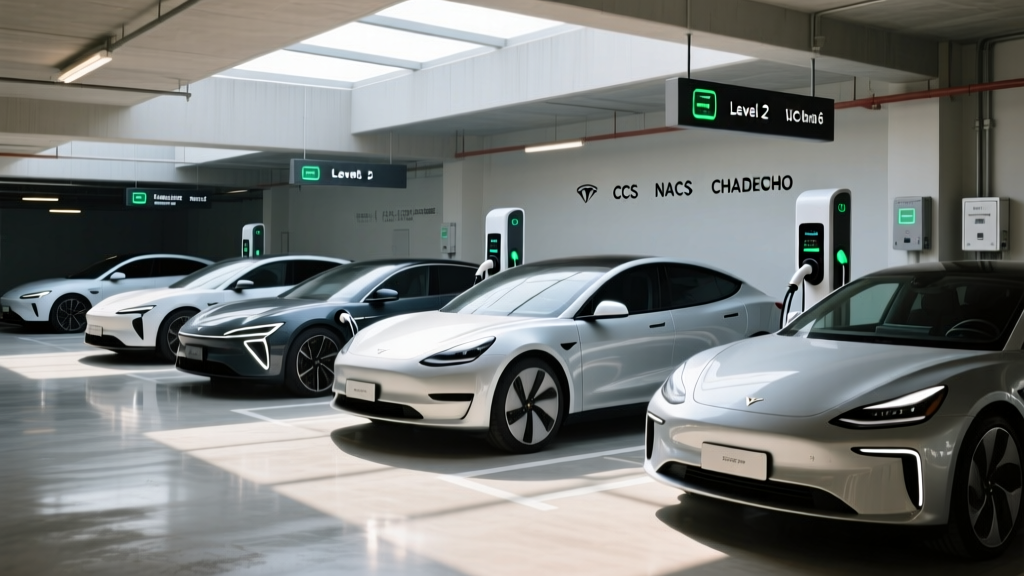
The EV industry has largely converged on the North American Charging Standard (NACS) — originally developed by Tesla — as the dominant connector for new vehicles sold in North America. However, millions of EVs on the road still use CCS1 (Combined Charging System), and older Nissan Leafs use CHAdeMO. Here's what you need to know:
| Connector | Brands Using It (2025–2026 Models) | Notes |
|---|---|---|
| NACS (Tesla) | Tesla (all), Ford (2025+), GM (2025+), Rivian (2025+), Hyundai/Kia (2025+), Volvo/Polestar, BMW, Mercedes | Now the SAE J3400 standard; most new EVs ship with NACS ports |
| CCS1 | VW ID.4 (pre-2025), older Ford/GM/Hyundai/Kia models, Stellantis | Being phased out on new models; adapters available for NACS chargers |
| CHAdeMO | Nissan Leaf (all years), Mitsubishi Outlander PHEV (older) | Legacy standard; declining public infrastructure support |
Adapter reality check: If you drive a CCS1-equipped EV (like a 2024 Hyundai Ioniq 5), you can purchase a CCS-to-NACS adapter ($150–$250) to access Tesla Superchargers. Tesla sells an official adapter, and third-party options from Lectron and A2Z are widely available. For home Level 2 charging, most chargers now ship with NACS connectors; if your EV uses CCS1, ensure the charger you buy has a CCS1 plug or buy the appropriate adapter.
Cost to Charge: Home vs. Public vs. Gas — Real Numbers
One of the strongest arguments for home charging is cost. Electricity prices vary dramatically by state and time of day, but the math consistently favors home Level 2 charging over public DC fast charging and gasoline.
| Scenario | Cost per kWh | Vehicle Efficiency | Cost per Mile | Annual Cost (12,000 mi) |
|---|---|---|---|---|
| Home Level 2 (off-peak TOU rate) | $0.09–$0.14 | 3.0 mi/kWh (typical EV) | $0.03–$0.047 | $360–$564 |
| Home Level 2 (standard flat rate) | $0.14–$0.20 | 3.0 mi/kWh | $0.047–$0.067 | $564–$804 |
| Public Level 2 (workplace/retail) | $0.20–$0.35 | 3.0 mi/kWh | $0.067–$0.117 | $804–$1,404 |
| DC Fast Charge (Electrify America, EVgo) | $0.35–$0.55 | 3.0 mi/kWh (with charging losses) | $0.117–$0.183 | $1,404–$2,196 |
| Gasoline vehicle (27 MPG avg) | $3.40/gallon | 27 mi/gal | $0.126 | $1,512 |
The takeaway: Home charging on an off-peak time-of-use (TOU) rate plan costs roughly 3–4 cents per mile — about 75% less than gasoline per mile. Even standard-rate home charging undercuts gas. However, if you rely exclusively on DC fast charging (no home or workplace access), your per-mile cost can equal or exceed gasoline. This is why home charger installation is so critical to the EV ownership value proposition.
Many utilities offer EV-specific TOU plans that drop rates to $0.07–$0.10/kWh between 11 PM and 6 AM. Pair this with your charger's scheduled charging feature, and you'll consistently hit the lowest-cost tier.
Recommended Level 2 Home Chargers for 2026
We've tested and tracked reliability data on dozens of home chargers. Here are the top picks across categories, with exact specs:
Best Overall: ChargePoint Home Flex
- Power output: Up to 11.5 kW (48 amps) on a 60A circuit; configurable down to 16A
- Connector: NACS (J3400) — CCS1 adapter available
- Cable length: 23 feet
- Smart features: Wi-Fi, app-based scheduling, Alexa integration, energy tracking, load sharing for multi-charger setups
- Installation: NEMA 14-50 plug or hardwired
- Price: ~$599 (hardware only)
- Why we recommend it: The adjustable amperage means you can install it on a 40A circuit today and reconfigure to 60A if you upgrade your panel later — no new hardware needed.
Best for Tesla/NACS Owners: Tesla Wall Connector
- Power output: Up to 11.5 kW (48 amps) on a 60A circuit
- Connector: NACS native (also available with J1772/CCS1 integrated connector)
- Cable length: 24 feet
- Smart features: Wi-Fi, firmware updates, Power Sharing (up to 6 units on one circuit), access control
- Installation: Hardwired only (no plug option)
- Price: ~$450 (hardware only)
- Why we recommend it: Best value per watt for NACS-vehicle owners. Power Sharing lets you install two chargers on a single 60A circuit — ideal for two-EV households.
Best for Smart Grid Integration: Emporia Vue + EV Charger
- Power output: Up to 11.5 kW (48 amps)
- Connector: NACS (J3400)
- Cable length: 24 feet
- Smart features: Whole-home energy monitoring, solar integration, TOU rate optimization, V2H-ready (with compatible vehicles)
- Installation: Hardwired
- Price: ~$549 (charger); Vue energy monitor ~$350 additional
- Why we recommend it: If you have or plan to add solar panels, Emporia's ecosystem lets you charge exclusively on surplus solar — driving your effective cost per mile near zero.
Budget Pick: Lectron V-BOX Pro
- Power output: Up to 9.6 kW (40 amps) on a 50A circuit
- Connector: NACS or J1772 options
- Cable length: 20 feet
- Smart features: Basic app scheduling, LED status indicators, no Wi-Fi dependency
- Installation: NEMA 14-50 plug
- Price: ~$330 (hardware only)
- Why we recommend it: Reliable, no-frills charging at the lowest price point. The plug-in design means you can take it with you if you move.
Safety, Code Compliance, and Inspection Requirements
EV charging draws significant current for extended periods — this isn't like plugging in a phone. Here's what the National Electrical Code (NEC) and best practices require:
- Dedicated circuit: Your Level 2 charger must be on its own dedicated breaker — it cannot share a circuit with other appliances. This prevents overloads and tripped breakers during long charging sessions.
- GFCI protection: NEC 2023 (Article 625.54) requires ground-fault circuit interrupter protection for all EV charging outlets rated 150V or less to ground and 60 amps or less. Many modern chargers and breakers have built-in GFCI. If your charger is hardwired, GFCI requirements may differ by jurisdiction — your electrician will confirm.
- Outdoor rating: If your charger is installed outdoors (driveway, carport), it must carry a NEMA 4 or NEMA 4X rating for weather resistance. All the chargers we recommend above meet this standard.
- Wire gauge: A 60-amp circuit requires 6 AWG copper wire (or 4 AWG aluminum). A 50-amp circuit needs 6 AWG. Your electrician will size wire based on run length and local code — longer runs may require thicker wire to prevent voltage drop.
- Permit and inspection: Most jurisdictions require a permit for new 240V circuit installations. The inspection ensures proper wire sizing, grounding, breaker rating, and GFCI compliance. Skipping the permit risks insurance denial if an electrical fire occurs.
- Cable management: For garage installations, mount a cable organizer or holster to keep the charging cable off the floor and away from vehicle tires. Trip hazards in a garage with a 240V live cable are a serious safety concern.
A note on NEMA 14-50 receptacles: Some homeowners prefer a plug-in charger on a NEMA 14-50 outlet for portability. However, the NEC requires that a 14-50 receptacle used for continuous EV charging be rated for the load and properly torqued. Cheap or worn outlets can overheat — invest in a high-quality, industrial-grade receptacle (Hubbell, Bryant) rather than a $15 big-box store unit.
Frequently Asked Questions
How much does it cost to install a home EV charger?
Expect $850–$2,550 for a standard Level 2 installation in a home with a 200-amp panel and a short wire run. If your home has a 100-amp panel requiring an upgrade, total costs range from $2,350–$5,550. The charger hardware itself runs $300–$700; the rest is electrician labor, materials, and permits.
How fast will each charging level add range?
Level 1 (120V) adds 3–5 miles per hour. Level 2 (240V, 48 amps) adds 30–45 miles per hour depending on vehicle efficiency. DC fast charging (150–350 kW) can add 150–1,000+ miles per hour at peak — but sustained rates are lower due to charge-curve tapering above 80% State of Charge.
Which connector/charger is compatible with my EV?
For 2025–2026 model-year EVs, most manufacturers have adopted NACS (J3400): Tesla, Ford, GM, Rivian, Hyundai, Kia, Volvo, BMW, Mercedes, and others. If you drive an older CCS1-equipped EV, you'll need a CCS-to-NACS adapter for Tesla Superchargers and newer NACS public stations. CHAdeMO is limited to Nissan Leaf and older Mitsubishi models.
How much does charging cost per mile vs gas?
Home Level 2 charging on an off-peak rate costs approximately $0.03–$0.05 per mile. A comparable gasoline vehicle at 27 MPG and $3.40/gallon costs about $0.13 per mile. That's roughly a 70–75% savings per mile when charging at home. Public DC fast charging narrows the gap to $0.12–$0.18 per mile.
What electrical upgrades might I need?
The most common upgrade is a panel upgrade from 100A to 200A ($1,500–$3,000) if your existing panel lacks capacity for a new 40–60 amp dedicated circuit. You may also need a new breaker, properly sized wire (6 AWG for 60A), a GFCI breaker, and possibly a utility-side transformer upgrade in rare cases. Always have a licensed electrician perform a load calculation per NEC Article 220 before committing to a circuit size.
Can I claim the charging station tax credit on top of the EV purchase credit?
Yes. The §30C charging equipment credit (up to $1,000) is separate from the §30D new EV purchase credit (up to $7,500). However, both have specific eligibility requirements — the §30C credit requires your home to be in a qualifying census tract, while §30D has income caps, MSRP limits, and battery-sourcing rules. Consult a tax professional to maximize both credits.
Do I need a smart charger, or will a basic unit work?
A basic, non-connected charger will charge your EV just fine. However, smart features like scheduled charging (to lock in off-peak TOU rates), energy monitoring, and load sharing (running two chargers on one circuit) add real financial and practical value. We recommend smart chargers for most buyers — the $100–$200 premium pays for itself in electricity savings within the first year.
Sources: IRS §30C Alternative Fuel Vehicle Refueling Property Credit, EPA Fuel Economy, NFPA National Electrical Code (NEC).