For most EV owners, the single best upgrade isn’t a faster car — it’s a reliable charging station for home. Waking up to a full battery every morning eliminates public-charger hunting, cuts fuel costs to a fraction of gas, and adds convenience no gas station can match. But choosing the right home charger, understanding your electrical panel’s limits, and budgeting for installation can feel overwhelming.
This guide walks through every decision point: charging speeds in real miles-per-hour, exact installation costs with electrician and permit breakdowns, connector compatibility for 2026 models, and specific charger recommendations with power output and pricing. Whether you drive a Tesla Model Y, Hyundai IONIQ 5, Ford F-150 Lightning, or any other current EV, you’ll have the data to choose and install with confidence.
Understanding EV Charging Levels: kW, kWh, and Miles Added Per Hour
Before buying hardware, you need clarity on two terms that get confused constantly: kW (kilowatts) measures power — how fast energy flows into your car. kWh (kilowatt-hours) measures energy — how much your battery holds. Think of kW as the width of a hose and kWh as the size of the bucket. A wider hose (higher kW) fills the bucket (kWh battery) faster.
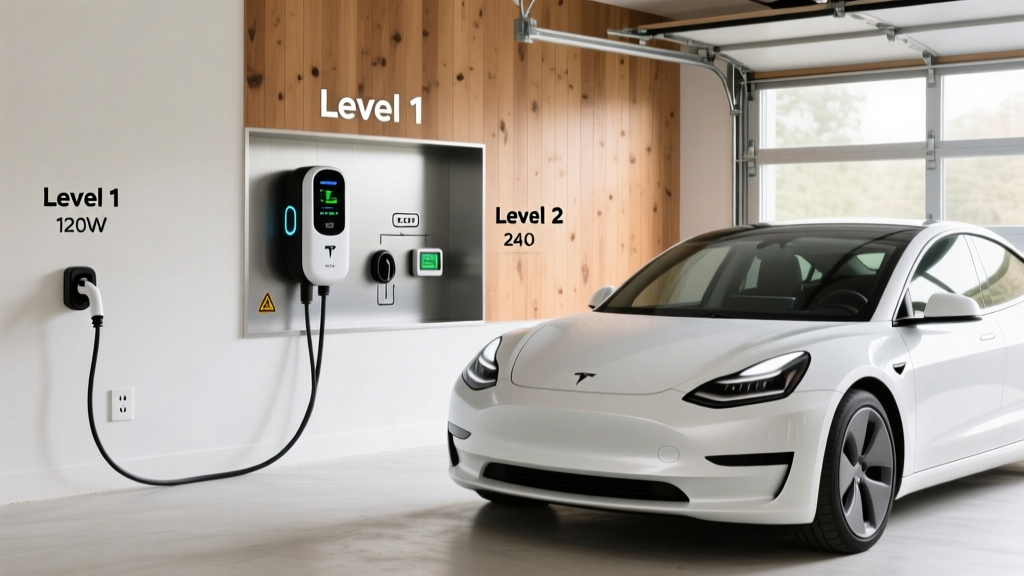
Here’s what each charging level delivers in real-world terms:
| Level | Voltage / Amps | Power (kW) | Miles of Range Added Per Hour | Typical Use Case |
|---|---|---|---|---|
| Level 1 (120V) | 120V / 12A | 1.4 kW | 3–5 miles | Overnight top-up for PHEVs or low-mileage commuters |
| Level 2 (240V) | 240V / 32–48A | 7.7–11.5 kW | 25–44 miles | Daily home charging for all BEVs |
| DC Fast Charging | 400–800V DC | 50–350 kW | 150–1,000+ miles (peak) | Road trips; not installed at home |
Level 1 works fine for plug-in hybrids with 25–40 miles of electric range (like the Toyota RAV4 Prime or Jeep Wrangler 4xe) or for BEV owners who drive under 30 miles daily and can charge over 12+ hours. But for any battery-electric vehicle with a 60–100+ kWh battery, Level 1 is impractical as a primary source — fully recharging an 84 kWh battery at 1.4 kW takes over 60 hours.
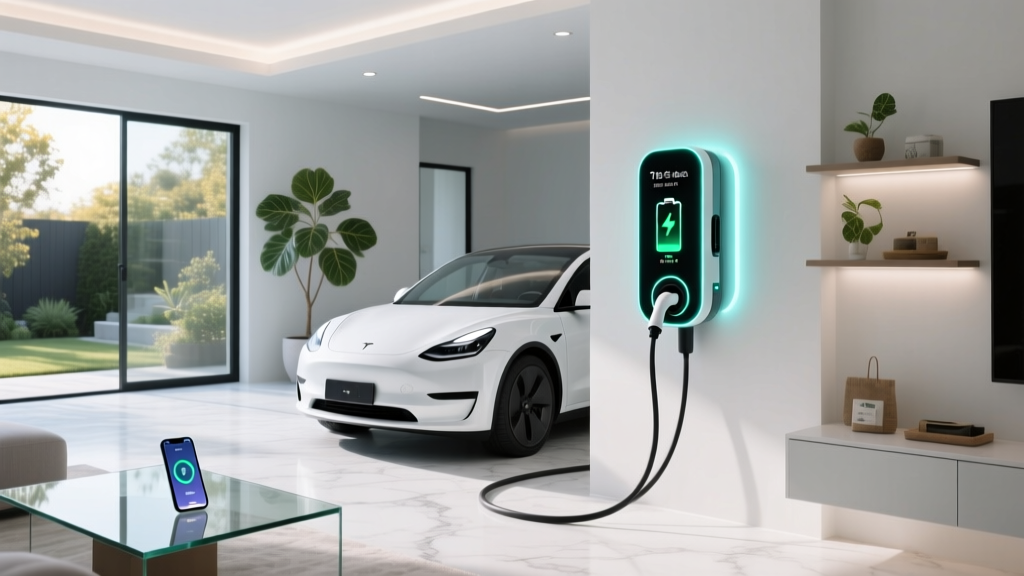
Level 2 at 240V is the standard for home EV charging. A 48-amp station delivering 11.5 kW can replenish roughly 35–44 miles of range per hour, meaning a 300-mile EV like the Tesla Model Y Long Range (75 kWh usable battery) charges from 10–80% in about 5–6 hours — easily overnight.
DC fast charging is what you use on road trips at stations like Tesla Superchargers, Electrify America, or EVgo. These deliver 50–350 kW directly to the battery, enabling 10–80% charges in 15–30 minutes depending on the vehicle’s charge curve. DC fast chargers cost $20,000–$150,000+ and are not residential equipment.
How Much Does It Cost to Install a Home EV Charger?
The total cost to install a Level 2 home charging station ranges from $500 to $2,500+ depending on your electrical panel capacity, the distance from panel to charger location, and local permit fees. Here’s the full breakdown:
| Cost Component | Low End | High End | Notes |
|---|---|---|---|
| Level 2 Charger (Equipment) | $300 | $700 | 32A–48A smart chargers; Wi-Fi-enabled models cost more |
| Electrician Labor | $300 | $1,500 | Depends on run length, wall type, and local rates |
| Electrical Permit | $50 | $200 | Required in most jurisdictions; varies by city/county |
| Panel Upgrade (if needed) | $1,500 | $4,000+ | 100A → 200A service upgrade for older homes |
| Total (No Panel Upgrade) | $650 | $2,400 | Most homes with 200A service fall in this range |
| Total (With Panel Upgrade) | $2,150 | $6,400+ | Common in homes built before 1990 with 100A panels |
What Electrical Upgrades Might You Need?
A Level 2 charger drawing 48 amps requires a dedicated 60-amp circuit on a 240V line (the National Electrical Code requires circuits rated at 125% of the continuous load — so 48A × 1.25 = 60A breaker). A 32-amp charger needs a 40-amp breaker.
Your electrical panel must have enough spare capacity. A 200-amp panel in a modern home typically has room for a 60-amp EV circuit without issue. A 100-amp panel in an older home may already be near capacity running HVAC, an electric dryer, an oven, and a water heater — adding 48 amps of EV charging could overload it, requiring a service upgrade to 200 amps.
Have a licensed electrician perform a load calculation before committing to a charger amperage. If your panel is tight but you don’t want to upgrade, a 32-amp charger on a 40-amp circuit draws significantly less and still adds ~25 miles of range per hour — enough for most daily needs.
Some newer solutions like the Span smart panel or load-management devices (e.g., the Emporia V2 with load monitoring) can dynamically throttle charger draw to avoid overloading the panel, potentially avoiding a costly upgrade. Check with your electrician about whether these are approved in your jurisdiction.
Which Connector Is Compatible With Your EV?
The connector landscape shifted dramatically in 2024–2025 when Ford, GM, Rivian, Volvo, BMW, and most other automakers adopted the North American Charging Standard (NACS) — Tesla’s connector — replacing CCS1 as the dominant standard. By the 2026 model year, nearly all new EVs sold in the U.S. ship with a NACS port natively.
| Connector | Brands Using It (2026) | Adapter Needed? |
|---|---|---|
| NACS (Tesla-style) | Tesla, Ford, GM (Chevy/Cadillac/GMC), Rivian, Volvo, Polestar, BMW, Hyundai/Kia (select 2026+ models), Mercedes-Benz | No — native on most new EVs. CCS-to-NACS adapter for older CCS vehicles. |
| CCS1 | Remaining 2024–2025 models still on road; some 2026 Stellantis, Honda, Nissan models | NACS-to-CCS adapter available if you want Tesla Supercharger access |
| CHAdeMO | Nissan Leaf (legacy only; discontinued in U.S.) | Limited adapter options; CHAdeMO infrastructure declining |
For home charging, this matters less than you might think. Most Level 2 home chargers sold in 2026 come with a NACS connector or offer both NACS and J1772 (the legacy Level 2 connector, now being phased out) options. If your EV has a CCS1 port, you can buy a NACS-to-J1772 or NACS-to-CCS adapter ($100–$250) to use a NACS-terminated home charger, or simply buy a J1772-terminated charger — both still work fine at home since Level 2 speeds don’t stress the connector standard.
For public DC fast charging, the connector choice matters far more. Tesla Superchargers (now open to non-Tesla EVs via the "Open Supercharger" program) use NACS exclusively. Electrify America and EVgo are adding NACS cables alongside CCS. If you drive a CCS-equipped EV in 2026, carry a NACS adapter for maximum network access.
Top Home Charging Stations for 2026: Power, Features, and Price
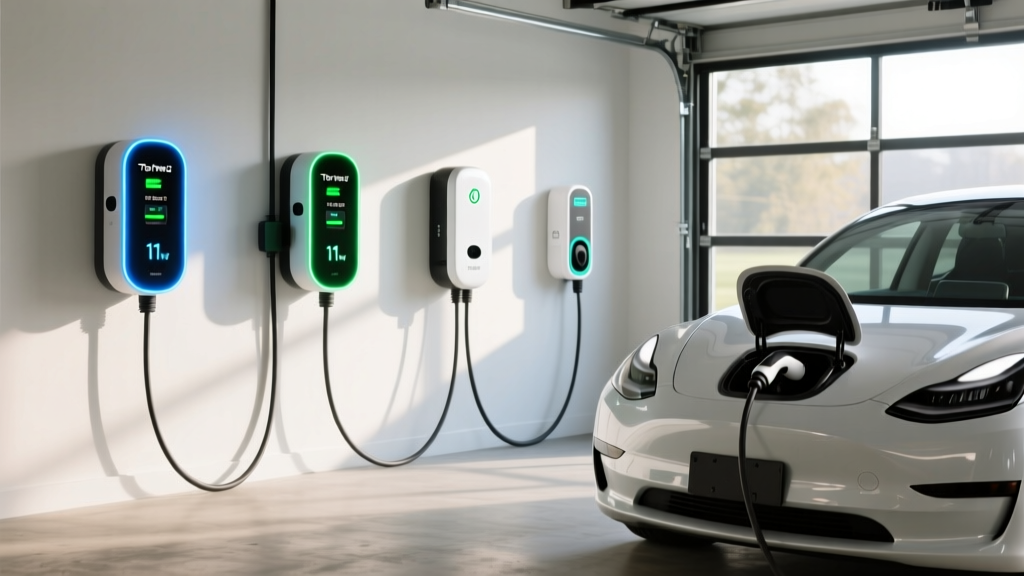
Based on power output, reliability, smart features, and value, here are the top Level 2 home chargers for 2026:
Tesla Wall Connector (Gen 4)
- Power: 11.5 kW (48A)
- Connector: NACS native
- Cable Length: 24 ft
- Smart Features: Wi-Fi, OTA updates, power sharing with second unit, access control
- Price: ~$475
- Best For: Tesla owners and any NACS-equipped EV (Ford, GM, Rivian, etc.)
ChargePoint Home Flex (2nd Gen)
- Power: Up to 12 kW (50A, configurable down to 16A)
- Connector: NACS or J1772 (choose at purchase)
- Cable Length: 23 ft
- Smart Features: Wi-Fi, Alexa/Google integration, scheduling, energy reporting, flexible amperage
- Price: ~$550–$650
- Best For: Homes with limited panel capacity (dial amperage down to match circuit)
Emporia Vue EV Charger
- Power: 11.5 kW (48A)
- Connector: J1772 or NACS (2026 models)
- Cable Length: 24 ft
- Smart Features: Integrated with Emporia energy monitoring, solar-aware charging, load management
- Price: ~$400–$500
- Best For: Solar-panel owners and budget-conscious buyers wanting smart features
Grizzl-E Smart (United Chargers)
- Power: 10 kW (40A)
- Connector: J1772 or NACS
- Cable Length: 24 ft
- Smart Features: Wi-Fi, OCPP-compatible, built-in load balancing, extreme cold rated (-40°F)
- Price: ~$450–$550
- Best For: Cold-climate owners and those wanting open-protocol (non-proprietary) smart charging
Key buying tip: Match charger amperage to your circuit. A 48A charger needs a 60A breaker. If your electrician recommends a 50A breaker, choose a 40A charger. Never exceed 80% of breaker capacity for continuous loads.
How Much Does Home Charging Cost Per Mile vs. Gas?
The cost advantage of home charging is where EV ownership economics make the strongest case. Here’s how common scenarios compare, using the EPA’s fuel economy data and national average energy prices:
| Scenario | Rate | Cost Per Mile (3.5 mi/kWh EV) | Annual Cost (12,000 mi) |
|---|---|---|---|
| Home Off-Peak (Time-of-Use rate) | $0.09/kWh | $0.026 | $312 |
| Home Standard Rate | $0.16/kWh | $0.046 | $552 |
| Public Level 2 (ChargePoint, etc.) | $0.30/kWh | $0.086 | $1,032 |
| DC Fast Charging (Electrify America) | $0.48/kWh | $0.137 | $1,644 |
| Gas Car (28 MPG combined, $3.40/gal) | $3.40/gal | $0.121 | $1,452 |
At home on a standard rate, an EV with average efficiency (3.5 miles per kWh, typical of vehicles like the Hyundai IONIQ 5 or Tesla Model 3) costs roughly $0.05 per mile — less than half the cost of a 28 MPG gas car at $3.40/gallon. On off-peak utility rates (many utilities offer $0.07–$0.10/kWh overnight), that drops to under $0.03 per mile.
Even public DC fast charging at $0.48/kWh is roughly comparable to gas per mile. The savings multiply when you charge at home, which is why a home charging station pays for itself within 1–3 years for most drivers.
Utility tip: Check whether your utility offers a dedicated EV time-of-use (TOU) rate. Many utilities in 2026 — including PG&E, Con Edison, Xcel Energy, and Duke Energy — offer overnight rates as low as $0.06–$0.10/kWh for EV owners who enroll. Combined with smart charger scheduling, this can cut your annual charging cost below $350.
Charging Time Examples: How Long to Charge Common EV Batteries at Home
Charging time depends on battery size (kWh), charger power (kW), and the vehicle’s onboard charger limit. Most 2026 EVs accept 11.5 kW on Level 2, but some are limited to 7.7 kW or 9.6 kW. Here’s what to expect charging from 10% to 80% state of charge at home:
| Vehicle (2026) | Usable Battery | Onboard Charger Limit | 11.5 kW Charger (48A) | 7.7 kW Charger (32A) |
|---|---|---|---|---|
| Tesla Model 3 Long Range | 75 kWh | 11.5 kW | ~4.5 hours | ~6.8 hours |
| Hyundai IONIQ 5 (Long Range) | 77.4 kWh | 10.9 kW | ~5.0 hours | ~7.2 hours |
| Ford F-150 Lightning (Extended) | 131 kWh | 19.2 kW (optional) / 11.3 kW (std) | ~8.0 hours (std) | ~11.5 hours |
| Chevrolet Equinox EV | 85 kWh | 11.5 kW | ~5.1 hours | ~7.7 hours |
| BMW i4 eDrive40 | 81.5 kWh | 11 kW | ~5.2 hours | ~7.5 hours |
Even with the largest batteries (the F-150 Lightning Extended Range at 131 kWh), an overnight charge window of 8–10 hours on an 11.5 kW station replenishes enough energy for 200+ miles of driving — more than most drivers need between charges.
Level 2 home charging also avoids the charge-curve taper you see at DC fast stations. On a DC fast charger, peak kW only applies at low state of charge; above 80%, charging slows dramatically to protect the battery. At home on Level 2, the charge rate stays relatively constant from 10% to ~95%, making it more predictable and gentler on long-term battery health.
Safety, Electrical Code, and Installation Best Practices
Home EV charging involves high-amperage, continuous-load electrical work. Cutting corners risks fire, failed inspections, or voided insurance. Here’s what the National Electrical Code (NEC) and best practices require:
- Dedicated circuit: Your EV charger must have its own dedicated breaker — never shared with other appliances.
- Breaker sizing: 125% of the charger’s rated amperage (48A charger = 60A breaker; 32A charger = 40A breaker).
- Wire gauge: 6 AWG copper for 48A/60A circuits; 8 AWG for 32A/40A circuits (may vary by run length and local code).
- GFCI protection: The 2020 NEC and later require GFCI protection for 240V EV outlets (NEMA 14-50). Hardwired installations may be exempt depending on jurisdiction — ask your electrician.
- Outdoor rating: If installing outdoors, the charger must carry a NEMA 4 or IP65 weather rating. All chargers listed above meet this standard.
- Permit and inspection: Most jurisdictions require an electrical permit and post-installation inspection. Your electrician typically handles this. Don’t skip it — unpermitted work can void homeowner’s insurance claims.
- NEMA 14-50 outlet vs. hardwired: A 14-50 outlet gives you portability (take the charger when you move), but some jurisdictions now require GFCI breakers for outlets, adding $100–$150. Hardwired installations avoid this requirement and provide a cleaner look, but are permanent.
Hire a licensed electrician — preferably one with EV charger installation experience. Ask for a load calculation, a written quote including permit costs, and confirmation they’ll pull the required permits. The International Brotherhood of Electrical Workers (IBEW) and many utilities maintain lists of EV-certified electricians.
Federal Tax Credits and Utility Rebates for Home Charging
As of 2026, the federal Alternative Fuel Vehicle Refueling Property Credit (IRS Form 8911) provides a tax credit of up to 30% of the cost of home EV charging equipment and installation, capped at $1,000. This credit applies to both the charger hardware and the electrician labor.
Key eligibility requirements per IRS guidelines:
- The charger must be installed at your primary residence in the United States.
- The property must be placed in service during the tax year.
- The credit is nonrefundable (it reduces your tax liability to zero but doesn’t generate a refund beyond that).
- Eligibility is restricted to census tracts that are not "high-income" — check the IRS eligibility tool for your address.
Beyond federal credits, many utilities offer direct rebates of $250–$750 for purchasing a smart Level 2 charger, and some (like SMUD, Austin Energy, and National Grid) offer rebates covering part of the installation cost or even free chargers. Check your utility’s EV programs page before purchasing.
Frequently Asked Questions
Can I install a home EV charger myself?
Level 1 (120V) charging requires no installation — just plug into a standard outlet on a dedicated 15A or 20A circuit. Level 2 (240V) installation involves high-amperage wiring, breaker work, and permit requirements. Unless you are a licensed electrician, hire a professional. DIY 240V work that fails inspection or causes a fire will likely void your homeowner’s insurance.
Will a home charger work with any EV I buy in the future?
If you buy a NACS-terminated charger in 2026, it will work natively with nearly all new EVs being sold (Tesla, Ford, GM, Rivian, Volvo, BMW, and expanding). If you buy a future EV with a different connector (unlikely but possible), adapters are available. J1772 chargers remain compatible with older EVs and can use a J1772-to-NACS adapter for newer vehicles.
Does Level 2 home charging degrade my battery faster than Level 1?
No. Level 2 charging at 7.7–11.5 kW generates minimal heat compared to DC fast charging at 150–350 kW. Battery degradation is primarily driven by heat, high state of charge sustained over time, and DC fast charging frequency. Level 2 home charging is well within the safe thermal envelope for both NMC and LFP battery chemistries. Most manufacturers recommend daily charging to 80% for NMC batteries and allow 100% for LFP batteries — check your owner’s manual.
What if I live in an apartment or don’t have a garage?
Outdoor-rated Level 2 chargers can be installed on exterior walls or pedestals in driveways. For apartment dwellers, look into shared charging solutions (your building may qualify for utility or state incentives to install shared Level 2 stations), workplace charging, or rely on public Level 2 and DC fast charging networks. Some cities offer curbside Level 2 charging programs as of 2026.
How do I know if my electrical panel can handle an EV charger?
Check your panel’s main breaker rating (100A or 200A — printed on the main breaker). A 200A panel typically supports a 60A EV circuit. A 100A panel may require an upgrade or a lower-amperage charger (32A on a 40A breaker). A licensed electrician will perform a NEC Article 220 load calculation to determine your panel’s actual spare capacity — this accounts for all existing loads, not just the breaker count.