Why Your Charging Strategy Defines the EV Experience
Whether you're mapping a 600-mile charging road trip across the Midwest or simply plugging in overnight in your garage, understanding EV charging is the single most important skill for any electric-vehicle owner. The difference between a seamless journey and a frustrating one comes down to three things: knowing your charging levels, matching your connector, and planning around real-world charge curves — not marketing peak numbers.
This guide breaks down every charging scenario you'll encounter, from a standard 120V outlet to a 350 kW DC fast charger, with exact speeds, costs, and equipment picks current for the 2026 model year.
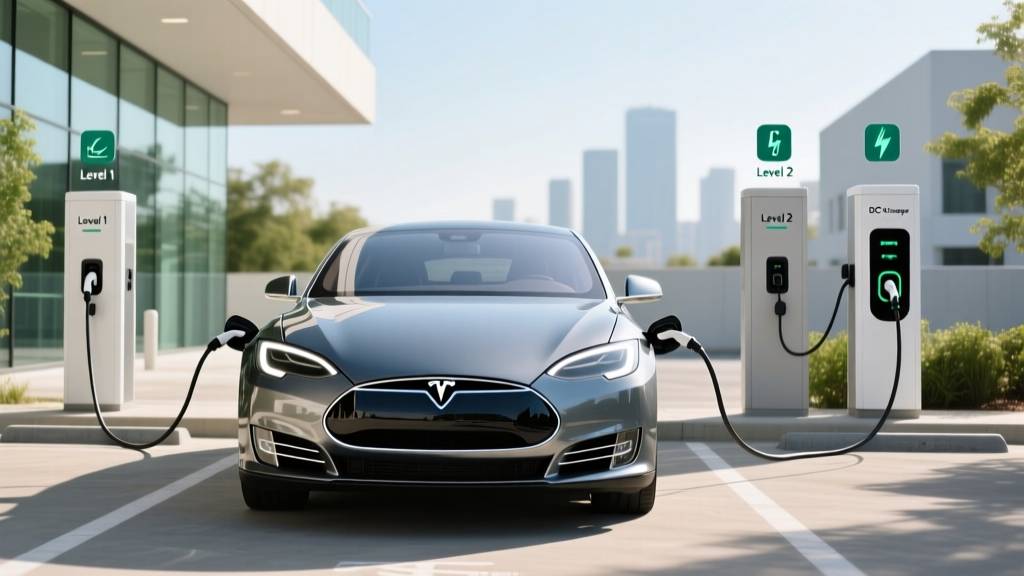
Charging Levels Explained: Speeds, Power, and Real-World Range Added
Before we get into equipment and costs, let's clear up the most common confusion in EV ownership: kW (kilowatts) measures power — how fast energy flows into your battery. kWh (kilowatt-hours) measures energy — the total capacity of your battery, like gallons in a fuel tank. A 75 kWh battery charged at 11 kW takes roughly 7 hours from empty; that same battery at 150 kW (DC fast) can go from 10–80% in about 25 minutes.
| Level | Voltage | Power (kW) | Miles of Range per Hour | Best For |
|---|---|---|---|---|
| Level 1 | 120V AC | 1.0–1.4 kW | 3–5 mi/hr | Overnight top-ups, PHEVs, emergencies |
| Level 2 | 240V AC | 3.3–19.2 kW | 12–75 mi/hr | Daily home/workplace charging |
| DC Fast (Level 3) | 200–500V DC | 50–350 kW | 150–1,200+ mi/hr (peak) | Charging road trips, quick stops |
Real-world caveat: DC fast-charging speeds peak only between roughly 10–40% State of Charge (SoC). Above 80%, the charge curve tapers significantly to protect battery chemistry. A charger rated at 250 kW might average only 120–140 kW across a full 10–80% session. Always plan road-trip stops around 10–80% times, not peak kW claims.
Home Charger Installation: Requirements, Costs, and Panel Gotchas
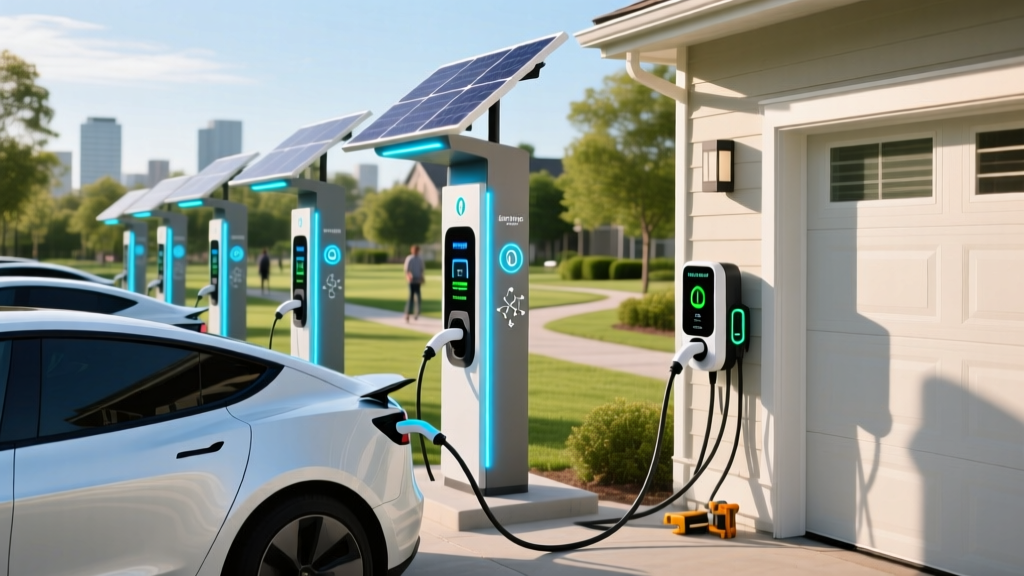
Installing a Level 2 home charger is the single best upgrade for EV ownership. Most daily driving (30–50 miles) is easily replenished overnight, and home electricity rates are typically a fraction of public DC fast-charging prices.
Electrical Requirements
A typical Level 2 home charger requires a 240V dedicated circuit, similar to what an electric dryer or oven uses. The most common setup is a 40-amp or 48-amp circuit on a NEMA 14-50 outlet or hardwired connection. Per the National Electrical Code (NEC), continuous loads like EV chargers must be derated to 80% of the circuit's rated capacity — so a 48A charger needs a 60A breaker.
What Could Drive Your Cost Up: The Panel Upgrade
Homes built before 1990 often have 100A or 125A main electrical panels. Adding a 48A EV circuit to an already-loaded panel may require upgrading to a 200A service — a significant expense. A licensed electrician will perform a load calculation per NEC Article 220 to determine if your panel has headroom. If an upgrade is needed, expect to add $1,500–$4,000 to your project.
| Component | Typical Cost Range | Notes |
|---|---|---|
| Level 2 Charger (Equipment) | $350–$750 | Smart Wi-Fi models at higher end |
| Electrician Labor (standard install) | $400–$1,200 | Depends on run length from panel |
| Electrical Permit | $50–$250 | Varies by municipality |
| Outlet or Hardwire Materials | $50–$150 | NEMA 14-50 receptacle or junction box |
| Total (no panel upgrade) | $850–$2,350 | Average: ~$1,400 |
| Panel Upgrade (if needed) | $1,500–$4,000 | 100A → 200A service upgrade |
| Total (with panel upgrade) | $2,350–$6,350 | Older homes most affected |
Federal incentive: The IRS §30D alternative fuel vehicle refueling property credit can cover up to 30% of home charger equipment and installation costs (capped at $1,000) for eligible taxpayers in qualifying census tracts. Check current eligibility at irs.gov, as rules and qualifying areas are subject to change. Consult a tax professional for your specific situation.
Connector Compatibility: NACS, CCS1, CHAdeMO, and Adapter Realities
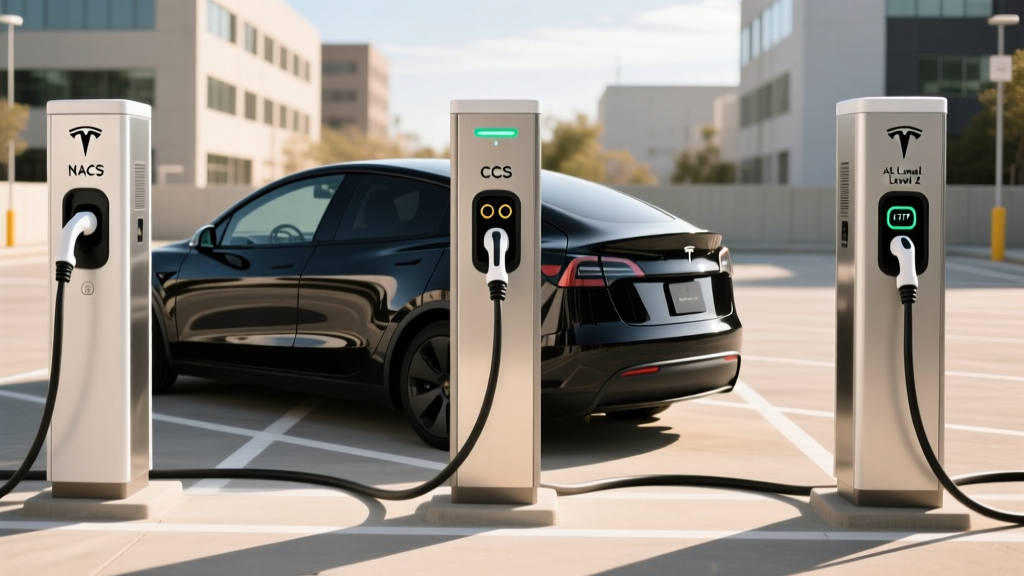
The North American charging landscape has consolidated significantly since 2024, when most major automakers adopted the North American Charging Standard (NACS), originally developed by Tesla. Here's where each connector stands for 2026 model-year vehicles:
| Connector | Brands Using It (Native) | Notes |
|---|---|---|
| NACS (Tesla) | Tesla, Ford, GM, Rivian, Volvo, Polestar, Mercedes, Nissan (new), Honda (new), Fisker | Now dominant standard; access to Tesla Supercharger network |
| CCS1 | Hyundai, Kia, BMW, Volkswagen, Stellantis, Lucid (legacy models) | Still widely available at Electrify America, EVgo; adapters to NACS available |
| CHAdeMO | Nissan Leaf (older), Mitsubishi Outlander PHEV | Being phased out; avoid for new purchases |
Adapter guidance: If your EV has a CCS1 port but you want access to Tesla Superchargers (now open to non-Tesla vehicles via NACS), you'll need a CCS-to-NACS adapter. Ford and GM provide these to owners. Third-party adapters from brands like Lectron and A2Z run $150–$250. Conversely, NACS-equipped EVs can use NACS-to-CCS adapters at Electrify America and other CCS-only stations.
Cost to Charge: Home vs. Public vs. DC Fast — and Per-Mile Comparison to Gas
One of the strongest arguments for EV ownership is fuel-cost savings, but only if you charge strategically. Public DC fast charging on a charging road trip can approach or even exceed gasoline costs per mile in some regions.
| Scenario | Avg $/kWh | Cost for 75 kWh Battery (10–80%) | Cost per Mile (250-mi range EV) |
|---|---|---|---|
| Home (off-peak utility rate) | $0.08–$0.14 | $3.15–$7.35 | $0.03–$0.05 |
| Home (standard rate) | $0.13–$0.20 | $5.10–$10.50 | $0.04–$0.07 |
| Public Level 2 (workplace/mall) | $0.20–$0.35 | $7.80–$18.40 | $0.06–$0.11 |
| DC Fast (Electrify America, EVgo) | $0.35–$0.55 | $13.65–$28.90 | $0.10–$0.17 |
| Tesla Supercharger (avg) | $0.28–$0.40 | $10.90–$21.00 | $0.07–$0.13 |
| Gasoline comparison (30 MPG, $3.40/gal) | — | $29.75 (equivalent) | $0.11 |
The takeaway: Home charging at off-peak rates delivers fuel costs at roughly one-third to one-half what gasoline costs per mile. But frequent DC fast charging on road trips narrows the gap considerably. For maximum savings, prioritize home and workplace Level 2 charging and use DC fast charging selectively for longer trips.
Charging Times for Common Battery Sizes: What to Actually Expect
Marketing materials highlight peak charge rates, but real charging sessions follow a curve. Here are realistic 10–80% charge times for common EV battery capacities at different charging speeds:
| Battery Size (usable kWh) | Example Vehicles | Level 2 (11.5 kW) | DC Fast 150 kW (avg) | DC Fast 250 kW (avg) | DC Fast 350 kW (avg) |
|---|---|---|---|---|---|
| 58 kWh | VW ID.4 Std, base Hyundai Kona EV | ~3.5 hrs | ~28 min | ~22 min | N/A (vehicle-limited) |
| 75 kWh | Tesla Model Y LR, Ford Mustang Mach-E ER | ~4.6 hrs | ~32 min | ~24 min | N/A (vehicle-limited) |
| 84–90 kWh | Hyundai Ioniq 5, Kia EV6, BMW iX | ~5.3 hrs | ~35 min | ~18 min | ~18 min (800V arch) |
| 100+ kWh | Tesla Model S, GMC Hummer EV, Lucid Air | ~6.5+ hrs | ~42 min | ~28 min | ~20 min (where supported) |
Preconditioning matters: Many EVs (Tesla, Hyundai/Kia 800V models, BMW) will precondition the battery — warming it to optimal temperature — when you navigate to a DC fast charger. In cold weather (below 40°F), preconditioning can cut your 10–80% time by 30–50%. Always use your car's built-in navigation to route to a charger, as this triggers preconditioning automatically.
Equipment Picks: Best Home Level 2 Chargers for 2026
Here are four proven Level 2 chargers suited to different needs and budgets. All support 240V and come with appropriate safety certifications (UL or ETL listed).
Tesla Wall Connector (Gen 4)
Power Output: Up to 11.5 kW (48A) on a 60A circuit
Connector: NACS native; CCS adapter included in box
Cable Length: 24 ft
Smart Features: Wi-Fi, OTA updates, load sharing (pair up to 6 units on one circuit), access control, energy tracking via Tesla app
Price: ~$475
Best For: Tesla owners and NACS-equipped EVs; best value-to-feature ratio
ChargePoint Home Flex
Power Output: Up to 12 kW (50A) configurable on 40A–60A circuits
Connector: NACS or CCS1 (configurable at purchase)
Cable Length: 23 ft
Smart Features: Wi-Fi, ChargePoint app scheduling, utility demand-response programs, Alexa integration
Price: ~$550–$650
Best For: Non-Tesla EV owners wanting utility integration and flexible amperage
Emporia Vue Level 2 Charger
Power Output: Up to 11.5 kW (48A) on a 60A circuit
Connector: NACS or J1772 (CCS adapter available)
Cable Length: 24 ft
Smart Features: Wi-Fi, Emporia energy dashboard (pairs with Emporia Vue home energy monitor), solar-aware charging, time-of-use scheduling
Price: ~$400
Best For: Budget-conscious buyers and solar-panel owners who want energy tracking
Grizzl-E Smart
Power Output: Up to 10 kW (40A) on a 50A circuit
Connector: NACS or J1772
Cable Length: 24 ft
Smart Features: Wi-Fi, OCPP-compatible (works with utility programs), adjustable amperage, rugged aluminum enclosure
Price: ~$450
Best For: Outdoor installations and extreme climates (rated -40°F to 122°F); Canadian-built
Safety and Electrical Code: What Your Installation Must Include
EV charging draws sustained high current for hours — this is not the same as plugging in a phone. Proper installation isn't optional; it's a safety and insurance requirement.
- Dedicated circuit: Your Level 2 charger must be on its own dedicated breaker — never shared with other appliances.
- GFCI protection: NEC 2023/2026 requires Ground Fault Circuit Interrupter protection for all EV charging outlets. Hardwired chargers with built-in GFCI may satisfy this; confirm with your electrician and local inspector.
- Outdoor rating: If your charger is installed outside (garage exterior, driveway), it must carry a NEMA 4 or IP65 weather rating. All four chargers recommended above meet this standard.
- Wire gauge: A 48A charger on a 60A circuit typically requires 6 AWG copper wire (THHN in conduit or NM-B). Longer runs may need 4 AWG to prevent voltage drop. Your electrician will calculate this.
- Permit and inspection: Nearly all jurisdictions require an electrical permit for EV charger installation. Skipping this can void your homeowner's insurance in the event of a fire and may cause issues at home sale.
Planning a Charging Road Trip: Strategy Beyond the Plug
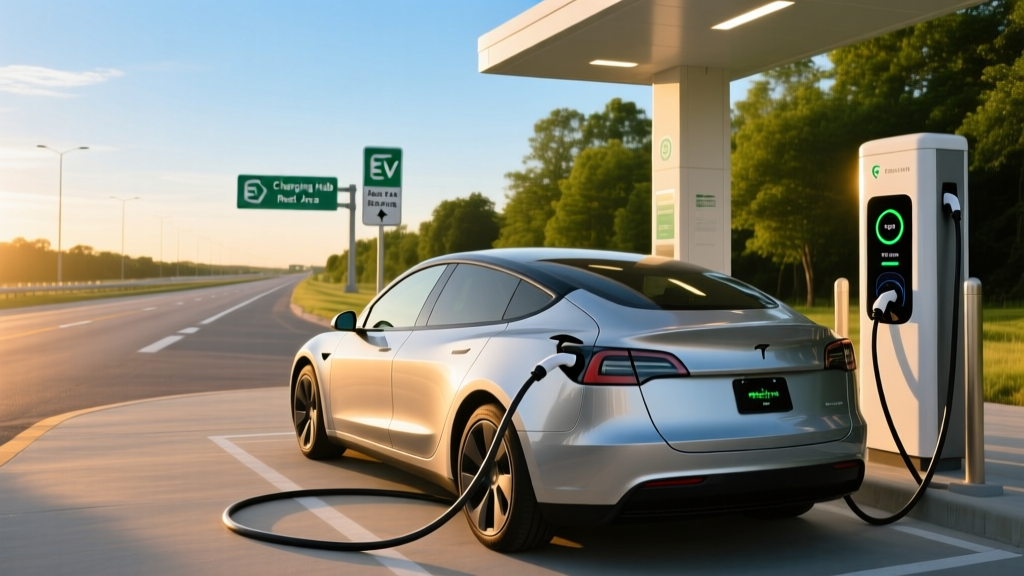
Long-distance EV travel in 2026 is practical, but it rewards preparation. Here's a framework for mapping any charging road trip:
- Use your car's native route planner first. Tesla, Hyundai, BMW, and Ford all integrate charger routing with battery preconditioning. Third-party apps like A Better Routeplanner (ABRP) are excellent for non-integrated vehicles.
- Plan stops at 10–80%. Charging from 80–100% on DC fast chargers can take as long as 10–80% due to the taper. Stop at ~15–20% SoC, charge to 80%, and move on.
- Target chargers with amenities. A 20–25 minute stop is ideal for a rest break, food, or restroom. Prioritize stations near restaurants or shopping centers.
- Check real-time charger status. Use PlugShare, ChargePoint, or the network's app to verify that chargers at your planned stop are operational before you arrive. Reliability on Electrify America and EVgo has improved but isn't perfect.
- Cold-weather buffer: In winter, add a 25–35% range buffer. A car rated at 300 miles EPA may deliver 200–225 miles at 70 mph in 20°F weather due to battery resistance and cabin heating load. See fueleconomy.gov for EPA efficiency data by model.
Frequently Asked Questions
How much does it cost to install a home EV charger?
A standard Level 2 home charger installation costs between $850 and $2,350 when no panel upgrade is needed. This includes the charger unit ($350–$750), electrician labor ($400–$1,200), permit ($50–$250), and materials. If your home needs a 200A panel upgrade, add $1,500–$4,000, bringing the total to $2,350–$6,350.
How fast will each charging level add range?
Level 1 (120V) adds 3–5 miles per hour. Level 2 (240V) adds 12–75 miles per hour depending on amperage (a typical 48A/11.5 kW charger adds ~35–45 miles per hour for most EVs). DC fast charging can add 150–300+ miles in 20–30 minutes depending on the vehicle's charge acceptance rate and battery size.
Which connector/charger is compatible with my EV?
For 2026 models: Tesla, Ford, GM, Rivian, Volvo, and most new Honda/Nissan models use NACS. Hyundai, Kia, BMW, and VW largely use CCS1. CHAdeMO is limited to older Nissan Leafs and is being phased out. Check your vehicle's charge port or owner's manual, and purchase an adapter if you need cross-network access.
How much does charging cost per mile vs gas?
Home charging at average rates ($0.13–$0.20/kWh) costs roughly $0.04–$0.07 per mile for a typical EV — about one-third to one-half the cost of gasoline at $3.40/gallon in a 30 MPG car ($0.11/mile). Public DC fast charging at $0.35–$0.55/kWh costs $0.10–$0.17/mile, which can approach or exceed gas costs.
What electrical upgrades might I need?
If your home has a 100A or 125A electrical panel and is already running central AC, an electric dryer, and an electric range, you may need a panel upgrade to 200A. A licensed electrician will perform an NEC Article 220 load calculation. Some utilities offer rebates for panel upgrades that support EV adoption — check with your local provider.