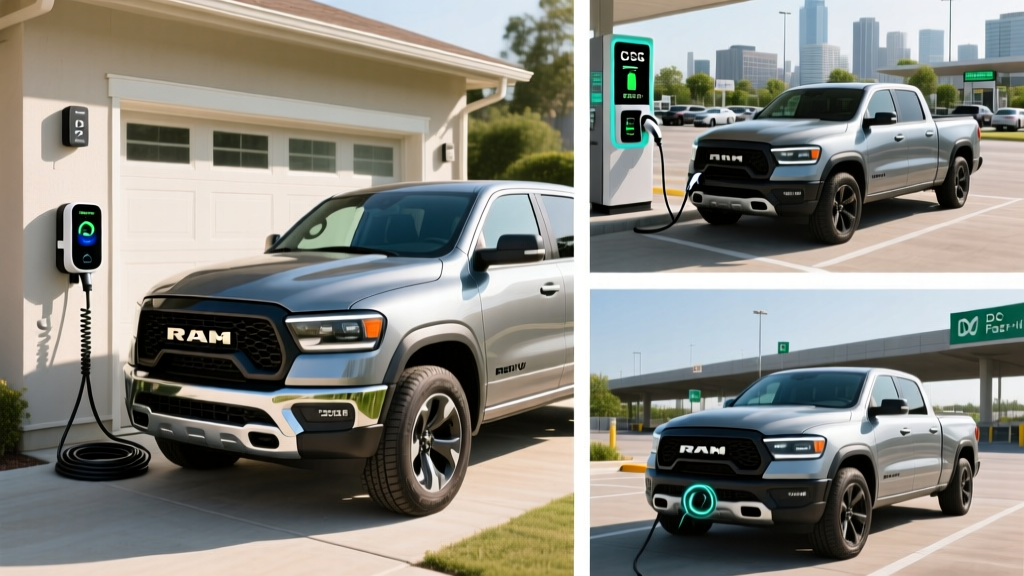
The RAM 1500 REV is one of the first full-size electric pickups to challenge the notion that trucks and EVs don't mix. With a 98 kWh usable battery (extended-range option: 173 kWh) and EPA-estimated range up to 350 miles, it's built for real work and real road trips. But owning an electric truck means rethinking how you fuel up — and that starts with understanding exactly what charging looks like at home, in public, and on the highway.
This guide breaks down every charging scenario RAM 1500 REV owners face: Level 1 trickle charging, Level 2 home setups (including electrical requirements and installation costs), DC fast charging speeds, connector compatibility, and the real math on cost per mile versus a gas RAM 1500.
RAM 1500 REV Charging Hardware at a Glance
Before diving into scenarios, here's the RAM 1500 REV's charging hardware spec sheet. These numbers define what's physically possible with the truck's onboard charger and battery management system.
| Spec | Standard Range (98 kWh) | Extended Range (173 kWh) |
|---|---|---|
| Battery Chemistry | NMC (Nickel Manganese Cobalt) | NMC |
| Usable Capacity | 98 kWh | 173 kWh |
| Max DC Fast Charge Rate | 150 kW peak | 150 kW peak |
| 10–80% DC Fast Time | ~41 minutes | ~65 minutes |
| Onboard Charger (Level 2) | 11.5 kW (48A at 240V) | 11.5 kW (48A at 240V) |
| Level 2 Full Charge Time | ~9.5 hours (0–100%) | ~16 hours (0–100%) |
| Charge Port / Connector | CCS1 (NACS via adapter) | CCS1 (NACS via adapter) |
| EPA Range | ~230 miles | ~350 miles |
| Battery Warranty | 8 years / 100,000 miles | 8 years / 100,000 miles |
Real-world range note: The EPA 350-mile figure for the extended-range model assumes mixed driving. On sustained highway runs at 75 mph, expect roughly 280–310 miles. In cold weather (below 32°F), battery efficiency drops 15–25%, meaning a 350-mile sticker can realistically deliver 260–290 miles in winter conditions. Towing a trailer cuts range further — plan for 40–50% reduction under heavy load.
Charging Levels Explained: Speeds, Power, and Range Added
EV charging operates at three distinct levels. Understanding the difference between kW (power — the rate of energy delivery) and kWh (energy — the total capacity of your battery) is essential. Think of kW as the width of a hose and kWh as the size of the bucket you're filling.
| Level | Voltage | Power (kW) | Miles of Range Added per Hour | Typical Use Case |
|---|---|---|---|---|
| Level 1 | 120V AC | 1.2–1.4 kW | 3–5 miles | Emergency / overnight trickle |
| Level 2 | 240V AC | 7.2–11.5 kW | 25–40 miles | Home daily charging |
| DC Fast Charge | 400V+ DC | 50–150+ kW | 150–350+ miles | Road trips / highway stops |
The RAM 1500 REV's 11.5 kW onboard charger means it can accept the full output of a 48-amp Level 2 home charger — one of the faster AC charge rates among electric trucks. This matters because it lets you recover roughly 35–40 miles of range per hour plugged in at home.
Level 2 Home Charging: Installation, Electrical Requirements, and Cost
Home Level 2 charging is where the RAM 1500 REV makes the most sense economically. You'll wake up every morning with a full battery, and your cost per mile drops to a fraction of gasoline. But getting a Level 2 charger installed properly requires understanding your home's electrical system.
Electrical Requirements
To deliver the RAM 1500 REV's maximum 11.5 kW AC charge rate, you need:
- Circuit: Dedicated 60-amp breaker (EV chargers are continuous loads, so the circuit must be rated at 125% of the charger's max draw — a 48A charger requires a 60A circuit)
- Wiring: 6 AWG copper wire (or 4 AWG aluminum) from your panel to the charger location
- Voltage: 240V single-phase (standard US residential split-phase)
- Panel capacity: Your main electrical panel must have both a spare double-pole slot and sufficient amperage headroom. A 200-amp service panel is typically sufficient; older 100-amp panels may require an upgrade.
Panel Upgrade: The Hidden Cost
Many homes built before 2000 have 100-amp or 150-amp electrical panels. Adding a 60-amp EV circuit to an already-loaded panel can exceed the panel's rated capacity, requiring an upgrade to 200 amps. This is the single biggest variable in home charger installation cost.
| Component | Cost Range | Notes |
|---|---|---|
| Level 2 Charger (hardware) | $400 – $750 | 40A–48A smart chargers; Wi-Fi enabled |
| Electrician labor (standard install) | $500 – $1,500 | Varies by run length from panel to garage |
| Electrical permit | $50 – $200 | Required in most jurisdictions; inspected |
| Panel upgrade (if needed) | $1,500 – $3,500 | 100A → 200A service upgrade |
| Total (no panel upgrade) | $950 – $2,450 | Most common scenario for newer homes |
| Total (with panel upgrade) | $2,450 – $5,950 | Older homes with 100A service |
Tip: Some utilities offer rebates of $250–$500 for Level 2 charger installation, and the federal Residential Clean Energy Credit may cover up to 30% of charger hardware and installation costs (up to $1,000) through 2032, subject to eligibility. Check IRS Publication 5695 and consult a tax professional for your specific situation.
Safety and Code Considerations
- Dedicated circuit: Your EV charger must be on its own dedicated breaker — never shared with other appliances.
- GFCI protection: NEC 2023 and later require GFCI protection for all EV charging outlets (hardwired chargers may have GFCI built in).
- Outdoor rating: If installing outside, ensure the charger is rated NEMA 4 (weatherproof). The ChargePoint Home Flex and Emporia Vue are rated for outdoor use.
- Cable management: Choose a charger with at least 18–24 feet of cable to reach your RAM 1500 REV's charge port regardless of parking orientation.
Equipment Recommendations: Best Level 2 Chargers for RAM 1500 REV
Not all Level 2 chargers are equal. The RAM 1500 REV's 11.5 kW onboard charger can utilize up to 48 amps — so a 48A charger will extract maximum charging speed from your home setup. Here are the top options for 2026:
ChargePoint Home Flex
- Max Power: 12 kW (50A / 240V)
- Connector: J1772 (CCS-compatible; NACS with adapter)
- Cable Length: 23 feet
- Smart Features: Wi-Fi, app scheduling, Alexa integration, energy reports
- Price: ~$550–$650
- Best For: Reliability, utility demand-response programs
Emporia Level 2 EV Charger
- Max Power: 11.5 kW (48A / 240V)
- Connector: J1772
- Cable Length: 24 feet
- Smart Features: Wi-Fi, solar integration, real-time energy monitoring, load management
- Price: ~$400–$500
- Best For: Solar-home owners, budget-conscious buyers
Grizzl-E Smart
- Max Power: 10 kW (40A / 240V)
- Connector: J1772
- Cable Length: 24 feet
- Smart Features: OCPP-compatible, app control, adjustable amperage
- Price: ~$450–$550
- Best For: Cold climates (rated to -40°F), rugged outdoor use
Tesla Wall Connector (with adapter)
- Max Power: 11.5 kW (48A / 240V)
- Connector: NACS (requires J1772-to-NACS adapter for RAM 1500 REV)
- Cable Length: 24 feet
- Smart Features: Wi-Fi, power sharing between units, OTA updates
- Price: ~$425–$475
- Best For: Multi-EV households with both Tesla and non-Tesla vehicles
Connector Compatibility: NACS, CCS1, and Adapter Needs
The RAM 1500 REV ships with a CCS1 (Combined Charging System) charge port. This is the standard connector used by most non-Tesla EVs in North America. However, the charging infrastructure is rapidly shifting toward NACS (North American Charging Standard, pioneered by Tesla). Here's what that means for you:
| Connector | Used By | RAM 1500 REV Compatible? | Adapter Needed? |
|---|---|---|---|
| CCS1 | Most non-Tesla EVs (Ford, GM, Hyundai, VW, RAM) | Yes — native | No |
| NACS (Tesla) | Tesla, and new 2025+ models from Ford, GM, Rivian, Volvo, others | Yes — via adapter | Yes — NACS-to-CCS1 adapter (~$200–$300) |
| CHAdeMO | Nissan Leaf, Mitsubishi Outlander PHEV (legacy) | No | N/A — being phased out |
| J1772 (AC only) | All EVs (Level 1 & 2 AC charging) | Yes — native | No |
Why the NACS adapter matters: Tesla's Supercharger network has over 25,000 stalls in North America and is widely regarded as the most reliable public DC fast charging network. As of 2025, Tesla has opened Superchargers to non-Tesla EVs via the Tesla app — but only at stations equipped with a built-in CCS1 cable ("Magic Dock") or when you bring your own NACS-to-CCS1 adapter. RAM has indicated it will offer a first-party adapter; third-party options from Lectron and A2Z are also available.
For home Level 2 charging, the connector is a non-issue: all Level 2 chargers use the J1772 standard, which plugs directly into the RAM 1500 REV's CCS port (the J1772 portion sits in the upper section of the CCS inlet).
Cost to Charge: Home vs. Public vs. Gas Comparison
The economics of EV ownership hinge on charging costs. Here's how the RAM 1500 REV stacks up against its gasoline counterpart, the RAM 1500 with the 3.6L V6 (20 MPG combined, per fueleconomy.gov).
| Scenario | Rate | Cost per Full Charge (98 kWh) | Cost per Mile |
|---|---|---|---|
| Home — Off-Peak (utility rate) | $0.08/kWh | $7.84 | $0.034 |
| Home — Average US Rate | $0.16/kWh | $15.68 | $0.068 |
| Public Level 2 (ChargePoint, EVgo) | $0.25–$0.40/kWh | $24.50–$39.20 | $0.11–$0.17 |
| DC Fast Charge (Electrify America, EVgo) | $0.35–$0.55/kWh | $34.30–$53.90 | $0.15–$0.23 |
| Gas RAM 1500 V6 (20 MPG) | $3.40/gallon | N/A | $0.17 |
The takeaway: Charging at home on an off-peak rate delivers the RAM 1500 REV at roughly $0.03–$0.07 per mile — a 60–80% savings versus gas. Even public DC fast charging at $0.45/kWh ($0.20/mile) is comparable to or slightly more than gasoline. The math strongly favors home charging.
For the extended-range 173 kWh battery, multiply these costs by roughly 1.77x for a full charge — but remember you're also getting 350 miles of range instead of 230, so the per-mile cost stays the same.
DC Fast Charging: What to Expect on Road Trips
The RAM 1500 REV's 150 kW peak DC fast charge rate is competitive but not class-leading. For comparison, the Hyundai Ioniq 5 peaks at 240 kW, and the Tesla Cybertruck at roughly 250 kW. However, 150 kW still delivers meaningful range recovery on highway stops.
Here's what typical DC fast charging sessions look like:
| Battery | 10–80% Time | Range Added in 20 Minutes | Range Added in 30 Minutes |
|---|---|---|---|
| Standard (98 kWh) | ~41 minutes | ~110 miles | ~160 miles |
| Extended (173 kWh) | ~65 minutes | ~130 miles | ~210 miles |
Charge curve reality: Expect to see peak rates of 130–150 kW between 10–35% SoC. From 35–60%, the rate typically drops to 80–100 kW. Above 80%, it falls below 40 kW. This is normal battery management — lithium-ion cells charge fastest when empty and slow down as they fill to prevent heat damage and preserve long-term battery health.
Preconditioning tip: If your RAM 1500 REV supports navigation-based battery preconditioning, always enter your DC fast charging destination into the nav system. The truck will warm the battery to optimal temperature before arrival, which can shave 5–10 minutes off your charge time, especially in cold weather.
Frequently Asked Questions
How much does it cost to install a home EV charger for the RAM 1500 REV?
Expect $950–$2,450 for a standard installation (Level 2 charger hardware, electrician labor, and permit) if your electrical panel has sufficient capacity. If your home needs a panel upgrade from 100A to 200A service, add $1,500–$3,500. Always get at least two quotes from licensed electricians, and verify they have specific EV charger installation experience.
How fast will each charging level add range to the RAM 1500 REV?
Level 1 (120V) adds 3–5 miles per hour — useful only for overnight top-ups or emergencies. Level 2 (240V, 48A) adds 35–40 miles per hour, fully recharging the standard battery overnight in ~9.5 hours. DC fast charging at 150 kW adds up to 150+ miles in a 20-minute session (10–80% in ~41 minutes for the standard battery).
Which connector is compatible with my RAM 1500 REV?
The RAM 1500 REV uses a CCS1 connector natively. This works with all Electrify America, EVgo, and ChargePoint DC fast stations. For Tesla Supercharger access, you'll need a NACS-to-CCS1 adapter (expected cost: $200–$300). For home Level 2 charging, any J1772 charger plugs directly into the CCS port.
How much does charging the RAM 1500 REV cost per mile vs. gas?
At home on the US average electricity rate ($0.16/kWh), the RAM 1500 REV costs roughly $0.07 per mile. A gas RAM 1500 V6 at 20 MPG with gas at $3.40/gallon costs $0.17 per mile. Home charging saves roughly 60% per mile. Public DC fast charging at $0.45/kWh costs ~$0.20/mile — slightly more than gas, so it's best reserved for road trips.
What electrical upgrades might I need for a home charger?
The most common upgrade is a panel amperage increase (100A → 200A), which costs $1,500–$3,500 and is needed when your existing panel lacks headroom for a 60-amp dedicated EV circuit. You may also need a new conduit run if the distance from your panel to the garage exceeds 50 feet (adds $300–$800 in wire and labor). A licensed electrician can assess your panel with a load calculation before you commit.
Does the RAM 1500 REV qualify for the federal EV tax credit?
The RAM 1500 REV's eligibility for the §30D New Clean Vehicle Credit depends on battery component sourcing, critical mineral requirements, MSRP caps ($80,000 for trucks), and buyer income limits ($300,000 joint / $150,000 single). As of 2026, credit amounts range from $0 to $7,500 depending on sourcing compliance. The credit can be transferred to the dealer as a point-of-sale discount. Always verify current eligibility on the IRS website and consult a tax professional before purchasing.
Sources: RAM Trucks official specifications, fueleconomy.gov (US EPA), IRS §30D Clean Vehicle Credit. All specs reflect 2026 model-year data available at time of publication. Real-world range and charging times vary based on temperature, driving style, and infrastructure conditions.