Buying one of the longest range EVs of 2025 — like the Lucid Air Grand Touring (516 miles EPA), Tesla Model S Long Range (402 miles), or Chevrolet Silverado EV 4WT (492 miles) — solves half the ownership equation. The other half is charging infrastructure. A 118 kWh battery pack is an asset only if you can replenish it efficiently at home and on the road.
This guide breaks down exactly what it takes to charge high-capacity EV batteries: charging speeds in kW (power — the rate of energy flow) versus kWh (energy — what your battery stores), home installation realities, connector compatibility across brands, and the real cost per mile compared to gasoline.
Charging Levels Explained: Speeds, kW, and Miles Per Hour
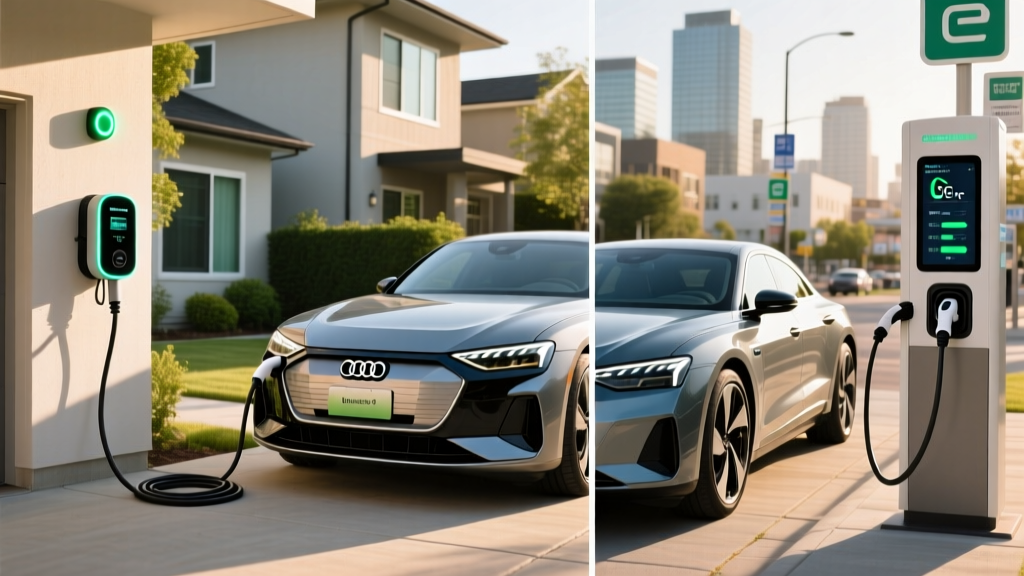
Every EV owner needs to understand three charging tiers. The difference between them determines whether you wake up with a full battery or wait hours at a public station.
| Level | Voltage | Power (kW) | Miles of Range Per Hour | Best For |
|---|---|---|---|---|
| Level 1 | 120V AC | 1.0–1.4 kW | 3–5 miles | Overnight top-ups, PHEVs, emergency |
| Level 2 | 240V AC | 7.2–19.2 kW | 25–75 miles | Daily home charging, workplace |
| DC Fast Charge | 400–900V DC | 50–350 kW | 150–1,200+ miles/hr (peak) | Road trips, rapid replenishment |
Critical distinction: kW (kilowatts) measures power — how fast energy flows into your battery. kWh (kilowatt-hours) measures energy capacity — how much your battery holds. A Lucid Air Grand Touring has a 118 kWh usable battery. Charging it at 11.5 kW (a typical Level 2 home charger) from empty to full takes roughly 10.3 hours. At a 250 kW DC fast charger, a 10–80% session takes approximately 20–25 minutes, though the charge curve tapers significantly above 80% State of Charge (SoC) to protect battery health.
Home Charger Installation: Electrical Requirements and Costs
Installing a Level 2 home charger is the single highest-impact upgrade for EV ownership. Here's what's involved electrically and financially.
Electrical Requirements
A standard Level 2 home charger requires a 240V dedicated circuit, identical to what powers an electric dryer or oven. Common amperage configurations:
- 40A circuit / 32A continuous: Delivers 7.7 kW — sufficient for most EVs overnight
- 50A circuit / 40A continuous: Delivers 9.6 kW — ideal for large-battery EVs (100+ kWh)
- 60A circuit / 48A continuous: Delivers 11.5 kW — fastest residential single-phase option
- 80A circuit / 64A continuous: Delivers 15.4–19.2 kW — requires 100A+ panel capacity; offered by chargers like the Tesla Wall Connector (on 60A breaker for 48A continuous, or hardwired at higher amperage)
Panel upgrade reality: Most homes built before 2000 have 100A or 150A main electrical panels. Adding a 60A EV circuit alongside existing loads (HVAC, electric range, dryer) may exceed your panel's capacity. A panel upgrade to 200A costs $1,500–$3,500 and is the single largest variable in installation pricing. Have a licensed electrician perform a load calculation before committing to a charger amperage.
Installation Cost Breakdown
| Component | Basic Install (Near Panel) | Complex Install (Long Run / Panel Upgrade) |
|---|---|---|
| Level 2 Charger Equipment | $350–$500 | $500–$750 |
| Electrician Labor | $300–$600 | $800–$2,000 |
| Electrical Permit | $50–$150 | $50–$200 |
| Conduit/Wire (if long run) | $100–$300 | $300–$800 |
| Panel Upgrade (if needed) | $0 | $1,500–$3,500 |
| Total | $800–$1,550 | $3,150–$7,250 |
Many utility companies offer rebates of $250–$1,000 for Level 2 charger installation, and some states provide additional incentives. The federal Residential Clean Energy Credit does not cover EV chargers after 2022 for most installations, though the Alternative Fuel Vehicle Refueling Property Credit (IRS Form 8911) may cover 30% of charger hardware costs up to $1,000 in eligible census tracts — consult a tax professional.
Connector Compatibility: NACS, CCS1, and CHAdeMO
The North American charging connector landscape has consolidated significantly. Here's what fits the longest range EVs of 2025:
| Connector | Brands Using It (Native) | DC Fast Charge Max | Notes |
|---|---|---|---|
| NACS (Tesla / J3400) | Tesla, Ford, GM, Rivian, Volvo, Polestar, Mercedes, BMW, Hyundai/Kia (2025+), Lucid (2025+) | Up to 350 kW (at compatible stations) | Now the SAE J3400 standard; dominant in North America |
| CCS1 | Legacy VW ID.4, older Hyundai/Kia, Stellantis, some BMW | Up to 350 kW | Being phased out; adapters available to NACS stations |
| CHAdeMO | Nissan Leaf (discontinued), Mitsubishi Outlander PHEV | Up to 100 kW (typically 50 kW) | Effectively deprecated in North America |
Adapter guidance: If you own a CCS1-equipped EV (e.g., 2024 Hyundai Ioniq 5), you'll need a CCS-to-NACS adapter ($150–$250) to access Tesla Supercharger stations, which now welcome non-Tesla vehicles via the NACS standard. Most 2025+ models ship with NACS ports natively. For home Level 2 charging, all EVs use the J1772 connector (or NACS, which integrates J1772 signaling) — no adapter needed.
Charging the Biggest Batteries: 10–80% Times for Long-Range EVs
The longest range EVs of 2025 carry massive battery packs. Here's how long they take to charge at each level:
| Vehicle | Battery (kWh Usable) | EPA Range | Peak DC kW | DC Fast 10–80% | Level 2 (11.5 kW) |
|---|---|---|---|---|---|
| Lucid Air Grand Touring | 118 kWh | 516 mi | ~300 kW | ~20–25 min | ~7.2 hours (0–100%) |
| Chevy Silverado EV 4WT | ~200 kWh | 492 mi | 350 kW | ~30–40 min | ~13+ hours (0–100%) |
| Tesla Model S Long Range | ~100 kWh | 402 mi | 250 kW | ~25–30 min | ~6.5 hours (0–100%) |
| Rivian R1T Dual Max | 141 kWh | 410 mi | ~200 kW | ~35–42 min | ~9 hours (0–100%) |
| Mercedes EQS 580 | 108.4 kWh | 390 mi | 200 kW | ~31–35 min | ~7 hours (0–100%) |
Cost Per Mile: EV Charging vs. Gasoline
The economic case for charging the longest range EVs of 2025 depends heavily on where and when you plug in.
| Scenario | $/kWh | Cost to Add 200 mi* | Cost Per Mile | vs. Gas (28 MPG @ $3.40/gal) |
|---|---|---|---|---|
| Home Off-Peak (Time-of-Use rate) | $0.08–$0.12 | $4.80–$7.20 | $0.024–$0.036 | 80–70% cheaper |
| Home Standard Rate | $0.13–$0.18 | $7.80–$10.80 | $0.039–$0.054 | 68–55% cheaper |
| Public Level 2 (ChargePoint, etc.) | $0.20–$0.35 | $12.00–$21.00 | $0.060–$0.105 | 50–13% cheaper |
| DC Fast (Electrify America, EVgo) | $0.30–$0.55 | $18.00–$33.00 | $0.090–$0.165 | 25% cheaper to 36% more expensive |
| Tesla Supercharger (member rate) | $0.25–$0.35 | $15.00–$21.00 | $0.075–$0.105 | 38–13% cheaper |
| Gasoline Baseline (28 MPG) | — | $24.29 | $0.121 | — |
*Based on 3.0–3.5 mi/kWh efficiency typical of large luxury EVs (Lucid Air achieves ~4.0 mi/kWh; Silverado EV closer to 2.5 mi/kWh due to weight and aerodynamics).
The takeaway: home charging makes even the largest battery packs economically compelling. A Lucid Air owner charging exclusively at home off-peak rates spends roughly $450–$600/year on electricity for 15,000 miles of driving. The equivalent gasoline vehicle at 28 MPG costs $1,821/year. However, relying exclusively on DC fast charging erases most savings — a scenario relevant only for frequent road trippers or apartment dwellers without home charging access.
Recommended Home Charging Equipment
Not all Level 2 chargers are equal. Here are tested picks for owners of high-capacity, long-range EVs:
Tesla Wall Connector (J3400/NACS)
- Power: Up to 11.5 kW (48A on 60A circuit)
- Connector: NACS (J3400) — fits Tesla, Ford, GM, Rivian, Lucid natively
- Cable: 24 ft
- Smart Features: Wi-Fi, OTA updates, load sharing, power-sharing between units
- Price: ~$475
- Best For: NACS-native EVs; Tesla ecosystem integration
ChargePoint Home Flex
- Power: Up to 12 kW (50A on 60A circuit), configurable down to 16A
- Connector: J1772 (works with all EVs; NACS vehicles use included adapter)
- Cable: 24 ft
- Smart Features: Wi-Fi, app scheduling, Alexa, utility demand-response
- Price: ~$550–$650
- Best For: Multi-EV households with mixed connectors; flexible amperage
Emporia Vue Level 2 Charger
- Power: Up to 11.5 kW (48A)
- Connector: J1772 (NACS adapter included)
- Cable: 24 ft
- Smart Features: Energy monitoring, solar integration, scheduling
- Price: ~$400
- Best For: Budget-conscious buyers; solar-panel households
Safety, Code, and Installation Best Practices
EV charging equipment must comply with the National Electrical Code (NEC) Article 625. Key requirements and best practices:
- Dedicated circuit: Your EV charger must be on its own breaker — never shared with other appliances. Continuous loads (charging for 3+ hours) require the circuit to be rated at 125% of the charger's maximum draw (a 48A charger needs a 60A breaker).
- GFCI protection: NEC 2020+ requires Ground Fault Circuit Interrupter protection for outdoor outlets. Many modern EV chargers include built-in GFCI; hardwired installations may require a GFCI breaker ($50–$100 more than standard).
- Outdoor rating: If mounting outdoors, ensure the charger carries a NEMA 4 or IP55+ rating for weather resistance. The Tesla Wall Connector and ChargePoint Home Flex are both rated for outdoor use.
- Permit requirement: Virtually all jurisdictions require an electrical permit for new 240V circuits. Permit fees range $50–$200. Unpermitted work can void home insurance and create issues at resale.
- Cable management: For garage installs, mount a cable organizer or retractable reel. A 24-ft cable left on the floor is a tripping hazard and degrades faster from abrasion.
Frequently Asked Questions
How much does it cost to install a home EV charger?
A straightforward Level 2 installation (short wire run, adequate panel capacity) costs $800–$1,550 including equipment, labor, and permit. Complex installations requiring long conduit runs, trenching, or a panel upgrade to 200A can reach $3,150–$7,250. Always get a load calculation from a licensed electrician before committing to a charger amperage.
How fast will each charging level add range?
Level 1 (120V) adds 3–5 miles per hour — adequate only for PHEVs or overnight trickle charging. Level 2 (240V) adds 25–75 miles per hour depending on amperage, fully replenishing most EVs overnight. DC fast charging adds 150–1,200+ miles per hour at peak rates, but the charge curve tapers significantly above 80% SoC, making 10–80% the practical measurement (typically 20–40 minutes for long-range EVs).
Which connector/charger is compatible with my EV?
All 2025+ models from Tesla, Ford, GM, Rivian, Volvo, Hyundai, Kia, and Lucid use the NACS (J3400) connector natively. Older CCS1 vehicles can use adapters to access NACS/Supercharger stations. For home Level 2 charging, any J1772 or NACS charger will work — NACS vehicles accept J1772 via a simple adapter, and J1772 vehicles can use NACS chargers with the reverse adapter.
How much does charging cost per mile vs. gas?
Home charging at off-peak rates costs $0.024–$0.054 per mile — 55–80% cheaper than gasoline at $3.40/gallon and 28 MPG. Public DC fast charging costs $0.09–$0.165 per mile, which can approach or exceed gasoline costs depending on local fuel prices and the charging network's pricing structure.
What electrical upgrades might I need?
Homes with 100A or 150A main panels often need a panel upgrade to 200A ($1,500–$3,500) to support a 48A+ EV charger alongside existing loads. Older homes may also need aluminum-to-copper wire replacement, grounding upgrades, or service lateral replacement. A licensed electrician's load calculation is the definitive answer — never guess based on panel label amperage alone.
Sources: EPA Fuel Economy for range and efficiency data; IRS Alternative Fuel Vehicle Refueling Property Credit; manufacturer specifications from Lucid, Tesla, GM, Rivian, and Mercedes-Benz press sites.