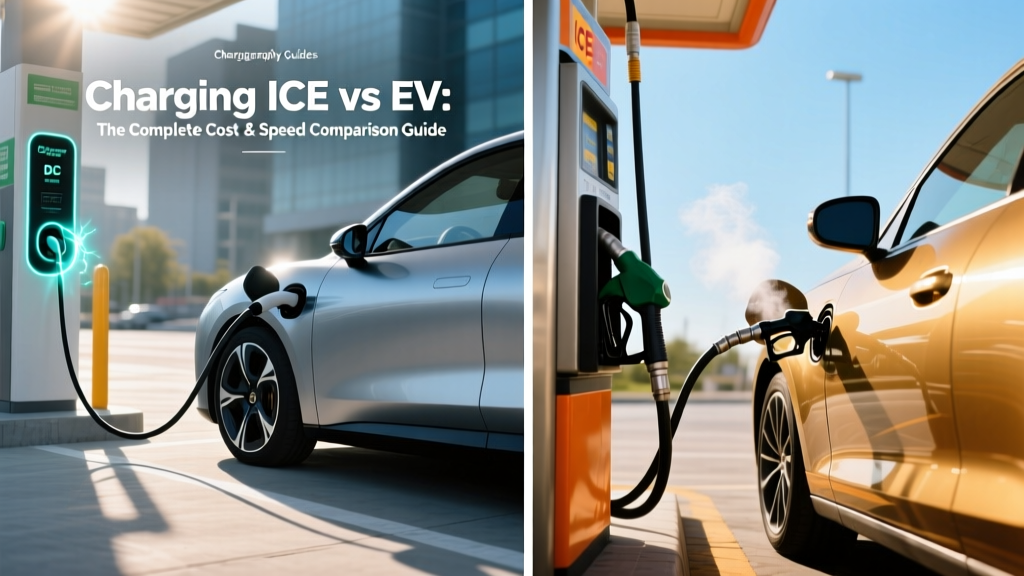
Search "charging ICE" and you'll find forums debating whether you should top off your gas car's battery or fill the tank first. But in the EV world, the real comparison is between the infrastructure of the internal combustion engine (ICE) era — gas stations, fuel pumps, $3.50/gallon — and the emerging electric charging ecosystem. This guide breaks down exactly what it costs, how fast it works, and what you need at home to make the switch practical.
Charging Levels Explained: Speed, Power, and Range Per Hour
The single most important distinction in EV charging is between kW (kilowatts — the rate of power delivery, like water pressure in a hose) and kWh (kilowatt-hours — the total energy delivered, like gallons in a bucket). Your battery capacity is measured in kWh; your charger's speed is measured in kW. Confusing these is the most common EV literacy mistake.
| Level | Voltage | Max Power (kW) | Miles of Range Added Per Hour | Typical Use Case |
|---|---|---|---|---|
| Level 1 | 120V AC | 1.4–1.9 kW | 3–5 miles | Overnight trickle; PHEVs with small batteries |
| Level 2 | 240V AC | 7.2–19.2 kW | 20–60 miles | Home daily charging; workplace; destinations |
| DC Fast Charging (DCFC) | 400–800V DC | 50–350 kW | 150–1,200 miles (equivalent/hr) | Road trips; rapid top-ups at public stations |
Real-world charging time examples (10–80% SoC):
- Tesla Model Y (75 kWh battery, 250 kW peak): ~18–22 minutes at a V3 Supercharger
- Hyundai Ioniq 5 (77.4 kWh, 350 kW capable): ~18 minutes at a 350 kW Electrify America station
- Ford F-150 Lightning Extended Range (131 kWh, 150 kW peak): ~41 minutes — larger batteries take longer even at moderate peak rates
- Chevrolet Equinox EV (85 kWh, 150 kW peak): ~30 minutes at a 150 kW DCFC
A critical reality often omitted from marketing: peak kW is not sustained kW. A vehicle advertising "250 kW charging" will only hit that rate at a low state of charge (typically 10–30% SoC) with a preconditioned battery. Above 80% SoC, charging slows dramatically — sometimes to Level 2 speeds — to protect battery chemistry. This is called the charge curve taper, and it's why 10–80% times are the standard metric rather than 0–100%.
How Much Does It Cost to Install a Home EV Charger?
Home Level 2 charging is where 80–90% of EV charging happens for owners with garage or driveway access. But the sticker price of the charger is only part of the equation. Here's the real breakdown:
| Cost Component | Low End | High End | Notes |
|---|---|---|---|
| Level 2 Charger (Equipment) | $300 | $750 | 32A–48A smart chargers; hardwired or NEMA 14-50 plug |
| Electrician Labor | $500 | $2,000 | Depends on run length from panel, wall type, conduit |
| Electrical Permit | $50 | $250 | Varies by municipality; some jurisdictions waive for EV installs |
| Panel Upgrade (if needed) | $1,500 | $4,000 | Required if existing panel is 100A or near capacity |
| Total (no panel upgrade) | $850 | $3,000 | Most homes with 200A service and short runs |
| Total (with panel upgrade) | $2,350 | $7,000 | Older homes with 100A panels or heavy existing loads |
Electrical Requirements for a Level 2 Home Charger
A typical 48-amp Level 2 charger requires a 240V, 60-amp dedicated circuit (the National Electrical Code requires circuits to be rated at 125% of continuous load, so a 48A charger needs a 60A breaker). Here's what to evaluate:
- Panel capacity: Most modern homes have 200-amp service. A 60A circuit consumes 30% of that — usually manageable, but an electrician will perform a load calculation to confirm.
- Wire gauge: 6 AWG copper for runs up to ~50 feet; 4 AWG for longer runs to prevent voltage drop.
- NEMA 14-50 outlet vs. hardwired: A 14-50 receptacle allows portability but requires a GFCI breaker (adding $100–$150). Hardwired connections are more reliable and avoid the GFCI nuisance-trip issue common with some breakers.
- Outdoor installation: Requires a NEMA 4-rated (weatherproof) charger enclosure and proper conduit sealing.
Which Connector Is Compatible With My EV?
The connector landscape shifted dramatically in 2024–2025 when nearly every major automaker adopted the North American Charging Standard (NACS) — originally Tesla's proprietary connector. Here's where things stand for 2026 model-year vehicles:
| Connector | Brands Using It (2026 MY) | Adapter Needed? |
|---|---|---|
| NACS (Tesla) | Tesla (all), Ford, GM, Rivian, Volvo, Polestar, Hyundai/Kia (new models), Mercedes-Benz | CCS-to-NACS adapter ($150–$250) for legacy CCS vehicles accessing Superchargers |
| CCS1 | VW/ID.4 (some carryover), Stellantis, BMW (some models), legacy models from Ford/GM pre-2025 | NACS-to-CCS adapter for Tesla Supercharger access |
| CHAdeMO | Nissan Leaf (discontinued after 2025 MY — used market only), Mitsubishi Outlander PHEV (older) | Limited DCFC network; CHAdeMO-to-CCS adapters rare and expensive |
For home Level 2 charging: All vehicles use a J1772 connector for AC charging (or NACS, which incorporates J1772 signaling). Every NACS-equipped EV ships with a J1772-to-NACS adapter. If you buy a third-party Level 2 charger with a J1772 plug, it will work with every EV on the road — NACS vehicles simply use their included adapter.
Key recommendation: If you're buying a new EV in 2026, prioritize NACS-equipped models. Tesla's Supercharger network remains the most reliable and extensive DC fast-charging infrastructure in North America, with over 25,000 stalls. CCS networks (Electrify America, EVgo) have improved but still trail in uptime and coverage density, according to J.D. Power's EVX Public Charging Study.
Cost to Charge: Electricity vs. Gas Per Mile
This is where the "charging ICE" comparison becomes stark. The cost advantage of electricity over gasoline depends heavily on where and when you charge.
| Scenario | Cost per kWh | Vehicle Efficiency | Cost Per Mile | Equivalent Gas Price (at 28 MPG) |
|---|---|---|---|---|
| Home charging (off-peak utility rate) | $0.10/kWh | 3.5 mi/kWh (e.g., Tesla Model 3) | $0.029/mi | $0.81/gallon |
| Home charging (national avg. residential) | $0.17/kWh | 3.0 mi/kWh (e.g., Ford Mustang Mach-E) | $0.057/mi | $1.59/gallon |
| Public Level 2 (ChargePoint, workplace) | $0.25/kWh | 3.0 mi/kWh | $0.083/mi | $2.33/gallon |
| DC Fast Charging (Electrify America, EVgo) | $0.48/kWh | 2.8 mi/kWh (highway, cold weather) | $0.171/mi | $4.80/gallon |
| Tesla Supercharger (avg. 2026) | $0.32/kWh | 3.5 mi/kWh | $0.091/mi | $2.56/gallon |
| Gas vehicle (national avg. $3.35/gal, 28 MPG combined) | — | 28 mi/gal | $0.120/mi | $3.35/gallon (actual) |
The takeaway: Home charging at off-peak rates makes EVs roughly 4× cheaper per mile than gas vehicles. Even public DC fast charging — the most expensive EV scenario — often costs less per mile than premium gasoline in a mid-efficiency ICE car. But if you rely exclusively on DCFC, the savings narrow significantly, and in some high-cost markets (California, Hawaii), peak DCFC rates can exceed gas per-mile costs.
According to fueleconomy.gov, the average 2026 EV achieves 100–130 MPGe combined (equivalent to 3.0–3.9 mi/kWh), making home charging economics compelling in nearly every US market.
Best Home EV Chargers for 2026: Equipment Picks
We evaluate chargers on five criteria: power output, cable length, smart features, connector type, and price. All picks below support J1772 (universal AC) and work with NACS vehicles via adapter.
ChargePoint Home Flex
- Power: Up to 12 kW (50A) on a 60A circuit; adjustable down to 16A
- Connector: J1772 (25-foot cable)
- Smart features: Wi-Fi, app scheduling, utility demand-response, Alexa
- Price: ~$549
- Best for: Flexibility — adjustable amperage works with any panel capacity
Wallbox Pulsar Plus
- Power: Up to 11.5 kW (48A) on a 60A circuit
- Connector: J1772 (25-foot cable); also available with NACS pigtail
- Smart features: Wi-Fi + Bluetooth, load balancing, solar integration
- Price: ~$449
- Best for: Compact size, solar-home integration, competitive price
Tesla Wall Connector
- Power: Up to 11.5 kW (48A) on a 60A circuit
- Connector: NACS native (24-foot cable); includes J1772 adapter
- Smart features: Wi-Fi, OTA updates, Power Sharing (link multiple units), load management
- Price: ~$475
- Best for: Tesla/NACS owners wanting native plug without adapter fumbling
Emporia Vue Level 2 Charger
- Power: Up to 11.5 kW (48A)
- Connector: J1772 (24-foot cable)
- Smart features: Energy monitoring (pairs with Emporia Vue panel monitor), scheduling, solar-aware
- Price: ~$399
- Best for: Budget pick with whole-home energy monitoring integration
Pro tip: Buy a charger rated for more power than your current EV accepts on AC. Many EVs accept only 7.2 kW or 11.5 kW on Level 2, but upgrading to a 48A/11.5 kW unit now means you're covered when your next vehicle supports higher AC rates.
Safety, Code, and Installation Considerations
EV charging draws sustained high current for hours — this is fundamentally different from intermittent appliance loads. The National Electrical Code (NEC) Article 625 governs EV charging installations, and your electrician should follow these requirements:
- Dedicated circuit: Your Level 2 charger must have its own breaker — no sharing with other outlets or appliances.
- GFCI protection: Required for receptacle-based (NEMA 14-50) installations. Note: some GFCI breakers are prone to nuisance tripping with EV chargers; hardwiring eliminates this issue entirely.
- Outdoor rating: Any charger or outlet exposed to weather must be NEMA 3R or NEMA 4 rated. Use an in-use cover for receptacles.
- Cable management: NEC requires strain relief and that the charging cable not create a trip hazard. Wall-mounted cable organizers ($25–$50) keep things tidy and code-compliant.
- Permitting: Most jurisdictions require a permit and inspection for EV charger installations. Skipping the permit risks insurance claim denials if a fire originates from an uninspected circuit.
Frequently Asked Questions
How much does it cost to install a home EV charger?
Most installations with a 200A panel and a short wire run cost $850–$3,000 total (equipment + electrician + permit). Homes needing a panel upgrade to 200A should budget $2,350–$7,000. Get 2–3 quotes from licensed electricians — prices vary significantly by region and job complexity.
How fast will each charging level add range?
Level 1 (120V): 3–5 miles per hour. Level 2 (240V, 48A): 30–45 miles per hour for most EVs. DC Fast Charging: 10–80% in 18–45 minutes depending on peak kW, battery size, and thermal conditions. See the charging levels table above for details.
Which connector/charger is compatible with my EV?
For 2026 models, NACS is the dominant DC fast-charging connector (Tesla, Ford, GM, Rivian, Hyundai/Kia new models). CCS1 persists on some VW and BMW models. CHAdeMO is effectively discontinued. For home Level 2 charging, all EVs accept J1772 — NACS vehicles use an included adapter.
How much does charging cost per mile vs gas?
Home charging at the national average rate of $0.17/kWh costs roughly $0.04–$0.06/mile depending on vehicle efficiency. The average gas car at $3.35/gallon and 28 MPG costs $0.12/mile. EVs charged at home are 2–4× cheaper per mile. Public DCFC narrows the gap to roughly 1.3–1.5× cheaper.
What electrical upgrades might I need?
If your home has a 100A electrical panel, you'll likely need a panel upgrade to 200A ($1,500–$4,000). If your panel is already 200A but near capacity (common with electric heat, AC, dryer, range, and pool equipment), an electrician's load calculation may require a lower-amperage charger (32A instead of 48A) or a panel upgrade. Some utilities offer managed charging programs that allow a higher circuit by throttling the charger during peak demand — ask your utility about this before paying for a panel upgrade.
Can I charge my EV from a regular 120V outlet?
Yes, but slowly. Level 1 charging adds only 3–5 miles of range per hour — adequate for PHEVs with 25–40 mile electric ranges or for BEV owners who drive under 30 miles daily and can charge for 10+ hours overnight. For most BEV owners, Level 1 is impractical as a primary charging method.
Does the federal tax credit cover home charger installation?
The IRS §30C Alternative Fuel Vehicle Refueling Property Credit covers 30% of home charger equipment and installation costs, up to $1,000. This is separate from the §30D new EV purchase credit. Eligibility depends on your census tract meeting certain income or rural criteria — verify at irs.gov before assuming qualification.