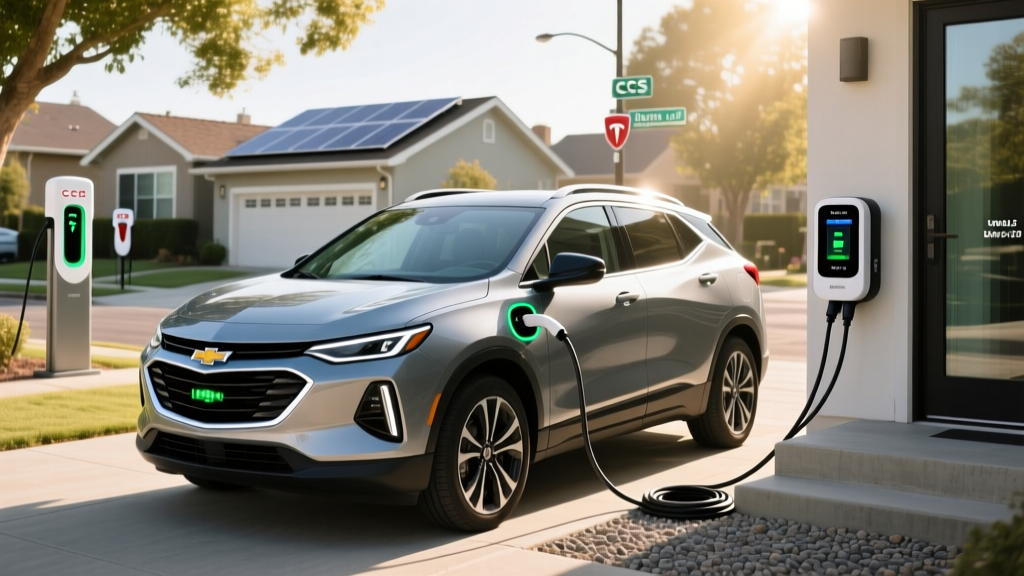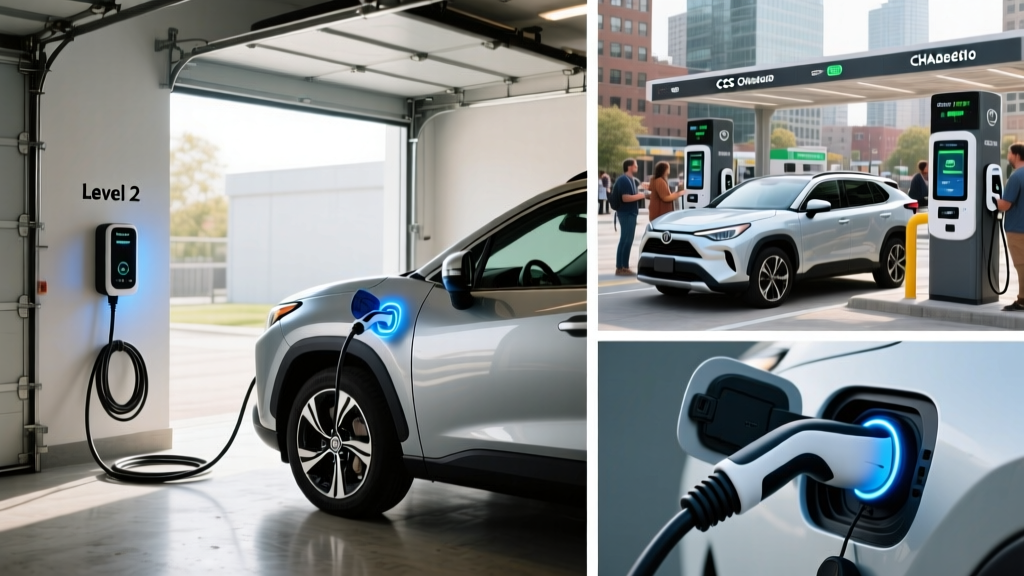
Extended range EVs — those packing 100 kWh or more of usable battery capacity — are proliferating across the 2026 lineup. The Lucid Air Grand Touring (118 kWh usable, EPA 512 miles), Chevrolet Silverado EV 4WT (200+ kWh, EPA 450+ miles), and GMC Hummer EV (246 kWh, EPA 329 miles) all trade larger battery packs for fewer charging stops on long trips. But bigger batteries also mean longer charge sessions if your equipment isn't matched to the task. A 100+ kWh pack plugged into a standard 120V outlet would take days to fill. This guide maps out exactly what charging infrastructure you need — at home and in public — to make an extended range EV practical day to day.
Charging Levels Explained: Speeds That Match Big Batteries
Before selecting equipment, understand the three charging tiers available to EV owners. Power is measured in kilowatts (kW), which is the rate of energy delivery — distinct from kilowatt-hours (kWh), the total energy stored in the battery. Think of kW as the flow rate of a hose and kWh as the size of the bucket.
| Level | Voltage | Power (kW) | Miles of Range Added per Hour | Best Use Case |
|---|---|---|---|---|
| Level 1 (120V AC) | 120V | 1.0–1.4 kW | 3–5 mi/hr | Overnight top-ups, PHEVs, emergencies |
| Level 2 (240V AC) | 240V | 3.3–19.2 kW | 12–70 mi/hr | Daily home charging, workplace |
| DC Fast Charging | 400–800V DC | 50–350 kW | 150–400+ mi/hr (peak) | Road trips, rapid top-ups |
Home Charger Installation: Electrical Requirements and Costs
Most extended range EV owners will want a hardwired Level 2 home charger rated between 48 and 80 amps. The electrical requirements are substantial, especially in older homes.
Typical Electrical Specifications
- 48-amp charger: Requires a dedicated 60-amp, 240V circuit (NEC code mandates circuits be rated 125% above continuous load). Uses 6 AWG copper wire.
- 80-amp charger: Requires a dedicated 100-amp, 240V circuit. Uses 3 AWG copper wire. This is the sweet spot for extended range EVs — delivering up to 19.2 kW, adding roughly 55–70 miles of range per hour depending on vehicle efficiency.
- Panel capacity: A 200-amp residential panel can typically support a 60-amp EV circuit alongside normal household loads. Homes with 100-amp or 150-amp panels will likely need a panel upgrade ($1,500–$3,500) or a smart load-management device like the Emporia Smart Load Center to avoid overloading the service.
Permitting and Code Requirements
Nearly all jurisdictions require an electrical permit for new 240V circuit installation. The permitting process ensures the installation meets National Electrical Code (NEC) Article 625, which governs EV charging systems. Key code requirements include:
- Dedicated circuit — the EV charger cannot share a breaker with other outlets
- GFCI protection — required for outdoor receptacles (hardwired installations may be exempt depending on local code)
- NEMA 4 or NEMA 4X rating — for any outdoor-mounted equipment (protects against rain, ice, and dust)
- Cable management — cord should not stretch across walkways or driveways
Full Installation Cost Breakdown
| Component | Typical Range | Notes |
|---|---|---|
| Level 2 Charger Unit (48–80A) | $400–$800 | Smart Wi-Fi-enabled models at higher end |
| Electrician Labor | $600–$2,500 | Depends on run length from panel to garage/carport |
| Electrical Permit | $50–$250 | Varies by municipality |
| Panel Upgrade (if needed) | $1,500–$3,500 | 100A → 200A service upgrade |
| Conduit, Wire, Breaker | $150–$500 | Longer runs and heavier gauge = higher cost |
| Total (no panel upgrade) | $1,200–$4,050 | Most homes with 200A panels |
| Total (with panel upgrade) | $2,700–$7,550 | Older homes with 100–150A service |
Some utilities and states offer rebates of $250–$1,000 for home charger installation. Check with your local utility and the Alternative Fuels Data Center state law database for current incentive availability.
Connector Compatibility: NACS, CCS, and CHAdeMO in 2026
The North American Charging Standard (NACS), originally developed by Tesla, has become the dominant connector for new EVs sold in North America as of 2025–2026. Most extended range EVs now ship with NACS ports, though some fleet and legacy models still use CCS1 or CHAdeMO.
| Connector | Vehicles Using It | DC Fast Charge Max Power | Adapter Needed? |
|---|---|---|---|
| NACS (Tesla-style) | Tesla Model S/X, Lucid Air (2025+), Ford F-150 Lightning, Rivian R1S/R1T (2025+), GM Ultium vehicles (2025+), Hyundai Ioniq 9 | Up to 350 kW (varies) | No — native access to Tesla Superchargers and NACS-equipped networks |
| CCS1 (Combo) | Hyundai Ioniq 5 (pre-2025), Kia EV6 (pre-2025), VW ID.4, BMW iX, older Ford Mustang Mach-E | Up to 350 kW | CCS-to-NACS adapter (~$200) for Supercharger access |
| CHAdeMO | Nissan Ariya (some trims), older Nissan Leaf — largely discontinued for new models | Up to 100 kW typically | No widely available adapter; network access shrinking |
Charging Cost: Per-Mile Economics vs. Gasoline
Extended range EVs consume more energy per mile than compact EVs — typically 2.0–3.5 kWh/mile for large trucks and luxury sedans — but the per-mile fuel cost still undercuts gasoline in most scenarios.
| Scenario | Cost per kWh or Gallon | Vehicle Efficiency | Cost per Mile |
|---|---|---|---|
| Home charging (off-peak utility rate) | $0.08–$0.14/kWh | 2.5 kWh/mi (large EV truck) | $0.20–$0.35/mi |
| Home charging (standard rate) | $0.15–$0.22/kWh | 2.5 kWh/mi | $0.38–$0.55/mi |
| Public Level 2 (network pricing) | $0.25–$0.49/kWh | 2.5 kWh/mi | $0.63–$1.23/mi |
| DC Fast Charging (Electrify America, EVgo) | $0.35–$0.65/kWh | 2.5 kWh/mi | $0.88–$1.63/mi |
| Gasoline truck (20 MPG combined) | $3.40/gallon (2026 avg) | 20 MPG | $0.17/mi |
| Gasoline sedan (30 MPG combined) | $3.40/gallon | 30 MPG | $0.11/mi |
Charging Times for Extended Range Battery Packs
Here's how long it actually takes to charge common extended range battery sizes across different charging levels. These figures assume a 10–80% charge window, which is the practical fast-charging range most owners use (charging above 80% slows dramatically to protect battery health).
| Battery Size (Usable kWh) | Example Vehicles | 48A Level 2 (11.5 kW) | 80A Level 2 (19.2 kW) | 250 kW DC Fast (peak) | 350 kW DC Fast (peak) |
|---|---|---|---|---|---|
| 100 kWh | BMW iX xDrive50, Mercedes EQS 450+ | ~6.1 hrs | ~3.6 hrs | ~28–35 min* | ~22–28 min* |
| 118 kWh | Lucid Air Grand Touring | ~7.2 hrs | ~4.3 hrs | ~25–32 min* | ~20–25 min* |
| 131 kWh | Ford F-150 Lightning Extended Range | ~8.0 hrs | ~4.8 hrs | ~38–45 min* | ~32–40 min* |
| 200+ kWh | GMC Hummer EV, Silverado EV 4WT | ~12.2+ hrs | ~7.3+ hrs | ~55–70 min* | ~45–60 min* |
*DC fast charge times are estimates for the 10–80% window. Actual times depend on battery temperature, preconditioning, charge curve taper, and station output. Peak kW rates are sustained only in the middle of the SoC range; expect average rates 30–50% below peak.
Recommended Home Charging Equipment for Extended Range EVs
For a 100+ kWh battery, a 48-amp charger is the minimum practical choice. An 80-amp unit cuts charge times nearly in half and is worth the electrical upgrade for daily drivers of large-battery vehicles.
ChargePoint Home Flex (up to 50A / 12 kW)
- Power Output: Up to 12 kW (50A on a 60A circuit)
- Connector: J1772 (NACS adapter included for newer models)
- Cable Length: 23 feet
- Smart Features: Wi-Fi, scheduled charging, Alexa integration, energy tracking via app
- Price: ~$599–$649
- Best For: Owners who need flexible amperage settings (dip-switch adjustable from 16A–50A to match available circuits)
Wall Connector (Tesla, 3rd Gen — 48A / 11.5 kW)
- Power Output: Up to 11.5 kW (48A on a 60A circuit)
- Connector: NACS native
- Cable Length: 24 feet
- Smart Features: Wi-Fi, over-the-air updates, power sharing between multiple units, integrated cable management
- Price: ~$420–$475
- Best For: Tesla and NACS-equipped vehicle owners; best value-to-performance ratio for native NACS vehicles
FLO Home X80 (80A / 19.2 kW)
- Power Output: Up to 19.2 kW (80A on a 100A circuit)
- Connector: J1772 (NACS adapter available)
- Cable Length: 25 feet
- Smart Features: Wi-Fi, load balancing, scheduling, energy dashboard, NEMA 4 outdoor-rated enclosure
- Price: ~$899–$1,099
- Best For: Extended range EV owners with 100A circuits who want the fastest Level 2 charge times available; outdoor installations
Emporia Vue EV Charger (48A / 11.5 kW)
- Power Output: Up to 11.5 kW (48A on a 60A circuit)
- Connector: J1772
- Cable Length: 24 feet
- Smart Features: Integrates with Emporia whole-home energy monitor, solar-aware charging, time-of-use scheduling
- Price: ~$399–$499
- Best For: Budget-conscious buyers and solar panel owners who want charger-to-home energy integration
Safety, Code, and Installation Best Practices
Extended range EV charging places a sustained high-current load on your home's electrical system — the equivalent of running a large electric oven continuously for 6–10 hours. Safety is non-negotiable.
- Always use a licensed electrician. DIY 240V work is dangerous and typically voids homeowner insurance if unpermitted. The final installation spec should come from a licensed professional who has evaluated your panel, wire runs, and local code.
- Hardwired over plug-in for 60A+ circuits. NEMA 14-50 receptacles are rated for 50A and are fine for 40–48A chargers. Above that, hardwired connections eliminate the receptacle as a failure point and are often required by code for circuits over 50A.
- Thermal imaging post-install. After installation, ask your electrician to perform a thermal scan of the breaker and connections under load. Hot spots indicate loose connections that need tightening.
- Outdoor ratings matter. If your charger is mounted outside, both the unit and any conduit connections must carry a NEMA 4 rating. Indoor-rated equipment will fail prematurely in rain or humidity.
- Ground fault protection. NEC 2023 (and the 2026 adoption cycle in most states) requires GFCI protection for outdoor EV receptacles. Hardwired chargers may be exempt, but many electricians include GFCI breakers as a safety best practice regardless.
Frequently Asked Questions
How much does it cost to install a home EV charger for an extended range EV?
Expect $1,200–$4,050 for a complete Level 2 installation in a home with an adequate 200-amp electrical panel. This includes the charger unit ($400–$800), electrician labor ($600–$2,500), permit ($50–$250), and materials ($150–$500). If your home has a 100-amp or 150-amp panel and needs a service upgrade, add $1,500–$3,500, bringing the total to $2,700–$7,550. Always get a site-specific quote from a licensed electrician.
How fast will each charging level add range to an extended range EV?
Level 1 (120V) adds 3–5 miles per hour — essentially useless for a 100+ kWh pack. Level 2 (240V, 48A) adds roughly 25–35 miles per hour for a large EV truck, or 40–55 miles per hour for an efficient sedan like the Lucid Air. An 80A Level 2 charger increases this to 40–70 miles per hour. DC fast charging at 250 kW can add 150–300 miles in a 20–30 minute session, depending on battery size, vehicle efficiency, and charge curve taper.
Which connector and charger is compatible with my extended range EV?
For 2026 models, most new extended range EVs use the NACS connector (Tesla, Lucid, Ford, GM, Rivian, Hyundai). If your vehicle has a CCS1 port (older Hyundai, Kia, VW models), you'll need a CCS-to-NACS adapter (~$200) to access the Tesla Supercharger network. For home Level 2 charging, all vehicles accept the J1772 connector standard on non-Tesla chargers, and Tesla vehicles can use the included J1772 adapter or a native NACS Wall Connector. Check your vehicle's charge port before purchasing equipment.
How much does charging an extended range EV cost per mile compared to gas?
At home on off-peak rates ($0.08–$0.14/kWh), a large EV truck averaging 2.5 kWh/mile costs $0.20–$0.35 per mile — comparable to a gas truck getting 17–20 MPG at $3.40/gallon ($0.17–$0.20/mi). On public DC fast chargers ($0.40–$0.65/kWh), the cost jumps to $1.00–$1.63 per mile, exceeding gasoline. The economic case for extended range EVs depends heavily on home charging access. See fueleconomy.gov for specific vehicle efficiency data.
What electrical upgrades might I need for an 80-amp home charger?
An 80-amp charger requires a dedicated 100-amp, 240V circuit — consuming 50% of a standard 200-amp panel's capacity. If your panel is already heavily loaded (electric heating, hot tub, workshop equipment), you may need a panel upgrade to 300–400 amps ($2,500–$5,000) or a smart load-management system that dynamically reduces charger amperage when other circuits are in use. Homes built before 1990 with 100-amp service will almost certainly need a panel upgrade. Your electrician can perform a load calculation per NEC Article 220 to determine your exact capacity.
Is a 48-amp charger enough for a 100+ kWh battery, or do I need 80 amps?
A 48-amp (11.5 kW) charger will fully replenish a 100 kWh battery in roughly 9 hours from near-empty — adequate if you charge nightly and rarely deplete below 20%. However, extended range EV owners who regularly drive 200+ miles daily, tow, or live in cold climates (where range drops 20–30%) will benefit from an 80-amp unit that cuts charge time to about 5.5 hours. The incremental cost of an 80A charger ($200–$400 more) is small relative to the electrical labor; the main cost driver is whether your panel can support the 100A circuit.
Extended range EVs reward their owners with 350–500+ miles of real-world driving between stops — but that capability only works if your charging infrastructure is matched to the battery size. Invest in a properly rated Level 2 home charger installed by a licensed electrician, understand your vehicle's connector and DC fast-charge acceptance rate, and prioritize off-peak home charging to keep per-mile costs low. For the latest federal tax credit rules that may offset vehicle and charger costs, consult the IRS clean vehicle credit page and speak with a tax professional about your specific eligibility.