Why Cold Weather Changes Everything About EV Charging
When temperatures drop below freezing, lithium-ion batteries fight physics. Internal resistance increases, charge acceptance drops, and the energy you'd normally use for propulsion gets diverted to battery and cabin heating. If you've searched for guidance on charging EV in cold weather, you've likely noticed that your usual 30-minute DC fast charge stretches to 45 minutes or more, and your EPA-rated 300-mile range might deliver closer to 210–240 miles on a 20°F morning.
This isn't a defect — it's electrochemistry. Cold electrolyte slows lithium-ion movement between the cathode and anode. Battery management systems (BMS) deliberately restrict charge rates to prevent lithium plating, a condition where metallic lithium deposits on the anode and causes permanent capacity loss. The result: slower charging, reduced range, and a need for smarter preparation.
- Range loss at 20°F: 20–30% without preconditioning; 10–15% with a heat pump and preconditioning (source: fueleconomy.gov)
- DC fast-charge slowdown: 10–80% times can increase 40–60% below freezing without battery preconditioning
- Cabin heating draw: Resistive heaters pull 3–6 kW; heat pumps pull 1–2 kW — a massive efficiency difference
The good news? A properly configured home charging setup and a few winter habits can neutralize most of these penalties. This guide covers the charging infrastructure, equipment, and techniques that keep you moving when the mercury drops.
Charging Levels Explained: Speeds in kW and Miles Per Hour
Before we address cold-weather specifics, let's lock in the fundamentals. kW (kilowatts) measures power — how fast energy flows into your car. kWh (kilowatt-hours) measures energy — the total capacity of your battery. Think of kW as the width of a hose and kWh as the size of the bucket.
| Level | Voltage | Power (kW) | Miles Added/Hour (75°F) | Miles Added/Hour (20°F) | Best Use Case |
|---|---|---|---|---|---|
| Level 1 | 120V AC | 1.0–1.4 kW | 3–5 mi/hr | 2–3 mi/hr | Overnight top-up, PHEVs, emergencies |
| Level 2 | 240V AC | 7.2–19.2 kW | 25–65 mi/hr | 20–50 mi/hr | Daily home charging, winter preconditioning |
| DC Fast | 400–800V DC | 50–350 kW | 150–1,000+ mi/hr | 100–600 mi/hr (w/o preconditioning) | Road trips, rapid replenishment |
In cold weather, Level 2 home charging becomes your most valuable tool. Plugging in overnight does more than refill your battery — it keeps the pack above freezing, so when you start your commute, the battery is already warm enough to accept a full charge and deliver regenerative braking from mile one. Unplugged cold-soaking, by contrast, means your car spends the first 10–20 minutes of driving warming the battery instead of recapturing energy.
Home Charger Installation: Electrical Requirements and Real Costs
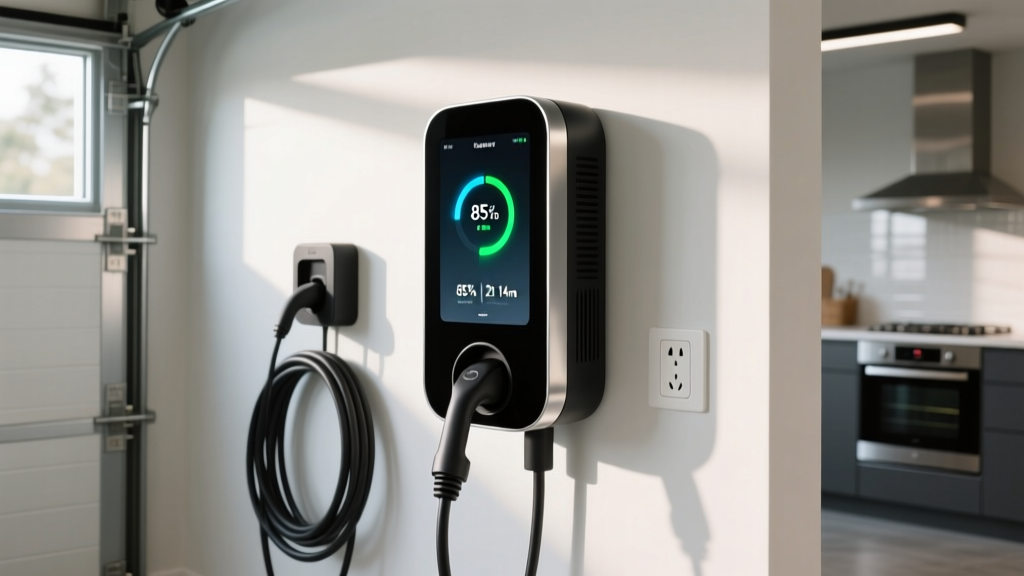
A Level 2 home charger is the single highest-impact upgrade for cold-weather EV ownership. Here's what an installation actually requires and what it costs in 2026.
Electrical Requirements
Most residential Level 2 chargers require a 240V dedicated circuit on a double-pole breaker. Common configurations include:
- 40-amp circuit / 32-amp continuous charge (7.7 kW): Sufficient for most daily driving; works with 100-amp and 200-amp panels
- 50-amp circuit / 40-amp continuous charge (9.6 kW): Ideal for larger batteries (80–100+ kWh); recommended for cold climates where you want faster warm-up
- 60-amp circuit / 48-amp continuous charge (11.5 kW): Maximum for most homes; requires 200-amp panel with spare capacity
- 80-amp circuit / 64-amp continuous charge (15.4–19.2 kW): Requires upgraded 200- or 400-amp service; typically only for high-end installations
Do You Need a Panel Upgrade?
If your home has a 100-amp electrical panel that's already near capacity (common in homes built before 1990), adding a 40–50 amp EV circuit may push you over the safe 80% continuous-load threshold. Signs you might need a panel upgrade:
- Your panel is 100 amps or less
- You have no spare breaker slots
- You run electric heat, an electric dryer, an electric oven, and an EV charger simultaneously
- Your electrician calculates your existing load at or above 80% of panel capacity
A panel upgrade from 100A to 200A typically costs $1,500–$3,500 including permits. In some utility territories, load-management devices (like the Span smart panel or Emporia load-management systems) can avoid a full upgrade by dynamically reducing charger amperage when other circuits draw heavily.
| Component | Low End | High End | Notes |
|---|---|---|---|
| Level 2 Charger (hardware) | $350 | $750 | Smart Wi-Fi chargers, 25-ft cable, NACS or J1772 |
| Electrician labor (standard install) | $600 | $1,800 | Varies by run length, conduit, wall material |
| Permit & inspection | $100 | $400 | Required in most jurisdictions; ensures NEC compliance |
| Panel upgrade (if needed) | $1,500 | $3,500 | 100A → 200A service upgrade |
| Total (no panel upgrade) | $1,050 | $2,950 | Typical for homes with 200A panels |
| Total (with panel upgrade) | $2,550 | $6,450 | Older homes needing service upgrade |
Federal incentive note: The IRS §30C Alternative Fuel Vehicle Refueling Property Credit offers up to $1,000 (30% of cost, capped) for home charger installation — but only if you live in a qualifying census tract. Check your eligibility at the IRS site before counting on it.
Cold-Weather Charging Times: What to Actually Expect
Cold batteries accept charge more slowly. Here's how that translates to real charging sessions for common battery sizes when the ambient temperature is around 20°F, compared to 75°F baseline.
| Battery Size | Charger Type | Warm (75°F) | Cold (20°F) — No Preconditioning | Cold (20°F) — With Preconditioning |
|---|---|---|---|---|
| 60 kWh (e.g., Chevy Equinox EV) | Level 2, 11.5 kW | ~4.0 hrs | ~4.5 hrs | ~4.0 hrs |
| 60 kWh | DC Fast, 150 kW peak | ~22 min | ~38 min | ~25 min |
| 82 kWh (e.g., Tesla Model Y LR) | Level 2, 11.5 kW | ~5.5 hrs | ~6.0 hrs | ~5.5 hrs |
| 82 kWh | DC Fast, 250 kW peak | ~25 min | ~42 min | ~28 min |
| 100 kWh (e.g., Ford F-150 Lightning ER) | Level 2, 11.5 kW | ~6.7 hrs | ~7.5 hrs | ~6.7 hrs |
| 100 kWh | DC Fast, 250 kW peak | ~30 min | ~50 min | ~35 min |
What preconditioning does: When you set a departure time or navigate to a DC fast charger, the car's thermal management system warms the battery pack to its optimal charge-acceptance temperature (typically 70–90°F). This can cut cold-weather DC fast-charge times nearly in half. Without preconditioning, the first 10–15 minutes of a cold DC fast session may be limited to 30–50 kW regardless of the station's rated output.
Connector Compatibility: NACS, CCS, and CHAdeMO in 2026
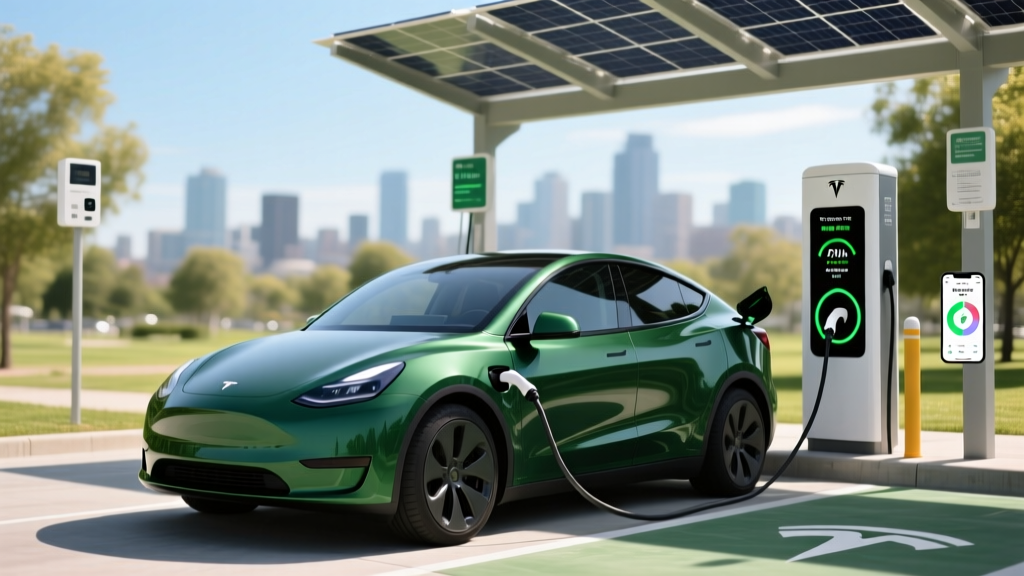
The connector landscape has shifted dramatically. By 2026, the North American Charging Standard (NACS) — originally Tesla's proprietary plug — has become the dominant connector for new EVs. Here's where things stand:
| Connector | Brands Using It (Native) | Adapter Needed For | Notes |
|---|---|---|---|
| NACS (J3400) | Tesla, Ford, GM, Rivian, Volvo, Polestar, Mercedes, BMW, Hyundai (new models) | Older CCS stations (with adapter) | Industry standard for new vehicles; access to Tesla Supercharger network |
| CCS1 | VW ID.4 (2024 and earlier), some Stellantis models, legacy EVs | Tesla Superchargers (with Magic Dock or adapter) | Still widely available at Electrify America, EVgo stations |
| CHAdeMO | Nissan Leaf (all years), Mitsubishi Outlander PHEV | N/A — declining network | Being phased out; few new stations being built |
For cold-weather home charging, the connector matters less — Level 2 home chargers use either NACS or J1772 (the AC standard). If your car has a NACS port, buy a NACS home charger. If it has J1772 (most pre-2025 non-Tesla EVs), buy a J1772 charger or use a J1772-to-NACS adapter. The important thing is that the charger's amperage matches your electrical circuit and your car's onboard charger capacity.
Cost to Charge: Home vs. Public vs. Gas, Including Winter Premiums
Cold weather increases your per-mile energy cost because the car uses more kWh to heat the battery and cabin. Here's a realistic breakdown comparing charging costs to gasoline.
| Scenario | Energy Cost | Efficiency (Winter) | Cost Per Mile | Annual Cost (12,000 mi) |
|---|---|---|---|---|
| Home Level 2, off-peak ($0.09/kWh) | $0.09/kWh | 3.0 mi/kWh (from ~3.5 in summer) | $0.030 | $360 |
| Home Level 2, standard rate ($0.16/kWh) | $0.16/kWh | 3.0 mi/kWh | $0.053 | $640 |
| Public Level 2 ($0.25/kWh) | $0.25/kWh | 3.0 mi/kWh | $0.083 | $1,000 |
| DC Fast Charging ($0.40/kWh) | $0.40/kWh | 3.0 mi/kWh | $0.133 | $1,600 |
| Gas car (28 MPG combined, $3.20/gal) | $3.20/gallon | 28 mi/gallon | $0.114 | $1,371 |
| Gas car (winter, 25 MPG, $3.20/gal) | $3.20/gallon | 25 mi/gallon | $0.128 | $1,536 |
Even with winter efficiency losses, home-charged EVs cost roughly 60–75% less per mile than gasoline. The advantage narrows if you rely exclusively on DC fast charging — at $0.40/kWh, you're paying slightly more per mile than a gas car in winter. This is why home Level 2 charging is the economic backbone of EV ownership, especially in cold climates.
Pro tip for winter savings: Many utilities offer time-of-use (TOU) rates with off-peak pricing between 10 PM and 6 AM. Schedule your charging during these windows using your charger's app or your car's built-in scheduling. Precondition the cabin while still plugged in so the battery doesn't have to power heating during your first miles.
Best Home Chargers for Cold Climates: 2026 Equipment Picks
Cold-weather charging demands specific hardware features: outdoor-rated enclosures (NEMA 4 or 4X), cold-rated cables that stay flexible below freezing, Wi-Fi connectivity for remote scheduling, and sufficient amperage to recharge overnight even with reduced efficiency.
ChargePoint Home Flex (NACS)
- Power: Up to 12 kW (50A circuit) or 9.6 kW (40A circuit) — adjustable in app
- Connector: NACS (J1772 version also available)
- Cable: 23 ft, cold-flex rated to -22°F (-30°C)
- Smart features: Wi-Fi scheduling, Alexa integration, energy reporting, load sharing
- Outdoor rating: NEMA 4 — fully weatherproof
- Price: ~$599 (charger only)
- Best for: Flexible amperage lets you match your panel's capacity without overspending on electrical work
Tesla Wall Connector (NACS)
- Power: Up to 11.5 kW (60A circuit / 48A continuous)
- Connector: NACS native
- Cable: 24 ft, rated to -22°F
- Smart features: Wi-Fi updates, power sharing (up to 6 units on one circuit), access control
- Outdoor rating: NEMA 4
- Price: ~$475
- Best for: Tesla owners and new NACS-adopting vehicles; excellent value at max amperage
Emporia Level 2 Smart Charger
- Power: Up to 11.5 kW (60A circuit / 48A continuous)
- Connector: J1772 (NACS adapter included)
- Cable: 24 ft, cold-flex rated
- Smart features: Load management with Emporia Vue panel monitor, solar integration, TOU scheduling, detailed energy dashboard
- Outdoor rating: NEMA 4
- Price: ~$399
- Best for: Homes with solar panels or those wanting to avoid a panel upgrade via automatic load management
Grizzl-E Smart (NACS or J1772)
- Power: Up to 10 kW (40A continuous)
- Connector: Available in NACS or J1772
- Cable: 24 ft, rated to -40°F (-40°C) — best-in-class cold rating
- Smart features: OCPP-compatible, adjustable amperage via DIP switches, EVEnergy app integration
- Outdoor rating: NEMA 4X (highest weather protection)
- Price: ~$449
- Best for: Extreme cold climates (Minnesota, Alaska, Canada border states); built in Canada for harsh winters
Safety, Code, and Winter Installation Tips
National Electrical Code (NEC) requirements for EV charging installations are strict, and cold climates add a few extra considerations.
Required Safety Features
- Dedicated circuit: Your EV charger must be on its own breaker — no shared circuits with outlets or appliances
- GFCI protection: NEC 2023 and later require ground-fault circuit-interrupter protection for all outdoor receptacles and hardwired EV chargers. Most modern chargers have built-in GFCI
- Hardwired vs. plug: Hardwired installations (no plug, direct junction-box connection) are preferred for outdoor cold-climate installs. NEMA 14-50 receptacles can suffer from thermal expansion/contraction in extreme temperature swings, loosening connections over time
- Conduit and wiring: Outdoor runs require UV-rated conduit (typically PVC Schedule 80 or EMT). Wire gauge must match amperage: 6 AWG copper for 50A circuits, 4 AWG for 60A circuits
Cold-Climate Installation Tips
- Mount the charger on a south-facing wall if possible — even a few degrees of solar warming helps cable flexibility
- Keep the cable path clear of snow accumulation; consider a wall-mounted cable organizer at chest height
- If installing a NEMA 14-50 receptacle outdoors, use a weatherproof in-use cover rated for your climate zone
- Have your electrician torque-check all connections — thermal cycling in extreme cold can loosen improperly torqued terminals over a season
Winter Charging Best Practices: Maximize Range and Minimize Wait
Beyond hardware, your habits determine how well your EV performs in the cold. These techniques are drawn from real-world cold-climate ownership across multiple EV platforms.
Precondition Every Time
Set a scheduled departure time in your car's app or infotainment system. When the car is plugged in, it will warm the battery and cabin using grid power rather than battery power. This means you leave with a warm pack (full charge acceptance and regen) and a warm cabin (zero initial range drain from heating). Tesla, Ford, GM, Hyundai, and BMW all support scheduled preconditioning via their mobile apps.
Charge to 80–90% in Winter, Not 100%
For NMC (nickel manganese cobalt) batteries, sitting at 100% state of charge accelerates degradation — and cold temperatures compound this stress. Charge to 80–90% for daily driving. Reserve 100% for road trips where you'll depart immediately. LFP (lithium iron phosphate) batteries, found in base-model Teslas and some Rivians, tolerate 100% better and actually benefit from periodic full charges for BMS calibration.
Use Seat and Steering Wheel Heaters Over Cabin Air
Resistive cabin heaters draw 3–6 kW. Heated seats and steering wheels draw 0.1–0.3 kW combined. In moderate cold (30–45°F), using contact heaters and setting the cabin to 62–65°F instead of 72°F can recover 15–25 miles of range on a 250-mile battery. Heat-pump-equipped vehicles (standard on most 2025–2026 EVs from Tesla, Hyundai, Kia, VW) reduce this penalty significantly, pulling only 1–2 kW for cabin heating.
Plan DC Fast Stops With Preconditioning
When navigating to a DC fast charger in your car's built-in navigation, most modern EVs will automatically begin preconditioning the battery 10–30 minutes before arrival. This is critical in cold weather — arriving at a 250 kW Supercharger with a cold battery might net you only 50–70 kW for the first 10 minutes. With preconditioning, you hit peak charge rate within 1–2 minutes of plugging in. If your car doesn't auto-precondition (some older models), manually activate it through the app or climate settings before you arrive.
Frequently Asked Questions: Cold-Weather EV Charging
How much range do I actually lose charging and driving an EV in cold weather?
Expect 20–30% range reduction at 20°F compared to the EPA sticker if you don't precondition. With a heat pump and preconditioning while plugged in, that loss narrows to 10–15%. For a car rated at 300 miles EPA, plan for roughly 210–240 miles of real-world winter range without preconditioning, or 255–270 miles with it. Below 0°F, losses can reach 35–40% on short trips where the cabin and battery never fully warm up.
Is it safe to charge an EV outside in freezing rain or snow?
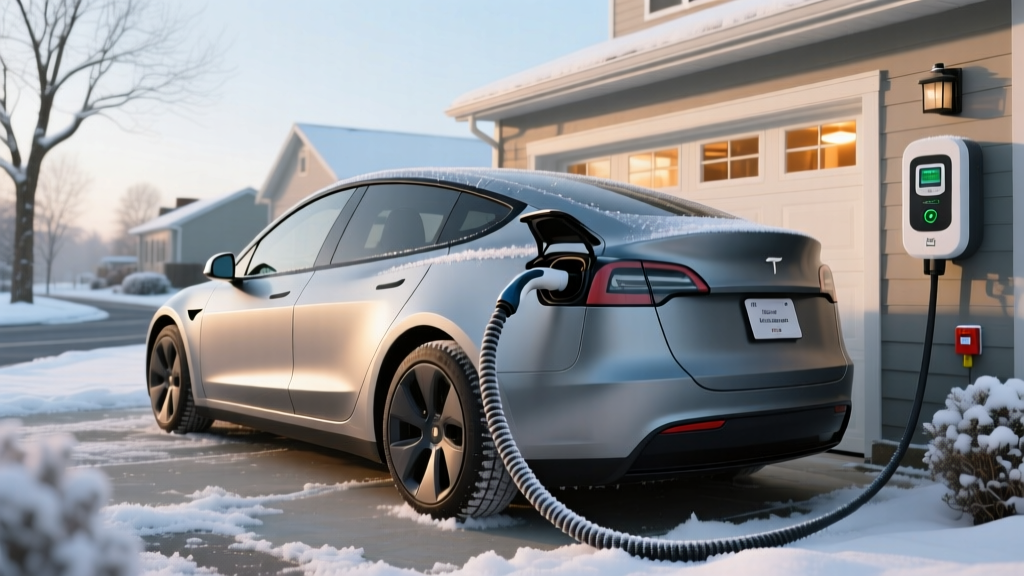
Yes. All UL-listed EV chargers rated NEMA 4 or higher are designed for outdoor use in rain, snow, and ice. The charging connector is sealed when mated to the car's port. Avoid charging during active lightning, and ensure your outdoor outlet or hardwired connection has proper GFCI protection. Clear snow and ice from the charge port before plugging in.
Should I leave my EV plugged in during extreme cold snaps?
Absolutely. Keeping your EV plugged in to a Level 2 charger during sub-zero temperatures allows the battery thermal management system to maintain the pack above its minimum safe temperature, using grid power rather than depleting your battery. Most EVs will periodically run their battery heater when plugged in, consuming 0.5–2 kWh over a cold night — a small price to avoid cold-soak damage and sluggish morning performance.
Can I use a Level 1 (120V) charger in winter, or do I need Level 2?
Level 1 is technically possible but impractical as a primary winter strategy. At 1.2 kW, you're adding roughly 3 miles of range per hour in warm weather — and closer to 2 mi/hr in the cold, since some of that power goes to battery maintenance heating. Over a 12-hour night, that's 24–36 miles of range. If your daily commute exceeds 30 miles round-trip, Level 1 won't keep up in winter. A Level 2 installation is strongly recommended for cold-climate owners.
Does DC fast charging damage the battery in cold weather?
Not if the car's BMS is functioning properly. Modern EVs will throttle charge speed when the battery is cold to prevent lithium plating. The risk comes from aftermarket or poorly designed charging equipment that bypasses the car's thermal protocols — stick to reputable networks (Tesla Supercharger, Electrify America, EVgo). Always precondition before DC fast charging to get both faster speeds and healthier battery chemistry.
What's the best state of charge to store my EV in during a cold week when I'm not driving?
For NMC batteries, store at 50–60% state of charge. For LFP batteries, 50–70% is fine. Keep the car plugged in if possible so the thermal management system can protect the pack from extreme cold. Avoid storing at 100% or below 20% for extended periods in any temperature.
Cold weather doesn't break EV ownership — it just demands better preparation. A properly installed Level 2 home charger, preconditioning discipline, and realistic range expectations turn winter from a source of anxiety into a manageable routine. The drivers who struggle most in the cold are those relying on Level 1 charging, skipping preconditioning, and expecting EPA sticker range on a 15°F morning. Set up your infrastructure right, and your EV will start every winter morning warm, charged, and ready — something a gas car can never promise.