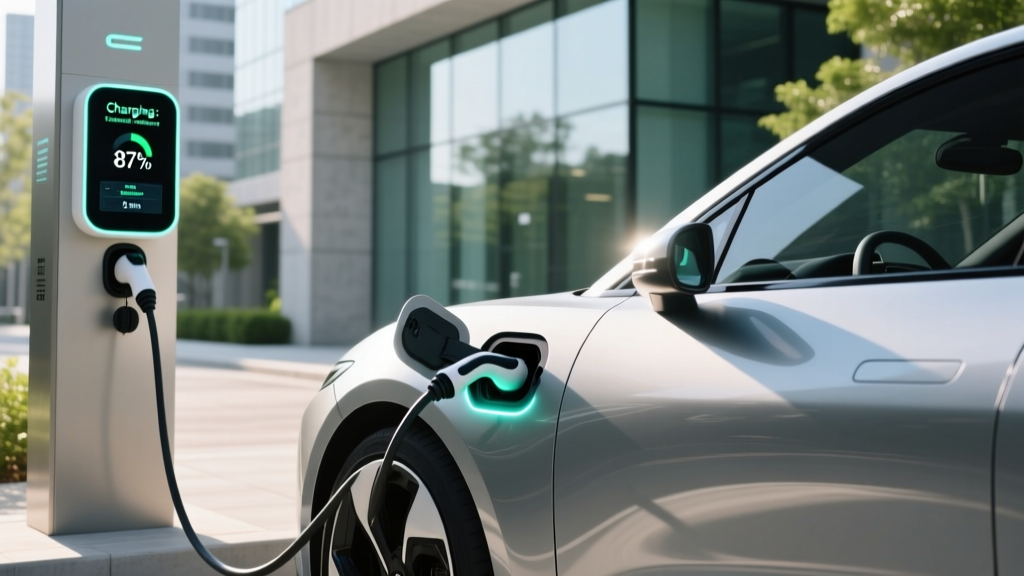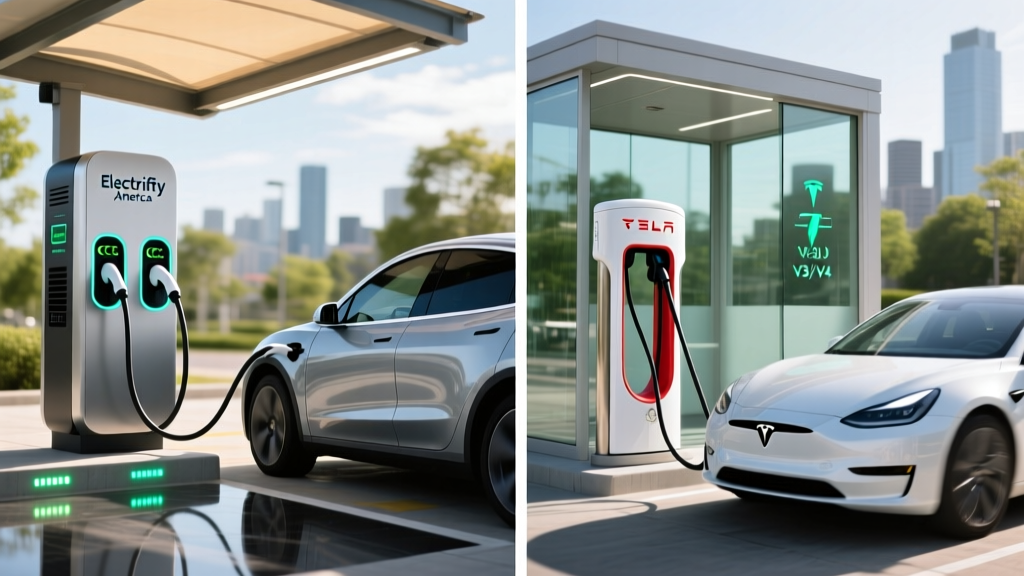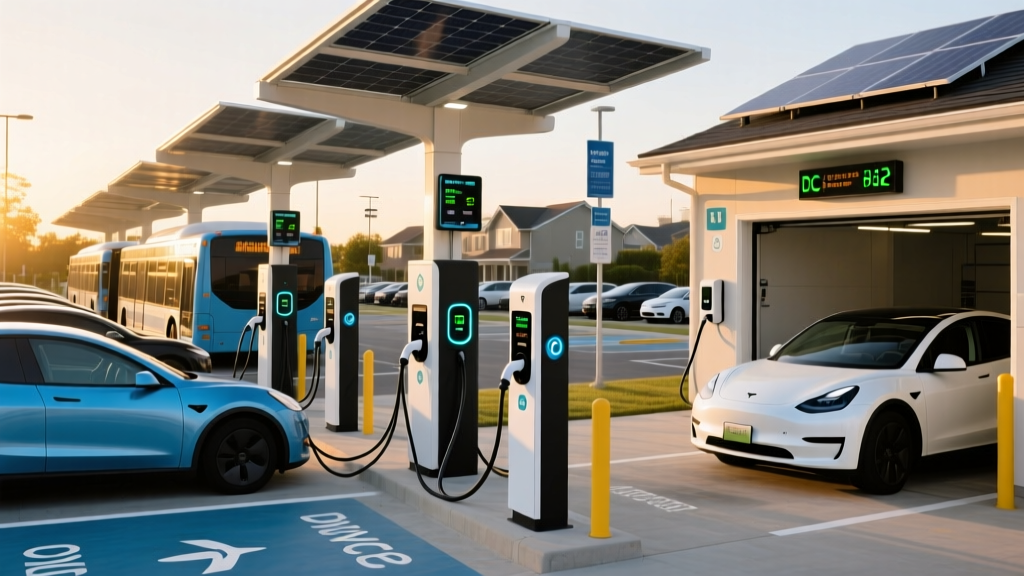
Whether you're electrifying a delivery-van fleet, transitioning company sedans to EVs, or simply managing two household electric vehicles, the infrastructure question is the same: how do you keep multiple vehicles charged, available, and cost-efficient without blowing your electrical panel? This guide breaks down the hardware, electrical requirements, connector realities, and per-mile economics of charging an electric fleet — from a two-car home garage to a 20-vehicle commercial depot.
Charging Levels Explained: Speed, Power, and What Each Adds Per Hour
The single most important distinction in EV charging is between kW (kilowatts — the rate of power delivery, like water pressure from a hose) and kWh (kilowatt-hours — the total energy stored, like gallons in a tank). A charger rated at 11.5 kW delivers energy at that rate; a 75 kWh battery holds that total capacity. Confusing the two leads to wildly wrong time estimates.
| Level | Voltage | Power (kW) | Miles of Range Added Per Hour | Typical Use Case |
|---|---|---|---|---|
| Level 1 | 120V AC | 1.0–1.4 kW | 3–5 mi/hr | Overnight top-up, PHEVs, emergency |
| Level 2 | 208/240V AC | 3.3–19.2 kW | 12–75 mi/hr | Home depot, workplace, overnight fleet |
| DC Fast (Level 3) | 400–800V DC | 50–350 kW | 150–1,000+ mi/hr (peak) | Highway stops, rapid daytime turnaround |
For a fleet that returns to a depot overnight, Level 2 is the workhorse. A 75 kWh battery charging at 11.5 kW (48A on a 60A circuit) adds roughly 35–40 miles of range per hour — enough to fully replenish most fleet EVs in 7–9 hours. DC fast charging is reserved for midday top-ups or vehicles that can't afford an 8-hour sit; it's also 3–5× more expensive per kWh at public stations.
Electrical Requirements for Fleet Charging: Panels, Circuits, and Upgrades
Every Level 2 charger requires a dedicated circuit sized at 125% of the charger's continuous draw. A 48A charger needs a 60A breaker; a 40A charger needs a 50A breaker. When installing multiple chargers, you're adding substantial continuous load to your electrical service.
Here's what a typical small fleet or multi-EV home installation demands:
- Single 48A Level 2 charger: 60A dedicated 240V circuit, 6 AWG copper wire, ~$500–$1,200 install (assuming panel capacity exists)
- Two 48A chargers: Two 60A circuits or one subpanel with load management; may require 200A service upgrade
- Four+ chargers (small depot): Commercial 480V three-phase service, dedicated subpanel, likely utility coordination for demand charges
When You'll Need a Panel Upgrade
Most US homes built before 2010 have 100A or 150A main service. A single 60A EV circuit can consume 40–60% of available headroom on a 100A panel — especially if you're also running electric heat, a dryer, and an oven. Commercial fleet depots almost always need dedicated service from the utility, sized based on simultaneous charging load.
Load-management solutions (like Emporia or Wallbox Power Sharing) let multiple chargers share a single circuit, dynamically splitting amperage so you never trip the breaker. This can save a $3,000–$5,000 panel upgrade in many scenarios.
| Component | Typical Cost Range | Notes |
|---|---|---|
| Level 2 EVSE hardware (40–48A) | $400–$750 | Smart/Wi-Fi models at upper end |
| Electrician labor (single charger) | $500–$1,500 | Varies by wire run length, wall type |
| Permit and inspection | $50–$250 | Required in most jurisdictions |
| Panel upgrade (if needed) | $2,000–$5,000 | 100A→200A residential; commercial higher |
| Load-management controller (multi-charger) | $200–$600 | Optional; avoids panel upgrade |
| Total (no panel upgrade) | $950–$2,500 | Per charger, installed |
| Total (with panel upgrade) | $3,000–$7,500 | First charger; subsequent cheaper |
Always hire a licensed electrician and pull permits. The National Electrical Code (NEC) Article 625 governs EV charging installations, and unpermitted work can void insurance and create fire risk.
Connector Compatibility: NACS, CCS, CHAdeMO, and Fleet Adapter Strategy
The North American connector landscape has consolidated significantly. Tesla's NACS (North American Charging Standard) is now adopted by Ford, GM, Rivian, Volvo, Hyundai, and most major OEMs starting with 2025–2026 model-year vehicles. CCS1 remains on many 2022–2024 models still in fleet service. CHAdeMO is effectively legacy — found only on older Nissan Leafs and Mitsubishi Outlander PHEVs.
| Connector | Vehicles Using It | AC Level 2 Charging | DC Fast Charging | Adapter Needed? |
|---|---|---|---|---|
| NACS (Tesla) | All Teslas; Ford, GM, Rivian, Hyundai, Volvo 2025+ models | NACS (native) | NACS Supercharger / NACS DC stations | CCS→NACS adapter for older CCS vehicles (~$200–$300) |
| CCS1 | 2022–2024 Ford, GM, VW, Hyundai, Kia, BMW, most non-Tesla | J1772 (native or adapter) | CCS DC stations | NACS→CCS adapter available from Tesla (~$250) |
| CHAdeMO | Nissan Leaf (all years), Mitsubishi Outlander PHEV | J1772 | CHAdeMO stations (declining) | No practical adapter; plan replacement |
| J1772 | All non-Tesla EVs (AC Level 1/2 only) | J1772 (native) | N/A (AC only) | Tesla Mobile Connector includes J1772 adapter |
Fleet planning tip: If your fleet mixes 2023 CCS vehicles with 2026 NACS vehicles, install Level 2 chargers with J1772 connectors (universally compatible for AC charging with the included adapter on Teslas/NACS vehicles). For DC fast charging in the field, ensure drivers carry the appropriate adapter. Standardize on NACS for any new vehicle orders from 2025 onward.
Cost to Charge Per Mile: Fleet EVs vs. Gas Vehicles
The economics of charging an electric fleet hinge on your electricity rate — and that varies dramatically between home/off-depot charging, commercial utility rates, and public DC fast networks.
| Scenario | $/kWh or $/Gallon | Vehicle Efficiency | Cost Per Mile |
|---|---|---|---|
| Home depot (off-peak utility rate) | $0.08–$0.12/kWh | 3.0 mi/kWh (100 MPGe) | $0.027–$0.040 |
| Home depot (standard residential rate) | $0.14–$0.18/kWh | 3.0 mi/kWh | $0.047–$0.060 |
| Commercial utility (fleet depot, demand charges) | $0.10–$0.20/kWh | 2.8 mi/kWh | $0.036–$0.071 |
| Public Level 2 (ChargePoint, EVgo) | $0.25–$0.49/kWh | 3.0 mi/kWh | $0.083–$0.163 |
| Public DC fast (Electrify America, Tesla Supercharger) | $0.35–$0.55/kWh | 2.8 mi/kWh | $0.125–$0.196 |
| Gasoline vehicle (fleet avg 25 MPG) | $3.40/gallon | 25 MPG | $0.136 |
| Gasoline vehicle (fleet avg 18 MPG, trucks/vans) | $3.40/gallon | 18 MPG | $0.189 |
At off-peak residential or commercial rates, fleet EV charging costs roughly $0.03–$0.06 per mile — a 60–75% savings versus a 25 MPG gas vehicle and a 70–80% savings versus an 18 MPG cargo van. The savings erode at public DC fast chargers, which is why depot-based overnight charging is the economic backbone of any electric fleet strategy.
For context on efficiency ratings, the EPA's fueleconomy.gov publishes MPGe figures for every EV sold in the US. A Ford E-Transit rates at 2.0 mi/kWh (67 MPGe combined); a Tesla Model Y rates at 3.4 mi/kWh (117 MPGe combined). Use your actual fleet vehicles' efficiency for precise projections.
Charging Time Examples: What to Expect for Common Fleet Battery Sizes
Here's how long common fleet EV batteries take to charge at each level, using the 10–80% window that most fleet operators target (charging to 100% daily accelerates battery degradation on NMC chemistries):
- Ford E-Transit (68 kWh usable, NMC): Level 2 at 11.5 kW → ~6.5 hours 10–80%; DC fast at 115 kW peak → ~45 min 10–80%
- Chevrolet Equinox EV (85 kWh, NMC): Level 2 at 11.5 kW → ~7.5 hours 10–80%; DC fast at 150 kW peak → ~35 min 10–80%
- Tesla Model Y (75 kWh, NMC/LFP depending on trim): Level 2 at 11.5 kW → ~6 hours 10–80%; DC fast at 250 kW peak → ~22 min 10–80%
- Rivian EDV delivery van (112 kWh, NMC): Level 2 at 11.5 kW → ~10 hours 10–80%; DC fast at 200 kW peak → ~50 min 10–80%
- Hyundai Ioniq 5 (77.4 kWh, NMC): Level 2 at 10.9 kW → ~7 hours 10–80%; DC fast at 240 kW peak → ~18 min 10–80%
Recommended Charging Equipment for Fleet Deployments
Not all Level 2 chargers are equal. For fleet use, prioritize: hardwired installation (more reliable than plug-in NEMA 14-50 for daily use), cable length ≥24 feet (to reach multiple parking positions), Wi-Fi/scheduling for off-peak charging, and UL/ETL certification for safety.
ChargePoint Home Flex
- Power: Up to 12 kW (50A) / configurable down to 16A
- Connector: J1772 (NACS adapter included for Teslas)
- Cable: 23 ft
- Smart features: Wi-Fi, scheduling, Alexa, load-sharing between units
- Price: ~$550–$700
- Best for: Multi-unit fleet depots with load management
Wallbox Pulsar Plus
- Power: Up to 11.5 kW (48A)
- Connector: J1772
- Cable: 25 ft
- Smart features: Wi-Fi + Bluetooth, Power Sharing for up to 10 units on one circuit
- Price: ~$500–$650
- Best for: Scalable multi-charger fleet installs without panel upgrades
Emporia Vue EV Charger
- Power: Up to 11.5 kW (48A)
- Connector: J1772
- Cable: 24 ft
- Smart features: Integrated energy monitoring, solar-aware scheduling, load management
- Price: ~$400–$500
- Best for: Budget-conscious fleet operators wanting granular energy data
Tesla Wall Connector
- Power: Up to 11.5 kW (48A)
- Connector: NACS (native Tesla); J1772 adapter included
- Cable: 24 ft
- Smart features: Wi-Fi, Power Sharing, OTA updates
- Price: ~$475
- Best for: All-Tesla fleets; mixed fleets with adapter
For commercial DC fast charging at a depot, expect to invest $25,000–$100,000+ per unit (50–180 kW) plus utility service upgrades. Most small-to-mid fleets rely on public DC networks (Electrify America, EVgo, Tesla Supercharger) for occasional fast charging and Level 2 depot charging for daily needs.
Safety, Code, and Inspection Requirements
Fleet charging installations must comply with NEC Article 625 and local amendments. Key requirements:
- Dedicated circuit: Each Level 2 charger needs its own breaker — no sharing with other appliances
- GFCI protection: Required for outdoor installations and many indoor garage installations (2020+ NEC)
- Outdoor rating: NEMA 4 or NEMA 4X enclosure for any exterior-mounted charger (rain, dust, ice protection)
- Wire gauge: Must match circuit amperage and run length; longer runs require thicker wire to prevent voltage drop
- Strain relief: Hardwired connections must include cable strain relief fittings
- Ventilation: Not typically required for Level 2, but enclosed charging rooms should have airflow to manage heat from multiple units
For commercial fleet depots with 4+ chargers, consider a dedicated EV subpanel with individual metering. This simplifies utility demand-charge management and provides clean data for IRS §30C Alternative Fuel Vehicle Refueling Property Credit, which covers up to 30% of charging equipment and installation costs (up to $100,000 per item for commercial property) in eligible census tracts. Confirm eligibility with a tax professional and IRS guidelines.
Fleet Charging Strategy: Decision Framework
Choose Your Charging Architecture
Choose all-Level 2 depot charging if: Your vehicles return to base nightly, have ≥8 hours of dwell time, and your daily routes consume less than 80% of battery capacity. This is the lowest-cost, lowest-complexity approach — roughly $0.03–$0.06/mile fuel cost.
Add DC fast charging (on-site or public) if: Your vehicles run multi-shift operations, cover 200+ miles daily, or need midday turnaround in under an hour. Budget $0.12–$0.20/mile for public DC, or $30K–$100K+ for depot DC infrastructure.
Implement load management if: You're installing 3+ chargers and want to avoid a $5,000–$20,000 service upgrade. Power-sharing systems let 4–6 chargers run on a single 100A circuit by dynamically allocating amperage.
Frequently Asked Questions
How much does it cost to install a home or depot EV charger?
A single Level 2 charger (40–48A) costs $950–$2,500 installed if your electrical panel has capacity. Add $2,000–$5,000 if you need a panel upgrade from 100A to 200A service. Commercial depot installations with multiple chargers and a dedicated subpanel typically run $3,000–$8,000 per charge point, with the first unit absorbing most of the infrastructure cost.
How fast will each charging level add range?
Level 1 (120V) adds 3–5 miles per hour — essentially unusable for fleet operations. Level 2 (240V, 48A) adds 30–40 miles per hour for most EVs, fully replenishing a 75 kWh battery overnight. DC fast charging adds 150–1,000+ miles per hour at peak, but real-world 10–80% sessions take 18–50 minutes depending on battery size and peak kW acceptance.
Which connector and charger is compatible with my EV?
All 2025–2026 model-year EVs from major OEMs use NACS for DC fast charging and J1772 or NACS for AC Level 2. Older 2022–2024 non-Tesla EVs use CCS1. For a mixed-age fleet, install J1772 Level 2 chargers (universally compatible with adapters) and stock CCS-to-NACS adapters for drivers who need DC fast charging on the newer network.
How much does charging cost per mile vs gas?
At off-peak depot rates ($0.08–$0.12/kWh), EVs cost $0.03–$0.04 per mile — roughly 75% less than a 25 MPG gas vehicle at $3.40/gallon ($0.14/mile). Even at standard residential rates ($0.15/kWh), you're paying ~$0.05/mile. Public DC fast charging narrows the gap to ~$0.13–$0.20/mile, approaching gas parity.
What electrical upgrades might I need for a fleet charger?
Homes or small businesses with 100A service will likely need a 200A upgrade ($2,000–$5,000) before adding a 60A EV circuit. Commercial depots often need dedicated three-phase 480V service from the utility — a process that can take 3–12 months and cost $10,000–$50,000+ depending on transformer proximity. Load-management hardware offers a middle path: run 4–6 chargers on existing service by dynamically sharing amperage.
Are there tax credits for fleet charging equipment?
Yes. The IRS §30C Alternative Fuel Vehicle Refueling Property Credit covers 30% of equipment and installation costs — up to $100,000 per item for commercial property — provided the installation is in an eligible low-income or non-urban census tract. The IRS §30C page details eligibility. Consult a tax professional to confirm your site qualifies before committing to a build.