If you own or are shopping for a Chevrolet Bolt EV or Bolt EUV, understanding your charging options is the single biggest factor in daily satisfaction. The Bolt platform uses a 65 kWh (usable) lithium-ion NMC battery pack delivering an EPA-estimated 259 miles (Bolt EV) or 247 miles (Bolt EUV). But those range numbers only matter if you can replenish the pack efficiently. This guide breaks down exactly how to charge the Chevy Bolt at every level, what equipment you need, what it costs, and where the real-world gotchas hide.
Charging Levels Explained: How Fast Will Each Add Range?
Before plugging in, it helps to separate kW (kilowatts — the rate of power flow, like water pressure from a hose) from kWh (kilowatt-hours — the total energy stored, like gallons in a tank). Charging speed is measured in kW; your Bolt's battery capacity is measured in kWh. Confusing the two is the most common mistake new EV owners make.
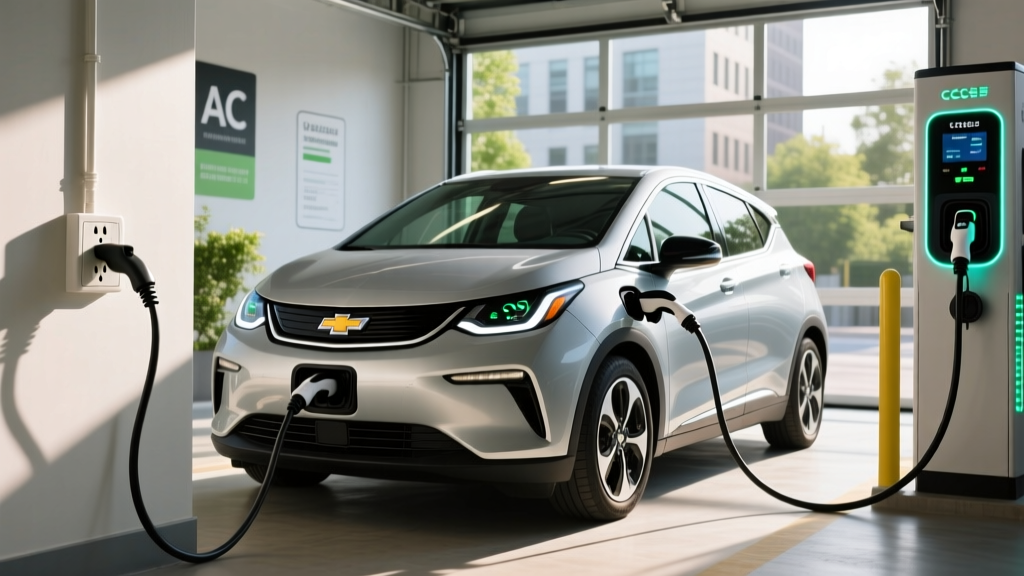
The Bolt EV and EUV accept up to 11.5 kW on Level 2 AC and up to 55 kW on DC fast charging (via CCS1 connector, or NACS with an adapter on 2025+ models equipped with the Tesla Supercharger adapter). Here is how each level performs with the Bolt's 65 kWh pack:
| Level | Power Source | Max kW to Bolt | Miles of Range Added Per Hour | 0–100% Time (65 kWh) | Best Use Case |
|---|---|---|---|---|---|
| Level 1 | 120V / 12A household outlet | ~1.4 kW | ~4–5 mi/hr | ~48–52 hours | Overnight top-up, low daily mileage |
| Level 2 | 240V / 48A dedicated circuit | 11.5 kW | ~34–39 mi/hr | ~6–7 hours | Daily home charging, full overnight replenishment |
| DC Fast | CCS1 or NACS (w/ adapter) public station | 55 kW peak | ~150–170 mi/hr (at peak) | N/A (10–80% in ~55–60 min) | Road trips, emergency top-ups |
DC fast-charging reality check: The Bolt's 55 kW peak DC charge rate is modest by 2026 standards (many competitors hit 150–250 kW). The pack charges from 10–80% in roughly 55–60 minutes at a capable station. Above 80% state of charge (SoC), the rate tapers significantly — often below 20 kW — to protect battery longevity. On a long road trip, plan stops around the 60-minute mark rather than waiting for a full charge.
Connector Compatibility: NACS, CCS1, and the Bolt
The connector landscape shifted dramatically between 2023 and 2025. Here is where the Bolt stands:
| Connector | Bolt EV/EUV (2022–2024) | Bolt EV/EUV (2025+) | Notes |
|---|---|---|---|
| CCS1 (Combined Charging System) | Native port | Native port | Standard on all Bolt models; works at Electrify America, EVgo, ChargePoint DC stations |
| NACS (Tesla / North American Charging Standard) | Requires aftermarket adapter (not officially supported) | GM-provided adapter included or available | Unlocks Tesla Supercharger network; confirm adapter availability with dealer |
| CHAdeMO | Not compatible | Not compatible | Legacy standard; irrelevant for Bolt owners |
| J1772 (Level 2 AC) | Native port | Native port (or NACS with J1772 adapter) | All public Level 2 and home chargers use J1772 or NACS AC |
Key takeaway: If you own a 2022–2024 Bolt, your DC fast-charging universe is CCS1 stations. The Tesla Supercharger network remains off-limits without an unofficial adapter (which GM does not endorse for older models). For 2025+ Bolt owners, the GM-approved NACS adapter opens roughly 20,000+ Supercharger stalls nationwide — a significant expansion of your road-trip options. Always verify adapter compatibility with your specific model year through your Chevrolet dealer.
Home Charger Installation: Electrical Requirements and Costs
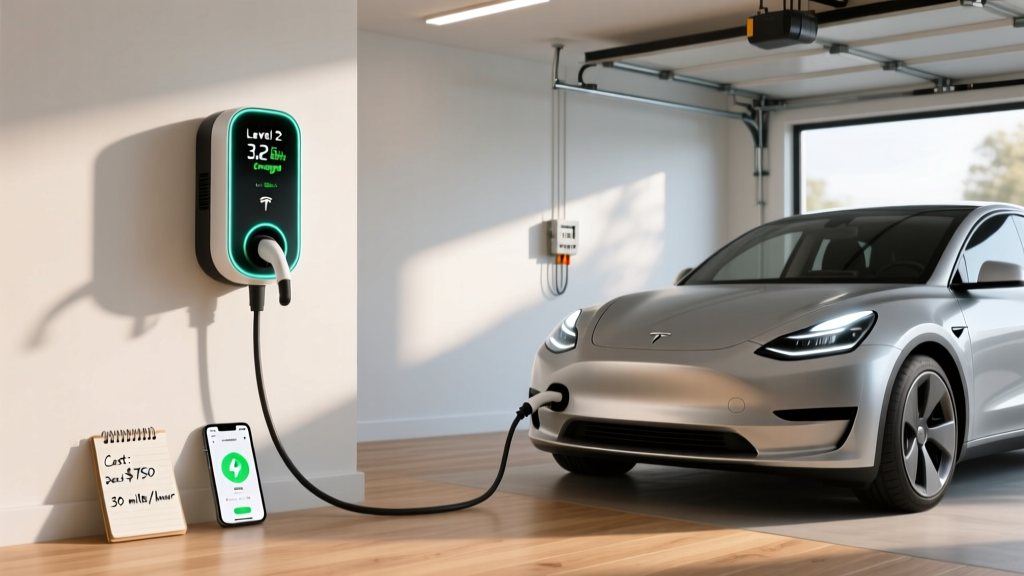
Charging the Chevy Bolt at home on Level 2 is the most practical and cost-effective approach. To unlock the Bolt's full 11.5 kW AC acceptance rate, you need a 240-volt circuit rated at 48 amps (a 60-amp breaker, since electrical code requires circuits to be derated to 80% of breaker capacity for continuous loads).
Electrical Panel and Circuit Requirements
- Breaker: 60A double-pole breaker in your main panel
- Wire: 6 AWG copper (THHN in conduit or NM-B/Romex where code allows)
- Outlet vs. hardwire: NEMA 14-50 outlet (if your charger has a plug) or direct hardwire (required for some 48A+ chargers)
- Panel capacity: Your main panel must have enough spare amperage. A 200A panel with existing heavy loads (electric range, dryer, HVAC) may require a load calculation or a panel upgrade to 300A–400A
Installation Cost Breakdown
| Component | Simple Install (panel nearby, no upgrade) | Complex Install (long run, panel upgrade) |
|---|---|---|
| Level 2 Charger Equipment | $350–$700 | $350–$700 |
| Electrical Permit | $50–$200 | $50–$300 |
| Electrician Labor (wiring + breaker) | $500–$1,200 | $1,500–$3,500 |
| Panel Upgrade (if needed) | $0 | $1,500–$5,500 |
| Conduit, Wire, Misc. Materials | $100–$300 | $300–$800 |
| Total Estimated Cost | $1,000–$2,400 | $3,700–$10,800 |
The wide range reflects real-world variability: garage distance from the panel, whether walls need to be opened, local labor rates, and whether your utility offers rebates. Many utilities in 2026 offer $250–$750 rebates for Level 2 installations — check with your provider. The federal Residential Clean Energy Credit (25C) may also cover up to 30% of charger and installation costs (max $1,000) through 2032, subject to IRS eligibility rules.
Recommended Home Chargers for the Chevy Bolt
The Bolt's 11.5 kW onboard charger means you benefit from a 48A-capable Level 2 unit. Here are proven options across price tiers:
Emporia Vue Level 2 Charger (Budget Pick)
- Power Output: 48A / 11.5 kW (240V)
- Connector: J1772 (NACS version available)
- Cable Length: 24 ft
- Smart Features: Wi-Fi, app scheduling, energy monitoring, solar integration
- Price: ~$399
- Best For: Budget-conscious Bolt owners who want smart scheduling for off-peak rates
ChargePoint Home Flex (Best Overall)
- Power Output: Up to 50A / 12 kW (240V, adjustable)
- Connector: J1772 (NACS plug option available)
- Cable Length: 23 ft
- Smart Features: Wi-Fi, Alexa, app-based scheduling, detailed session history, UL-listed
- Price: ~$549–$649
- Best For: Bolt owners who want reliability, a polished app, and adjustable amperage for panel flexibility
Grizzl-E Smart (Rugged / Outdoor Pick)
- Power Output: 40A / 9.6 kW (240V)
- Connector: J1772 (NACS adapter available)
- Cable Length: 24 ft
- Smart Features: OCPP-compatible, app scheduling, extreme-weather rated (-40°F to 122°F)
- Price: ~$449
- Best For: Outdoor installations in cold climates; slightly lower 9.6 kW output still adds ~30 mi/hr to the Bolt
Wallbox Pulsar Plus (Compact / Premium)
- Power Output: 48A / 11.5 kW (240V)
- Connector: J1772 or NACS
- Cable Length: 25 ft
- Smart Features: Wi-Fi + Bluetooth, Power Sharing (dual-unit), Eco-Smart solar mode
- Price: ~$599–$699
- Best For: Two-EV households needing load-balanced dual charging on one circuit
Editor's note: Even though the Grizzl-E maxes out at 40A (9.6 kW), it still charges the Bolt faster than most owners will need overnight. A fully depleted Bolt EUV will reach 100% in roughly 7 hours at 9.6 kW versus 6 hours at 11.5 kW — a negligible difference for overnight charging. Prioritize circuit quality and a UL-listed unit over chasing the last 1.9 kW.
Cost to Charge the Chevy Bolt: Home vs. Public vs. Gas
Charging economics depend on your local electricity rate, time-of-use schedule, and how often you rely on public DC fast chargers. The Bolt's 65 kWh battery provides a clear baseline for calculations.
| Charging Scenario | Rate ($/kWh) | Cost for Full 65 kWh Charge | Cost Per Mile (at 3.5 mi/kWh efficiency) |
|---|---|---|---|
| Home — Off-Peak (national avg) | $0.12 | $7.80 | $0.034 |
| Home — Peak (TOU high) | $0.28 | $18.20 | $0.080 |
| Public Level 2 (ChargePoint, EVgo) | $0.25–$0.39 | $16.25–$25.35 | $0.070–$0.109 |
| DC Fast (Electrify America, EVgo) | $0.35–$0.55 | $22.75–$35.75 | $0.098–$0.154 |
| Tesla Supercharger (w/ adapter, 2025+) | $0.28–$0.42 | $18.20–$27.30 | $0.078–$0.118 |
| Gasoline Baseline (28 MPG avg, $3.40/gal) | — | — | $0.121 |
The bottom line: Charging the Bolt at home on off-peak electricity costs roughly 3.4 cents per mile — about a quarter of the cost of gasoline at $3.40/gallon in a comparable 28 MPG compact car. Even at peak DC fast-charging rates ($0.48–$0.55/kWh), the Bolt remains cost-competitive with gas. The savings compound: a driver covering 12,000 miles per year saves $1,000–$1,500 annually by charging at home versus fueling a gas car.
To maximize savings, schedule charging during off-peak hours (typically 10 PM – 6 AM, varying by utility). Most smart chargers and the myChevrolet app support scheduled charging. If your utility offers an EV-specific time-of-use rate plan, enroll — it can cut charging costs by 30–50%.
DC Fast Charging on Road Trips: Planning Around the Bolt's 55 kW Ceiling
The Bolt's 55 kW peak DC charge rate is its most discussed limitation. While competitors like the Hyundai Ioniq 5 (peak 240 kW) or Tesla Model Y (peak 250 kW) can add 200 miles in 15–18 minutes, the Bolt requires roughly 30 minutes to add 100–120 miles at a capable DC station. This matters for road trips but is irrelevant for daily driving.
Here is what a realistic DC fast-charging session looks like for the Bolt:
- 10–30% SoC: Charges near the 55 kW peak — adds ~40 miles in ~12 minutes
- 30–60% SoC: Sustains ~45–50 kW — adds ~65 miles in ~20 minutes
- 60–80% SoC: Tapers to ~35–40 kW — adds ~45 miles in ~18 minutes
- 80–100% SoC: Drops below 20 kW — slow; avoid unless necessary
Road-trip strategy: Charge from 10% to 70% (about 35–40 minutes), then drive on. Avoid charging above 80% at DC stations — the taper makes it painfully slow and you are paying premium DC rates for trickle-speed electrons. Preconditioning the battery (available via the myChevrolet app when a charging stop is navigated to) can improve charge speeds by 10–15% in cold weather.
Safety, Permits, and Code Considerations
EV charging circuits carry significant continuous current. Cutting corners on safety is not an option — and your home insurance may deny claims from unpermitted electrical work.
- Dedicated circuit: Your Level 2 charger must be on its own dedicated breaker — never share a circuit with a dryer, oven, or HVAC system
- GFCI protection: NEC 2020 and later require GFCI protection for outdoor EV outlets. Hardwired indoor installations may not require GFCI, but check local amendments
- Outdoor rating: If mounting outdoors, ensure the charger carries a NEMA 4 (or IP65+) weather rating. The Grizzl-E and ChargePoint Home Flex are rated for outdoor use
- Permit and inspection: Virtually all jurisdictions require a permit for new 240V circuits. The inspection ensures proper wire gauge, breaker sizing, grounding, and GFCI compliance. Budget $50–$300 for the permit
- Utility notification: Some utilities require notification before adding a Level 2 charger, especially in areas with transformer capacity constraints. A few offer free or discounted panel upgrades for EV adopters
Frequently Asked Questions
How much does it cost to install a home charger for the Chevy Bolt?
A straightforward Level 2 installation (60A circuit, short wire run, no panel upgrade) typically costs $1,000–$2,400 including the charger, permit, and electrician labor. Complex installs requiring long wire runs, conduit through walls, or a panel upgrade can reach $3,700–$10,800. Always get 2–3 quotes from licensed electricians and check for utility rebates.
Can I charge the Chevy Bolt on a regular 120V outlet?
Yes. Level 1 charging on a standard 120V/12A outlet adds roughly 4–5 miles of range per hour (~1.4 kW). A full charge from empty takes about 48–52 hours. Level 1 works if your daily driving is under 30–40 miles and you can charge every night, but a Level 2 installation is strongly recommended for anyone driving more or wanting flexibility.
How fast will each charging level add range to the Bolt?
Level 1 (120V): ~4–5 miles per hour. Level 2 (240V, 48A): ~34–39 miles per hour. DC fast charging (55 kW peak): up to ~170 miles per hour at peak, but the Bolt's charge curve tapers significantly — expect a 10–80% session to take about 55–60 minutes.
Is the Chevy Bolt compatible with Tesla Superchargers?
The 2025+ Bolt EV and EUV are compatible with Tesla Superchargers using a GM-approved NACS adapter. Earlier model years (2022–2024) have a native CCS1 port and are not officially supported on the Supercharger network. Check with your Chevrolet dealer for adapter availability and firmware requirements.
How much does charging the Bolt cost per mile compared to gas?
At the national average off-peak residential rate of $0.12/kWh, charging the Bolt costs roughly $0.034 per mile. A comparable gas car getting 28 MPG at $3.40/gallon costs $0.121 per mile. That is a 72% fuel cost reduction for home charging. Even at public DC fast-charging rates ($0.40–$0.55/kWh), the Bolt remains at or below gasoline cost per mile.
What electrical upgrades might I need for a Level 2 charger?
If your home has a 200A electrical panel with available capacity, you likely need only a new 60A double-pole breaker and wiring — no upgrade required. Homes with 100A or 150A panels, or panels already near capacity, may need a panel upgrade to 200A–400A ($1,500–$5,500). A licensed electrician will perform a load calculation to determine this.
Does fast charging degrade the Bolt's battery?
Occasional DC fast charging has minimal impact on battery health. GM warranties the Bolt's battery for 8 years/100,000 miles against degradation below 60% of original capacity. Long-term studies show NMC packs like the Bolt's typically retain 85–92% capacity after 100,000 miles with mixed charging habits. To maximize longevity, avoid routinely charging to 100% or leaving the car at 0% for extended periods; a daily target of 80% SoC is ideal.