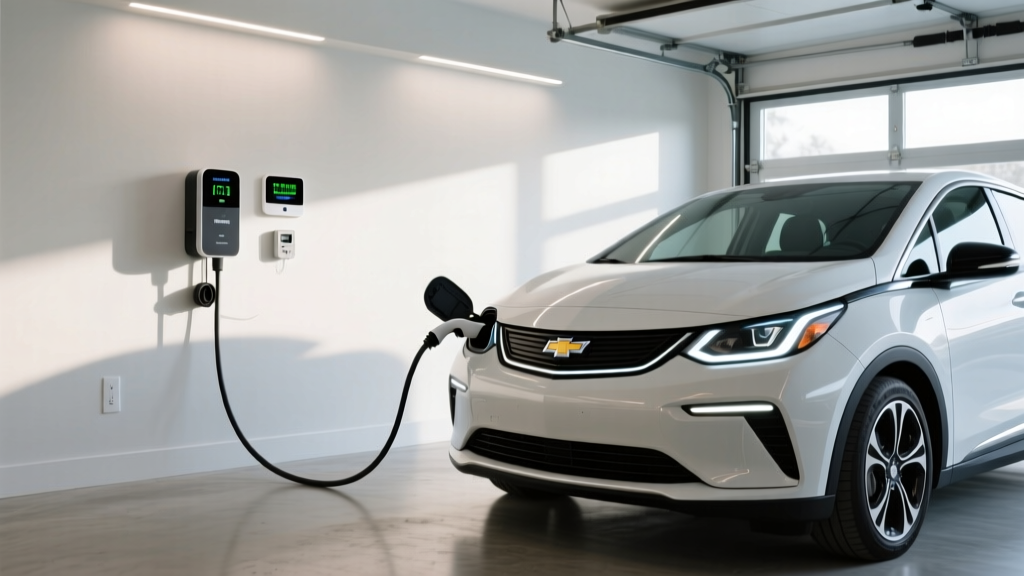
If you own or are considering a Chevrolet Bolt EV or Bolt EUV, home charging is the single most impactful upgrade you can make for daily convenience. The Bolt's 65 kWh battery pack (usable capacity) means that while Level 1 charging technically works, it tests the patience of all but the most predictable commuters. A proper Level 2 home setup transforms the Bolt from a car you plan around into a car that's always ready.
This guide covers every electrical, equipment, and cost consideration for charging Chevy Bolt at home — with exact kW figures, installation cost breakdowns, and charger recommendations that match the Bolt's 11.5 kW onboard charger limit.
Chevy Bolt Battery and Charging Specs at a Glance
Before selecting equipment, you need the Bolt's hard numbers. Both the Bolt EV and Bolt EUV share the same powertrain architecture across current model years.
| Specification | Bolt EV | Bolt EUV |
|---|---|---|
| Usable Battery Capacity | 65 kWh (NMC) | 65 kWh (NMC) |
| EPA Range | 259 miles | 247 miles |
| Max Level 2 AC Charge Rate | 11.5 kW | 11.5 kW |
| Max DC Fast Charge Rate | 55 kW (CCS1) | 55 kW (CCS1) |
| Onboard Charger | 11.5 kW / 48A | 11.5 kW / 48A |
| Connector (AC) | J1772 | J1772 |
| Connector (DC) | CCS1 | CCS1 |
| Battery Warranty | 8 years / 100,000 miles | 8 years / 100,000 miles |
| Battery/Powertrain Warranty Capacity Threshold | 60% retention | |
Real-world range note: The EPA rates the Bolt EV at 259 miles, but expect approximately 220–240 miles on sustained highway driving at 70+ mph, and as low as 170–190 miles in sub-freezing temperatures due to cabin heating draw and reduced battery chemistry efficiency. Source: fueleconomy.gov.
Charging Levels Explained: How Fast Will Each Add Range?
Understanding the three charging levels is essential. Note that kW (kilowatts) measures power — the rate of energy delivery — while kWh (kilowatt-hours) measures energy, the total amount stored in your battery. Think of kW as the speed of water flowing from a hose, and kWh as the total gallons in the bucket.
| Level | Voltage | Power (kW) | Miles of Range per Hour | Full 0–100% Time (65 kWh) | Best Use Case |
|---|---|---|---|---|---|
| Level 1 | 120V AC | 1.0–1.4 kW | 3–5 miles/hr | 46–65 hours | Emergency top-ups, very low daily mileage |
| Level 2 | 240V AC | 3.3–11.5 kW | 12–39 miles/hr | 5.5–20 hours | Daily home charging (primary method) |
| DC Fast | 400V+ DC | 55 kW (Bolt max) | ~180+ miles/hr (peak) | N/A (10–80% in ~55 min) | Road trips, rapid top-ups |
Critical Bolt-specific detail: The Bolt's onboard charger maxes out at 11.5 kW (48 amps). Even if you install a 19.2 kW Level 2 charger, the Bolt will only draw 11.5 kW. This means a 48-amp circuit (60-amp breaker) fully saturates the Bolt's AC charging capability. Installing a higher-capacity charger isn't wasted — it future-proofs for your next EV — but don't expect faster charging on the Bolt itself.
DC fast charging caveat: The Bolt's 55 kW peak DC rate is among the slowest in the current EV market. On a 150 kW or 350 kW station, the Bolt will still peak at 55 kW, and its charge curve tapers significantly above 80% state of charge (SoC). A 10–80% session takes approximately 55 minutes — acceptable for road trips with a meal stop, but noticeably slower than competitors like the Hyundai Ioniq 5 (18 minutes) or Tesla Model 3 (15–20 minutes).
Home Level 2 Installation: Electrical Requirements and Costs
Installing a Level 2 charger at home for your Chevy Bolt requires a dedicated 240V circuit, similar to what powers an electric dryer or oven. Here's what's involved.
Electrical Requirements for Bolt Home Charging
- Voltage: 240V AC (split-phase, standard US residential)
- Recommended circuit: 60-amp breaker supporting a continuous 48-amp load (National Electrical Code requires circuits rated at 125% of continuous load)
- Minimum viable circuit: 20-amp breaker for a 16-amp charger (3.8 kW) — functional but slow for the Bolt's 65 kWh battery
- Wire gauge: 6 AWG copper for 60A; 10 AWG for 30A; varies by run length
- Outlet option: NEMA 14-50 (if using a plug-in charger) or hardwired (often preferred for 48A+ units)
Panel Upgrade: The Cost Many Guides Ignore
Most homes built after 1990 have a 200-amp electrical panel, which can usually accommodate a 60-amp EV circuit. However, older homes with 100-amp service, or homes where the panel is already near capacity (electric HVAC, dryer, water heater, oven), may require a panel upgrade or a smart load-management system.
Signs you may need a panel upgrade:
- Your panel is 100-amp service
- Few or no open breaker slots
- Your electrician's load calculation shows you're near 80% of panel capacity
- You have a Federal Pacific or Zinsco panel (known safety hazards that must be replaced)
| Component | Low Estimate | High Estimate | Notes |
|---|---|---|---|
| Level 2 Charger (Equipment) | $300 | $700 | 32A–48A smart chargers; see recommendations below |
| Electrician Labor | $500 | $1,500 | Depends on run length, wall material, conduit needs |
| Electrical Permit | $50 | $300 | Varies by municipality; required in most jurisdictions |
| Panel Upgrade (if needed) | $1,500 | $4,000 | 100A→200A upgrade; not needed in most modern homes |
| Utility Make-Ready Work | $0 | $500 | Some utilities cover this; others charge for service drop upgrades |
| Total (No Panel Upgrade) | $850 | $2,500 | Typical scenario for 200A-panel homes |
| Total (With Panel Upgrade) | $2,350 | $6,500 | Older homes or high-load panels |
Federal incentive: The IRS §30D-related Residential Clean Energy Credit (25C) covers 30% of home EV charger equipment and installation costs, up to $1,000 per year. This credit applies through 2032 and can offset $250–$750 of a typical Bolt home charging installation. Confirm current eligibility with a tax professional.
How Much Does Charging a Chevy Bolt Cost Per Mile vs. Gas?
This is where home charging pays for itself. The Bolt EV achieves approximately 28 kWh per 100 miles in mixed driving (per fueleconomy.gov). Here's what that costs across different charging scenarios.
| Scenario | Rate | Cost per 100 Miles | Cost per Mile |
|---|---|---|---|
| Home Charging (national avg. residential) | $0.16/kWh | $4.48 | $0.045 |
| Home Charging (off-peak utility rate) | $0.08/kWh | $2.24 | $0.022 |
| Public Level 2 (ChargePoint, etc.) | $0.30/kWh | $8.40 | $0.084 |
| DC Fast Charging (Electrify America) | $0.48/kWh | $13.44 | $0.134 |
| Gas Equivalent (30 MPG, $3.40/gal) | $3.40/gallon | $11.33 | $0.113 |
Annual savings calculation: At 12,000 miles per year, charging at home at the national average rate costs approximately $540 annually. A comparable gas car at 30 MPG costs $1,360. That's $820 per year in fuel savings — meaning a typical $1,500 home charger installation pays for itself in under two years, before any tax credits.
If your utility offers time-of-use (TOU) rates and you charge overnight at $0.08/kWh, annual fuel cost drops to $268. The Bolt's scheduled charging feature (configurable through the MyChevrolet app or the charger's own app) makes TOU optimization automatic.
Connector Compatibility: What Plug Does the Chevy Bolt Use?
The Bolt EV and EUV use the J1772 connector for AC (Level 1 and Level 2) charging and the CCS1 (Combo) connector for DC fast charging. This is the standard for nearly all non-Tesla EVs sold in North America through 2024.
| Connector | Type | Used By | Bolt Compatible? |
|---|---|---|---|
| J1772 | AC (Level 1/2) | Bolt, most non-Tesla EVs (pre-2025) | Yes — native |
| NACS (Tesla) | AC + DC | Tesla (all), Ford, GM, Rivian, others (2025+) | No — adapter required |
| CCS1 | DC Fast | Bolt, VW ID.4, Hyundai/Kia (pre-2025) | Yes — native |
| CHAdeMO | DC Fast | Nissan Leaf (legacy) | No — not applicable |
The NACS transition and your Bolt: General Motors has adopted the NACS (North American Charging Standard, developed by Tesla) for its EVs starting with the 2025 model year. However, the current Bolt EV/EUV retains CCS1/J1772. If you plan to keep your Bolt for several years and eventually switch to a NACS-equipped GM, consider purchasing a dual-standard or adapter-compatible home charger, or simply use a J1772 charger now and swap later. A NACS-to-J1772 adapter (such as the Lectron or A2Z adapter, $150–$250) allows a NACS-equipped charger to serve your Bolt today.
Best Home Chargers for the Chevy Bolt: Equipment Picks
Since the Bolt draws a maximum of 11.5 kW (48 amps) on Level 2, you want a charger rated for at least 48 amps to fully utilize the car's onboard charger. Here are tested recommendations across price tiers.
Emporia Vue Level 2 Smart Charger
- Power Output: 48 amps / 11.5 kW (max matches Bolt's limit)
- Connector: J1772 (NACS version available)
- Cable Length: 24 feet
- Smart Features: Wi-Fi, app scheduling, energy monitoring, solar integration, load management
- Installation: Hardwire or NEMA 14-50 plug
- Price: ~$399
- Verdict: Best value 48A charger; energy monitoring pairs well with TOU rate optimization
ChargePoint Home Flex
- Power Output: Up to 50 amps / 12 kW (adjustable down via DIP switches)
- Connector: J1772 (NACS version available)
- Cable Length: 23 feet
- Smart Features: Wi-Fi, app scheduling, Alexa/Google integration, flexible amperage
- Installation: NEMA 14-50 or hardwire
- Price: ~$549–$699
- Verdict: Excellent flexibility; adjustable amperage means you can install on a 40A or 60A circuit without changing hardware
Wallbox Pulsar Plus
- Power Output: 48 amps / 11.5 kW
- Connector: J1772
- Cable Length: 25 feet
- Smart Features: Wi-Fi + Bluetooth, app control, Power Sharing (for multi-charger setups), ECO mode for solar
- Installation: Hardwire recommended
- Price: ~$449–$599
- Verdict: Compact form factor, strong app, ideal if you plan a second charger later
Grizzl-E Smart (Budget Pick)
- Power Output: 40 amps / 9.6 kW
- Connector: J1772
- Cable Length: 24 feet
- Smart Features: Basic app, OCPP compatibility
- Installation: NEMA 14-50 or hardwire
- Price: ~$349
- Verdict: Rugged, Canadian-built, good for outdoor install. Slightly under Bolt's max draw at 9.6 kW, but still delivers ~32 miles/hr — adequate for overnight charging
Installation tip: Always hire a licensed electrician and pull a permit. The NEC requires GFCI protection for outdoor receptacles, and many jurisdictions now require it for indoor EV outlets as well. Hardwired installations bypass the GFCI-breaker requirement (the charger provides ground-fault protection internally), which can save $50–$100 on breaker cost and reduce nuisance trips.
Safety and Electrical Code Considerations
Home EV charging is safe when installed to code. Here's what your electrician should address:
- Dedicated circuit: Your EV charger must have its own dedicated breaker — never share a circuit with other appliances
- Continuous load derating: NEC Article 625 requires EV charging circuits to be rated at 125% of the charger's maximum draw (a 48A charger requires a 60A breaker)
- Outdoor rating: If installing outside, the charger must carry a NEMA 4 or IP65 rating for weather resistance. All chargers listed above meet this standard
- GFCI protection: Required for outdoor NEMA 14-50 receptacles in most jurisdictions; hardwired chargers handle this internally
- Cable management: Use a wall-mounted holster or retractable reel to keep cables off the ground and prevent trip hazards and insulation damage
- Ventilation: Not required for Level 2 EV chargers (unlike older lead-acid battery chargers), but avoid enclosed spaces without airflow if your charger's manual specifies it
Frequently Asked Questions
How much does it cost to install a home EV charger for my Chevy Bolt?
A typical Level 2 installation with a 60-amp circuit costs $850–$2,500 including the charger, electrician labor, and permit — assuming your electrical panel has sufficient capacity. If a panel upgrade from 100A to 200A is needed, add $1,500–$4,000. The federal 25C Residential Clean Energy Credit can offset 30% of equipment and installation up to $1,000.
Can I charge my Chevy Bolt on a regular 120V outlet?
Yes, but slowly. Level 1 charging at 120V delivers roughly 1.2 kW, adding about 4 miles of range per hour. A full charge from empty takes 50+ hours. This works only if your daily driving is under 30–40 miles and you can leave the car plugged in for 10+ hours overnight. For most Bolt owners, Level 1 is a backup, not a primary strategy.
How fast will a Level 2 charger add range to my Bolt?
At the Bolt's maximum 11.5 kW draw (48 amps, 240V), you'll add approximately 39 miles of range per hour. A full charge from 10% to 90% (roughly 52 kWh replenished) takes about 4.5 hours — easily achievable overnight. Even a 32-amp charger (7.7 kW) adds about 26 miles per hour, which covers most daily needs in an 8-hour overnight session.
Should I buy a 48-amp or 32-amp charger for the Bolt?
A 48-amp charger matches the Bolt's onboard charger limit and delivers the fastest Level 2 speeds. However, a 32-amp charger on a 40-amp circuit costs less to install (thinner wire, smaller breaker) and still fully replenishes the Bolt overnight for most drivers. Choose 48A if your panel supports a 60A circuit and you want maximum speed or plan to own a future EV with higher AC acceptance.
Will a Tesla Wall Connector work with my Chevy Bolt?
The Tesla Wall Connector uses a NACS plug, which is not natively compatible with the Bolt's J1772 port. You would need a NACS-to-J1772 adapter ($150–$250). While this works, it adds a connection point and reduces convenience. Unless you also own a Tesla or plan to switch to NACS soon, a J1772-native charger is the simpler path for Bolt owners.
Does the Chevy Bolt support scheduled charging for off-peak rates?
Yes. The Bolt supports delayed charging through the MyChevrolet app and the vehicle's infotainment system. You can set a departure time or a charge-start window to align with your utility's off-peak rate period (typically 10 PM – 6 AM). Most smart Level 2 chargers (ChargePoint, Emporia, Wallbox) also offer scheduling through their own apps, giving you dual control layers.
What electrical upgrades might I need for a Bolt home charger?
Most homes with a 200-amp panel and available breaker slots need no upgrades beyond the dedicated 60-amp circuit and wiring run. Homes with 100-amp service, full panels, or aging wiring may need a panel upgrade ($1,500–$4,000), a sub-panel installation, or a smart load-management device that throttles the charger when other high-draw appliances are active. Your electrician's load calculation will determine this.