If you bought or inherited an electric vehicle from the 2020 model year — a Tesla Model 3, Chevrolet Bolt EV, Nissan Leaf, Hyundai Kona Electric, or Ford Mustang Mach-E — you likely have a vehicle with 200–300+ miles of EPA range and a battery between 40 kWh and 82 kWh usable. But the charging ecosystem has shifted dramatically since those cars rolled off the line. The North American Charging Standard (NACS) has largely replaced CCS1 for new infrastructure, DC fast-charging speeds have climbed past 350 kW at newer stations, and home charging equipment has become smarter, more affordable, and more powerful.
This guide breaks down exactly what it takes to charge a 2020-era EV in 2026 — from Level 1 trickle charging on a standard outlet to Level 2 home installations and public DC fast charging — with real numbers for speed, cost, and installation.
Charging Levels Explained: Speeds, Power, and Miles Per Hour
The single most important distinction in EV charging is between kW (kilowatts — the rate of power delivery, like water pressure in a hose) and kWh (kilowatt-hours — the total energy stored in your battery, like the size of the tank). A charger rated at 11.5 kW delivers energy at that rate; a 75 kWh battery holds that much total energy. Confusing the two is the most common mistake new EV owners make.
Here is how each charging level performs with a typical 2020-era EV battery (60–80 kWh):
| Level | Voltage / Amps | Max Power (kW) | Miles of Range Added Per Hour | 10–80% Time (75 kWh Battery) |
|---|---|---|---|---|
| Level 1 (Standard Outlet) | 120V / 12–16A | 1.4–1.9 kW | 3–5 mi/hr | ~40–50 hours |
| Level 2 (Home / Public AC) | 240V / 16–80A | 3.8–19.2 kW | 14–60 mi/hr | ~4–12 hours |
| DC Fast Charging | 400–800V DC | 50–350 kW | 150–1,000+ mi/hr (peak) | ~18–55 minutes |
Real-world context: A 2020 Tesla Model 3 Long Range (75 kWh battery, ~322 miles EPA) charging on a 48-amp Level 2 home circuit (11.5 kW) will add roughly 37 miles of range per hour and go from 10% to 80% in about 4.5 hours. The same car at a 250 kW Tesla Supercharger V3 can hit 10–80% in roughly 25–30 minutes, though the charge curve tapers significantly above 60% state of charge (SoC). A 2020 Chevy Bolt EV (66 kWh, ~259 miles EPA) is limited to ~55 kW DC fast charging, so even at a 350 kW station, its 10–80% time is around 45–55 minutes — a hardware limitation of that generation.
Home Level 2 Installation: Electrical Requirements and Real Costs
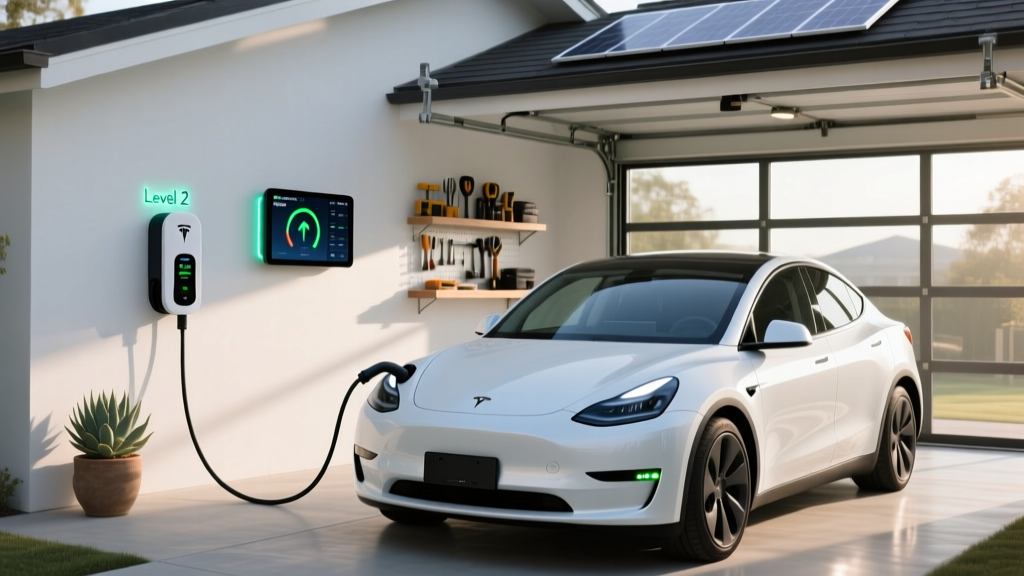
Installing a Level 2 charger at home is the single most impactful upgrade for daily EV ownership. Most 2020-era EVs have onboard chargers rated between 6.6 kW and 11.5 kW, meaning the car itself caps how fast it can accept AC power. Here's what the electrical side requires:
- Circuit: A dedicated 240V circuit. For a 48-amp charger (11.5 kW), the National Electrical Code (NEC) requires a 60-amp breaker (EVSE must be derated to 80% of circuit capacity for continuous loads).
- Wire gauge: Typically 6 AWG copper for a 60-amp circuit; 4 AWG for longer runs (over 50 feet from panel).
- Panel capacity: Your main electrical panel must have sufficient amperage headroom. A 200-amp panel can usually support a 60-amp EV circuit. A 100-amp panel likely cannot and will require an upgrade.
- Permit: Most jurisdictions require an electrical permit for a new 240V circuit, with inspection after installation.
- GFCI protection: NEC 2020 and later require GFCI protection for EV charging outlets; hardwired EVSE units often have built-in ground-fault protection, which can simplify compliance.
Installation Cost Breakdown
Costs vary widely based on panel condition, wire run distance, and local labor rates. Here is a realistic range for 2026:
| Component | Simple Install (Short Run, 200A Panel) | Complex Install (Long Run or Panel Upgrade) |
|---|---|---|
| Level 2 EVSE Equipment | $350–$700 | $350–$700 |
| Electrician Labor (2–6 hrs @ $85–$150/hr) | $170–$500 | $500–$1,200 |
| Materials (Wire, Conduit, Breaker) | $50–$150 | $150–$400 |
| Electrical Permit | $50–$150 | $50–$200 |
| Panel Upgrade (100A → 200A, if needed) | $0 | $1,500–$3,500 |
| Total Estimated Cost | $620–$1,500 | $2,550–$6,000 |
Panel upgrade reality check: Homes built before 1990 frequently have 100-amp service. Adding a 60-amp EV circuit to a 100-amp panel with existing loads (electric dryer, HVAC, oven) will overload it. Budget $1,500–$3,500 for a panel upgrade to 200 amps — this is the single biggest variable in home charging cost. Some utilities offer rebates of $200–$500 for panel upgrades tied to EV adoption; check with your local provider. As of 2026, the federal Energy Efficient Home Improvement Credit (IRC §25C) covers 30% of qualified EVSE installation costs up to $1,000, subject to income and location requirements.
Connector Compatibility: NACS, CCS1, and CHAdeMO in 2026
The connector landscape has consolidated significantly since 2020. Here is where each standard stands for your 2020-era vehicle:
| 2020 Vehicle | Original Connector | 2026 Charging Network Access | Adapter Needed? |
|---|---|---|---|
| Tesla Model 3 / Model Y | Tesla (now NACS) | Tesla Supercharger network + growing NACS public networks (Electrify America, EVgo transitioning) | CCS adapter (~$200–$250) for non-Tesla CCS stations |
| Chevrolet Bolt EV / EUV | CCS1 | CCS stations (declining); NACS stations with CCS adapter (once available from OEM) | NACS-to-CCS adapter when available; currently limited to CCS networks |
| Nissan Leaf | CHAdeMO | CHAdeMO stations (shrinking rapidly) | No reliable CHAdeMO-to-NACS adapter exists; limited future access |
| Hyundai Kona Electric / Kia Niro EV | CCS1 | CCS stations; NACS stations with adapter (OEM adapters rolling out 2025–2026) | NACS-to-CCS adapter from Hyundai/Kia (~$200–$300) |
| Ford Mustang Mach-E (2020–2021) | CCS1 | Tesla Superchargers (via Ford-provided NACS adapter, available since 2024) | Ford-provided NACS adapter included or ~$200 aftermarket |
The NACS shift: By 2026, virtually every major automaker has adopted NACS for new vehicles, and most 2020-era CCS vehicles from Ford, GM, Hyundai, Kia, and Rivian can access Tesla Superchargers using an OEM-approved NACS adapter. Nissan Leaf owners face the most challenging situation — CHAdeMO infrastructure is declining, and no viable adapter path to NACS exists. If you own a 2020 Leaf, plan your road trips around the remaining Electrify America and EVgo CHAdeMO-equipped stations, which you can locate on fueleconomy.gov or PlugShare.
Charging Cost: Home vs. Public vs. Gas Per Mile
The economics of EV charging depend heavily on where and when you plug in. Here is a realistic 2026 comparison for a typical 2020-era EV averaging 3.5 miles per kWh (roughly 115 MPGe combined):
| Charging Scenario | Cost per kWh | Cost per Mile | Equivalent Gas Price (at 28 MPG) |
|---|---|---|---|
| Home — Off-Peak Utility Rate | $0.08–$0.14 | $0.023–$0.040 | $0.64–$1.12/gal |
| Home — Standard Residential Rate | $0.14–$0.20 | $0.040–$0.057 | $1.12–$1.60/gal |
| Home — Peak / Time-of-Use High | $0.25–$0.40 | $0.071–$0.114 | $2.00–$3.20/gal |
| Public Level 2 (ChargePoint, etc.) | $0.25–$0.49 | $0.071–$0.140 | $2.00–$3.92/gal |
| DC Fast Charging (Electrify America, EVgo) | $0.35–$0.65 | $0.100–$0.186 | $2.80–$5.20/gal |
Key takeaway: Home charging at off-peak rates is 3–5x cheaper per mile than gasoline. Even DC fast charging at $0.50/kWh is typically cheaper than gas at $3.50/gallon for a 28 MPG vehicle. However, if you rely exclusively on public DC fast charging at peak rates ($0.55–$0.65/kWh in some markets), your per-mile cost approaches that of a fuel-efficient hybrid. The economic case for EV ownership is strongest with reliable home charging.
Many utilities offer time-of-use (TOU) plans that discount electricity to $0.06–$0.10/kWh overnight (typically 11 PM – 7 AM). Scheduling your 2020 Model 3 or Bolt to charge during these windows via the car's built-in timer or your EVSE's smart scheduling can cut your annual charging cost to $200–$400 for 12,000 miles of driving.
Recommended Level 2 Chargers for 2020-Era EVs
These 2026-tested Level 2 units pair well with 2020-era vehicles. All are available in NACS and/or J1772 (with adapter) configurations:
Emporia Vue Level 2 EVSE
- Power Output: 48 amps / 11.5 kW (240V)
- Connector: J1772 (NACS version available)
- Cable Length: 24 ft
- Smart Features: Wi-Fi, energy monitoring via Emporia app, solar integration, scheduled charging, load management
- Price: ~$399
- Best for: Budget-conscious buyers who want smart scheduling and energy tracking. Pairs well with the Bolt EV's 7.2 kW onboard charger (won't bottleneck it).
ChargePoint Home Flex
- Power Output: Up to 50 amps / 12 kW (240V, adjustable 16–50A)
- Connector: J1772 or NACS (configurable)
- Cable Length: 23 ft
- Smart Features: Wi-Fi, Alexa integration, ChargePoint app scheduling, works with ChargePoint public network account
- Price: ~$599–$699
- Best for: Owners who want adjustable amperage to match their circuit (set to 40A on a 50A circuit, or 48A on a 60A circuit). Excellent for the Model 3's 11.5 kW onboard charger.
Tesla Wall Connector (Gen 4)
- Power Output: 48 amps / 11.5 kW (240V)
- Connector: NACS native; includes J1772 adapter in box (2026 revision)
- Cable Length: 24 ft
- Smart Features: Wi-Fi, OTA updates, Tesla app integration, load sharing between two units on one circuit, Powerwall integration
- Price: ~$450
- Best for: Tesla Model 3/Y owners and any NACS-equipped vehicle. The load-sharing feature is ideal for two-EV households on a single 60A circuit.
Grizzl-E Smart
- Power Output: 40 amps / 9.6 kW (240V)
- Connector: J1772 or NACS
- Cable Length: 24 ft
- Smart Features: Wi-Fi, OCPP protocol, app scheduling, works with utility demand-response programs
- Price: ~$449
- Best for: Cold-climate owners — rated to -40°F, built in Canada, with a rugged aluminum enclosure. 9.6 kW is well-matched to the Kona Electric's 7.2 kW and Mach-E's 10.5 kW onboard chargers.
Matching charger to onboard charger: Your 2020 EV's onboard charger caps AC charging speed regardless of how powerful your home EVSE is. A Chevy Bolt EV (7.2 kW onboard) won't charge faster on a 48-amp (11.5 kW) circuit than on a 32-amp (7.7 kW) circuit. A Tesla Model 3 Long Range (11.5 kW onboard) will benefit from the full 48 amps. Size your circuit and EVSE to your vehicle's onboard charger — overspending on a 80-amp circuit for a 6.6 kW car wastes money.
Safety, Electrical Code, and Outdoor Installation
Level 2 EV charging is a continuous load — the NEC defines this as a load expected to run for 3 hours or more. This triggers specific code requirements:
- Dedicated circuit: Your EVSE must be on its own breaker — no sharing with other outlets or appliances.
- 80% derating rule: A 48-amp EVSE requires a 60-amp breaker (48 ÷ 0.80 = 60). Never install a 48-amp charger on a 50-amp circuit.
- GFCI protection: Required for receptacle-connected (plug-in) EVSEs on 240V circuits per NEC 2020 §625.54. Hardwired units often satisfy this with internal ground-fault protection.
- Outdoor rating: If mounting outside, ensure the EVSE is rated NEMA 4 (weatherproof). All units listed above carry NEMA 4 or NEMA 4X ratings. Use an in-use cover for plug-in (NEMA 14-50) receptacles.
- Strain relief and cable management: Wall-mounted units should have proper cable holsters or retractors to prevent tripping hazards and connector damage.
Always hire a licensed electrician familiar with NEC Article 625 (Electric Vehicle Charging System Equipment). Per the NFPA 70 National Electrical Code, improper installation voids equipment warranties and creates fire risk. A qualified electrician will perform a load calculation on your panel before recommending a circuit size.
DC Fast Charging Realities: Charge Curves and 10–80% Times
Public DC fast charging is essential for road trips but comes with nuances that spec sheets obscure. The peak kW number advertised for a charger is not sustained across the entire session. Here is what actually happens:
- 10–50% SoC: The battery accepts near-peak power. A 2020 Model 3 Long Range at a 250 kW Supercharger will pull 170–250 kW in this window.
- 50–80% SoC: Power tapers to protect battery health. That same Model 3 may drop to 60–100 kW.
- Above 80% SoC: Charging slows dramatically — often below 30 kW. This is why most road-trip guides recommend charging to 80% and moving on.
Estimated 10–80% DC fast charge times for 2020-era EVs:
- Tesla Model 3 Long Range (75 kWh, 250 kW peak): ~25–30 minutes at a V3 Supercharger
- Ford Mustang Mach-E Extended Range (88 kWh, 150 kW peak): ~38–45 minutes at a 150+ kW station
- Hyundai Kona Electric (64 kWh, ~77 kW peak): ~40–50 minutes at a 100+ kW station
- Chevy Bolt EV (66 kWh, ~55 kW peak): ~50–60 minutes — the Bolt's DC charging speed is its most criticized limitation
- Nissan Leaf Plus (62 kWh, ~100 kW peak): ~35–45 minutes at a CHAdeMO station (availability declining)
Preconditioning matters: Tesla vehicles automatically precondition the battery when you navigate to a Supercharger, warming it to optimal temperature for faster charging. Most 2020-era non-Tesla EVs (Bolt, Kona, Leaf) lack active battery preconditioning for DC charging, meaning cold-weather charging speeds can drop 30–50% below rated peaks. If you're charging a Bolt or Kona in winter, expect a 10–80% session to take significantly longer than the numbers above.
Frequently Asked Questions
How much does it cost to install a home EV charger?
A straightforward Level 2 installation (short wire run, 200-amp panel with available capacity) typically costs $620–$1,500 including equipment, electrician labor, materials, and permit. If your home needs a panel upgrade from 100A to 200A, total costs rise to $2,550–$6,000. The federal IRC §25C credit covers 30% of EVSE installation costs up to $1,000, and many utilities offer additional rebates — check the IRS Energy Efficient Home Improvement Credit page for current eligibility rules.
How fast will each charging level add range?
Level 1 (120V outlet) adds 3–5 miles per hour — adequate only for plug-in hybrids or very low daily mileage. Level 2 (240V, 32–48 amps) adds 14–60 miles per hour depending on amperage and your car's onboard charger — this fully replenishes most 2020-era EVs overnight. DC fast charging adds 150–1,000+ miles per hour at peak, but sessions are typically limited to 10–80% in 25–55 minutes due to charge-curve taper.
Which connector and charger is compatible with my 2020 EV?
2020 Teslas use the Tesla/NACS connector natively and access Superchargers directly. Most other 2020 EVs (Bolt, Kona, Mach-E, ID.4) use CCS1; Ford and GM vehicles can now access Tesla Superchargers via OEM NACS adapters. The Nissan Leaf uses CHAdeMO, which has the most limited 2026 infrastructure. For home Level 2 charging, all non-Tesla 2020 EVs use the J1772 connector — any J1772 Level 2 EVSE will work. Tesla Wall Connectors now ship with a J1772 adapter for non-Tesla vehicles.
How much does charging cost per mile compared to gas?
Home charging at off-peak utility rates ($0.08–$0.14/kWh) costs $0.023–$0.040 per mile — equivalent to paying $0.64–$1.12 per gallon of gas for a 28 MPG vehicle. Even public DC fast charging at $0.50/kWh ($0.143/mile) is typically cheaper than gas at current prices. The savings are largest when you charge at home on a time-of-use plan overnight.
What electrical upgrades might I need for a home charger?
The most common upgrade is a panel replacement from 100-amp to 200-amp service ($1,500–$3,500) if your existing panel lacks capacity for a 60-amp dedicated EV circuit. Homes with 200-amp panels typically need only a new breaker, wire run, and receptacle or hardwired connection. Older homes may also need service lateral upgrades if the utility feed is insufficient. A licensed electrician's load calculation will determine this before any work begins.