Understanding the Charger Swinger Bat: Your Complete EV Charging Setup Guide
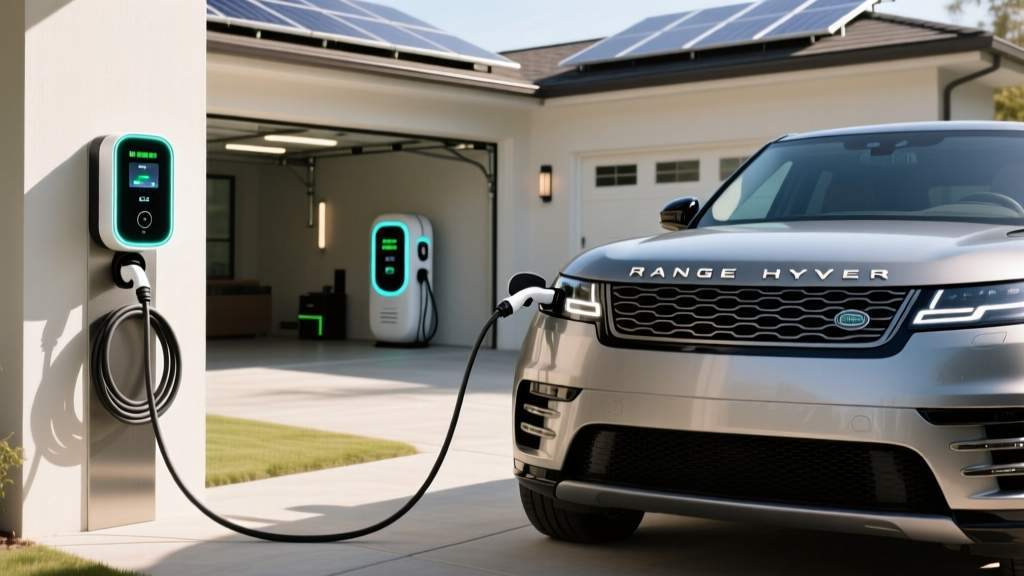
Whether you're a new EV owner or planning your first electric purchase, understanding your charging options is the single most important factor in daily ownership satisfaction. The phrase "charger swinger bat" has become shorthand in EV communities for the complete home charging setup — the charger unit, the swing-arm or cable management system, and the electrical "bat" or conduit run from your panel to the garage. This guide breaks down every element you need to budget for, from electrical requirements to real-world charging speeds.
Before we get into specifics, let's clarify the most common EV terminology mistake: kW (kilowatts) measures power — how fast energy flows into your battery. kWh (kilowatt-hours) measures energy — the total capacity of your battery, like gallons in a fuel tank. A 7.7 kW Level 2 charger delivers 7.7 kWh of energy per hour. This distinction matters every time you evaluate charging equipment.
Charging Levels Explained: Speeds, Power, and Real-World Range Added
Every EV sold in the US supports three charging tiers. Here's what each delivers in practice:
| Level | Voltage | Power (kW) | Miles of Range Added per Hour | Best For |
|---|---|---|---|---|
| Level 1 (120V) | 120V AC | 1.2–1.9 kW | 3–5 miles | Overnight top-ups, PHEVs, emergency backup |
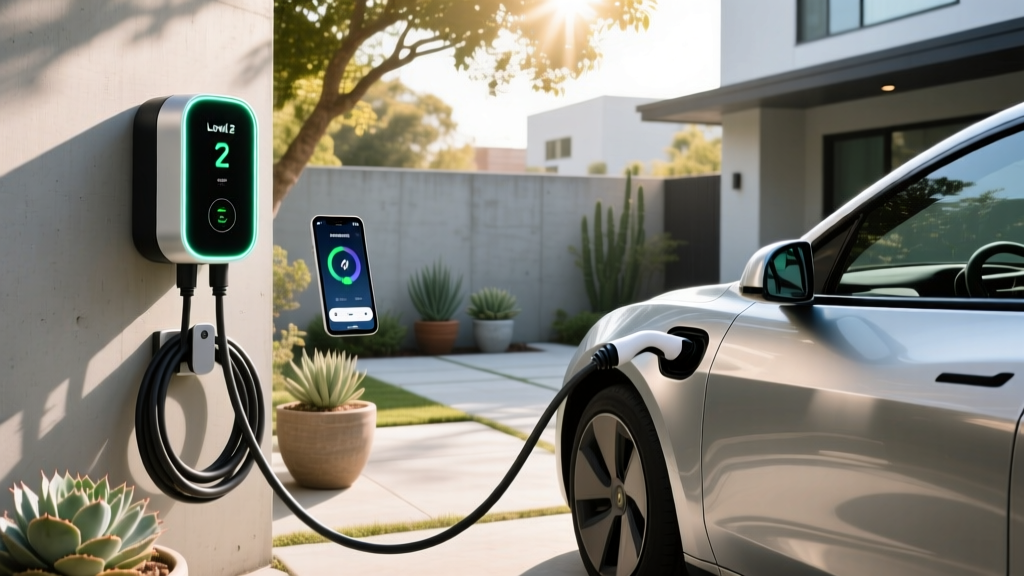
| Level 2 (240V) | 240V AC | 3.3–19.2 kW | 12–75 miles | Daily home charging, most BEV owners |
| DC Fast Charging | 400–800V DC | 50–350 kW | 150–1,200+ miles/hr equivalent | Road trips, rapid top-ups away from home |
Real-world context: A typical BEV with a 75 kWh battery (like the Tesla Model Y or Hyundai Ioniq 5) consuming roughly 3–4 miles per kWh will gain about 30–40 miles of range per hour on a standard 9.6 kW (40-amp) Level 2 home charger. That's more than enough for overnight replenishment of a 200-mile daily drive.
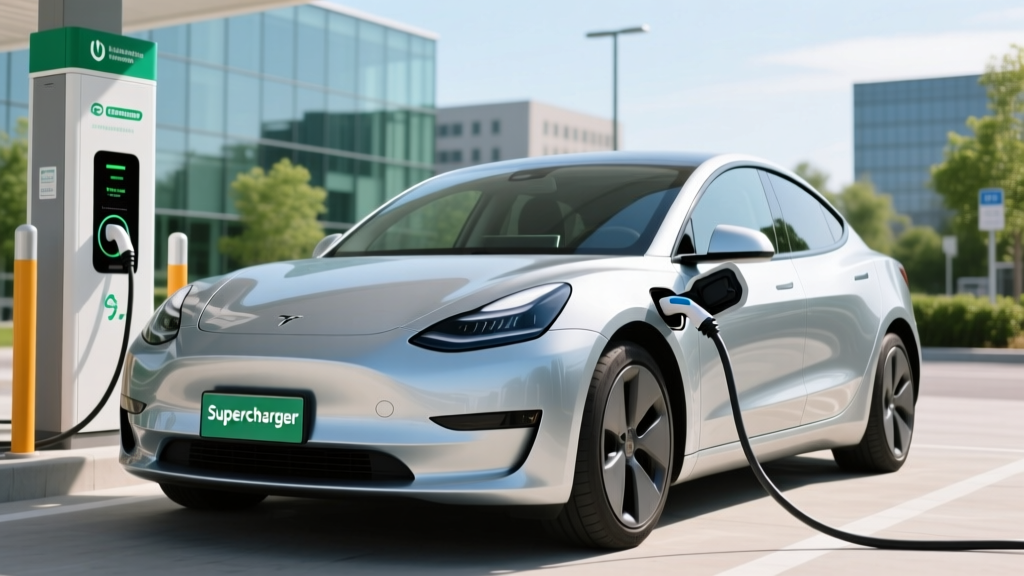
DC fast charging speeds vary dramatically by vehicle and state of charge. A Hyundai Ioniq 5 with 800V architecture can peak at 240 kW and charge 10–80% in roughly 18 minutes at a compatible 350 kW station. But that peak rate only holds between roughly 10–55% SoC — above 80%, charging tapers significantly to protect battery health. This is called the charge curve, and it means the last 20% can take as long as the first 60%.
Home Charger Installation: Electrical Requirements and Total Cost Breakdown
The "charger swinger bat" setup involves three cost components: the charger unit itself, the electrical work (wiring, conduit, breaker), and any panel upgrades your home may need. Here's what to expect:
Electrical Requirements for Level 2 Home Charging
Most residential Level 2 chargers require a 240-volt dedicated circuit, similar to what powers an electric dryer or oven. The most common configurations:
- 40-amp circuit (delivers 32 amps continuous / 7.7 kW) — suitable for most EVs, requires a 50-amp breaker
- 48-amp circuit (delivers 11.5 kW) — requires a 60-amp breaker, ideal for larger batteries like the Ford F-150 Lightning's 131 kWh extended range pack
- 60-amp circuit (delivers 48 amps / 11.5 kW) — requires an 80-amp breaker, maximum common residential setup
The National Electrical Code (NEC) requires EV circuits to be rated at 125% of the continuous load, which is why a 40-amp charger needs a 50-amp breaker. Your electrician will also need to install a GFCI-protected outlet (NEMA 14-50) or hardwire the unit directly, which many electricians prefer for safety and code compliance.
Installation Cost Breakdown
| Component | Basic Install (Short Run) | Standard Install | Complex Install (Panel Upgrade) |
|---|---|---|---|
| Charger Unit (Level 2) | $350–$500 | $400–$700 | $400–$700 |
| Electrical Permit | $50–$150 | $50–$200 | $100–$300 |
| Electrician Labor + Materials | $300–$600 | $600–$1,200 | $1,500–$3,000 |
| Panel Upgrade (if needed) | $0 | $0 | $1,500–$4,000 |
| Total Estimated Cost | $700–$1,250 | $1,050–$2,100 | $3,500–$8,000 |
Panel upgrade reality check: Homes built before 2000 often have 100-amp electrical panels that may already be near capacity. Adding a 50-amp EV circuit could require upgrading to a 200-amp panel, which adds $1,500–$4,000 depending on your utility and local labor rates. Some utilities offer rebates of $200–$500 for panel upgrades tied to EV adoption — check with your provider. A licensed electrician can perform a load calculation to determine if your current panel has headroom.
For the wiring run itself, expect your electrician to use 6 AWG copper wire (for 50-amp circuits) or 4 AWG (for 60-amp circuits) run through conduit. The "bat" or conduit run from panel to garage typically costs $8–$15 per linear foot including wire, conduit, and labor. A 50-foot run is common in many homes.
Connector Compatibility: NACS, CCS1, and CHAdeMO Explained
The connector landscape has shifted significantly. As of 2026, the North American Charging Standard (NACS), originally developed by Tesla, has become the dominant connector for new EVs. Here's where each brand stands:
| Connector | Brands Using It (New Vehicles) | Adapter Needed? |
|---|---|---|
| NACS (Tesla) | Tesla, Ford, GM, Rivian, Volvo, Polestar, Hyundai/Kia (2025+), BMW, Mercedes, Nissan (2025+) | CCS-to-NACS adapter for older CCS vehicles ($150–$300) |
| CCS1 | Most pre-2025 non-Tesla EVs still on the road (VW ID.4, older Hyundai/Kia, BMW i4 pre-2025) | NACS-to-CCS adapter increasingly available |
| CHAdeMO | Nissan Leaf (legacy), Mitsubishi Outlander PHEV (legacy) — essentially discontinued | Limited adapter options; CHAdeMO stations declining |
Home charger connector choice: If you're buying a new EV in 2026, choose a home charger with a NACS plug. Most major charger manufacturers now offer NACS-connector versions. If you own an older CCS vehicle, you can buy a NACS-equipped charger and use a NACS-to-CCS adapter, or buy a CCS charger and plan to replace it when you upgrade vehicles.
For home Level 2 charging, the J1772 connector (the round connector used for years on non-Tesla EVs) is being phased out in favor of NACS on new vehicles, but J1772 adapters are widely available for backward compatibility.
Cost to Charge: Home vs. Public vs. Gas — Per-Mile Comparison
Charging cost is where EVs shine — but the savings depend heavily on where and when you charge. Here's a realistic breakdown using a vehicle that averages 3.5 miles per kWh (typical for a midsize crossover like the Tesla Model Y or Ford Mustang Mach-E):
| Charging Scenario | Cost per kWh | Cost per Mile | Annual Cost (12,000 mi) |
|---|---|---|---|
| Home — Off-Peak (Time-of-Use rate) | $0.08–$0.12 | $0.023–$0.034 | $275–$410 |
| Home — Standard Residential Rate | $0.14–$0.18 | $0.040–$0.051 | $480–$615 |
| Public Level 2 (ChargePoint, EVgo, etc.) | $0.25–$0.49 | $0.071–$0.140 | $855–$1,680 |
| DC Fast Charging (Electrify America, Tesla Supercharger) | $0.30–$0.55 | $0.086–$0.157 | $1,030–$1,885 |
| Gas Vehicle (28 MPG combined, $3.40/gal) | — | $0.121 | $1,455 |
The bottom line: Home charging on an off-peak rate delivers fuel costs roughly 75–80% lower than an equivalent gas vehicle. Even at standard residential rates, you'll save $800–$1,000 annually. But if you rely exclusively on DC fast charging, your costs can approach or exceed gas — which is why home charging access is the single most important factor in EV economics.
Many utilities now offer time-of-use (TOU) rates that provide electricity as low as $0.05–$0.08/kWh during overnight hours (typically 10 PM–6 AM). Pairing a smart Level 2 charger with scheduled charging during these windows maximizes savings. According to fueleconomy.gov, the average EV costs roughly $0.04 per mile to fuel at home versus $0.12–$0.15 for a comparable gas vehicle.
Recommended Home EV Chargers for 2026
Based on power output, reliability, smart features, and cable management (the "swinger" or mounting arm), here are top picks across budget tiers:
Best Overall: ChargePoint Home Flex (NACS)
- Power Output: Up to 12 kW (50-amp circuit) — adjustable down to 16A for lower-capacity panels
- Connector: NACS (also available in J1772)
- Cable Length: 23 feet
- Smart Features: Wi-Fi, app scheduling, Alexa integration, energy tracking, UL-listed
- Price: ~$550–$650
- Why it wins: Adjustable amperage means it works with nearly any electrical panel without requiring an upgrade. Excellent app and scheduling for TOU rate optimization.
Best Premium Pick: Tesla Wall Connector (Gen 4)
- Power Output: Up to 11.5 kW (48 amps on 60-amp circuit)
- Connector: NACS native
- Cable Length: 24 feet
- Smart Features: Wi-Fi updates, power sharing (link up to 6 units on one circuit), load management, integrated cable organizer
- Price: ~$425–$475
- Why it wins: Best value-to-performance ratio. Power sharing feature is ideal for multi-EV households. The integrated cable management arm eliminates the need for a separate "swinger" mount.
Best Budget: Emporia Vue Level 2 Charger
- Power Output: Up to 11.5 kW (48 amps)
- Connector: NACS or J1772
- Cable Length: 24 feet
- Smart Features: Wi-Fi, app control, energy monitoring, solar integration, scheduled charging
- Price: ~$350–$400
- Why it wins: Lowest price for a full-featured 48-amp smart charger. Excellent solar integration for homes with rooftop panels.
Best for Outdoor Installation: Grizzl-E Smart
- Power Output: Up to 10 kW (40 amps)
- Connector: NACS or J1772
- Cable Length: 24 feet
- Smart Features: Wi-Fi, OCPP compatibility, extreme temperature rated (-40°F to 122°F), IP67 waterproof
- Price: ~$450–$550
- Why it wins: Built in Canada for harsh climates. The most robust outdoor rating in its class. Ideal for driveway installations without garage access.
Safety, Electrical Code, and Installation Best Practices
Your "charger swinger bat" installation must meet local electrical codes. Here are the critical requirements your licensed electrician will address:
- Dedicated circuit: Your EV charger must have its own dedicated breaker — never share a circuit with other appliances. EV charging is a continuous load (3+ hours), which the NEC treats more strictly than intermittent loads.
- GFCI protection: The 2020 NEC and later require GFCI protection for all EV charging outlets. Hardwired installations may not require a GFCI breaker in all jurisdictions, but it's recommended. GFCI breakers for 50-amp circuits cost $50–$120.
- Outdoor rating: If your charger is installed outdoors or in an unenclosed carport, the unit must carry at minimum a NEMA 4 (weatherproof) rating. All chargers recommended above meet this standard.
- Conduit and wire gauge: Your electrician will size wire and conduit to the circuit amperage. Undersized wire creates fire risk and voltage drop, reducing charging speed. For runs over 100 feet, wire gauge may need to increase to compensate for voltage drop.
- Permit and inspection: Most jurisdictions require an electrical permit ($50–$300) and a post-installation inspection. Do not skip this — unpermitted work can void home insurance coverage and create resale issues.
Cable management (the "swinger"): A wall-mounted cable organizer or swing arm keeps your charging cable off the garage floor, prevents tripping hazards, and protects the cable from damage. Most premium chargers include integrated cable management. Aftermarket swing arms cost $30–$80 and mount to a wall stud near the charger.
Charging Time Examples: How Long to Charge Common EV Batteries
Here's what 10–80% charging looks like for popular 2026 EVs across different charging scenarios:
| Vehicle (Battery Size) | Level 1 (1.4 kW) | Level 2 Home (9.6 kW) | DC Fast (Peak Rate) |
|---|---|---|---|
| Tesla Model Y LR (75 kWh usable) | ~35 hours | ~5.5 hours | ~25 min (250 kW peak) |
| Hyundai Ioniq 5 (77.4 kWh usable) | ~36 hours | ~5.6 hours | ~18 min (240 kW peak, 800V) |
| Ford F-150 Lightning Ext. Range (131 kWh usable) | ~61 hours | ~9.5 hours | ~41 min (150 kW sustained) |
| Chevrolet Equinox EV (85 kWh usable) | ~40 hours | ~6.2 hours | ~30 min (150 kW peak) |
Cold weather caveat: In sub-freezing temperatures, expect Level 2 charging to slow by 10–20% and DC fast charging to slow by 30–50% unless your vehicle has battery preconditioning. Tesla, Hyundai/Kia, and Ford all include preconditioning that warms the battery before a fast-charging session, dramatically improving cold-weather charge speeds. Always enable navigation to a charger to trigger preconditioning when available.
Federal Tax Credit and Utility Rebates for Home Charging
Under the current IRS §30C Alternative Fuel Vehicle Refueling Property Credit, homeowners can claim a tax credit of up to $1,000 (30% of cost, capped at $1,000) for the purchase and installation of qualified home EV charging equipment. Key requirements:
- The charger must be installed at your primary residence
- The property must be located in an eligible census tract (many suburban and rural areas qualify; check the IRS locator tool)
- The credit covers both equipment and installation labor
- It is non-refundable — you must have tax liability to claim it
Additionally, many utilities offer rebates of $200–$750 for installing a smart Level 2 charger, and some offer free or discounted chargers when you enroll in a time-of-use rate plan. Check with your local utility before purchasing equipment.
Frequently Asked Questions
How much does it cost to install a home EV charger?
A typical Level 2 home charger installation costs $1,050–$2,100 all-in (charger + electrician + permit) for homes with adequate panel capacity. If your home requires a 200-amp panel upgrade, total costs can reach $3,500–$8,000. The charger unit itself runs $350–$700 for quality smart units.
How fast will each charging level add range?
Level 1 (120V) adds 3–5 miles of range per hour. Level 2 (240V, 40-amp circuit) adds roughly 30–40 miles per hour for most EVs. DC fast charging can add 150–300+ miles in a 20–30 minute session, depending on the vehicle's peak charge rate and battery architecture.
Which connector/charger is compatible with my EV?
Check your vehicle's charge port. If you own a 2025+ model from Tesla, Ford, GM, Rivian, Hyundai, Kia, Volvo, or BMW, you likely have a NACS port. Older non-Tesla EVs typically use CCS1. The Nissan Leaf uses CHAdeMO. Match your home charger's connector to your vehicle's port, or use an appropriate adapter.
How much does charging cost per mile vs gas?
Home charging costs $0.02–$0.05 per mile depending on your electricity rate, versus $0.10–$0.15 per mile for a comparable gas vehicle at current fuel prices. That translates to $800–$1,200 in annual fuel savings for a driver covering 12,000 miles per year with home charging.
What electrical upgrades might I need?
The most common upgrade is a panel capacity increase from 100 amps to 200 amps ($1,500–$4,000), needed in older homes with limited breaker space or near-capacity loads. Your electrician will perform a load calculation per NEC Article 220 to determine if your panel can support a new 50-amp or 60-amp dedicated circuit. Some homes may also need a meter-main upgrade if the utility service entrance is undersized.