Why SUV Owners Need a Charging Strategy, Not Just a Plug
If you drive or plan to buy an electric SUV — whether it's a Tesla Model Y, Hyundai Ioniq 5, Ford Mustang Mach-E, Rivian R1S, or Kia EV9 — you've likely searched for a charger SUV solution that actually works for your daily life. The problem is that electric SUVs carry large battery packs (typically 75–110 kWh usable), which means charging times and costs scale up fast if you're relying on the wrong equipment or the wrong rate plan.
This guide cuts through the noise with exact numbers: how many miles per hour each charging level delivers, what a home Level 2 install actually costs in 2026, which connector your SUV needs, and what you'll pay per mile compared to a gas equivalent. No hype — just the data you need to make a decision.
Charging Levels Explained: kW, Miles per Hour, and Real-World Times
Before buying any charger, understand the three tiers of EV charging. The critical distinction: kW (kilowatts) measures power — how fast energy flows into your battery. kWh (kilowatt-hours) measures energy — how much your battery stores. A 80 kWh battery charged at 10 kW takes roughly 8 hours from empty; at 150 kW, it takes roughly 30 minutes to 80%.
| Level | Voltage / Amps | Power (kW) | Miles Added per Hour | Best For |
|---|---|---|---|---|
| Level 1 | 120V / 12A | ~1.4 kW | 3–5 mi/hr | Overnight top-up, PHEVs, emergency use |
| Level 2 (Home) | 240V / 32–48A | 7.7–11.5 kW | 25–44 mi/hr | Daily home charging, covers most SUV needs |
| DC Fast Charge | 400–800V DC | 50–350 kW | 150–1,200+ mi/hr (peak) | Road trips, rapid top-ups away from home |
Real-world SUV charging time examples (10–80% SoC):
- Tesla Model Y Long Range (75 kWh usable, NACS): ~25–30 min on a 250 kW Supercharger (peak ~250 kW tapering above 50%)
- Hyundai Ioniq 5 (77.4 kWh, NMC, 800V architecture): ~18 min on a 350 kW Electrify America station (peak ~240 kW sustained longer thanks to 800V)
- Ford Mustang Mach-E Extended Range (91 kWh usable): ~35 min on 150 kW DCFC (peak ~150 kW, tapers significantly past 80%)
- Kia EV9 GT-Line (99.8 kWh, 800V): ~24 min on 350 kW DCFC (peak ~236 kW)
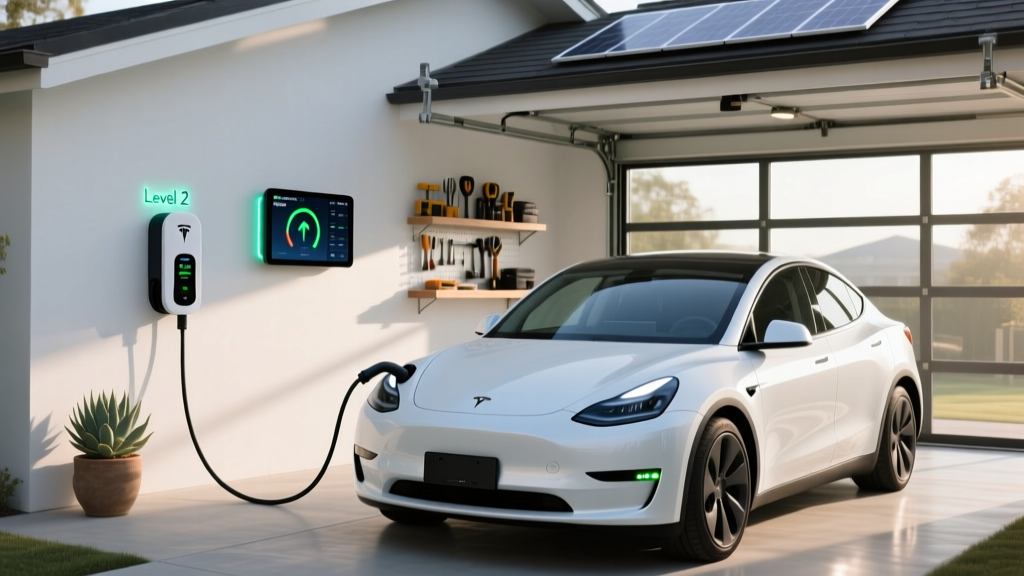
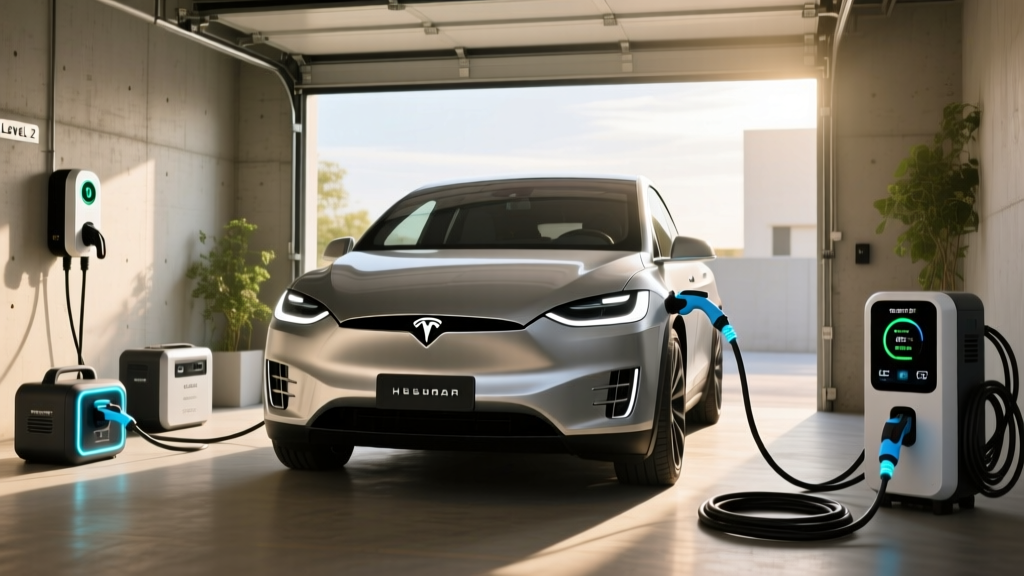
- Home Level 2 at 11.5 kW (48A): Any of these SUVs will fully recharge overnight in 7–10 hours from near-empty — more than enough for daily driving.
For most electric SUV owners, a Level 2 home charger at 40–48 amps is the sweet spot. You'll add 150–300 miles overnight, which covers virtually any daily commute and most weekend road trips with a single DCFC stop.
Home Level 2 Charger Installation: Electrical Requirements and Costs
Installing a Level 2 charger is not a simple plug-in affair. You're adding a high-draw, continuous-load appliance to your home's electrical system. Here's what's involved.
Electrical Requirements
- Circuit: A dedicated 240V circuit is required. For a 48A charger, NEC code (2023/2026 adoption) requires a 60A breaker (continuous loads must be sized at 125% of rated draw: 48A × 1.25 = 60A).
- Wire gauge: Typically 6 AWG copper (THHN in conduit) for a 60A circuit; 4 AWG for longer runs over 100 feet to minimize voltage drop.
- Panel capacity: Your main service panel must have enough spare capacity. A typical home has 100A or 200A service. Adding a 60A EV circuit to a 100A panel that's already near capacity will require a panel upgrade or a smart load-management solution.
- GFCI protection: The 2020 NEC (and 2023/2026 updates adopted in most states) requires GFCI protection for all EV receptacles. Hardwired chargers may bypass this requirement depending on local code — ask your electrician.
- Outdoor rating: If your charger mounts outside (garage-less homes, carports), it must carry a NEMA 4 or NEMA 4X rating for weather resistance.
Do You Need a Panel Upgrade?
This is the single biggest cost variable. Homes with 200A service and spare breaker slots typically need no upgrade. Homes with 100A service, older Federal Pacific or Zinsco panels, or panels already running electric ranges, dryers, and HVAC may need:
- Panel upgrade to 200A: $1,500–$3,500 (electrician labor + new panel + permit)
- Smart load-management device (e.g., Span panel or Emporia smart breaker): $500–$1,500 installed — lets the charger dynamically reduce draw when other appliances kick on, avoiding a full panel upgrade.
- Sub-panel installation: $400–$800 if the main panel is full but has capacity; a sub-panel near the garage gives you dedicated breaker space.
| Item | Low Estimate | High Estimate | Notes |
|---|---|---|---|
| Level 2 charger (hardware) | $350 | $700 | 32A–48A Wi-Fi-enabled units |
| Electrician labor (install circuit + charger) | $500 | $1,500 | Depends on run length, conduit, wall type |
| Electrical permit | $50 | $200 | Varies by municipality |
| Panel upgrade (if needed) | $1,500 | $3,500 | 100A → 200A service upgrade |
| Conduit/wire (long runs 50–100+ ft) | $200 | $600 | Detached garages, far panel locations |
| Total (no panel upgrade) | $1,100 | $3,000 | Most homes with 200A service |
| Total (with panel upgrade) | $2,600 | $6,500 | Older homes or 100A service |
Get at least two quotes from licensed electricians. Ask specifically about your panel's remaining capacity (they should perform a load calculation per NEC Article 220). Some utilities offer rebates of $200–$500 for charger installation — check with your provider before scheduling work.
Connector Compatibility: NACS, CCS, and CHAdeMO for SUVs
The connector landscape shifted dramatically between 2023 and 2026. Here's where things stand for electric SUVs sold in the US market.
| Connector | Brands Using It | Home Charger Availability | Public DCFC Availability |
|---|---|---|---|
| NACS (Tesla / SAE J3400) | Tesla (all), Ford (2025+), GM (2025+), Rivian (2025+), Hyundai/Kia (2026+), Volvo, Polestar, Fisker | Tesla Wall Connector, ChargePoint Home Flex (NACS variant), Emporia, Lectron | Tesla Supercharger (25,000+ stalls), Electrify America (adding NACS), EVgo, Pilot |
| CCS1 | VW ID.4 (through 2025), BMW iX, some legacy models, pre-2025 Hyundai/Kia | ChargePoint Home Flex, Emporia, JuiceBox (discontinued but supported) | Electrify America, EVgo, ChargePoint, Shell Recharge |
| CHAdeMO | Nissan Ariana (2026 LEAF replacement TBD), Mitsubishi Outlander PHEV (AC only, J1772) | Limited — most home chargers are J1772/NACS | Declining; few new installations |
Adapter note: If you own a CCS-equipped SUV (e.g., 2024 Hyundai Ioniq 5 or VW ID.4), you can purchase a CCS-to-NACS adapter (~$150–$250) to access Tesla Superchargers, which now accept non-Tesla vehicles via the Tesla Supercharger network. Ford, GM, and Rivian owners with native NACS ports don't need adapters. Always verify adapter compatibility with your specific model year before purchasing.
Recommended Home Chargers for Electric SUVs
These are the Level 2 chargers we recommend for SUV owners in 2026, based on power output, reliability, smart features, and connector options.
Tesla Wall Connector (Gen 3, NACS)
- Power: Up to 11.5 kW (48A on 60A circuit)
- Connector: NACS native; J1772 adapter available (~$50)
- Cable length: 24 ft
- Smart features: Wi-Fi, OTA updates, Tesla app integration, power sharing between two units on one circuit
- Price: ~$475
- Best for: Tesla owners and NACS-equipped Ford/GM/Rivian SUVs. Best-in-class reliability and speed.
ChargePoint Home Flex (NACS or J1772)
- Power: Up to 12 kW (50A on 60A circuit, adjustable down to 16A)
- Connector: Available in NACS or J1772 (CCS) variants
- Cable length: 23 ft
- Smart features: Wi-Fi, ChargePoint app scheduling, utility demand-response integration, Alexa
- Price: ~$599
- Best for: Multi-EV households, renters who may move (adjustable amperage works with various circuits).
Emporia Vue EV Charger
- Power: Up to 11.5 kW (48A on 60A circuit)
- Connector: NACS or J1772 options
- Cable length: 24 ft
- Smart features: Integrated energy monitoring (pairs with Emporia Vue home energy monitor), solar-aware charging, app scheduling
- Price: ~$399
- Best for: Budget-conscious buyers who want energy monitoring without a separate system.
All three units are UL-listed, NEMA 4 rated for outdoor use, and compatible with hardwired or plug-in (NEMA 14-50 receptacle) installation. Hardwired is generally preferred for 48A+ chargers because NEMA 14-50 receptacles are rated for 50A and some jurisdictions now require GFCI breakers on receptacles, which can cause nuisance tripping with EV chargers. A hardwired connection avoids this issue entirely.
Cost to Charge: Home vs. Public vs. Gas — Real Numbers
The economics of charging an electric SUV depend heavily on where and when you plug in. Here's a realistic breakdown using a mid-size SUV consuming roughly 3.0 miles/kWh (approximately 100 MPGe combined — representative of a Model Y, Ioniq 5, or Mach-E).
| Scenario | Rate / Cost | Cost per Mile | Monthly Cost (1,200 mi) |
|---|---|---|---|
| Home Level 2, off-peak utility rate | $0.09/kWh | $0.030 | $36 |
| Home Level 2, average US rate | $0.17/kWh | $0.057 | $68 |
| Public Level 2 (ChargePoint, EVgo) | $0.35/kWh | $0.117 | $140 |
| DC Fast Charge (Electrify America, EVgo) | $0.48/kWh | $0.160 | $192 |
| Tesla Supercharger (varies by location) | $0.30/kWh | $0.100 | $120 |
| Gas SUV (25 MPG combined, $3.40/gal) | — | $0.136 | $163 |
| Gas SUV (20 MPG, $3.40/gal — large SUV) | — | $0.170 | $204 |
The takeaway: Home charging at off-peak rates saves electric SUV owners $1,500–$2,000 per year compared to a comparable gas SUV. Even at average utility rates, home charging is roughly half the per-mile cost of gasoline. Public DC fast charging, however, can approach or exceed gas costs — which is why a home Level 2 installation pays for itself within 1–2 years for most drivers.
Check your utility's time-of-use (TOU) rate plans. Many utilities offer off-peak rates between 10 PM and 6 AM that are 40–60% cheaper than peak pricing. Set your charger's scheduling feature to charge only during those windows.
Federal Tax Credit and Utility Rebates for Home Charging
The IRS §30C Alternative Fuel Vehicle Refueling Property Credit covers 30% of the cost of home EV charger installation, up to $1,000, for equipment and labor. This is separate from the §30D new EV purchase credit. Key rules for 2026:
- The credit applies to both the charger hardware and electrician installation costs.
- Your home must be located in an eligible census tract (low-income or non-urban area, per IRS guidance). Check the IRS eligibility tool before filing.
- Income caps apply: modified AGI cannot exceed $150,000 (single) or $300,000 (joint) in the year of installation.
- The credit is non-refundable — it reduces your tax liability but won't generate a refund beyond what you owe.
Many utilities and state energy offices offer additional rebates of $200–$750 for Level 2 charger purchase and installation. Contact your local utility before buying equipment — some programs require pre-approval or specific charger models.
Safety, Code, and Maintenance Considerations
A Level 2 charger draws continuous high current for hours at a time. Safety isn't optional.
- Dedicated circuit: Your EV charger must have its own dedicated breaker — never share a circuit with other appliances.
- GFCI protection: Required for receptacle-based installations per NEC 2020/2023 (625.54). Hardwired units may be exempt depending on jurisdiction.
- Outdoor rating: If mounted outside, the charger must be NEMA 4 rated. Don't use an indoor-rated unit in a carport or exterior wall.
- Cable management: Use a holster or cable wrap to keep the charging cable off the ground, especially in garages where tripping hazards or water exposure are concerns.
- Annual inspection: Check the connector face for debris, corrosion, or pin damage. Inspect the cable for cracking or fraying. Most quality chargers last 8–12 years with minimal maintenance.
- Surge protection: Consider a whole-home surge protector ($200–$400 installed) if you live in an area with frequent lightning or utility switching events. A surge can destroy the charger's internal electronics.
Frequently Asked Questions
How much does it cost to install a home EV charger?
For most homes with a 200A panel and a short wire run, expect $1,100–$3,000 total (charger + electrician + permit). Homes needing a panel upgrade to 200A should budget $2,600–$6,500. Always get multiple quotes from licensed electricians and confirm they perform an NEC Article 220 load calculation before quoting.
How fast will each charging level add range to my electric SUV?
Level 1 (120V) adds roughly 3–5 miles per hour — too slow for an SUV with a large battery. Level 2 at 48A (11.5 kW) adds 30–44 miles per hour, enough to fully recharge overnight. DC fast charging at 150–350 kW can add 150–300 miles in 18–35 minutes depending on the SUV's battery architecture and charge curve.
Which connector or charger is compatible with my SUV?
Check the table above for your brand. Most 2025–2026 electric SUVs now use NACS (SAE J3400), including Tesla, Ford, GM, Rivian, Hyundai, and Kia. Older models (pre-2025) from Hyundai, Kia, VW, and BMW use CCS1. CHAdeMO is nearly discontinued. If your SUV has CCS1, a CCS-to-NACS adapter (~$150–$250) unlocks the Tesla Supercharger network.
How much does charging cost per mile vs. gas?
Home charging at average US electricity rates ($0.17/kWh) costs roughly $0.05–$0.06 per mile for a mid-size electric SUV. A comparable gas SUV at 25 MPG and $3.40/gallon costs $0.14 per mile. That's a 55–60% savings per mile with home charging. Public DC fast charging ($0.40–$0.50/kWh) narrows the gap to near parity with gas.
What electrical upgrades might I need for a home charger?
The most common upgrade is adding a 60A breaker to your panel. If your panel is full or you have 100A service, you may need a panel upgrade ($1,500–$3,500) or a smart load-management device ($500–$1,500) that dynamically shares capacity between the charger and other appliances. A licensed electrician should perform a load calculation to determine your specific needs.
Can I use a NEMA 14-50 outlet instead of hardwiring?
Yes, but with caveats. A NEMA 14-50 receptacle is rated for 50A, which limits your charger to 40A continuous (9.6 kW). Many jurisdictions now require a GFCI breaker on 14-50 receptacles used for EV charging, and these breakers are prone to nuisance tripping with the sustained high-draw loads EV chargers produce. Hardwiring at 48A (60A breaker) avoids both issues and is the recommended approach for permanent installations.