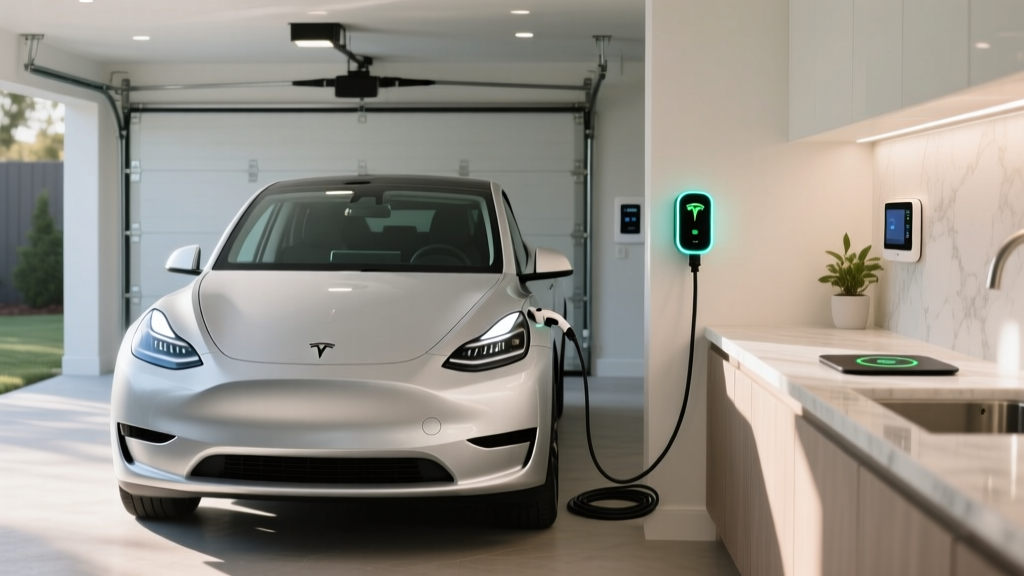
If you've just brought home a new electric vehicle — or you're about to — the single biggest ownership upgrade you can make is installing a dedicated Level 2 home charger. Public DC fast charging is great for road trips, but 80% or more of EV charging happens at home, and the right wallbox can add 25–45 miles of range per hour of plug-in time versus the 3–5 miles per hour you'd get from a standard 120V outlet.
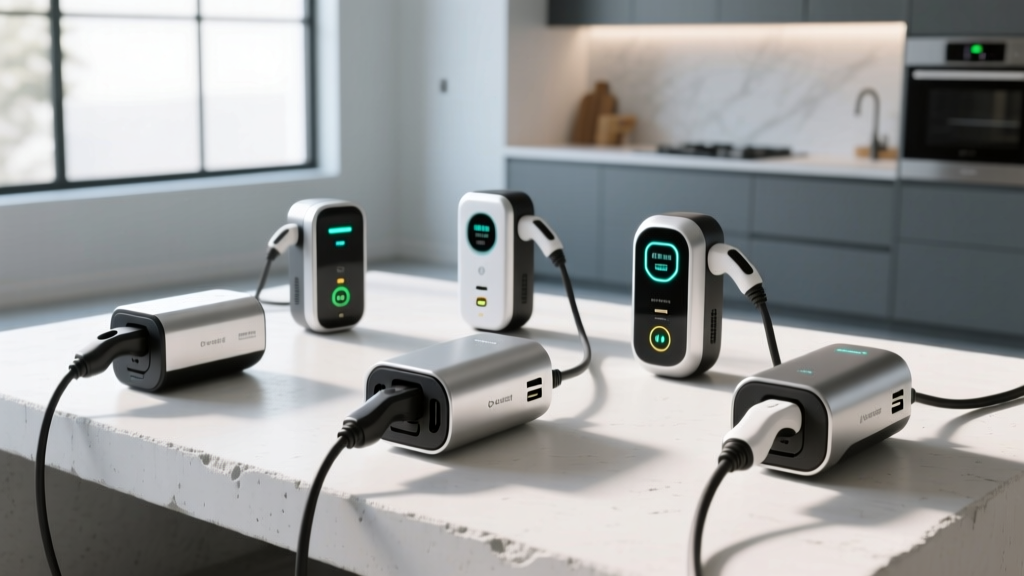
Every year, we assemble what we call the charger sixpack — a curated lineup of the six best residential Level 2 EV chargers based on power output, build quality, smart features, connector compatibility, and real-world value. For this updated 2026 edition, we've tested and evaluated units across NACS and CCS1 connectors, measured actual charge rates on vehicles with 60–100 kWh battery packs, and factored in the latest home electrical requirements and installation realities.
Before we rank the sixpack, let's ground the fundamentals: charging levels, electrical requirements, connectors, and what installation actually costs in 2026.
Charging Levels Explained: kW, Speed, and Real-World Range Added
The most common point of confusion for new EV owners is the difference between kW (kilowatts) and kWh (kilowatt-hours). Think of it this way: kW is the rate at which electricity flows into your battery — like the flow rate of a hose. kWh is the total energy stored — like the size of the bucket. A 48-amp (11.5 kW) Level 2 charger delivers 11.5 kilowatts of power; if you charge for one hour into a 75 kWh battery, you've added roughly 11.5 kWh of energy (about 35–40 miles of range depending on vehicle efficiency).
| Level | Voltage | Max Power (kW) | Miles of Range Added/Hour | Typical Use Case |
|---|---|---|---|---|
| Level 1 | 120V AC | 1.0–1.9 kW | 3–5 mi/hr | Overnight trickle; PHEVs; low daily mileage |
| Level 2 | 240V AC | 3.3–19.2 kW | 12–60+ mi/hr | Home daily charging; workplace; destination |
| DC Fast Charge | 200–800V DC | 50–350+ kW | 150–800+ mi/hr | Road trips; highway corridors; 10–80% in 15–30 min |
A few real-world nuances that spec sheets often gloss over:
- Vehicle acceptance rate matters. A 19.2 kW charger won't charge a Chevy Equinox EV any faster than its 11.5 kW onboard charger allows. Always match charger output to your vehicle's maximum AC acceptance rate.
- 80% rule for continuous loads. The National Electrical Code (NEC) requires circuits to be rated at 125% of the continuous charger load. A 48-amp charger needs a 60-amp breaker. A 32-amp charger needs a 40-amp breaker.
- Charging tapers above 80% SoC. Both at home and on DC fast chargers, the battery management system slows the charge rate significantly past 80% state of charge to protect battery longevity. That 10–80% time you see quoted? Expect 80–100% to take nearly as long again.
Home Installation: Electrical Requirements, Panel Upgrades, and Real Costs
The sticker price of a Level 2 charger ($350–$750 for quality units) is often the smallest part of the total investment. Installation costs vary enormously depending on your home's electrical panel capacity, the distance from panel to charger location, and whether you need a panel upgrade.
What Your Electrician Will Evaluate
A licensed electrician will perform a load calculation on your existing electrical panel to determine whether it can handle the additional continuous draw of an EV charger. Most modern homes with 200-amp service can accommodate a 48-amp (60-amp breaker) Level 2 circuit without issue. Older homes with 100-amp panels frequently cannot — especially if you also run electric heat, an electric dryer, and an electric range.
Here's what a typical 48-amp Level 2 installation requires:
- Dedicated 240V circuit with a 60-amp double-pole breaker
- 6 AWG copper wire (or 4 AWG aluminum) run from panel to charger location
- NEMA 14-50 receptacle (for plug-in units) or hardwired connection (required for some utility rebates and for circuits above 50 amps in many jurisdictions)
- GFCI protection — the 2020 NEC requires GFCI breakers for EV receptacles in garages; some jurisdictions have adopted the 2023 NEC which exempts hardwired EVSE from this requirement
- Permit and inspection — most municipalities require an electrical permit ($50–$200) and a post-installation inspection
| Component | Simple Install (Panel Adjacent) | Complex Install (Long Run / Upgrade) |
|---|---|---|
| EV charger unit (48A) | $400–$650 | $400–$650 |
| Electrician labor (2–4 hrs simple / 6–10 hrs complex) | $300–$600 | $900–$1,800 |
| Wire, conduit, breaker, fittings | $100–$250 | $400–$800 |
| Electrical permit | $50–$150 | $50–$200 |
| Panel upgrade (100A → 200A) if needed | $0 (not needed) | $1,500–$3,500 |
| Total estimated range | $850–$1,650 | $3,250–$6,950 |
Panel upgrade reality check: If your home has a 100-amp panel, budget $1,500–$3,500 for an upgrade to 200-amp service. This is the single biggest variable in installation cost and catches many homeowners by surprise. Some utilities and state programs offer rebates that partially offset panel upgrades — check with your local utility and the Alternative Fuels Data Center state incentive database for current programs.
Connector Compatibility: NACS, CCS1, and CHAdeMO in 2026
The connector landscape has undergone a seismic shift. As of 2026, nearly every new EV sold in North America uses the NACS (North American Charging Standard) connector, originally developed by Tesla and now adopted by Ford, GM, Rivian, Hyundai/Kia, BMW, and most other major automakers. The CCS1 connector is being phased out on new vehicles, though millions of CCS-equipped EVs remain on the road. CHAdeMO is effectively legacy, found primarily on older Nissan Leaf models.
| Connector | Status | Compatible Vehicles | Home Charger Availability |
|---|---|---|---|
| NACS (J3400) | Current standard | Tesla (all), Ford F-150 Lightning, GM Ultium vehicles, Rivian R1T/R1S (2025+), Hyundai Ioniq 5/6/9 (2025+), Kia EV6/EV9 (2025+), Volvo EX30/EX90, BMW iX/i4 (2025+) | Widely available — Tesla Wall Connector, Emporia, Grizzl-E, ChargePoint |
| CCS1 | Legacy / phasing out | VW ID.4 (pre-2025), older Ford Mustang Mach-E, Chevy Bolt EV/EUV, Hyundai Ioniq 5 (pre-2025), Kia EV6 (pre-2025), BMW i4 (pre-2025) | Available — ChargePoint, Emporia, JuiceBox; adapters for NACS chargers available ($150–$300) |
| CHAdeMO | Legacy only | Nissan Leaf (all years), Mitsubishi Outlander PHEV (older) | Limited — mostly legacy units; adapters rare |
Adapter strategy for mixed households: If you own both a NACS vehicle and a CCS1 vehicle, the most future-proof approach is to install a NACS home charger and purchase a NACS-to-CCS1 adapter ($150–$250) for the CCS vehicle. Tesla sells an official adapter, and third-party options from Lectron and A2Z are widely available.
The Charger Sixpack: 6 Best Home EV Chargers Ranked
Here's our 2026 charger sixpack — six Level 2 home chargers evaluated on power output, cable length, build quality, smart features, connector type, and price-to-performance value. We've organized them from best overall to best budget, with each pick suited to a specific buyer profile.
1. Tesla Wall Connector (NACS) — Best Overall
- Power output: Up to 11.5 kW (48 amps) on a 60-amp circuit
- Connector: NACS (J3400)
- Cable length: 24 feet
- Smart features: Wi-Fi, OTA firmware updates, power sharing (link up to 6 units on one circuit), Tesla app integration, access control
- Indoor/outdoor: Rated for both (NEMA 3R outdoor rating)
- Price: $475
- Verdict: The benchmark. If you drive a NACS-equipped vehicle, there's no compelling reason to choose anything else. The 24-foot cable reaches most garage configurations, and the power-sharing feature is ideal for two-EV households. Non-Tesla NACS vehicles (Ford, GM, Hyundai, Rivian) charge at full rate.
2. Emporia Vue EV Charger — Best Smart Features & Energy Integration
- Power output: Up to 11.5 kW (48 amps); configurable down to 16A for lower-capacity panels
- Connector: NACS (2025+ models) or J1772 (legacy models available)
- Cable length: 24 feet
- Smart features: Integrates with Emporia Vue energy monitor for whole-home energy tracking, solar-aware charging, time-of-use scheduling, detailed kWh tracking per session, Wi-Fi + Bluetooth
- Indoor/outdoor: NEMA 4 (fully weatherproof outdoor rating)
- Price: $399
- Verdict: If you have solar panels or want granular energy data, the Emporia ecosystem is unmatched. The ability to set charging to solar-only mode (charge only when panels are producing excess) is a genuine money-saver. Amperage configurability is excellent for homes with limited panel capacity.
3. ChargePoint Home Flex (NACS / CCS1) — Most Versatile
- Power output: Up to 12 kW (50 amps) on a 60-amp circuit; adjustable from 16A–50A via DIP switches
- Connector: Available in NACS or J1772 (CCS1 with adapter)
- Cable length: 23 feet
- Smart features: ChargePoint app, Alexa/Google Home integration, flexible amperage settings, detailed session history, scheduling
- Indoor/outdoor: NEMA 3R outdoor rated
- Price: $599 (NACS version)
- Verdict: The Flex's adjustable amperage is its killer feature — you can dial it from 16A to 50A to match whatever circuit your electrician installs. That means no wasted money on a 48A charger if your panel only supports a 30A circuit. The ChargePoint app is polished and reliable.
4. Grizzl-E Smart (NACS / J1772) — Most Durable / Cold-Weather Pick
- Power output: Up to 9.6 kW (40 amps) on a 50-amp circuit
- Connector: Available in NACS or J1772
- Cable length: 24 feet
- Smart features: Wi-Fi, OCPP-compatible (works with utility demand-response programs), app scheduling, energy monitoring
- Indoor/outdoor: NEMA 4X (extreme weather rated, tested to -40°F/-40°C)
- Price: $449
- Verdict: Built in Canada and designed for brutal winters. If you're in Minnesota, Montana, or anywhere that sees sub-zero temperatures, the Grizzl-E's cold-weather testing is the most rigorous in the category. The 40-amp output is slightly lower than the top tier, but 9.6 kW still adds ~30 miles per hour — more than adequate for overnight charging. The 3-year warranty is solid.
5. Wallbox Pulsar Plus (NACS / J1772) — Best Compact Design
- Power output: Up to 11.5 kW (48 amps) on a 60-amp circuit
- Connector: NACS or J1772 versions available
- Cable length: 25 feet (longest in the sixpack)
- Smart features: Wi-Fi + Bluetooth, myWallbox app, Power Sharing for dual installations, Eco-Smart mode (solar integration with optional Energy Meter accessory, $130)
- Indoor/outdoor: NEMA 4
- Price: $499
- Verdict: The smallest physical footprint in the sixpack — about the size of a large hardcover book. The 25-foot cable is the longest here, which matters if your charge port is on the opposite side of the garage from the wallbox. Eco-Smart solar integration requires the extra meter accessory, which is less elegant than Emporia's built-in approach.
6. Lectron V-BOX Pro (NACS) — Best Budget
- Power output: Up to 11.5 kW (48 amps) on a 60-amp circuit
- Connector: NACS
- Cable length: 20 feet
- Smart features: Basic app with scheduling and session tracking; Wi-Fi; LED status indicators
- Indoor/outdoor: NEMA 4
- Price: $329
- Verdict: The value pick. You get full 48-amp output, NACS compatibility, and a weatherproof enclosure for under $350. The app is functional but not as polished as ChargePoint or Wallbox. The 20-foot cable is shorter than competitors — measure your garage before committing. If you want maximum kW per dollar and don't need advanced energy integration, this is the one.
Charging Time Examples: What to Expect Overnight
Here's how long a full 10–80% charge takes on common EV battery sizes using a 48-amp (11.5 kW) Level 2 charger — the most common output in our sixpack:
| Vehicle Example | Battery (kWh usable) | 10–80% Energy Needed | Approx. Charge Time | Range Added (EPA) |
|---|---|---|---|---|
| Chevy Equinox EV | 85 kWh | ~59.5 kWh | ~5 hrs 10 min | ~215 mi |
| Tesla Model Y Long Range | 75 kWh | ~52.5 kWh | ~4 hrs 35 min | ~220 mi |
| Hyundai Ioniq 5 (2026, NACS) | 84 kWh | ~58.8 kWh | ~5 hrs 5 min | ~225 mi |
| Ford F-150 Lightning (extended) | 131 kWh | ~91.7 kWh | ~8 hrs | ~210 mi |
| BMW i4 eDrive40 | 81.5 kWh | ~57 kWh | ~4 hrs 55 min | ~210 mi |
Real-world note: These times assume your vehicle's onboard charger can accept the full 11.5 kW. The Ford F-150 Lightning's onboard charger is rated at 19.2 kW, so it will accept full rate. Some vehicles with smaller onboard chargers (e.g., certain PHEVs limited to 3.3–6.6 kW) will charge more slowly regardless of the wallbox output.
Cost to Charge: Home vs. Public vs. Gas per Mile
One of the most compelling reasons to install a home Level 2 charger is cost. Home electricity — especially on time-of-use (TOU) plans with off-peak rates — delivers dramatically lower per-mile fuel costs compared to both public DC fast charging and gasoline.
| Scenario | Rate | Vehicle Efficiency | Cost Per Mile | Annual Cost (12,000 mi) |
|---|---|---|---|---|
| Home off-peak (TOU plan) | $0.09/kWh | 3.0 mi/kWh (105 MPGe) | $0.030 | $360 |
| Home standard rate | $0.16/kWh | 3.0 mi/kWh | $0.053 | $640 |
| Public Level 2 (ChargePoint, etc.) | $0.25–$0.40/kWh | 3.0 mi/kWh | $0.083–$0.133 | $1,000–$1,600 |
| DC Fast Charging (Electrify America, EVgo) | $0.35–$0.55/kWh | 3.0 mi/kWh | $0.117–$0.183 | $1,400–$2,200 |
| Tesla Supercharger (member rate) | $0.25–$0.35/kWh | 3.0 mi/kWh | $0.083–$0.117 | $1,000–$1,400 |
| Gasoline (25 MPG combined) | $3.40/gal | 25 MPG | $0.136 | $1,632 |
| Gasoline (35 MPG combined) | $3.40/gal | 35 MPG | $0.097 | $1,164 |
The takeaway is clear: home off-peak charging at $0.03/mile saves roughly $1,270 per year compared to a 25 MPG gas vehicle at $3.40/gallon. Even at standard residential rates, home charging undercuts gasoline by roughly $1,000 annually. Public DC fast charging, by contrast, can approach or even exceed gas costs — which is why a home Level 2 installation pays for itself within 1–3 years for most drivers.
For the latest national and state-level electricity and fuel pricing data, fueleconomy.gov provides per-model energy cost estimates based on your local utility rates.
Safety, Electrical Code, and Installation Best Practices
EV chargers draw significant continuous current for hours at a time — this is fundamentally different from most household appliances that cycle on and off. Getting the installation right is both a safety and a longevity concern.
Critical Safety and Code Requirements
- Dedicated circuit only. Your EV charger must be on its own dedicated breaker — never shared with other appliances. Continuous loads on shared circuits create overheating risk.
- Correct wire gauge. 48-amp chargers on 60-amp circuits require minimum 6 AWG copper wire. Undersized wire is a fire hazard. Your electrician will size wire based on circuit amperage and run length (longer runs may need larger gauge to prevent voltage drop).
- GFCI protection. The NEC requires ground-fault protection for EV receptacles. Hardwired installations may be exempt in jurisdictions that have adopted the 2023 NEC revision. Hardwiring also eliminates the GFCI nuisance-trip issues some owners report with NEMA 14-50 receptacles.
- Outdoor rating. If your charger will be mounted outside or in an unenclosed carport, ensure it carries at minimum a NEMA 3R rating (rain and ice resistant). NEMA 4 or 4X is preferable for hose-down resistance and full dust/waterproofing.
- Permit and inspection. Skipping the permit to save $100 is false economy. The inspection catches wiring errors that could cause fires, and unpermitted electrical work can void homeowner's insurance claims. Most jurisdictions now offer online permit applications with 1–3 day turnaround.
- Surge protection. Consider a whole-panel surge protector ($150–$300 installed) if you live in an area with frequent lightning or grid instability. EV chargers contain sensitive electronics that can be damaged by voltage spikes.
Hardwired vs. Plug-In (NEMA 14-50)
Most chargers in our sixpack offer both hardwired and plug-in (NEMA 14-50) installation options. Hardwiring is generally preferred for new installations because:
- It eliminates the GFCI breaker requirement in many jurisdictions (fewer nuisance trips)
- It allows circuits above 50 amps (NEMA 14-50 is limited to 50A)
- It provides a more secure physical connection with less risk of overheating at the plug
- The trade-off: you lose portability — you can't unplug and take the charger with you if you move
Federal and State Incentives for Home Charger Installation
The federal §30C Alternative Fuel Vehicle Refueling Property Credit provides a tax credit of up to 30% of the cost of home EV charger equipment and installation, capped at $1,000. However, eligibility is restricted to installations in census tracts classified as low-income or non-urban. Check the IRS §30C guidelines for the current eligibility map and requirements.
Many states, municipalities, and utilities offer additional rebates:
- Utility rebates: Many utilities offer $250–$500 rebates for installing a smart Level 2 charger, especially if you enroll in a time-of-use rate plan. Some utilities (e.g., SMUD, Xcel Energy, Con Edison) offer free or heavily discounted chargers.
- State programs: California, New York, Massachusetts, Colorado, and others have active EVSE rebate programs. Check the AFDC state incentive database for current programs in your state.
- Panel upgrade assistance: A growing number of programs specifically target panel upgrades, recognizing this as the barrier to EV adoption in older housing stock.
Always confirm incentive availability before purchasing — programs frequently reach funding caps or change eligibility rules mid-year.
Frequently Asked Questions
How much does it cost to install a home EV charger?
For a straightforward installation with a 200-amp panel and a short wire run, expect $850–$1,650 total (charger + electrician + permit). If your home needs a panel upgrade from 100A to 200A, add $1,500–$3,500, bringing the total to $3,250–$6,950. The wide range reflects real variation in home electrical infrastructure.
How fast will each charging level add range?
Level 1 (120V) adds 3–5 miles per hour — enough for PHEVs or drivers covering under 30 miles daily. Level 2 (240V) at 48 amps adds 30–40 miles per hour for most EVs, fully replenishing a 75–85 kWh battery overnight in 5–7 hours. DC fast charging at 150+ kW can add 150–250 miles in 15–25 minutes, but is designed for road trips, not daily use.
Which connector and charger is compatible with my EV?
If your EV is a 2025+ model from Tesla, Ford, GM, Rivian, Hyundai, Kia, BMW, Volvo, or most other major brands, it almost certainly uses NACS. Older CCS1 vehicles (pre-2025 VW ID.4, older Mach-E, Chevy Bolt) can use NACS chargers with a $150–$250 adapter. Check your vehicle's charge port or owner's manual to confirm.
How much does charging cost per mile compared to gas?
Home off-peak charging averages $0.03/mile — roughly one-quarter the cost of gasoline at $0.136/mile (25 MPG, $3.40/gal). Even at standard residential rates ($0.16/kWh), home charging costs about $0.053/mile. Public DC fast charging at $0.35–$0.55/kWh can cost $0.12–$0.18/mile, approaching or exceeding gas costs.
What electrical upgrades might I need?
The most common upgrade is a panel increase from 100 amps to 200 amps ($1,500–$3,500). You may also need a new breaker slot (if your panel is full), heavier-gauge wire for long runs (50+ feet from panel to garage), or a sub-panel if the charger is in a detached garage. A licensed electrician's load calculation will determine exactly what's needed.
Can I install a Level 2 charger on a 100-amp panel?
Sometimes — it depends on your existing loads. A 32-amp charger (7.7 kW, 40-amp breaker) may work on a 100-amp panel if your home uses gas appliances (heat, stove, dryer). If you have electric heat, electric range, and electric dryer, a 100-amp panel likely cannot support an EV charger without a panel upgrade. Never skip the load calculation.
Is hardwired or plug-in (NEMA 14-50) better?
Hardwired is generally preferred for permanent installations: it avoids GFCI nuisance trips, allows circuits above 50 amps, and provides a more secure connection. Plug-in (NEMA 14-50) is better if you want portability (taking the charger when you move) or if you're renting and want a removable installation. Both are safe when installed correctly.
Final Verdict: Choosing the Right Charger from the Sixpack
The charger sixpack covers every common buyer profile:
- Tesla/NACS owner wanting the best: Tesla Wall Connector ($475) — nothing else matches its integration and value.
- Solar homeowner or data enthusiast: Emporia Vue ($399) — unmatched energy monitoring and solar-aware charging.
- Flexible panel capacity or mixed vehicles: ChargePoint Home Flex ($599) — adjustable amperage fits any circuit.
- Cold-climate or extreme-weather installation: Grizzl-E Smart ($449) — the most durable build in the category.
- Tight garage with far charge port: Wallbox Pulsar Plus ($499) — compact unit with the longest 25-foot cable.
- Budget-conscious buyer: Lectron V-BOX Pro ($329) — full 48-amp output at the lowest price.
Whichever unit you choose, invest in a proper installation by a licensed electrician, pull the permit, and enroll in your utility's time-of-use rate plan. That combination — the right hardware, a safe installation, and off-peak electricity pricing — is what makes EV ownership genuinely cheaper and more convenient than gasoline over the long haul.