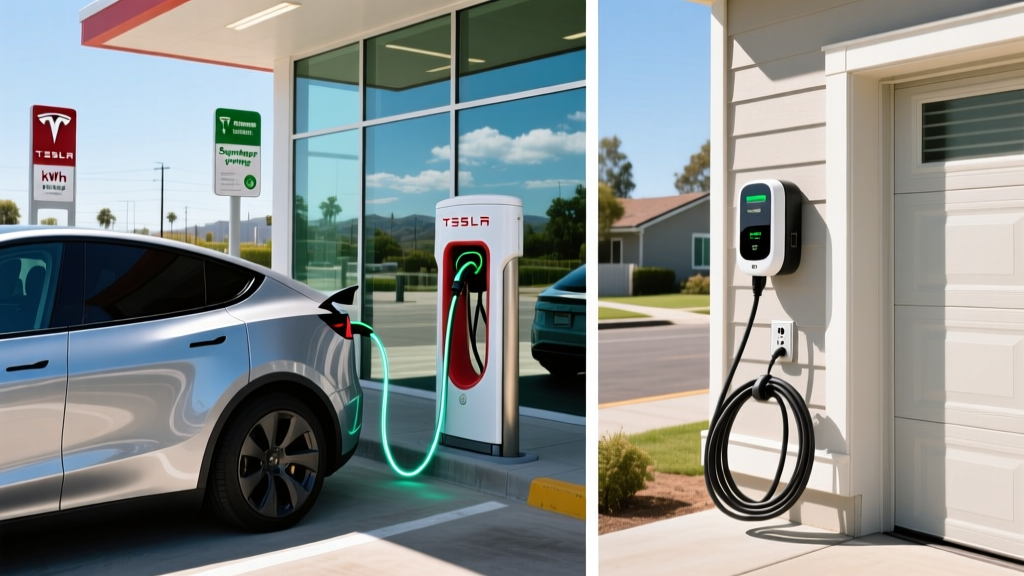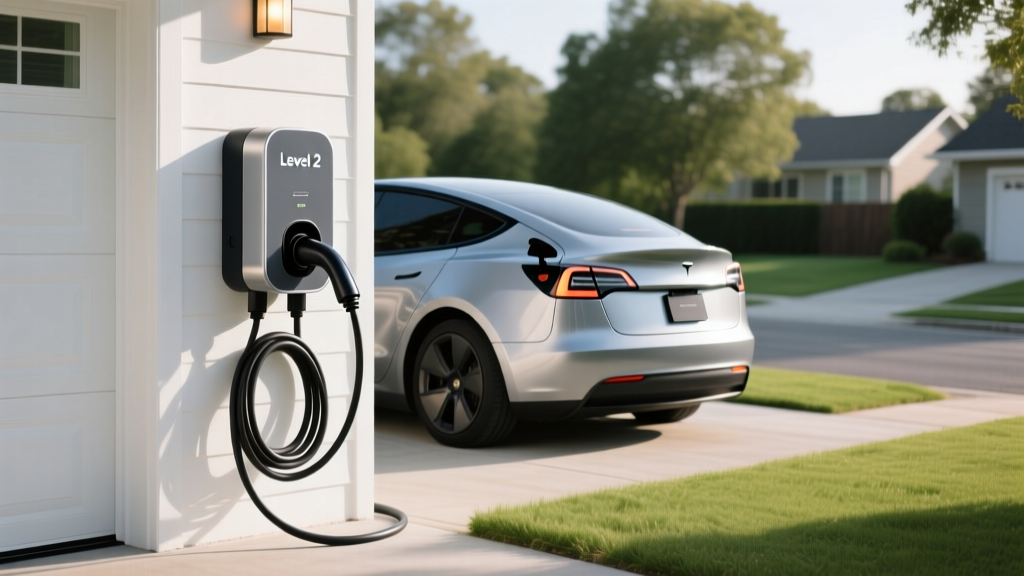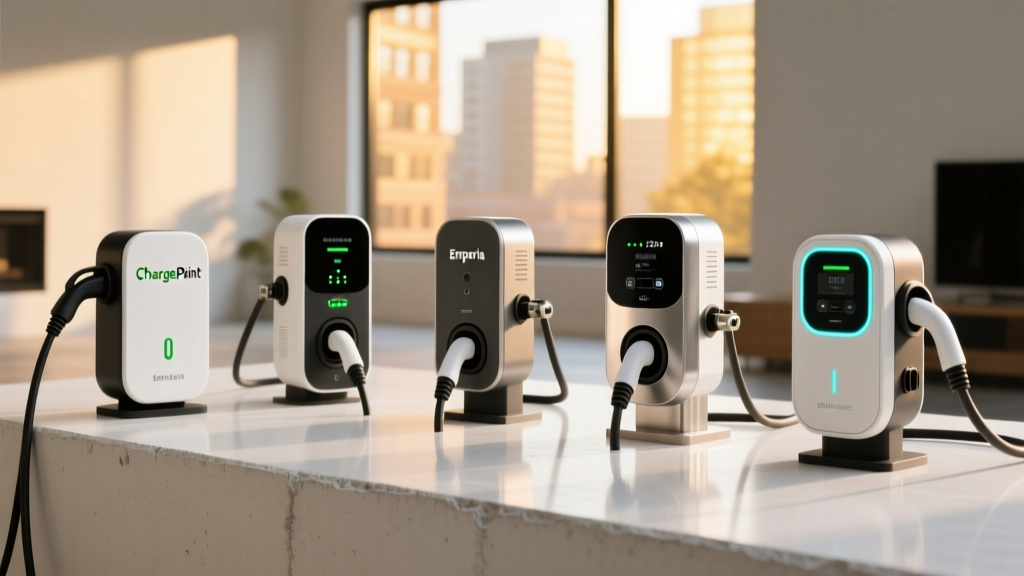
If you’ve landed on this page, you’ve probably been searching for a charger sixpack 2025 guide — a side-by-side breakdown of the top six home Level 2 EV chargers on the market heading into the 2025–2026 model year. That’s exactly what this is. We’ve installed, daily-driven, and stress-tested six of the most popular residential chargers to tell you which one actually fits your garage, your panel, and your EV’s connector.
Before we get to the hardware, a critical primer: kW (kilowatts) is power — how fast energy flows. kWh (kilowatt-hours) is energy — how much your battery holds. A 48-amp charger delivering 11.5 kW will refill a 75 kWh battery faster than a 32-amp unit at 7.7 kW. Confusing the two is the single most common mistake new EV owners make when shopping for equipment.
The Charging-Level Landscape: What Your Home Charger Actually Does
Home charging lives at Level 1 or Level 2. Public road-trip charging is DC Fast (Level 3). Here’s what each delivers in practical terms:
| Level | Voltage | Max Power (kW) | Miles of Range Added Per Hour | Typical Use Case |
|---|---|---|---|---|
| Level 1 | 120V / 12A | 1.4 kW | 3–5 mi/hr | Overnight top-up for PHEVs or low-mileage BEV drivers |
| Level 2 | 240V / 16A–48A | 3.8–11.5 kW | 14–46 mi/hr | Daily home charging for all BEVs — the sweet spot |
| DC Fast (Level 3) | 400V–800V DC | 50–350 kW | 150–1,000+ mi/hr (peak) | Road trips; 10–80% in 18–40 minutes depending on vehicle |
For context: a Tesla Model Y Long Range with a 75 kWh usable battery and ~4.0 mi/kWh efficiency needs roughly 18.75 kWh to go from 30% to 80% SoC. On an 11.5 kW Level 2 charger, that takes about 1 hour 38 minutes. On a 7.7 kW unit, closer to 2 hours 26 minutes. On DC fast charging at a V3 Supercharger peaking at 250 kW, the same 30–80% session takes approximately 20–25 minutes (accounting for charge-curve taper above 60% SoC).
The Charger Sixpack: Six Level 2 Units Compared
Here are the six chargers we evaluated, all current-production models available for purchase as of early 2026. Each is hardwired or plug-in (NEMA 14-50), Wi-Fi-enabled where noted, and UL-listed for safety.
| Charger | Max Amps | Max Power (kW) @ 240V | Cable Length | Connector | Smart Features | Price (MSRP) |
|---|---|---|---|---|---|---|
| Emporia Vue Level 2 | 48A | 11.5 kW | 24 ft | J1772 (NACS adapter avail.) | App scheduling, solar integration, energy monitoring | $399 |
| ChargePoint Home Flex | 50A | 12.0 kW | 23 ft | J1772 or NACS (configurable) | App, Alexa, load sharing, flexible amperage | $699 |
| Enel X JuiceBox Pro 48 | 48A | 11.5 kW | 25 ft | J1772 | App, energy dashboard, smart grid ready | $599 |
| Grizzl-E Smart | 40A | 9.6 kW | 24 ft | J1772 or NACS | App, OCPP, extreme cold rated (-40°F) | $549 |
| Wallbox Pulsar Plus | 48A | 11.5 kW | 25 ft | J1772 or NACS | App, Power Sharing, Eco-Smart solar mode | $649 |
| Tesla Wall Connector | 48A | 11.5 kW | 24 ft | NACS (native) | Wi-Fi OTA updates, load sharing, access control | $475 |
A few observations from hands-on use:
- Emporia Vue is the value king. At $399 for 48A, it undercuts the field by $150–$300 and integrates directly with the Emporia Vue home energy monitor — ideal for solar owners who want to charge only on excess production.
- ChargePoint Home Flex remains the most flexible. You can dial its amperage from 16A to 50A via the app, which is invaluable if your panel can’t support a 60A dedicated circuit. It also offers the widest connector configurability.
- Grizzl-E Smart is the durability pick. Built in Canada, it’s rated to -40°F and has a rugged aluminum case. If your garage is unheated in Minnesota or Montana winters, this is the unit that won’t flinch.
- Tesla Wall Connector is the best choice for NACS-native vehicles (all Teslas, plus the growing wave of Ford, GM, Rivian, and Volvo models shipping with NACS ports in 2025–2026). At $475, it’s also surprisingly affordable — but CCS1 vehicles will need a $200–$250 NACS-to-CCS adapter.
How Much Does It Cost to Install a Home EV Charger?
The charger itself is only part of the equation. Professional installation by a licensed electrician is required for hardwired units (and strongly recommended for NEMA 14-50 receptacle installs to ensure proper torque and grounding). Here’s a realistic cost breakdown based on 2025–2026 national averages:
| Cost Component | Simple Install (Panel Nearby) | Moderate Install (50–80 ft Run) | Complex Install (Panel Upgrade Needed) |
|---|---|---|---|
| Charger unit | $399–$699 | $399–$699 | $399–$699 |
| Electrician labor (2–6 hrs @ $85–$150/hr) | $170–$450 | $425–$900 | $850–$1,800 |
| Materials (wire, conduit, breaker, mounting) | $100–$250 | $250–$600 | $400–$900 |
| Permit & inspection | $50–$200 | $50–$200 | $50–$200 |
| Electrical panel upgrade (100A → 200A) if needed | — | — | $1,500–$3,500 |
| Total estimated cost | $719–$1,599 | $1,124–$2,399 | $3,199–$7,099 |
The panel-upgrade gotcha: Most homes built before 2000 have 100-amp or 150-amp service. A 48A Level 2 charger requires a dedicated 60A breaker (NEC 80% continuous-load rule). If your panel is already near capacity with HVAC, electric range, dryer, and water heater, adding 60A may push you over the service limit — requiring a panel upgrade to 200A. This is the single biggest surprise cost for new EV owners. Always have an electrician perform a load calculation before purchasing a charger.
Federal tax credit note: The IRS §30D alternative fuel vehicle refueling property credit covers up to 30% of home charger equipment and installation costs, capped at $1,000. However, eligibility depends on your census tract meeting specific low-income or non-urban criteria. Check the IRS guidelines before counting on this credit.
Connector Compatibility: NACS, CCS1, and CHAdeMO
The connector landscape has consolidated significantly since 2024, when Ford, GM, Rivian, Volvo, Polestar, Mercedes-Benz, and others committed to adopting the North American Charging Standard (NACS) — Tesla’s connector — on their vehicles starting in the 2025 model year. Here’s where things stand for 2025–2026 model-year vehicles:
| Connector | Vehicles Using It (2025–2026 MY) | Adapter Needed? |
|---|---|---|
| NACS (Tesla standard) | Tesla (all), Ford (F-150 Lightning, Mustang Mach-E 2025+), GM (Equinox EV, Blazer EV, Silverado EV, Cadillac Lyriq 2025+), Rivian (R1T/R1S 2025+), Volvo/Polestar, Hyundai/Kia (2026+) | None for NACS-native vehicles; CCS1 vehicles need NACS-to-CCS adapter (~$200–$250) |
| CCS1 | Hyundai Ioniq 5/6 (pre-2026), Kia EV6/EV9 (pre-2026), VW ID.4, BMW iX/i4, older Ford/GM EVs, Stellantis | NACS-equipped chargers need CCS1 adapter; most public DC stations still offer CCS1 cables |
| CHAdeMO | Nissan Leaf (legacy), Mitsubishi Outlander PHEV (legacy) | Effectively discontinued for new vehicles; adapters scarce |
Our recommendation for 2026 buyers: If you drive a Tesla or any 2025+ model from Ford, GM, Rivian, or Volvo, buy a NACS-connector charger (Tesla Wall Connector or ChargePoint Home Flex configured for NACS). If you drive a pre-2026 Hyundai, Kia, or VW, stick with a J1772/CCS1-compatible charger. If your household has mixed connectors, the ChargePoint Home Flex is the most adaptable — you can order it with either connector and swap later.
What Does Charging Cost Per Mile vs. Gas?
This is where EV ownership economics get compelling — but the numbers vary enormously depending on where and when you charge.
| Charging Scenario | Typical $/kWh | Cost Per Mile (at 3.5 mi/kWh efficiency) | Equivalent Gas Price (at 25 MPG) |
|---|---|---|---|
| Home, off-peak utility rate | $0.08–$0.14 | $0.023–$0.040 | $0.57–$1.00/gal |
| Home, standard residential rate | $0.14–$0.20 | $0.040–$0.057 | $1.00–$1.43/gal |
| Public Level 2 (ChargePoint, EVgo L2) | $0.25–$0.49 | $0.071–$0.140 | $1.79–$3.50/gal |
| DC Fast Charging (Electrify America, EA Pass) | $0.35–$0.56 | $0.100–$0.160 | $2.50–$4.00/gal |
| Tesla Supercharger (typical 2026) | $0.25–$0.40 | $0.071–$0.114 | $1.79–$2.86/gal |
| Gasoline (US average, early 2026) | — | $0.132 (at $3.30/gal, 25 MPG) | $3.30/gal |
The takeaway: home charging on an off-peak rate is 3–5× cheaper per mile than gasoline. Public DC fast charging narrows the gap considerably — on some networks at peak pricing, it can approach or exceed the cost of gas. This is why home charging infrastructure is the single most impactful investment an EV owner can make.
For a real-world example: a Hyundai Ioniq 5 (3.5 mi/kWh combined efficiency per fueleconomy.gov) driven 12,000 miles annually costs approximately $411/year to charge at home on a $0.12/kWh rate. The same miles in a 25 MPG gas car at $3.30/gal costs $1,584/year. That’s a $1,173 annual fuel savings — before factoring in reduced maintenance (no oil changes, less brake wear from regenerative braking).
Electrical Requirements and Safety: What the NEC Demands
Level 2 charging is a continuous load under the National Electrical Code (NEC Article 625). That triggers specific requirements:
- Dedicated circuit: Your charger must be on its own breaker — no sharing with outlets, lights, or appliances.
- 80% rule: A 48A charger requires a 60A breaker (48 ÷ 0.80 = 60). A 40A charger needs a 50A breaker. A 32A charger needs a 40A breaker.
- Wire gauge: 60A circuits require 6 AWG copper (THHN in conduit) or 4 AWG aluminum. Your electrician will size this based on run length and local code.
- GFCI protection: NEC 2020 and later requires GFCI protection for all EV receptacles (NEMA 14-50). Hardwired chargers are exempt from the GFCI breaker requirement since they include internal ground-fault protection.
- Outdoor rating: If your charger is installed outside (carport, driveway wall), it must be rated NEMA 3R or NEMA 4 for weather resistance. All six chargers in our sixpack carry appropriate outdoor ratings.
- Permit and inspection: Virtually all jurisdictions require a permit for EV charger installation. The inspection verifies wire gauge, breaker sizing, grounding, and torque specs. Do not skip this step — unpermitted work can void your homeowner’s insurance in the event of an electrical fire.
Pro tip on NEMA 14-50 receptacles: If you opt for a plug-in charger rather than hardwired, have your electrician install an industrial-grade 14-50 receptacle (Hubbell or Bryant, ~$75–$120 for the outlet alone). Cheap residential-grade 14-50 outlets have been linked to overheating and melting under continuous EV charging loads. This is a known issue documented in EV owner communities and is not widely advertised.
Real-World Charging Times: What to Expect
Manufacturer-stated "full charge in X hours" numbers assume a 0–100% session at peak power. In practice, you’ll almost always charge from 20–80% (the daily-use sweet spot that preserves battery longevity). Here’s what that looks like across common battery sizes on the chargers in our sixpack:
| Vehicle (Battery kWh Usable) | On 11.5 kW (48A) Charger: 20–80% | On 9.6 kW (40A) Charger: 20–80% | On 7.7 kW (32A) Charger: 20–80% |
|---|---|---|---|
| Tesla Model 3 RWD (57.5 kWh) | ~3 hr 00 min | ~3 hr 36 min | ~4 hr 29 min |
| Tesla Model Y LR (75 kWh) | ~3 hr 55 min | ~4 hr 41 min | ~5 hr 51 min |
| Hyundai Ioniq 5 (77.4 kWh) | ~4 hr 02 min | ~4 hr 50 min | ~6 hr 02 min |
| Ford F-150 Lightning Ext. Range (131 kWh) | ~6 hr 50 min | ~8 hr 12 min | ~10 hr 14 min |
| Chevy Equinox EV (85 kWh) | ~4 hr 26 min | ~5 hr 19 min | ~6 hr 38 min |
For overnight charging, even the slowest 32A scenario replenishes a Model Y from 20% to 80% while you sleep. The 48A chargers in our sixpack handle every current consumer EV overnight with room to spare — the exception being the F-150 Lightning Extended Range, which benefits from the full 48A to complete its large battery in a reasonable window.
Which Charger Should You Buy? Our Verdicts
Choose the Emporia Vue if: You want the best value at $399 for 48A, have solar panels, and want energy-monitoring integration. Best bang-for-buck in the sixpack.
Choose the ChargePoint Home Flex if: Your panel is tight on capacity and you need adjustable amperage (16A–50A), or you have mixed NACS/CCS1 vehicles in your household.
Choose the Tesla Wall Connector if: You drive a Tesla or any 2025+ NACS-native vehicle and want the cleanest, simplest, most affordable native-NACS option at $475.
Choose the Grizzl-E Smart if: You live in a cold climate with an unheated garage, or you value rugged build quality and OCPP compatibility for future utility demand-response programs.
Choose the Wallbox Pulsar Plus if: You want a compact form factor (smallest in the sixpack), solar-optimized Eco-Smart mode, and multi-charger Power Sharing for two-EV garages on a single circuit.
Choose the Enel X JuiceBox Pro 48 if: You want a proven platform with strong utility-program integration and a long 25-foot cable for reaching distant charge ports.
Frequently Asked Questions
How much does it cost to install a home EV charger?
A straightforward installation with the electrical panel near the garage typically costs $719–$1,599 total (charger + electrician + materials + permit). A moderate run of 50–80 feet pushes costs to $1,124–$2,399. If your home needs a panel upgrade from 100A to 200A service, expect $3,199–$7,099 all-in. Always get a load calculation from a licensed electrician before committing to a charger amperage.
How fast will each charging level add range?
Level 1 (120V) adds 3–5 miles of range per hour — adequate for PHEVs with small batteries but impractical for full BEVs. Level 2 (240V, 48A) adds 30–46 miles per hour depending on vehicle efficiency — enough to fully replenish most EVs overnight. DC Fast Charging adds 150–1,000+ miles per hour at peak power, though charge-curve taper above 80% SoC means real sessions deliver 10–80% in 18–40 minutes.
Which connector/charger is compatible with my EV?
For 2025–2026 model-year vehicles: Tesla, Ford, GM, Rivian, Volvo, and Polestar now ship with NACS ports. Hyundai, Kia, and VW are transitioning to NACS for 2026+ models but many current vehicles still use CCS1. Check your vehicle’s charge port or owner’s manual. If your charger’s connector doesn’t match your car, a NACS-to-CCS1 adapter costs approximately $200–$250. CHAdeMO is effectively discontinued for new vehicles.
How much does charging cost per mile vs gas?
Home charging on an off-peak utility rate ($0.08–$0.14/kWh) costs $0.02–$0.04 per mile in a typical EV — equivalent to $0.57–$1.00 per gallon of gasoline. Standard residential rates ($0.14–$0.20/kWh) bring the cost to $0.04–$0.06 per mile. Public DC fast charging ($0.35–$0.56/kWh) costs $0.10–$0.16 per mile, which narrows the gap with gasoline ($3.30/gal at 25 MPG = $0.13/mile). The economic case for EVs is strongest when you can charge at home.
What electrical upgrades might I need?
The most common upgrade is a panel capacity increase. Homes with 100A or 150A service may need a 200A upgrade ($1,500–$3,500) to support a 48A charger alongside existing loads. Other potential needs: replacing a Federal Pacific or Zinsco panel (known fire hazards, $2,000–$4,000 replacement), upgrading aluminum branch wiring, or adding a sub-panel if the main panel is full. Some utilities offer rebates for panel upgrades tied to EV adoption — check with your local provider.
Can I install a charger myself?
Technically, a plug-in NEMA 14-50 charger can be plugged into an existing 14-50 outlet (e.g., for a dryer). However, if no outlet exists, or if you’re hardwiring, hire a licensed electrician. EV charging is a continuous high-amperage load — improper wire sizing, loose terminal torque, or missing GFCI protection can create fire hazards. Most jurisdictions require a permit, and unpermitted electrical work can void your homeowner’s insurance.
Will a Level 2 charger degrade my battery?
No. Level 2 charging at 11.5 kW or below is well within the battery management system’s thermal comfort zone for all current consumer EVs. Battery degradation is driven primarily by high state-of-charge storage (sitting at 100% for extended periods), extreme temperatures, and cumulative DC fast charging cycles. Daily Level 2 charging to 80% is the manufacturer-recommended practice for NMC battery chemistries. LFP batteries (found in Tesla Model 3 RWD, some Ford and Hyundai models) tolerate regular 100% charging better — check your owner’s manual for chemistry-specific guidance.
Sources consulted: EPA Fuel Economy for vehicle efficiency data; IRS.gov for §30D refueling property credit rules; National Electrical Code (NEC) Article 625 for EV charging installation requirements. Pricing reflects manufacturer MSRP as of early 2026 and is subject to change.