The idea of a charger robot — an autonomous arm or mobile unit that plugs into your EV without human intervention — has circulated in EV tech demos for years. Volkswagen showcased its concept as early as 2020, and companies like Hyundai and various startups have since demonstrated robotic charging arms in parking-garage pilots. But in 2026, the practical reality for most EV owners remains a wall-mounted Level 2 home charger or a public DC fast-charging stop. This guide explains where charger-robot technology actually stands, and gives you the complete data framework for evaluating any EV charging setup today — from kilowatt speeds and connector compatibility to real installation costs and per-mile economics.
What Is a Charger Robot and Does It Exist in 2026?
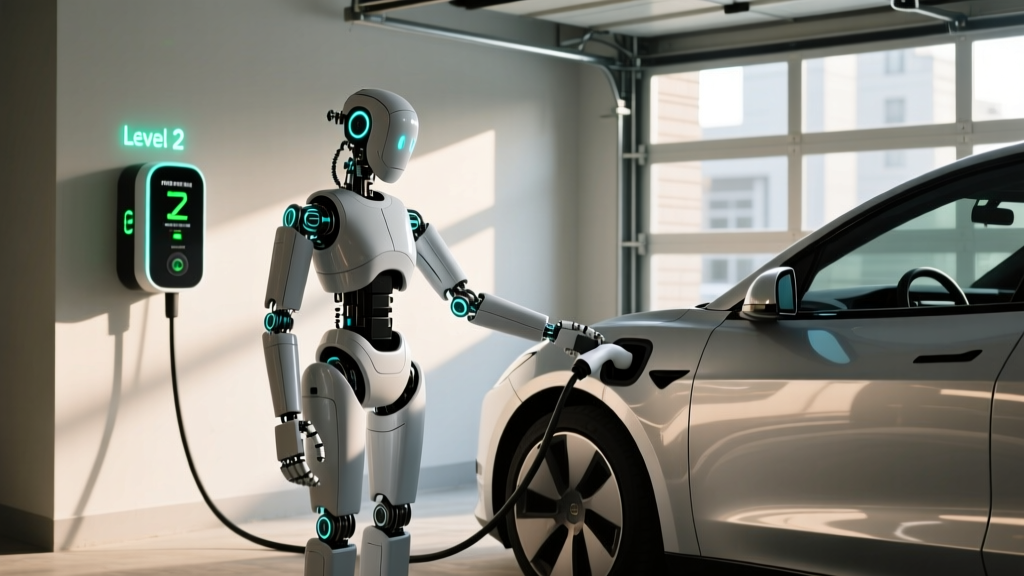
A charger robot is an automated system — typically a robotic arm paired with a vision system — that identifies an EV's charge port and physically inserts the charging connector without driver action. The promise is obvious: you park, walk away, and the robot handles the plug-in, session initiation, and eventually unplugging when complete.
As of early 2026, charger-robot deployments remain limited to controlled pilot programs — primarily in South Korea (Hyundai's robotic charging stations in Seoul parking structures), select fleet depots, and a handful of European demonstration sites. You cannot purchase a charger robot for home use. The technology faces three persistent barriers:
- Cost: Robotic arms with vision-guided alignment systems run $50,000–$150,000+ per unit, far beyond consumer economics.
- Standardization: Charge-port locations vary by model and manufacturer, requiring complex machine-learning models for each vehicle type.
- Speed vs. necessity: A human plugs in an EV in under 10 seconds — the problem robots solve (convenience for disabled drivers, autonomous fleet vehicles) doesn't yet justify the cost for individual owners.
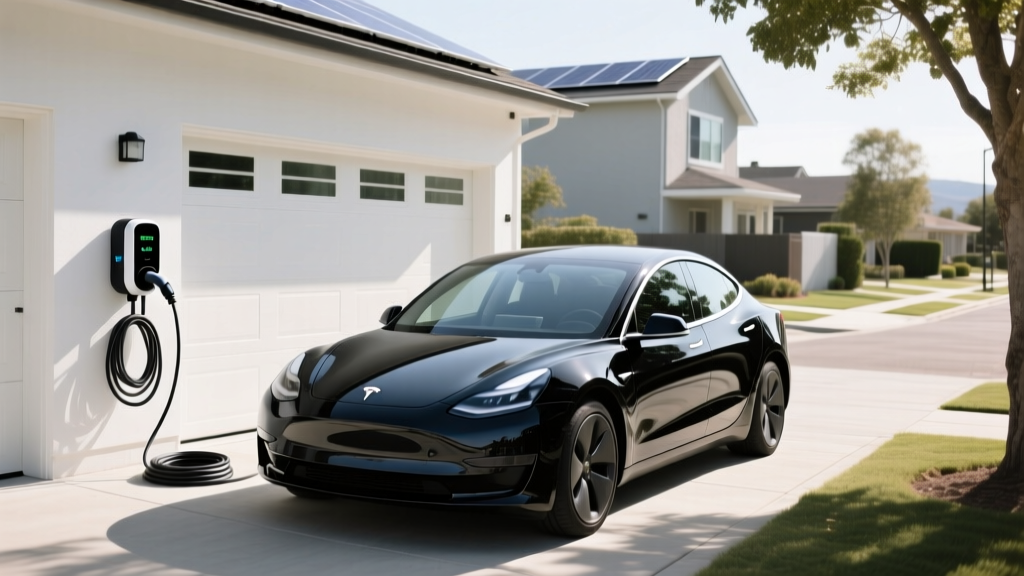
For now, and likely through the end of the decade, the charger robot's practical alternative is a high-quality Level 2 home charger paired with smart scheduling — which delivers 90% of the convenience at 1% of the cost. Below, we break down exactly what that setup requires.
Charging Levels Explained: kW Speeds and Real-World Range Added
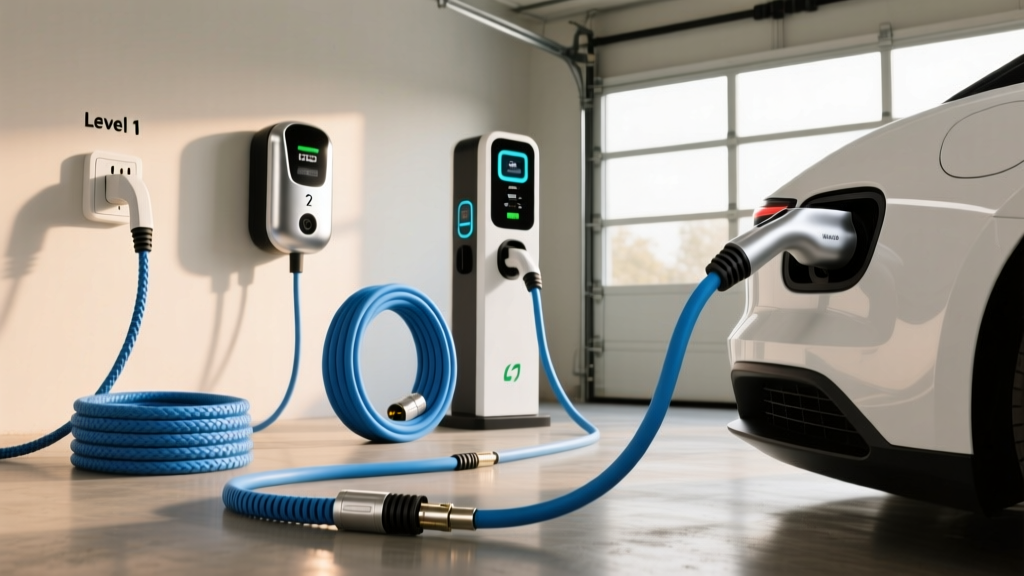
Before evaluating equipment, you need to understand the three charging tiers. The critical distinction: kW (kilowatts) measures power — how fast energy flows into your battery. kWh (kilowatt-hours) measures energy — the total capacity stored. A 48 kW charger delivers energy roughly 6× faster than an 8 kW charger, filling the same kWh battery in a fraction of the time.
| Level | Voltage | Power (kW) | Miles of Range Added per Hour | Typical Use Case |
|---|---|---|---|---|
| Level 1 | 120V AC | 1.0–1.9 kW | 3–5 miles | Overnight top-off, PHEVs, emergencies |
| Level 2 | 240V AC | 3.3–19.2 kW | 12–75 miles | Daily home charging, workplace, hotels |
| DC Fast Charge | 400–900V DC | 50–350 kW | 150–1,200+ miles (equivalent) | Road trips, highway corridors, 10–80% in 15–40 min |
Charging time examples for common battery sizes (10%–80% SoC):
- 60 kWh battery (e.g., base Tesla Model 3, Chevrolet Equinox EV): ~7 hours at 7.2 kW Level 2; ~22 minutes at 150 kW DC fast (with preconditioning).
- 85 kWh battery (e.g., Ford F-150 Lightning Extended Range): ~10 hours at 7.2 kW; ~28 minutes at 170 kW DC fast.
- 110 kWh battery (e.g., GMC Hummer EV): ~13 hours at 7.7 kW; ~35 minutes at 350 kW capable DC fast (sustained peak curve dependent).
Note on charge curves: DC fast charging does not sustain peak kW throughout the session. A charger rated at 250 kW may deliver that rate only between 10%–40% SoC, then taper to 100 kW or lower above 60%. Always evaluate 10–80% total time, not peak kW alone.
Home Level 2 Installation: Electrical Requirements, Permits, and Real Costs
Installing a hardwired Level 2 charger is the single highest-impact upgrade an EV owner can make. Here is what the process actually requires.
Electrical Requirements
- Circuit: A dedicated 240V circuit, typically 40A or 50A (supporting 32A or 40A continuous charging, respectively — NEC requires circuits rated 125% above continuous load).
- Wire gauge: 6 AWG copper for 50A circuits; 8 AWG for 40A circuits (varies by run length and local code).
- Panel capacity: Your main service panel must have spare amperage headroom. A 200A panel with existing high loads (electric range, dryer, HVAC) may need a load calculation or upgrade to 300A–400A service.
- GFCI protection: NEC 2020 and later requires GFCI breakers for EV charging circuits in garages — a $100–$180 addition.
- Outdoor rating: If mounting outside, the charger must carry a NEMA 4 or IP65 rating for weather resistance.
Installation Cost Breakdown
| Component | Low-End Estimate | High-End Estimate | Notes |
|---|---|---|---|
| Level 2 charger hardware | $350 | $750 | Smart Wi-Fi models with 25-ft cable |
| Electrician labor (standard install) | $400 | $1,200 | Short run from panel, no drywall repair |
| Permit and inspection | $50 | $250 | Varies by municipality |
| Panel upgrade (if needed) | $1,500 | $4,500 | 200A → 300A/400A service upgrade |
| Additional wiring (long runs) | $200 | $1,000 | Detached garages, conduit through masonry |
| Total (no panel upgrade) | $800 | $2,200 | Most homes with 200A+ panels |
| Total (with panel upgrade) | $2,300 | $6,700 | Older homes, 100A–150A service |
Some utilities and states offer rebates of $200–$1,000 for charger installation, and the federal Energy Efficient Home Improvement Credit (25C) may cover 30% of installation costs up to $1,000 — verify current-year eligibility with a tax professional.
Connector Compatibility: NACS, CCS1, CHAdeMO, and Adapter Reality
The North American charging landscape consolidated heavily in 2024–2025 when Ford, GM, Rivian, Volvo, and most major automakers adopted the North American Charging Standard (NACS) — Tesla's connector — as their native port. Here is where things stand in 2026:
| Connector | Used By (2026 Models) | Home Level 2 | DC Fast Charging |
|---|---|---|---|
| NACS (Tesla/J3400) | Tesla, Ford, GM, Rivian, Volvo, Polestar, Hyundai (2025+), most new EVs | Native or J1772 adapter | Native at Superchargers + NACS-equipped networks |
| CCS1 | Legacy VW ID.4 (pre-2025), BMW i4/iX, some Stellantis models | J1772 native | Electrify America, EVgo, ChargePoint |
| CHAdeMO | Nissan Leaf (discontinued 2025), Mitsubishi Outlander PHEV | J1772 native | Limited and declining availability |
| J1772 | All non-Tesla EVs (Level 1/2 AC only) | Universal standard | N/A — AC only |
Key adapter notes:
- Tesla sells a J1772-to-NACS adapter (~$150) for older Teslas to use J1772 Level 2 public chargers.
- Ford and GM include NACS-to-CCS adapters with 2025+ models to access legacy Electrify America CCS stations.
- For home Level 2, most smart chargers now ship with a NACS connector or include a J1772-to-NACS adapter in the box. Confirm before purchasing.
Cost to Charge: Per-Mile Economics vs. Gasoline
Electricity pricing varies dramatically by source. Here are real-world scenarios based on national averages in early 2026:
| Scenario | Rate ($/kWh) | Cost to Add 200 mi (at 3 mi/kWh) | Cost Per Mile |
|---|---|---|---|
| Home off-peak (utility time-of-use) | $0.08–$0.12 | $5.33–$8.00 | $0.027–$0.040 |
| Home standard rate | $0.14–$0.18 | $9.33–$12.00 | $0.047–$0.060 |
| Public Level 2 (ChargePoint, etc.) | $0.25–$0.49 | $16.67–$32.67 | $0.083–$0.163 |
| DC Fast (Electrify America, EVgo) | $0.35–$0.55 | $23.33–$36.67 | $0.117–$0.183 |
| Gasoline equivalent (25 MPG, $3.40/gal) | — | $27.20 | $0.136 |
The takeaway: home off-peak charging delivers a 200-mile refill for $5–$8, roughly one-quarter the cost of gasoline. Public DC fast charging narrows the gap, and in high-cost states (California, Massachusetts) can approach gas parity on a per-mile basis. This is why home Level 2 installation is the single most important economic decision in EV ownership.
Equipment Recommendations: 2026 Home Level 2 Chargers Compared
Based on sustained availability, verified power output, cable quality, and smart features, these are the top-performing Level 2 chargers for home installation in 2026:
ChargePoint Home Flex (NACS)
- Power output: Up to 19.2 kW (80A circuit) / 11.5 kW on 50A circuit
- Connector: NACS (2025+ version); J1772 available
- Cable length: 23 ft
- Smart features: Wi-Fi, app scheduling, Alexa integration, utility demand-response compatible
- Price: ~$599
Grizzl-E Smart (United Chargers)
- Power output: Up to 11.5 kW (50A circuit)
- Connector: NACS or J1772 (selectable at purchase)
- Cable length: 24 ft
- Smart features: Wi-Fi, OCPP open protocol, adjustable amperage via DIP switch, extreme cold rated (-40°F)
- Price: ~$449
Emporia Level 2 EV Charger
- Power output: Up to 11.5 kW (48A on 60A circuit)
- Connector: J1772 (NACS adapter included)
- Cable length: 24 ft
- Smart features: Wi-Fi, real-time energy monitoring, solar-integration scheduling, load management with Emporia Vue panel monitor
- Price: ~$349
Tesla Wall Connector (Gen 4)
- Power output: Up to 11.5 kW (48A on 60A circuit)
- Connector: NACS native
- Cable length: 24 ft
- Smart features: Wi-Fi, OTA updates, power sharing between two units on one circuit, integrated cable management
- Price: ~$475
For homes with limited panel capacity, the Emporia charger paired with an Emporia Vue energy monitor enables dynamic load management — the charger throttles down when other appliances draw power, potentially avoiding a costly panel upgrade.
Where Charger Robots Actually Fit: Autonomous Fleets and Accessibility
While charger robots are not a consumer product in 2026, they serve two use cases where the economics begin to justify the investment:
- Autonomous robotaxi and delivery fleets: Waymo, Cruise successors, and autonomous logistics operators need vehicles to charge without human attendants. Robotic charging arms integrated into depot parking spots enable 24/7 cycling. Companies like Volkswagen Group Components and Korean robotics firms are piloting these systems in controlled fleet environments.
- Accessibility: For drivers with mobility impairments who cannot physically handle a heavy DC fast-charging cable (which can weigh 10–15 lbs with liquid-cooled lines), robotic plug-in at designated accessible parking spots represents a genuine quality-of-life improvement. Pilot programs in South Korea and Japan target this use case.
For the individual EV owner reading this guide, the charger robot remains a future technology. Your best investment today is a properly installed, appropriately powered Level 2 home charger on a dedicated circuit — which delivers the closest thing to "invisible" charging: plug in when you park, wake up to a full battery every morning.
Safety, Code, and Panel-Upgrade Considerations
EV charging places a sustained high-amperage load on your home electrical system — comparable to running an electric oven continuously for 8 hours. Code compliance is not optional:
- Dedicated circuit required: EV chargers must have their own breaker — sharing a circuit with a dryer or range is a code violation and fire risk.
- Hardwired vs. plug: Hardwired installations (no NEMA outlet) are preferred for circuits above 40A, eliminate the $80–$150 receptacle cost, and reduce failure points. NEMA 14-50 outlets are acceptable for 40A circuits but must be installed with proper torque specifications — loose 14-50 receptacles have been linked to melting and fire incidents.
- GFCI breaker: Required by NEC 2020+ for garage EV circuits. Some chargers have built-in ground-fault protection; confirm with your electrician whether a GFCI breaker or standard breaker is appropriate for your unit.
- Panel load calculation: Before installation, your electrician should perform a NEC Article 220 load calculation. If your existing loads exceed 80% of panel capacity with the charger added, you will need a panel upgrade — the single largest cost variable in the installation table above.
- Permit and inspection: Nearly all jurisdictions require an electrical permit for EV charger installation. Unpermitted work can void home insurance claims and create issues at resale. Budget $50–$250 and 1–3 weeks for the inspection cycle.
Frequently Asked Questions
How much does it cost to install a home EV charger?
A standard Level 2 home charger installation (hardware + electrician + permit) ranges from $800–$2,200 for homes with adequate panel capacity. If your home needs a panel upgrade from 100A/150A to 200A+ service, total costs range from $2,300–$6,700. Always get a licensed electrician's load calculation before committing to a charger purchase.
How fast will each charging level add range?
Level 1 (120V) adds 3–5 miles per hour — suitable only for PHEVs or overnight trickle charging. Level 2 (240V) adds 12–75 miles per hour depending on amperage and your vehicle's onboard charger acceptance rate. DC fast charging can add 150+ miles in 15–20 minutes, though actual speed depends on battery preconditioning, ambient temperature, and charge-curve taper above 80% SoC.
Which connector/charger is compatible with my EV?
If you purchased a 2025 or 2026 model-year EV from Ford, GM, Rivian, Tesla, Hyundai, or Volvo, your vehicle uses the NACS connector. Older non-Tesla EVs and some current BMW/Stellantis models use CCS1. For home Level 2, all non-Tesla EVs accept J1772 natively, and adapters are widely available. Check your vehicle's charge port or owner's manual before ordering a charger.
How much does charging cost per mile vs. gas?
Home off-peak charging costs $0.03–$0.04 per mile — roughly 75% less than gasoline at $3.40/gal and 25 MPG ($0.136/mile). Standard home rates bring it to $0.05–$0.06/mile. Public DC fast charging at $0.35–$0.55/kWh costs $0.12–$0.18/mile, approaching gas parity. The economic case for EVs depends heavily on reliable home charging access.
What electrical upgrades might I need?
The most common upgrade is a panel capacity increase (100A or 150A service to 200A+) — required when your existing loads already consume most of your panel's capacity. Other potential upgrades include running new conduit for detached garages, upgrading wire gauge for long runs, and installing a GFCI breaker. A licensed electrician's load calculation (typically $150–$300 as a standalone service) will identify exactly what your home needs.
Will charger robots replace home Level 2 chargers?
Not in the foreseeable consumer timeline. Charger robots cost $50,000–$150,000+ per unit and remain confined to fleet depots and pilot programs. For individual owners, a $400–$750 smart Level 2 charger on a dedicated 240V circuit delivers equivalent convenience (plug once, scheduled charging, wake up full) at a fraction of the cost.