When Dodge unleashed the Charger Redeye with its supercharged 6.2L HEMI V8, it represented the peak of internal-combustion muscle. But as that era fades and Stellantis pivots to the electric Charger Daytona, a new kind of "charger" demands your attention: the hardware that refuels an EV in your garage. This guide uses the Charger Redeye's legacy as a launching point to break down everything you need to know about home and public EV charging in 2026 — speeds, costs, equipment, and the electrical upgrades that catch first-time EV buyers off guard.
From Redeye to Recharge: Why Charging Literacy Matters Now
The original Dodge Charger SRT Hellcat Redeye produced 797 horsepower and earned an EPA-rated 15 MPG combined. At $4.00/gallon gas, that cost roughly $0.267 per mile just in fuel. A modern EV like the 2025 Dodge Charger Daytona Scat Pack (590 hp, EPA-estimated 260 miles of range) can cost as little as $0.04–$0.06 per mile on home electricity. The math is compelling, but only if you understand the infrastructure. The single most important distinction: kW (kilowatts) measures power — how fast energy flows into your car. kWh (kilowatt-hours) measures energy — the total capacity of your battery, like gallons in a tank. Confusing them is the most common EV mistake.
Charging Levels Explained: Speeds, Power, and Real-World Range Added
Every EV owner uses a mix of three charging levels. Here is what each delivers in practice:
| Level | Voltage | Power (kW) | Miles of Range Added Per Hour | Best Use Case |
|---|---|---|---|---|
| Level 1 | 120V AC | 1.0–1.4 kW | 3–5 miles | Overnight top-ups, PHEVs, emergencies |
| Level 2 | 240V AC | 3.3–19.2 kW | 12–70 miles | Daily home charging, workplace, hotels |
| DC Fast (Level 3) | 400–800V DC | 50–350 kW | 150–1,200+ miles (equivalent rate) | Road trips, rapid top-ups (10–80% in 18–45 min) |
A typical Level 2 home charger at 11.5 kW (48 amps on a 60-amp circuit) will fully replenish a 75 kWh battery overnight in roughly 7 hours. A 350 kW DC fast charger can take that same battery from 10% to 80% in about 18–25 minutes, though the charge curve tapers significantly above 80% to protect battery health — peak kW is never sustained across the full session.
How Much Does It Cost to Install a Home EV Charger?
The total installed cost of a Level 2 home charger varies wildly based on your electrical panel's capacity and the distance from panel to parking spot. Here is a realistic 2026 breakdown:
| Component | Typical Range | Notes |
|---|---|---|
| Level 2 Charger Unit (hardwired, 40–48A) | $350–$700 | Smart Wi-Fi models at higher end |
| Electrician Labor (240V/50–60A circuit run) | $500–$1,500 | Depends on run length, wall/foundation penetrations |
| Electrical Permit | $50–$200 | Varies by municipality |
| Panel Upgrade (if needed: 100A → 200A) | $1,500–$3,500 | Required for older homes with 100A service |
| Total (no panel upgrade) | $900–$2,400 | Most newer homes with 200A panel |
| Total (with panel upgrade) | $2,400–$5,900 | Common for pre-2000 construction |
Which Connector and Charger Is Compatible with My EV?
The connector landscape shifted dramatically between 2023 and 2026. Tesla's North American Charging Standard (NACS) has become the dominant connector, adopted by Ford, GM, Rivian, Volvo, Hyundai, and most other automakers for 2025+ models. Here is where things stand:
| Connector | Brands Using It (New Vehicles) | Adapter Needed? |
|---|---|---|
| NACS (Tesla-style) | Tesla, Ford, GM, Rivian, Volvo, Polestar, Hyundai, Kia, Mercedes (2025+) | CCS-to-NACS adapter for legacy CCS vehicles (~$200–$250) |
| CCS1 (Combo) | Legacy 2022–2024 models (VW ID.4, older BMW iX, some Stellantis) | NACS-to-CCS adapter if accessing Tesla Superchargers |
| CHAdeMO | Nissan Leaf (discontinued in US after 2025), Mitsubishi Outlander PHEV | Limited DC fast network; adapter to CCS available (~$300) |
If you own a pre-2025 EV with a CCS1 port, you can still charge at home with any J1772 Level 2 charger (the AC standard that CCS builds on). For DC fast charging on the expanding Tesla Supercharger network, you will need an approved CCS-to-NACS adapter — Ford and GM provide these to owners, while aftermarket options from Lectron and A2Z are widely available.
Cost to Charge: Home Electricity vs. Gas Per Mile
This is where the Charger Redeye comparison becomes stark. Let's run the numbers for a typical 2026 EV with a 75 kWh battery and 270 miles of EPA range:
| Scenario | Cost per kWh | Cost for Full Charge (75 kWh) | Cost Per Mile (270 mi range) |
|---|---|---|---|
| Home Off-Peak (utility time-of-use rate) | $0.08–$0.12 | $6.00–$9.00 | $0.022–$0.033 |
| Home Standard Residential (national avg.) | $0.16 | $12.00 | $0.044 |
| Public Level 2 (ChargePoint, EVgo L2) | $0.25–$0.35 | $18.75–$26.25 | $0.069–$0.097 |
| DC Fast Charging (Electrify America, Tesla) | $0.35–$0.55 | $26.25–$41.25 | $0.097–$0.153 |
| Dodge Charger Redeye (15 MPG, $4.00/gal) | N/A | N/A | $0.267 |
| Average Gas Car (28 MPG, $3.60/gal) | N/A | N/A | $0.129 |
Even at the most expensive DC fast charging rates, the EV costs less per mile than the Redeye. At home off-peak rates, you are paying roughly one-eighth the fuel cost per mile. According to the U.S. Department of Energy's EV calculator, the national average eGallon (the electrical energy equivalent of one gallon of gas) costs $1.40–$1.80, compared to $3.50+ for a physical gallon.
Charging Time Examples: 10–80% for Common Battery Sizes
Real charging sessions rarely go from 0–100%. Most EV owners charge from roughly 10–20% to 80% to preserve battery longevity. Here is what that looks like across popular battery sizes:
| Battery Size (usable kWh) | Example Vehicle | Level 2 at 11.5 kW | DC Fast (peak rate → sustained avg.) | 10–80% Time (DC Fast) |
|---|---|---|---|---|
| 58 kWh | VW ID.4 Standard | ~3.5 hours | 135 kW peak → ~95 kW avg. | ~30 min |
| 75 kWh | Tesla Model Y Long Range | ~4.5 hours | 250 kW peak → ~150 kW avg. | ~25 min |
| 84 kWh | Hyundai Ioniq 5 (2025) | ~5 hours | 350 kW peak → ~210 kW avg. | ~18 min |
| 100 kWh | Ford F-150 Lightning Ext. Range | ~6 hours | 150 kW peak → ~110 kW avg. | ~41 min |
| 115 kWh | GMC Hummer EV (2025) | ~7 hours | 350 kW peak → ~250 kW avg. | ~30 min |
The key insight: peak charge rate is not sustained rate. A vehicle advertising "350 kW peak" only holds that rate at low state-of-charge (typically 10–30%). Above 50%, the battery management system throttles the rate to protect cell health. This is why 10–80% time is a more honest metric than peak kW alone.
Recommended Home EV Chargers for 2026
Based on reliability, smart features, and value, here are top picks for home Level 2 installations:
Emporia Vue Level 2 Smart Charger
- Power Output: 11.5 kW (48A)
- Connector: J1772 (NACS version available)
- Cable Length: 24 ft
- Smart Features: Wi-Fi, energy monitoring, solar integration, scheduling
- Price: ~$399
- Best For: Budget-conscious buyers wanting full smart features
ChargePoint Home Flex
- Power Output: Up to 12 kW (50A, configurable down)
- Connector: J1772 (NACS adapter included)
- Cable Length: 23 ft
- Smart Features: Wi-Fi, app scheduling, Alexa, load sharing
- Price: ~$549
- Best For: Flexibility across amperage; strong app ecosystem
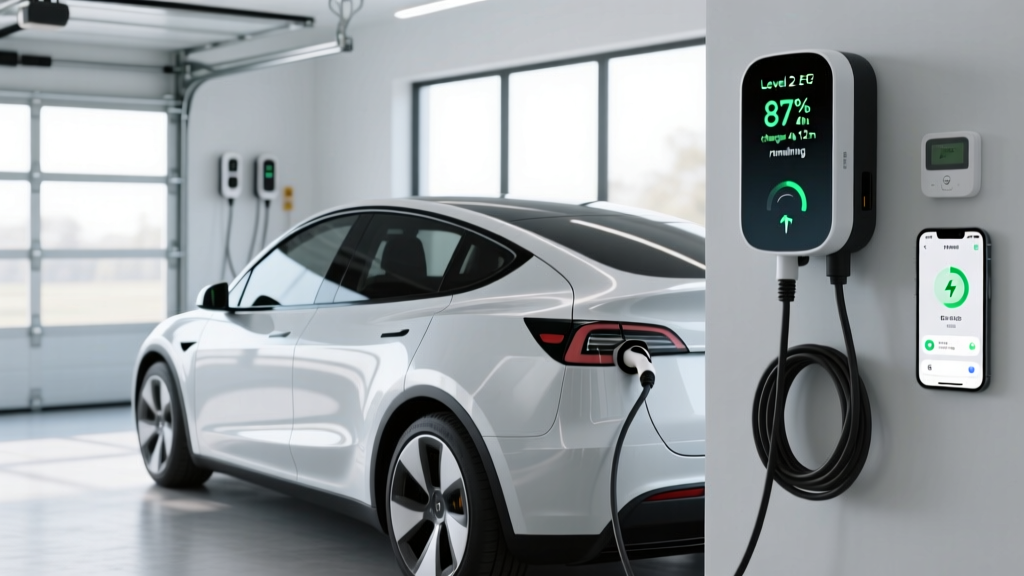
Tesla Wall Connector (Gen 4)
- Power Output: 11.5 kW (48A)
- Connector: NACS native
- Cable Length: 24 ft
- Smart Features: Wi-Fi, OTA updates, power sharing, access control
- Price: ~$475
- Best For: Tesla and NACS-adopted vehicle owners
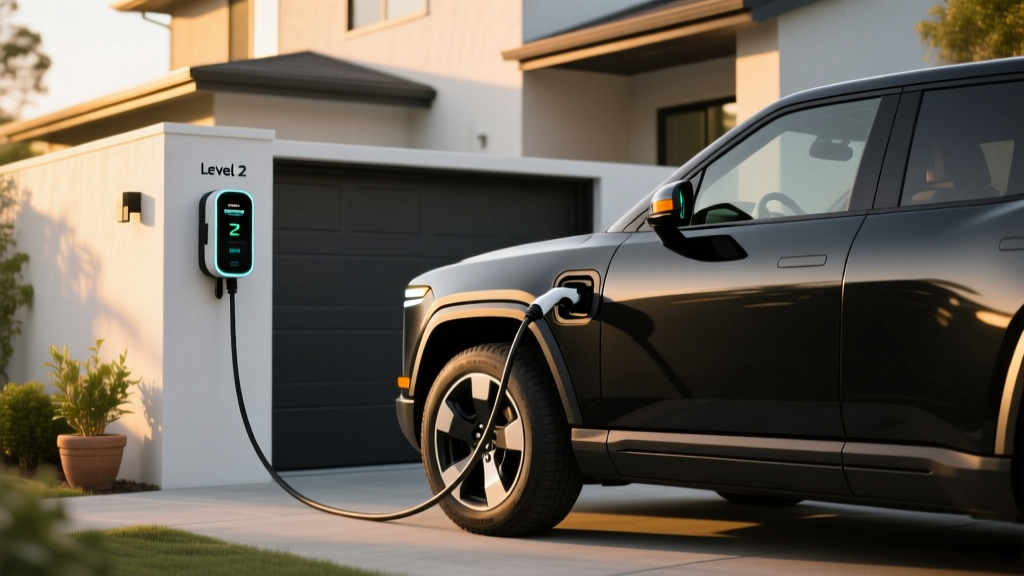
All three units are hardwired (no plug — required for circuits above 40A per NEC), UL-listed, and rated for indoor or outdoor installation (NEMA 4 enclosure). For homes with a NACS-equipped 2025+ EV, the Tesla Wall Connector eliminates adapter clutter. For mixed households or CCS legacy vehicles, the ChargePoint Home Flex with its included adapter offers the most flexibility.
Safety, Electrical Code, and Installation Requirements
A Level 2 charger is a continuous-load appliance under the National Electrical Code (NEC Article 625), which triggers specific requirements:
- Dedicated Circuit: Your charger must be on its own breaker — not shared with other outlets or appliances. A 48A charger requires a 60A breaker (NEC 125% rule for continuous loads).
- GFCI Protection: Outdoor installations require GFCI (Ground Fault Circuit Interrupter) protection. Most hardwired chargers have built-in GFCI; plug-in units (NEMA 14-50) may require a GFCI breaker, which adds $50–$100.
- Outdoor Rating: If mounted outside, the unit must carry a NEMA 4 (weatherproof) or NEMA 4X (corrosion-resistant) rating. All recommended units above meet this standard.
- Permit and Inspection: Nearly all jurisdictions require an electrical permit for a new 240V circuit. The inspection ensures proper wire gauge (6 AWG copper for 60A), grounding, and breaker sizing. Do not skip this — it protects your home insurance coverage.
- Wire Gauge: 6 AWG copper for 60A circuits; 4 AWG aluminum is an acceptable, lower-cost alternative for longer runs.
Frequently Asked Questions
How much does it cost to install a home EV charger?
Expect $900–$2,400 for a standard installation (equipment + electrician + permit) if your home already has a 200-amp electrical panel with available capacity. If a panel upgrade from 100A to 200A is needed, total costs range from $2,400–$5,900. Always get a load calculation from a licensed electrician before committing.
How fast will each charging level add range?
Level 1 (120V) adds 3–5 miles per hour. Level 2 (240V) adds 12–70 miles per hour depending on amperage (a 48A/11.5 kW unit adds roughly 35–44 miles per hour for a mid-size EV). DC fast charging can add 150–250 miles in a 20–30 minute session at a 150–350 kW station.
Which connector/charger is compatible with my EV?
For 2025–2026 model-year vehicles from Tesla, Ford, GM, Rivian, Hyundai, Kia, and Volvo: NACS is the native connector. For older CCS-equipped vehicles (2022–2024 VW, BMW, some Stellantis): J1772 for Level 2, CCS1 for DC fast. CHAdeMO is limited to the Nissan Leaf (now discontinued in the US) and Mitsubishi Outlander PHEV. Check your owner's manual or the DOE EV database for your specific model.
How much does charging cost per mile vs gas?
Home charging at the national average of $0.16/kWh costs roughly $0.04–$0.05 per mile for a typical EV. Gas at $3.60/gallon costs $0.13/mile for a 28 MPG car and $0.27/mile for a Charger Redeye at 15 MPG. Even public DC fast charging at $0.48/kWh averages $0.13/mile — comparable to an efficient gas car and far cheaper than a muscle car.
What electrical upgrades might I need?
The most common upgrade is a panel replacement from 100A to 200A service ($1,500–$3,500). Homes built after 2005 typically have 200A panels with sufficient headroom. Other potential upgrades: replacing a Federal Pacific or Zinsco panel (known fire hazards, ~$2,500–$4,000), adding a sub-panel near the garage ($400–$800), or upgrading the utility meter socket for higher service capacity. The IRS also notes that the §30C alternative fuel vehicle refueling property credit (up to $1,000 for residential charging equipment) may offset installation costs — consult a tax professional for eligibility based on your census tract and income.