Why a "Charger Rallye" Matters for Real-World EV Ownership
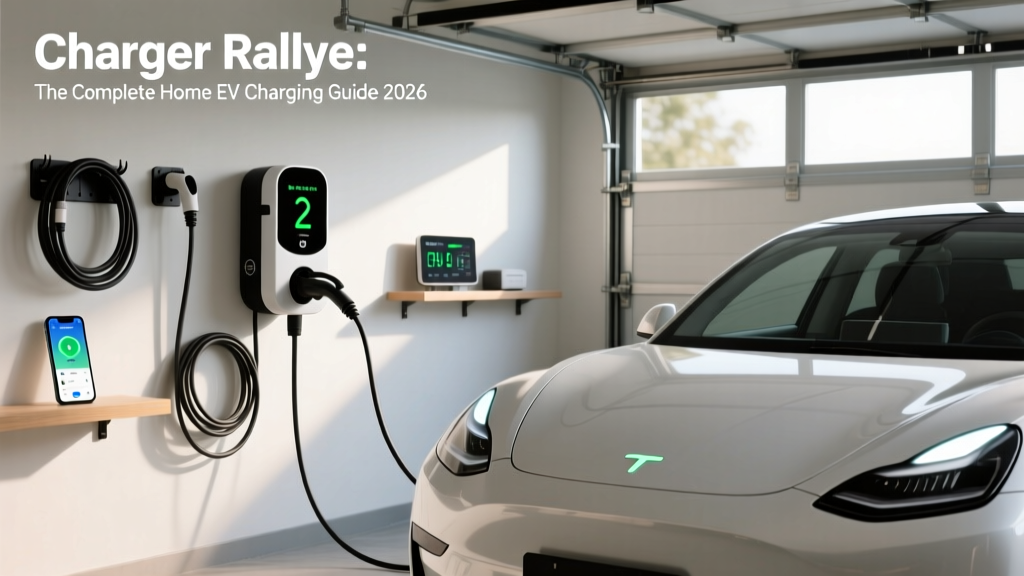
If you've seen EV owners talk about a charger rallye — a systematic home charging setup that reliably gets you from 20% to 80% overnight — you're looking at the single most impactful upgrade any electric vehicle owner can make. Public DC fast chargers are great for road trips, but fueleconomy.gov data shows that over 80% of EV charging happens at home. A well-planned charger rallye means waking up every morning with 200+ miles of range at a cost that undercuts gasoline by 60–75%.
This guide walks through every decision you'll make: charging levels and speeds, electrical requirements, installation costs with real breakdowns, connector compatibility in the NACS-dominant 2026 landscape, and equipment picks with exact power outputs and prices.
Charging Levels Explained: kW, Miles per Hour, and Real Charge Times
The most common EV literacy gap is confusing kW (kilowatts — the rate of power delivery, like water pressure) with kWh (kilowatt-hours — total energy stored, like gallons in a tank). A 48 kW charger delivers energy faster than a 7.2 kW charger, but both fill the same kWh battery. Here's how each level performs:
| Level | Voltage | Typical Power (kW) | Miles Added/Hour | Best For |
|---|---|---|---|---|
| Level 1 | 120V AC | 1.2–1.9 kW | 3–5 mi/hr | PHEVs, overnight top-ups |
| Level 2 | 240V AC | 7.2–19.2 kW | 20–65 mi/hr | Daily home charging (the charger rallye standard) |
| DC Fast | 400–800V DC | 50–350 kW | 150–1,200 mi/hr | Road trips, quick stops |
For context, a 75 kWh battery (common in midsize crossovers like the Hyundai Ioniq 5 or Tesla Model Y) charging on a 48 kW Level 2 circuit adds roughly 30–35 miles of range per hour. On a 150 kW DC fast charger, that same battery goes from 10–80% in about 25–30 minutes — but only if the vehicle's charge curve supports sustained peak rates. Many EVs taper significantly above 80% State of Charge to protect the battery.
How Much Does It Cost to Install a Home EV Charger?
A Level 2 home charger rallye installation typically runs between $500 and $3,200+ depending on your electrical panel, run distance, and local permitting. Here's an honest breakdown based on 2026 electrician rates and equipment pricing:
| Component | Simple Install (panel nearby) | Complex Install (long run / panel upgrade) |
|---|---|---|
| Level 2 Charger (hardware) | $350–$700 | $500–$1,200 |
| Electrician labor | $300–$600 | $800–$2,500 |
| Permit & inspection | $50–$150 | $100–$300 |
| Electrical panel upgrade (if needed) | N/A | $1,500–$3,500 |
| Total Range | $700–$1,450 | $2,900–$7,500 |
When Will You Need a Panel Upgrade?
Homes built before 2000 often have 100A or 150A service panels. Adding a 48A continuous-load EV charger (which requires a 60A breaker per NEC code) may push total household demand past your panel's capacity. A licensed electrician will perform a load calculation — if your panel is already running at 75%+ capacity with existing appliances, you'll need a 200A upgrade. This is the single biggest cost variable and the one most online guides gloss over.
Some utilities now offer managed charging programs that let you install a smart charger on a lower-amperage circuit (e.g., 32A on a 40A breaker) without a panel upgrade, throttling charge rate during peak household usage. Ask your utility before committing to a panel replacement.
Connector Compatibility: NACS, CCS1, and CHAdeMO in 2026
The connector landscape has shifted dramatically. As of 2026, the NACS (North American Charging Standard) — originally Tesla's proprietary connector — is the dominant plug for new EVs. Ford, GM, Rivian, Hyundai, Kia, and most major manufacturers have transitioned to NACS ports on 2025–2026 models. CCS1 remains on many 2020–2024 vehicles, and CHAdeMO is effectively legacy (Nissan Leaf being the last holdout).
| Connector | Brands Using It (2026 Models) | Home Charger Availability | Adapter Needed? |
|---|---|---|---|
| NACS (J3400) | Tesla, Ford, GM, Rivian, Hyundai, Kia, Volvo, Polestar | Wide — Tesla Wall Connector, ChargePoint, Emporia, Grizzl-E | No for new EVs; CCS-to-NACS adapters ~$200 for older CCS vehicles |
| CCS1 | VW ID.4 (pre-2025), BMW iX (pre-2025), some legacy models | Still available; decreasing selection | NACS-to-CCS adapters available for newer NACS chargers |
| CHAdeMO | Nissan Leaf (discontinued 2025), Mitsubishi Outlander PHEV (older) | Limited | No direct adapter to NACS for DC; CHAdeMO chargers being retired |
For a 2026 charger rallye setup, buy a NACS-connector Level 2 charger unless you own a CCS1 vehicle you plan to keep long-term. If you do own a CCS1 car, purchase a NACS charger with a CCS adapter — this future-proofs you for your next EV purchase.
Equipment Recommendations: Best Level 2 Chargers for a Charger Rallye
These are the chargers we recommend for a reliable home setup, based on sustained power output, cable quality, smart features, and long-term durability:
Emporia Vue Level 2 Smart Charger — Best Value
- Power Output: 48A max (11.5 kW on 240V)
- Connector: NACS (J3400)
- Cable Length: 24 ft
- Smart Features: Wi-Fi, app scheduling, solar integration, energy monitoring, load management
- Price: ~$399
- Best For: Budget-conscious owners who want full smart features and solar pairing
Tesla Wall Connector (Gen 4) — Best for NACS Homes
- Power Output: 48A max (11.5 kW on 240V)
- Connector: NACS native
- Cable Length: 24 ft
- Smart Features: Wi-Fi, OTA updates, power sharing (link two units on one circuit), Tesla app integration
- Price: ~$475
- Best For: Tesla owners or households with multiple NACS vehicles
ChargePoint Home Flex — Best for CCS1 Legacy Vehicles
- Power Output: Up to 50A (12 kW on 240V)
- Connector: NACS or CCS1 (select at purchase)
- Cable Length: 23 ft
- Smart Features: Wi-Fi, app scheduling, Alexa integration, adjustable amperage via dip switch
- Price: ~$649
- Best For: Owners who want flexible amperage tuning to match older panels
Grizzl-E Smart — Most Durable / Cold-Weather Pick
- Power Output: 40A max (9.6 kW on 240V)
- Connector: NACS or J1772
- Cable Length: 24 ft
- Smart Features: OCPP-compatible, app control, extreme temp rating (-40°F to +122°F)
- Price: ~$549
- Best For: Outdoor installs in northern climates; built in Canada
A critical note on amperage: the NEC requires that continuous loads (like EV charging) use only 80% of a circuit's rated capacity. A 48A charger needs a 60A breaker. A 40A charger needs a 50A breaker. Match your charger's max amperage to your available circuit — don't oversize the charger for a panel that can't support it.
Cost to Charge: Home vs. Public vs. Gasoline Per Mile
The financial case for a home charger rallye rests on electricity rates. Here's a realistic cost-per-mile comparison using a 2026 midsize EV averaging 3.0 miles per kWh (roughly 112 MPGe combined, per EPA data) versus a comparable gas vehicle at 28 MPG combined:
| Scenario | Rate / Price | Cost per Mile | Annual Cost (12,000 mi) |
|---|---|---|---|
| Home Level 2 (off-peak utility rate) | $0.09/kWh | $0.030 | $360 |
| Home Level 2 (avg. US residential) | $0.17/kWh | $0.057 | $680 |
| Public Level 2 (network pricing) | $0.30/kWh | $0.100 | $1,200 |
| DC Fast Charging (public) | $0.42/kWh | $0.140 | $1,680 |
| Gasoline (28 MPG, $3.40/gal) | $3.40/gal | $0.121 | $1,457 |
Even at the US residential average of $0.17/kWh, home charging costs less than half what gasoline costs per mile. Off-peak rates (available from most utilities with time-of-use plans) drop it to a quarter. The charger rallye only pays off if you charge at home — relying exclusively on DC fast charging erases most of the fuel-cost advantage.
Safety, Electrical Code, and Installation Requirements
A proper charger rallye install must meet National Electrical Code (NEC) requirements and local building codes. Here's what your electrician will address:
- Dedicated circuit: Your Level 2 charger must be on its own dedicated breaker — no sharing with other outlets or appliances.
- GFCI protection: NEC 2023 (and adopted 2026 codes in most states) requires Ground Fault Circuit Interrupter protection for all EV charging outlets. Hardwired chargers with built-in GFCI satisfy this; plug-in units on NEMA 14-50 outlets may need a GFCI breaker ($50–$100 more than a standard breaker).
- Outdoor rating: If your charger mounts outside, it must carry a NEMA 4 or IP65 weather rating. All chargers listed above meet this standard.
- Wire gauge: A 60A circuit requires 6 AWG copper wire (THHN in conduit) or 4 AWG for runs exceeding 100 feet to manage voltage drop. Your electrician will size accordingly.
- Permit & inspection: Most jurisdictions require an electrical permit ($50–$300) and a post-install inspection. Skipping this can void homeowner's insurance coverage for electrical fires and may cause issues at home sale.
Never use a standard household extension cord for Level 1 charging on a regular basis, and never daisy-chain adapters. If your install involves running conduit through an attached garage wall to a living space, fire-blocking requirements apply.
Frequently Asked Questions
How much does it cost to install a home EV charger?
A straightforward Level 2 install with the panel nearby runs $700–$1,450 total (charger + electrician + permit). Complex installs requiring long conduit runs or a 200A panel upgrade can reach $2,900–$7,500. Get three quotes from licensed electricians — pricing varies significantly by market.
How fast will each charging level add range?
Level 1 (120V): 3–5 miles per hour. Level 2 (240V, 48A): 25–35 miles per hour depending on vehicle efficiency. DC Fast (150 kW): roughly 150–300 miles in a 20–30 minute session, but charge speed tapers significantly above 80% SoC. A typical charger rallye on Level 2 replenishes 200+ miles overnight in 7–8 hours.
Which connector is compatible with my EV?
If your EV is a 2025–2026 model from Tesla, Ford, GM, Hyundai, Kia, Rivian, or Volvo, it almost certainly uses NACS. Older CCS1 vehicles (2020–2024 VW ID.4, BMW i4/iX) need a CCS1 charger or a NACS-to-CCS adapter. Nissan Leaf uses CHAdeMO, which is being phased out at public stations. Check your vehicle's charge port or owner's manual to confirm.
How much does charging cost per mile vs gas?
Home charging at the US average rate ($0.17/kWh) costs about $0.057 per mile in a typical EV — roughly half the $0.121/mile cost of a 28 MPG gas car at $3.40/gallon. Off-peak home rates ($0.09/kWh) drop it to $0.03/mile. Public DC fast charging at $0.42/kWh costs slightly more than gas per mile, which is why home charging is the economic linchpin of EV ownership.
What electrical upgrades might I need?
The most common upgrade is a 200A panel replacement ($1,500–$3,500) for older homes with 100A service. You may also need a new conduit run from the panel to your garage or parking spot ($5–$15 per linear foot), a GFCI breaker upgrade, or a sub-panel if your main panel is full. Some utilities offer managed-charging programs that let you avoid a panel upgrade by limiting peak draw — ask before spending on a replacement.
Is the federal tax credit available for home charger installation?
The IRS §30C Alternative Fuel Vehicle Refueling Property Credit covers 30% of home charger hardware and installation costs, up to $1,000. However, eligibility depends on whether your home census tract qualifies as a low-income or non-urban area — many suburban and urban addresses do not qualify. Check the IRS eligibility tool and consult a tax professional before counting on this credit.