The Charger Level 1 Question Every New EV Owner Asks
You just bought an electric vehicle — or you're about to — and the dealer handed you a cord that plugs into a standard 120-volt wall outlet. That's a charger Level 1, and it's the slowest way to replenish an EV battery. The question is whether it's slow enough to matter for your daily driving, or whether you need to invest in a 240-volt Level 2 home station.
The honest answer depends on three variables: your daily mileage, your battery size, and your electrical panel's capacity. Below, we break down every charging level with exact kW figures, miles added per hour, installation costs, and equipment picks so you can decide without guessing.
Charging Levels Explained: kW, Miles Per Hour, and Real-World Expectations
Before comparing hardware, let's nail down the single most important distinction in EV charging: kW (kilowatts) measures power — the rate of energy flow — while kWh (kilowatt-hours) measures energy, the total amount stored in your battery. A charger's kW rating tells you how fast it can push energy in; your battery's kWh capacity tells you how much it holds. Confusing the two is the most common EV literacy mistake.
| Level | Voltage | Power (kW) | Miles of Range Added Per Hour | Typical Use Case |
|---|---|---|---|---|
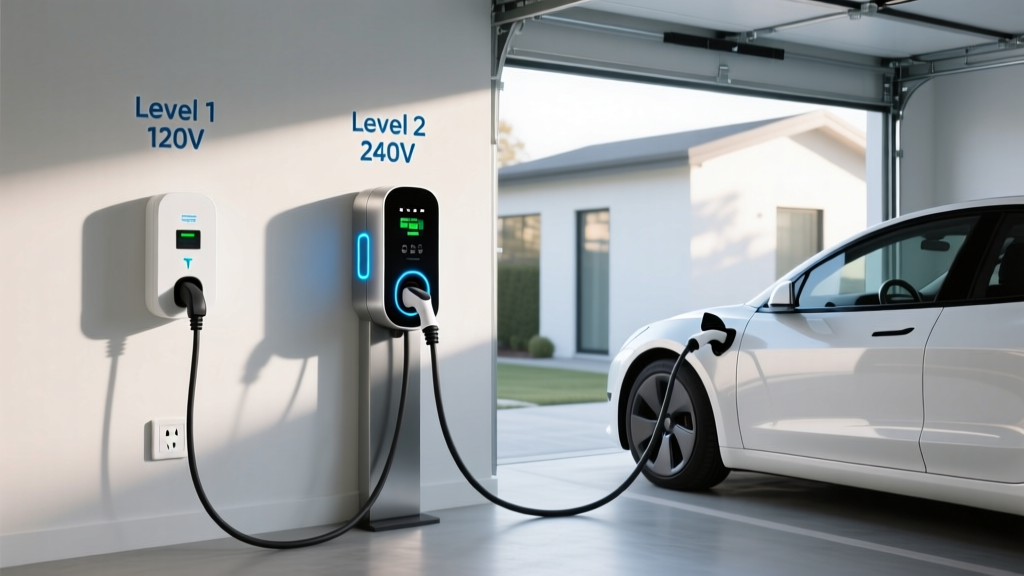
| Level 1 (120V) | 120V AC | 1.2–1.9 kW | 3–5 miles | Overnight top-up, PHEVs, low-mileage drivers |
| Level 2 (240V) | 240V AC | 3.3–19.2 kW | 12–75 miles | Primary home charging, workplace, public AC |
| DC Fast Charging | 200–900V DC | 50–350+ kW | 150–1,200+ miles (equivalent rate) | Road trips, rapid top-ups, commercial fleets |
Charger Level 1: The Reality Check
A Level 1 charger draws 12 amps continuously from a standard NEMA 5-15 household outlet, delivering roughly 1.4 kW. On a dedicated 20-amp circuit with a 16-amp draw, you can reach about 1.9 kW. For a vehicle averaging 3.5 miles per kWh — typical for a midsize crossover like the Hyundai Ioniq 5 or Tesla Model Y — that translates to roughly 4–5 miles of range per hour of charging.
Over a 12-hour overnight session, a charger Level 1 adds approximately 48–60 miles of range. If your daily commute is 30–40 miles round-trip, Level 1 is genuinely sufficient. For plug-in hybrids with smaller batteries (12–18 kWh usable), Level 1 can fully replenish overnight in 8–12 hours, which is why most PHEVs ship with only a Level 1 cord.
Level 2: The Home Standard
Level 2 operates on 240 volts — the same circuit your electric dryer uses — and spans a wide power range. A 32-amp station delivers 7.7 kW and adds roughly 27 miles of range per hour, while a 48-amp unit pushes 11.5 kW for about 40 miles per hour. The upper limit is 80 amps (19.2 kW) on a hardwired circuit, which some EVs like the Ford F-150 Lightning Extended Range can accept onboard.
For battery-electric vehicles with 75–100 kWh packs, Level 2 is the practical home standard. A full overnight charge from 10% to 100% on a 48-amp, 11.5 kW station takes 7–9 hours for most EVs.
DC Fast Charging: Road-Trip Speeds
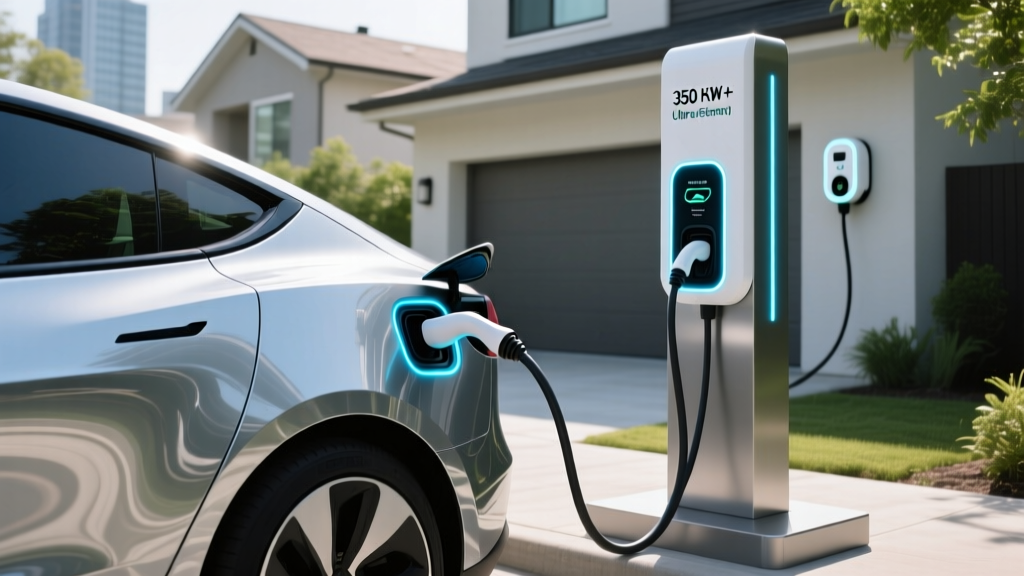
DC fast chargers bypass the vehicle's onboard charger and feed direct current straight into the battery at 50–350+ kW. A modern EV on a 250 kW charger (like a Tesla V3 Supercharger or Electrify America 350 kW station) can go from 10% to 80% in 18–25 minutes, adding 150–250 miles of range. However, charge speed tapers significantly above 80% State of Charge to protect battery health — the final 20% can take as long as the first 80%.
Home Electrical Requirements: What Your Panel Can Actually Handle
Before buying any Level 2 equipment, you need to understand your home's electrical capacity. Most modern homes have a 200-amp main panel, but older homes (pre-1990s) may have only 100-amp or 150-amp service. A Level 2 charger on a 48-amp circuit draws 40 amps continuously (EVSEs must be derated to 80% of circuit capacity per NEC Article 625), which is a substantial continuous load.
Key Electrical Specs for Level 2 Installation
- Circuit requirement: A 48-amp charger needs a 60-amp dedicated circuit breaker
- Wire gauge: 6 AWG copper for runs up to ~50 feet; 4 AWG for longer runs to minimize voltage drop
- Outlet type: NEMA 14-50 (50-amp receptacle) is the most common plug-in option; hardwired connections allow up to 80 amps
- GFCI protection: The 2020 NEC requires GFCI protection for EV receptacles in garages; many modern EVSEs include built-in GFCI
- Panel headroom: Your panel must have capacity for the additional continuous load — a licensed electrician will perform a load calculation per NEC 220
When a Panel Upgrade Is Necessary
If your home has a 100-amp panel and you're already running central A/C, an electric range, and an electric dryer, adding a 60-amp EV circuit will likely exceed your panel's capacity. A panel upgrade to 200 amps typically costs $1,500–$3,500 depending on your utility's requirements, local labor rates, and whether a new meter base or service drop is needed. This is the single biggest surprise cost in home EV charging — budget for it if your home is older.
Some homeowners opt for a lower-amperage Level 2 charger (16-amp or 24-amp on an existing 20-amp or 30-amp circuit) to avoid a panel upgrade. A 24-amp, 5.8 kW charger still adds about 20 miles of range per hour — enough for most daily needs — and may fit within existing panel capacity.
Home EV Charger Installation Cost: The Full Breakdown
Installation costs vary enormously based on your panel capacity, the distance from your panel to the garage or parking spot, and local permit fees. Here's a realistic range for 2026:
| Component | Simple Install (Panel Nearby, No Upgrade) | Complex Install (Long Run or Panel Upgrade) |
|---|---|---|
| Level 2 EVSE Equipment (32–48A) | $350–$700 | $350–$700 |
| Electrician Labor (2–8 hours) | $300–$800 | $800–$2,500 |
| Electrical Materials (wire, conduit, breaker) | $100–$300 | $300–$800 |
| Permit & Inspection | $50–$200 | $50–$200 |
| Panel Upgrade (if needed) | N/A | $1,500–$3,500 |
| Total Estimated Cost | $800–$2,000 | $3,000–$7,700 |
The federal residential clean energy credit does not cover EV charger equipment for 2026 (the Alternative Fuel Vehicle Refueling Property Credit, §30C, expired for residential installations after 2025 unless extended by Congress). However, many utilities and state programs offer rebates of $250–$1,000 for Level 2 equipment and installation — check with your local utility or the AFDC state incentive database for current programs in your area.
Connector Compatibility: NACS, CCS, and What Your EV Needs
The connector landscape shifted dramatically between 2023 and 2026. Tesla's North American Charging Standard (NACS) has been adopted by Ford, GM, Rivian, Volvo, Hyundai, Kia, BMW, and most major automakers. By the 2026 model year, the majority of new EVs sold in the U.S. ship with a native NACS port. CCS1 remains on some legacy models and most existing non-Tesla public DC fast chargers, while CHAdeMO is effectively discontinued for new vehicles (the Nissan Leaf was its last major holdout).
| Connector | Brands Using It (2026) | Adapter Needed for Level 2 Home Charging? |
|---|---|---|
| NACS (Tesla standard) | Tesla, Ford, GM, Rivian, Hyundai, Kia, Volvo, BMW, Mercedes (2025+), Nissan (2026+ Ariya) | No — most Level 2 EVSEs now ship with NACS connectors |
| CCS1 | VW ID.4 (through 2025), some legacy models still on road | NACS-to-CCS adapter ($100–$200) if using a NACS-terminated EVSE |
| CHAdeMO | Discontinued on new vehicles; legacy Nissan Leaf, Mitsubishi Outlander PHEV | No native adapter available; use CHAdeMO-terminated EVSE |
For Level 1 charging, the connector question is simpler: the J1772 standard (which NACS and CCS1 both incorporate for AC charging) fits virtually every EV sold in North America. The Level 1 cord included with your vehicle will have the correct connector. Tesla includes a NACS-to-J1772 adapter in the glovebox for compatibility with non-Tesla AC chargers.
How Much Does Charging Actually Cost Per Mile?
One of the strongest arguments for home charging — whether Level 1 or Level 2 — is cost. Electricity prices vary by region, but the economics consistently favor home charging over gasoline and even over public DC fast charging.
| Scenario | Rate | Cost Per Mile (at 3.5 mi/kWh) |
|---|---|---|
| Home Level 1 or 2 (national avg. residential, off-peak) | $0.12–$0.16/kWh | $0.034–$0.046 |
| Home Level 2 (California, off-peak TOU rate) | $0.13–$0.20/kWh | $0.037–$0.057 |
| Public Level 2 (ChargePoint, EVgo) | $0.25–$0.49/kWh | $0.071–$0.140 |
| DC Fast Charging (Electrify America, Tesla Supercharger) | $0.35–$0.55/kWh | $0.100–$0.157 |
| Gasoline vehicle (30 MPG, $3.40/gal) | $3.40/gallon | $0.113 |
At home rates, an EV costs roughly 3.5 to 4.6 cents per mile to fuel — about one-third the cost of a 30-MPG gasoline car. Even at public DC fast-charging rates, an EV is often cheaper per mile than gasoline. But the savings depend on charging at home. If you rely exclusively on public DC fast chargers, your per-mile cost approaches or exceeds that of gasoline.
This is where a charger Level 1 has a hidden advantage: it requires zero installation cost. If your daily driving is under 40 miles, the Level 1 cord that came with your EV plugged into a standard outlet delivers the cheapest possible fueling — no electrician, no permit, no equipment purchase.
Equipment Recommendations: Top Level 1 and Level 2 Chargers for 2026
Best Level 1 Chargers (120V)
Most EVs include a Level 1 cord, but aftermarket options offer longer cables, better durability, and adjustable amperage:
- Lectron V-BOX Level 1 (16A, 1.9 kW): 25-foot cable, J1772/NACS connector, adjustable 8–16A, ~$150. Good for maximizing Level 1 speed on a 20-amp circuit.
- Emporia Level 1/2 Combo (12A Level 1, 1.4 kW): Swappable plugs for 120V and 240V, 24-foot cable, smart scheduling via app, ~$250. Versatile if you might upgrade to Level 2 later.
Best Level 2 Chargers (240V) for Home
- ChargePoint Home Flex (up to 50A, 12 kW): NACS connector standard, 23-foot cable, Wi-Fi scheduling, works with Alexa/Google, NEMA 14-50 plug or hardwired, ~$550. A reliable all-rounder.
- Wall Connector Gen 4 (48A, 11.5 kW): Tesla NACS native, 24-foot cable, Wi-Fi, load sharing for multi-charger setups, hardwired only, ~$475. Best for Tesla and NACS-equipped EVs.
- Emporia Vue EV Charger (48A, 11.5 kW): Integrated energy monitoring pairs with Emporia Vue panel monitor, NEMA 14-50 or hardwired, 24-foot cable, ~$400. Best value with smart energy tracking.
- Grizzl-E Smart (40A, 9.6 kW): Built in Canada, NEMA 14-50 plug, -40°F rated, aluminum case, 24-foot cable, OCPP-compatible, ~$450. Best for extreme cold climates and outdoor installs.
Safety, Permits, and Code Considerations You Cannot Skip
EV charging is a high-draw, continuous electrical load — the National Electrical Code (NEC) treats it differently from plugging in a lamp. Here's what matters:
- Dedicated circuit: Your Level 2 charger must be on its own dedicated breaker. Sharing a circuit with other appliances risks tripping and fire hazard.
- Continuous load derating: NEC Article 625 requires EVSEs to draw no more than 80% of the circuit's rated capacity. A 50-amp circuit supports a 40-amp continuous charger; a 60-amp circuit supports 48 amps.
- GFCI protection: Required for receptacle-based EVSEs in garages (NEC 2020+). Hardwired installations may not require an external GFCI breaker if the EVSE has integrated ground-fault protection — most modern units do.
- Outdoor rating: If your charger is installed outside (carport, driveway), the EVSE must carry a NEMA 4 or IP65 weather rating. All units recommended above meet this standard.
- Permit and inspection: Most jurisdictions require an electrical permit for a new 240V circuit. The permit fee is typically $50–$200, and an inspector will verify wire gauge, breaker sizing, grounding, and GFCI compliance. Skipping the permit risks insurance claim denial if an electrical fire occurs.
Frequently Asked Questions
How much does it cost to install a home EV charger?
A simple Level 2 installation with an existing 200-amp panel and short wire run costs $800–$2,000 including equipment, electrician labor, materials, and permit. If your panel needs upgrading to 200 amps or the wire run exceeds 50 feet, expect $3,000–$7,700. Level 1 requires no installation — just plug into a standard 120V outlet.
How fast will each charging level add range?
Level 1 (1.4 kW) adds roughly 4–5 miles per hour. Level 2 at 48 amps (11.5 kW) adds about 40 miles per hour. DC fast charging at 250 kW can add 150–250 miles in 18–25 minutes, though the charge rate tapers above 80% State of Charge.
Which connector or charger is compatible with my EV?
For 2026 models, most new EVs use the NACS connector. VW ID.4 models through 2025 and some other legacy vehicles use CCS1. Level 1 cords included with your vehicle will have the correct connector. For Level 2 home chargers, purchase a unit with the connector matching your vehicle's port, or use an adapter.
How much does charging cost per mile vs. gas?
Home charging at average residential rates ($0.12–$0.16/kWh) costs roughly 3.5–4.6 cents per mile for an efficient EV. A 30-MPG gasoline car at $3.40/gallon costs about 11.3 cents per mile. Home charging is approximately one-third the fuel cost of gasoline.
What electrical upgrades might I need?
If your home has a 100-amp or 150-amp service panel with limited open breaker slots, you may need a panel upgrade to 200 amps ($1,500–$3,500). If your panel has capacity but no open slots, a tandem breaker or sub-panel may suffice ($200–$600). A licensed electrician's load calculation per NEC 220 will determine your exact needs. Some homeowners avoid upgrades entirely by choosing a lower-amperage charger (16A or 24A) that fits within existing panel headroom.
Is a charger Level 1 really enough for daily driving?
Yes — if your daily driving is under 40–50 miles and you can charge for 10–12 hours overnight. A Level 1 charger adds 40–60 miles overnight, which covers the average American commute. For PHEVs with smaller batteries, Level 1 is the intended home charging method. For BEV owners who regularly drive 60+ miles per day, take frequent road trips, or need quick turnaround between drives, Level 2 is a necessary upgrade.