Leasing vs. Buying a Home EV Charger: The Real Numbers
If you've just ordered an EV or plug-in hybrid, you're likely staring at a wall outlet wondering how to make home charging work. The good news: Level 2 home charging is the backbone of practical EV ownership, refilling your battery overnight at a fraction of public-charging costs. The question is whether to purchase a charger outright or enter a charger lease arrangement through your utility, automaker, or a third-party provider.
A charger lease typically bundles the hardware, installation, and sometimes maintenance into a monthly fee — often $15–$40/month depending on the program. Buying outright means $500–$800 for a quality Level 2 unit plus $600–$2,500+ for professional installation, depending on your electrical panel. Over a 5-year ownership cycle, the math isn't always obvious. Let's break it down with hard numbers.
Charging Levels Explained: Speeds That Actually Matter
Every EV owner deals with three charging tiers. Here's what each delivers in practical terms:
| Level | Voltage | Max Power (kW) | Miles of Range Added per Hour | Best Use Case |
|---|---|---|---|---|
| Level 1 | 120V AC | 1.4–1.9 kW | 3–5 miles/hr | Overnight top-ups for PHEVs or low-mileage drivers |
| Level 2 (Home) | 240V AC | 7.2–19.2 kW | 20–65 miles/hr | Daily home charging — the EV ownership sweet spot |
| DC Fast Charge | 400–800V DC | 50–350 kW | 150–1,000+ miles/hr | Road trips and quick top-ups on public networks |
Real-world charging time examples (10–80% SoC):
- Tesla Model Y (75 kWh battery, NACS): ~9.5 hours on a 7.2 kW Level 2 charger; ~6 hours on 11.5 kW; ~20 minutes on a 250 kW DC fast charger (with preconditioning)
- Hyundai Ioniq 5 (77.4 kWh, NACS/CCS): ~10 hours on 7.2 kW; ~6.5 hours on 11.5 kW; ~18 minutes on a 350 kW charger (800V architecture enables faster DC curves)
- Ford F-150 Lightning (131 kWh extended range): ~17 hours on 7.2 kW; ~10.5 hours on 11.5 kW; ~40 minutes on 150 kW DC fast charging
Note that DC fast charging follows a charge curve — peak kW rates apply only between roughly 10–50% SoC. Above 80%, charging slows dramatically to protect battery health. That's why manufacturers quote 10–80% times rather than 0–100%.
How Much Does It Cost to Install a Home EV Charger?
Installation cost is where most EV buyers get blindsided. The total depends on your home's electrical panel capacity, the distance from panel to charger location, and local permit fees. Here's a realistic 2026 breakdown:
| Cost Component | Simple Install (Panel Nearby) | Complex Install (Panel Far / Upgrade Needed) |
|---|---|---|
| Level 2 Charger Hardware | $500–$800 | $500–$800 |
| Electrician Labor (licensed) | $400–$800 | $1,200–$3,000 |
| Electrical Permit | $50–$200 | $100–$300 |
| Panel Upgrade (100A → 200A) | $0 (not needed) | $1,500–$4,000 |
| Conduit / Wiring (long runs) | $100–$300 | $500–$2,000 |
| Total Estimated Cost | $1,050–$2,100 | $3,800–$10,100 |
The panel upgrade gotcha: Most modern homes have 200-amp service panels, which can support a 40A–48A dedicated EV circuit without issue. But older homes (pre-1990s) often have 100-amp panels already near capacity. Adding a 40A continuous load (which the National Electrical Code requires sizing at 50A breaker capacity) may push you over the limit. A licensed electrician will perform a load calculation before recommending an upgrade.
This is where a charger lease program can help: some utility companies (like PG&E, ConEdison, and Xcel Energy) offer bundled lease packages that include the charger, installation, and panel assessment for a flat monthly fee — effectively spreading a $5,000+ install cost over several years.
Charger Lease vs. Purchase: A 5-Year Cost Comparison
Let's model two scenarios for a typical EV owner installing a 48A (11.5 kW) Level 2 charger on a 240V/50A circuit:
Option A: Buy Outright
- Hardware (e.g., ChargePoint Home Flex): $699
- Installation (moderate complexity): $1,500
- Permit: $150
- Upfront total: ~$2,349
- Ongoing cost: $0/month (just electricity)
- 5-year total: ~$2,349
- You own the equipment; portable if you move
Option B: Charger Lease (Utility Program)
- Upfront cost: $0–$250 enrollment fee
- Monthly lease fee: $25–$40/month
- Installation included in most programs
- 5-year total: $1,500–$2,650
- Maintenance/replacement included
- Equipment stays with the house if you move (lease may transfer or terminate)
Verdict: If your install is straightforward (panel nearby, no upgrade needed), buying outright is cheaper over 5 years. If you need a panel upgrade or long conduit run, a lease program that bundles installation can actually save money — and eliminates hardware failure risk. Always check whether your lease includes a smart charger with Wi-Fi and scheduling features; some utility leases provide basic non-smart units.
Which Connector and Charger Is Compatible With My EV?
The connector landscape shifted dramatically in 2024–2025 when nearly every major automaker adopted the North American Charging Standard (NACS), originally developed by Tesla. Here's where things stand in 2026:
| Connector | Brands Using It (2026 Models) | Adapter Needed? |
|---|---|---|
| NACS (Tesla) | Tesla, Ford, GM, Rivian, Hyundai/Kia (2025+), Volvo/Polestar, BMW, Mercedes-Benz, Honda, Nissan (2026+) | CCS-to-NACS adapters available (~$200–$250) for older CCS vehicles at Superchargers |
| CCS1 | Legacy models (pre-2025 VW ID.4, older BMW i4, Stellantis EVs); being phased out | NACS-to-CCS adapter needed for Supercharger access |
| CHAdeMO | Nissan Leaf (discontinued after 2025); Mitsubishi Outlander PHEV | Limited public infrastructure; no practical adapter to NACS |
For home Level 2 charging, all connectors use the same J1772 protocol underneath. NACS home chargers deliver Level 2 AC power just like CCS-compatible units — the physical plug shape differs, but the charging protocol is identical. Most Level 2 chargers sold in 2026 ship with a NACS connector or include a J1772-to-NACS adapter in the box.
If you drive a vehicle with a CCS port, buy a charger with a J1772 connector (the long-standing Level 2 standard) or a NACS connector with an adapter. If you drive a Tesla or any 2025+ NACS-equipped vehicle, buy a NACS-terminated charger for the cleanest setup.
How Much Does Charging Cost Per Mile vs. Gas?
Electricity pricing varies enormously by region and time of day. Here are representative 2026 scenarios for a mid-size EV averaging 3.0 miles/kWh (roughly 112 MPGe, similar to a Tesla Model Y or Hyundai Ioniq 5):
| Charging Scenario | $/kWh | Cost per Mile | Equivalent Gas Price (at 28 MPG) |
|---|---|---|---|
| Home off-peak (utility TOU rate) | $0.08–$0.12 | $0.03–$0.04 | $0.84–$1.12/gal |
| Home standard rate (no TOU) | $0.14–$0.20 | $0.05–$0.07 | $1.40–$1.87/gal |
| Public Level 2 (ChargePoint, EVgo L2) | $0.25–$0.40 | $0.08–$0.13 | $2.24–$3.64/gal |
| DC Fast Charge (Electrify America, Tesla Supercharger) | $0.35–$0.55 | $0.12–$0.18 | $3.36–$5.04/gal |
For context, the US average regular gasoline price in early 2026 hovers around $3.30/gallon (source: EIA). A comparable 28 MPG gas car costs about $0.12/mile to fuel.
The takeaway: Home charging on an off-peak rate is 3–4x cheaper per mile than gasoline. Even public DC fast charging is roughly cost-competitive with gas. The savings compound: driving 12,000 miles/year at home off-peak rates costs roughly $360–$480 in electricity vs. $1,415 in gas for a 28 MPG vehicle. That's $900–$1,050 in annual fuel savings.
Equipment Recommendations: Top Level 2 Chargers for 2026
These are proven, widely available Level 2 units that represent strong value across different use cases. All are hardwired or NEMA 14-50 plug-in compatible and carry UL or ETL safety certification.
ChargePoint Home Flex (NACS or J1772)
- Power output: Up to 11.5 kW (48A) on a 60A circuit; adjustable down to 16A
- Cable length: 23 feet
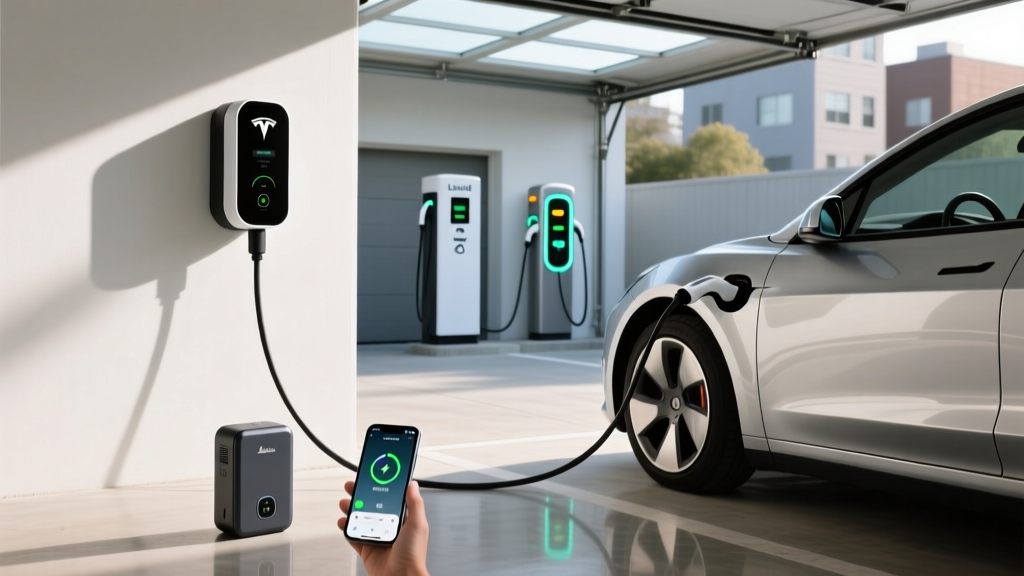
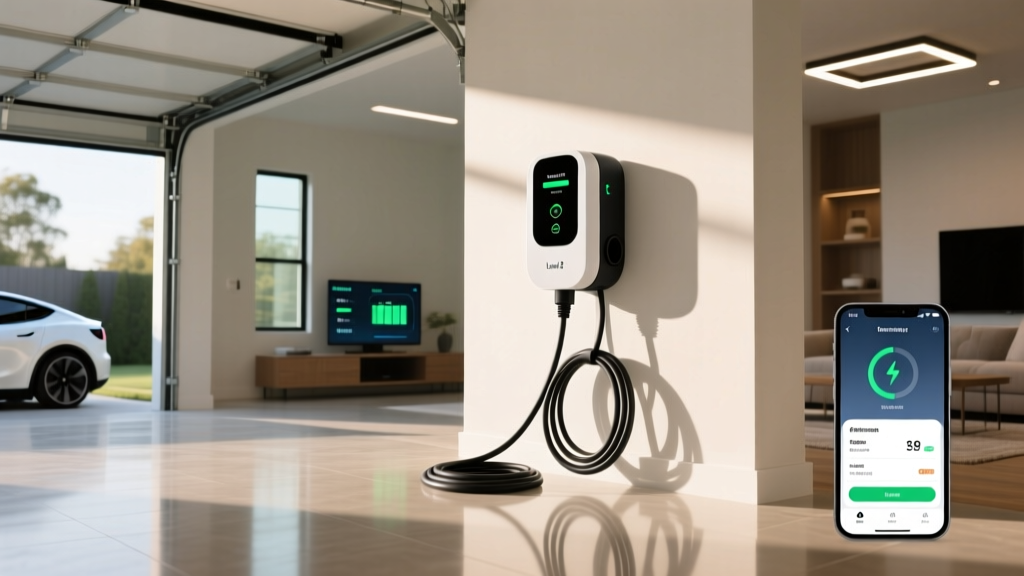
- Smart features: Wi-Fi, app scheduling, Alexa integration, energy tracking
- Connector: NACS or J1772 (select at purchase)
- Price: ~$699
- Best for: Most EV owners wanting a reliable smart charger with flexible amperage
Tesla Wall Connector (Gen 3)
- Power output: Up to 11.5 kW (48A) on a 60A circuit
- Cable length: 24 feet
- Smart features: Wi-Fi, over-the-air updates, power sharing between two units, load management
- Connector: NACS native
- Price: ~$450
- Best for: Tesla owners and NACS-equipped EVs seeking the lowest-cost premium unit
Emporia Level 2 EV Charger
- Power output: Up to 11.5 kW (48A) on 60A circuit; configurable
- Cable length: 24 feet
- Smart features: Wi-Fi, solar integration, real-time energy monitoring via Emporia app
- Connector: J1772 (NACS adapter available)
- Price: ~$399
- Best for: Budget-conscious buyers or homes with solar panels wanting energy tracking
Grizzl-E Smart (United Chargers)
- Power output: Up to 10 kW (40A) on a 50A circuit
- Cable length: 24 feet
- Smart features: Wi-Fi, OCPP compatibility, adjustable amperage
- Connector: J1772 or NACS
- Price: ~$499
- Best for: Cold-climate owners (rated to -40°F) and outdoor installs
Electrical Upgrades, Safety, and Code Considerations
Before any installation, understand the electrical and safety requirements that apply to residential EV charging:
Dedicated Circuit Requirement
NEC Article 625 requires EV chargers to be on a dedicated circuit — meaning no other outlets or appliances share that breaker. A 48A charger needs a 60A breaker (NEC requires the breaker to be rated at 125% of continuous load). A 32A charger needs a 40A breaker. Never plug an EV charger into a shared circuit or use extension cords.
GFCI Protection
The 2023 NEC update expanded GFCI (Ground Fault Circuit Interrupter) requirements for outdoor receptacles. If your charger plugs into a NEMA 14-50 outlet (rather than being hardwired), the outlet must have GFCI protection. Hardwired installations may have different GFCI requirements depending on local code — your electrician will determine this. Note: many quality EV chargers have built-in ground fault detection, which can make a hardwired install simpler and more reliable.
Outdoor Rating and Enclosures
If your charger mounts outdoors (garage-free homes, carports, driveways), ensure the unit carries a NEMA 4 or NEMA 4X weather-resistance rating. All the chargers recommended above meet this standard. Outdoor installations also require weatherproof conduit connections and, in some jurisdictions, a protective bollard if the unit faces driveway traffic.
Panel Load Calculation
A licensed electrician will perform a NEC Article 220 load calculation to determine whether your existing panel can handle the EV circuit. If your panel is already near capacity (common with electric ranges, dryers, and HVAC on a 100A service), you may need:
- A panel upgrade from 100A to 200A ($1,500–$4,000)
- A smart load management device (e.g., Emporia Smart Panel, Span Drive) that dynamically reduces charger amperage when other appliances draw heavy current — this can avoid a panel upgrade entirely ($300–$800 for the device)
- A secondary sub-panel dedicated to the EV circuit ($500–$1,500)
Smart load management is an increasingly popular middle ground. Devices like the Emporia Smart Panel or the Span Drive integration monitor your home's total draw in real time and throttle the charger if needed — ensuring you never trip the main breaker while avoiding the cost of a full panel upgrade.
Frequently Asked Questions
How much does it cost to install a home EV charger?
A straightforward Level 2 installation (panel nearby, no upgrade needed) typically runs $1,050–$2,100 total including hardware, electrician labor, and permits. Complex installs requiring a panel upgrade, long conduit runs, or trenching can reach $3,800–$10,100. A charger lease through your utility may bundle these costs into a $25–$40/month fee with little or no upfront expense.
How fast will each charging level add range?
Level 1 (120V) adds roughly 3–5 miles of range per hour — fine for PHEVs with small batteries but impractical for full EVs. Level 2 (240V) at 48A/11.5 kW adds 30–45 miles per hour for most EVs, enough to refill a 75 kWh battery overnight. DC fast charging at 150–350 kW can add 150–400+ miles in 20–30 minutes, depending on the vehicle's charge curve and battery preconditioning.
Which connector/charger is compatible with my EV?
For 2026 models, most new EVs use the NACS connector (Tesla, Ford, GM, Hyundai/Kia, Rivian, BMW, and more). Older models may still have CCS1. For home Level 2 charging, both connector types use the same AC charging protocol — just ensure your charger's physical plug matches your car's port. CHAdeMO is essentially discontinued for new vehicles. Check your owner's manual or the EPA's fueleconomy.gov database for your specific model's connector type.
How much does charging cost per mile vs. gas?
Home charging on off-peak electricity ($0.08–$0.12/kWh) costs $0.03–$0.04 per mile for an average EV — roughly equivalent to $0.84–$1.12/gallon gasoline. Standard home rates ($0.14–$0.20/kWh) bring the cost to $0.05–$0.07/mile. Public DC fast charging ($0.35–$0.55/kWh) costs $0.12–$0.18/mile, comparable to gas at $3.36–$5.04/gallon. Home charging delivers the biggest savings.
What electrical upgrades might I need?
The most common upgrade is a panel capacity increase from 100A to 200A service ($1,500–$4,000) if your existing panel can't handle the additional 40A–50A dedicated circuit. Alternatives include smart load management devices ($300–$800) that throttle charger power during peak household demand, or installing a sub-panel closer to the charger location. A licensed electrician's load calculation is the definitive answer — get this assessment before purchasing hardware.
Is a charger lease worth it?
A charger lease makes sense if: (1) your installation is complex and expensive, and the lease program bundles install costs; (2) you want maintenance and hardware replacement coverage; (3) you prefer predictable monthly costs over a large upfront payment. It's less ideal if your install is simple (buy outright and save over 5 years) or if the lease provides a non-smart charger without scheduling features. Always compare the lease's total 5-year cost against a purchase-plus-install quote from a local electrician.
Can I use the federal tax credit for a home charger?
The §30D federal tax credit applies to the vehicle, not the charger. However, the Alternative Fuel Vehicle Refueling Property Credit (IRC §30C) covers up to 30% of home charger hardware and installation costs, capped at $1,000, for equipment placed in service through 2032. Eligibility depends on census tract requirements (must be in a qualifying low-income or non-urban area). Consult IRS guidance on §30C or a tax professional for your specific situation.