What "Charger Fuel Economy" Actually Means for EV Owners
When you switch from gas to electric, your fuel station becomes your charger — and your fuel economy is no longer measured in miles per gallon but in kWh per 100 miles and cost per mile. The term "charger fuel economy" captures a practical question every EV buyer asks: how much will I actually spend to drive, and how does the charging method change that number?
The answer depends on three variables: your vehicle's efficiency (measured in kWh/100mi or MPGe), the price you pay per kWh (which varies wildly between home and public charging), and the charging level you use. A Tesla Model Y charging at home on off-peak electricity might cost 4 cents per mile, while that same vehicle at a DC fast charger could cost 16 cents per mile — rivaling a 30 MPG gas car. Understanding these numbers before you buy is essential.
This guide breaks down every layer: charging speeds, real cost-per-mile math across scenarios, home installation expenses (including the panel upgrade that catches many older-home owners off guard), connector compatibility, and specific equipment recommendations for 2026.
Charging Levels Explained: Speed, Power, and Range Added
Before calculating costs, you need to understand what each charging level delivers. Power is measured in kW (kilowatts) — the rate of energy flow — while your battery stores energy in kWh (kilowatt-hours). Think of kW as the width of the pipe and kWh as the size of the tank. Never confuse the two.
| Level | Voltage | Power (kW) | Miles of Range/Hour | Typical Use |
|---|---|---|---|---|
| Level 1 | 120V AC | 1.0–1.4 kW | 3–5 mi/hr | Overnight top-up, PHEVs, emergencies |
| Level 2 | 240V AC | 7.2–19.2 kW | 22–65 mi/hr | Daily home/work charging |
| DC Fast Charging | 400–800V DC | 50–350 kW | 150–1,200+ mi/hr | Road trips, rapid top-ups |
For context, a typical 75 kWh battery (like a Ford Mustang Mach-E Extended Range) charging on a 48-amp Level 2 circuit at 11.5 kW will go from 10% to 80% in roughly 4.5 hours. That same 10–80% fill on a 150 kW DC fast charger takes about 28–35 minutes, though sustained speeds taper significantly above 80% state of charge (SoC) due to the battery's charge curve — a physics limitation, not a charger defect.
Real-world charging time for common 2026 battery sizes on DC fast charging:
- 60 kWh battery (Hyundai Kona Electric): 10–80% in ~22 min at 100 kW peak (peak rate not sustained)
- 82 kWh battery (Tesla Model 3 Long Range): 10–80% in ~25 min at 250 kW peak on V3 Supercharger
- 100 kWh battery (Ford F-150 Lightning Extended Range): 10–80% in ~35 min at 150 kW sustained average
Charger Fuel Economy: Cost Per Mile vs. Gas
This is where the rubber meets the road. Your charger fuel economy depends on what you pay per kWh and how efficiently your EV converts that energy into miles. The EPA's fueleconomy.gov publishes kWh/100mi ratings for every EV sold in the US — the electric equivalent of MPG.
| Scenario | $/kWh | EV Efficiency | Cost/Mile | Gas Equivalent (30 MPG, $3.40/gal) |
|---|---|---|---|---|
| Home Level 2 (off-peak TOU rate) | $0.09 | 28 kWh/100mi | $0.025 | $0.113 |
| Home Level 2 (standard rate) | $0.16 | 28 kWh/100mi | $0.045 | $0.113 |
| Public Level 2 (ChargePoint, EVgo) | $0.28 | 28 kWh/100mi | $0.078 | $0.113 |
| DC Fast (Electrify America, Tesla) | $0.48 | 28 kWh/100mi | $0.134 | $0.113 |
| DC Fast (peak pricing, some networks) | $0.64 | 28 kWh/100mi | $0.179 | $0.113 |
The takeaway is stark: home charging on an off-peak rate is the cheapest way to drive any vehicle on the road, at roughly 2.5 cents per mile. But relying exclusively on DC fast charging can actually cost more than a fuel-efficient gas car. This is why home charger installation isn't a luxury — it's the economic foundation of EV ownership.
Efficiency matters, too. A Lucid Air Grand Touring achieves roughly 24 kWh/100mi (the most efficient large luxury sedan available), while a GMC Hummer EV 3X pushes 47 kWh/100mi. At the same electricity rate, the Hummer costs nearly twice as much per mile to drive. Check fueleconomy.gov's EV listings for your specific model's rating.
Home Charger Installation: Costs, Electrical Requirements, and Panel Upgrades
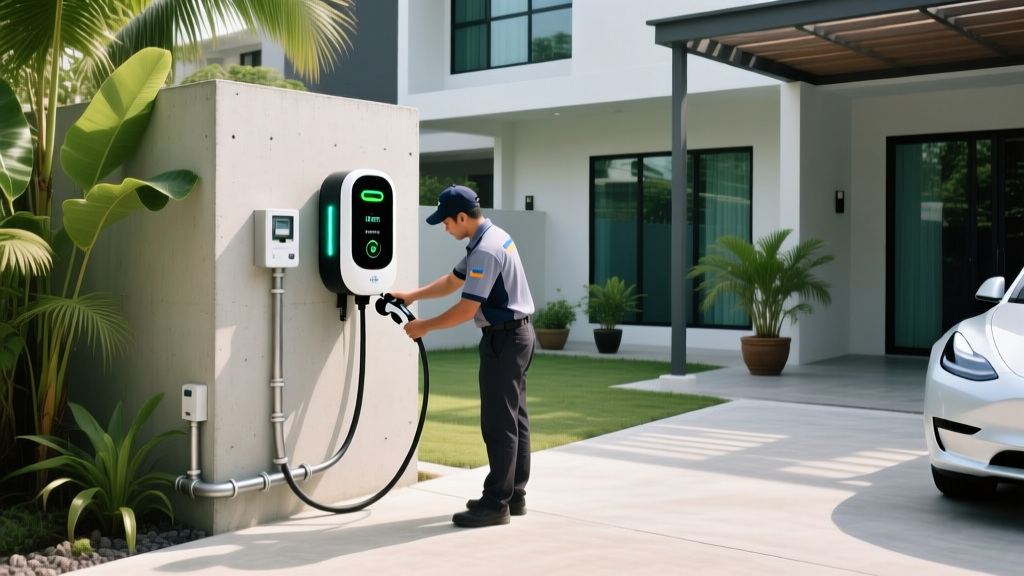
Installing a Level 2 home charger is the single highest-impact decision for your charger fuel economy. Here's what it actually involves and costs in 2026.
Electrical Requirements
A standard Level 2 home charger requires a 240V dedicated circuit, typically 40 to 60 amps. The most common setup is a NEMA 14-50 outlet (the same as an electric range) on a 50-amp breaker, which delivers up to 40 amps continuous (80% rule per NEC) — approximately 9.6 kW. For faster charging, a hardwired 60-amp circuit delivers 48 amps continuous, or 11.5 kW. Some homes with 200-amp panels can support an 80-amp circuit for 19.2 kW charging, but this is uncommon and requires thicker-gauge wiring.
Panel Upgrade: The Hidden Cost
Homes built before 2000 often have 100-amp or 150-amp electrical panels. Adding a 50-amp EV circuit to a panel already near capacity can require a panel upgrade to 200 amps — or, increasingly, a smart panel device like the SPAN smart panel or a load-management relay that throttles charger amperage when other large loads (dryer, HVAC) are running. Panel upgrades are the single largest variable in installation cost.
| Component | Simple Install (panel has capacity, short run) | Complex Install (long wire run, sub-panel) | Panel Upgrade Required |
|---|---|---|---|
| Level 2 charger unit | $400–$750 | $400–$750 | $400–$750 |
| Electrician labor + materials | $500–$1,200 | $1,500–$3,000 | $800–$1,500 |
| Permit & inspection | $50–$200 | $100–$300 | $150–$350 |
| Panel upgrade (if needed) | — | — | $2,000–$4,500 |
| Total | $950–$2,150 | $2,000–$4,050 | $3,350–$7,100 |
A few notes: the federal Alternative Fuel Vehicle Refueling Property Credit (IRS Form 8911) offers up to $1,000 (30% of equipment and installation costs) for home charger installs placed in service in 2026, subject to census-tract eligibility. Always confirm with a tax professional. Additionally, many utilities offer rebates of $250–$500 for Level 2 charger installations — check your local provider.
Connector Compatibility: NACS, CCS1, CHAdeMO, and Adapters
The connector landscape in 2026 has consolidated significantly around NACS (the North American Charging Standard, originally Tesla's proprietary connector). Here's where each brand stands:
| Connector | Brands Using It (Native) | Adapter Needed For |
|---|---|---|
| NACS (J3400) | Tesla (all), Ford, GM, Rivian, Volvo, Polestar, Hyundai/Kia (2025+), Nissan (2026+) | Older CCS public stations (adapter included with many vehicles) |
| CCS1 | Legacy VW ID.4 (pre-2026), BMW iX (some trims), Stellantis models | NACS Supercharger access via CCS-to-NACS adapter (~$200–$250) |
| CHAdeMO | Nissan Leaf (discontinued 2025 — used market only) | Limited network; no viable adapter to NACS |
For home charging, all Level 2 chargers use a J1772 connector for non-Tesla vehicles. Tesla vehicles use NACS. If you own a Tesla and buy a third-party Level 2 charger, you'll need a J1772-to-NACS adapter (included with most new Teslas, or ~$100 aftermarket). Conversely, most new non-Tesla NACS-equipped vehicles accept J1772 via an included adapter.
Practical advice: When buying a home charger in 2026, choose one with a NACS connector if your current or next EV uses it natively. The industry has standardized on NACS, and J1772-only chargers will have declining compatibility. Universal chargers with interchangeable connectors are emerging but remain rare.
Top Home EV Chargers for 2026: Equipment Picks
These are proven, code-compliant Level 2 chargers we recommend based on power output, reliability, smart features, and value. All are UL-listed (or equivalent) — never install a non-certified charger, as it may void your home insurance and violate NEC code.
Tesla Wall Connector (Gen 4)
- Power: Up to 11.5 kW (48A) on 60A circuit; 9.6 kW (40A) on 50A circuit
- Connector: NACS native; J1772 adapter included
- Cable length: 24 ft
- Smart features: Wi-Fi, OTA updates, load sharing (pair up to 6 units on one circuit), integrated cable management
- Price: ~$475
- Best for: Tesla owners, or any NACS-equipped vehicle. Best value-to-performance ratio.
ChargePoint Home Flex (2nd Gen)
- Power: Up to 12 kW (50A) on hardwired 60A circuit; adjustable 16–50A via DIP switch
- Connector: J1772 (NACS adapter available separately)
- Cable length: 23 ft
- Smart features: Wi-Fi, ChargePoint app with scheduling, Alexa integration, energy tracking, flexible amperage for older panels
- Price: ~$699
- Best for: Homes with limited panel capacity (dial down to 32A/7.7kW without rewiring). J1772 vehicles.
Emporia Vue Level 2 EV Charger
- Power: Up to 11.5 kW (48A) hardwired; 9.6 kW (40A) with NEMA 14-50 plug
- Connector: J1772 (NACS version available)
- Cable length: 24 ft
- Smart features: Integrates with Emporia Vue whole-home energy monitor, solar-aware scheduling, TOU rate optimization, load management
- Price: ~$399 (plug-in) / ~$449 (hardwired)
- Best for: Solar-panel owners and budget-conscious buyers who want smart scheduling at the lowest price.
Grizzl-E Smart (United Chargers)
- Power: Up to 10 kW (40A) on 50A circuit
- Connector: J1772 or NACS (select at purchase)
- Cable length: 24 ft
- Smart features: OCPP-compatible, works with multiple utility demand-response programs, adjustable amperage
- Price: ~$549
- Best for: Canadian and cold-climate owners (rated to -40°F), utility program participants. Extremely durable build.
Safety, Code, and Installation Best Practices
EV chargers draw sustained high current for hours — more like an electric furnace than a typical appliance. Cutting corners on installation creates fire risk and insurance liability. Here are the non-negotiables:
- Dedicated circuit: Your Level 2 charger must have its own dedicated breaker — never share a circuit with other large loads. NEC Article 625 governs EV charging installations.
- GFCI protection: The 2023 NEC (adopted by most jurisdictions by 2026) requires GFCI protection for all outdoor receptacles used for EV charging. Hardwired installations may have different requirements depending on local amendments — your electrician will know.
- Outdoor rating: If your charger is installed outdoors or in an unconditioned garage, it must carry a NEMA 4 (weatherproof) rating. All chargers listed above meet this standard.
- Wire gauge: A 50-amp circuit requires minimum 6 AWG copper wire; a 60-amp circuit requires 4 AWG. Longer wire runs (over 50 ft) may need thicker gauge to prevent voltage drop. Your electrician will calculate this.
- Permit and inspection: Most jurisdictions require an electrical permit and final inspection for EV charger installations. Skipping this can void homeowner's insurance coverage for electrical fires. Budget $50–$350 depending on locality.
- Load management: If your panel is near capacity, consider a load-management device (like the Emporia Smart Load Center or Tesla Wall Connector's built-in load sharing) rather than an expensive panel upgrade. These devices dynamically reduce charger amperage when other circuits are active.
Frequently Asked Questions
How much does it cost to install a home EV charger?
A straightforward Level 2 installation on an existing 200-amp panel with a short wire run typically costs $950–$2,150 all-in (charger, electrician, permit). If your panel needs upgrading from 100A or 150A to 200A, total costs can reach $3,350–$7,100. The federal Alternative Fuel Vehicle Refueling Property Credit can offset up to $1,000 of this cost, and many utilities offer additional rebates.
How fast will each charging level add range?
Level 1 (120V) adds 3–5 miles of range per hour — adequate only for plug-in hybrids with small batteries or overnight top-ups. Level 2 (240V, 48A) adds 30–40 miles per hour, fully replenishing most EVs overnight. DC fast charging at 150+ kW can add 150–250 miles in 20–30 minutes, though charging speed tapers significantly above 80% SoC to protect battery health.
Which connector and charger is compatible with my EV?
In 2026, most new EVs sold in the US use the NACS connector natively (Tesla, Ford, GM, Rivian, Hyundai, Kia, Volvo). Legacy CCS1 vehicles (older VW ID.4, some BMWs) can use CCS-to-NACS adapters for Supercharger access. CHAdeMO is effectively discontinued. For home Level 2 charging, verify whether your vehicle's inlet is NACS or J1772 and buy a matching charger or use the included adapter.
How much does charging cost per mile compared to gas?
At home on off-peak electricity ($0.09/kWh), an average-efficiency EV (28 kWh/100mi) costs about 2.5 cents per mile — roughly one-quarter the cost of a 30 MPG gas car at $3.40/gallon. At public DC fast chargers ($0.48–$0.64/kWh), the cost rises to 13–18 cents per mile, which can exceed gas costs. Home charging is where the economic advantage of EVs is won.
What electrical upgrades might I need for a home charger?
The most common upgrade is moving from a 100-amp or 150-amp service panel to a 200-amp panel ($2,000–$4,500). Older homes may also need service-line upgrades from the utility. Alternatives to a full panel upgrade include smart load-management devices that dynamically share capacity between the charger and other circuits, or simply installing a lower-amperage charger (e.g., 32A instead of 48A) that fits within existing panel headroom. A licensed electrician can perform a load calculation to determine your exact requirements.