Buying an electric vehicle is only half the equation. The other half — and the one that determines whether ownership feels effortless or frustrating — is your charging setup. The phrase "charger EV" covers a sprawling ecosystem: a standard 120V wall outlet, a hardwired 240V home station, 150–350 kW DC fast chargers along interstates, and the adapters that connect them all. Getting the mix right saves thousands of dollars and hours of waiting over the life of the car.
This guide breaks down every charging tier with real numbers (kW power, miles added per hour, 10–80% times), walks through what a home installation actually costs in 2026, and names specific hardware worth your money. We'll also settle the most common confusion: kW is power (how fast energy flows), kWh is energy (how much the battery holds). Think of kW as the width of a hose and kWh as the size of the bucket. Mixing them up is the single most common mistake new EV owners make.
Charging Levels Explained: Level 1, Level 2, and DC Fast
Every EV sold in the United States charges on one of three tiers. The right tier depends on your daily mileage, battery size, and whether you can install 240V equipment at home. Below is the spec-level breakdown you need before buying anything.
| Level | Voltage / Phase | Typical Power (kW) | Miles of Range Added per Hour | Best Use Case |
|---|---|---|---|---|
| Level 1 | 120V / single | 1.0 – 1.4 kW | 3 – 5 mi/hr | Overnight top-ups, PHEVs, low-mileage drivers |
| Level 2 (home/public AC) | 208–240V / single | 3.3 – 19.2 kW | 12 – 75 mi/hr | Daily home charging, workplace, destinations |
| DC Fast Charging (DCFC) | 400–900V DC | 50 – 350 kW | 150 – 1,200+ mi/hr (peak) | Road trips, quick top-ups, fleet/rideshare |
A few practical realities the table doesn't show. Level 1 is fine for plug-in hybrids with 25–45 miles of electric range (a Toyota RAV4 Prime or Jeep Wrangler 4xe refills overnight), but it's painfully slow for a 75–100 kWh BEV. Level 2 at 11.5 kW (48A on a 60A circuit) is the sweet spot for most EV owners — it refills a Tesla Model Y Long Range (~75 kWh usable) from 20% to 80% in roughly 5 hours while you sleep. DC fast charging is for road trips and emergencies; it's more expensive per kWh and, used exclusively, can accelerate long-term battery wear.
Realistic 10–80% Charging Times by Battery Size
Peak kW numbers on marketing materials are misleading because no EV sustains peak power across the full charge curve. As the battery approaches 80% state of charge (SoC), the vehicle's battery management system tapers power to protect the cells. Here's what 10–80% actually looks like for common 2025–2026 battery packs:
- Hyundai Ioniq 5 (84 kWh, NMC, 800V architecture): peaks at ~240 kW, averages ~170 kW across the curve → ~18 minutes on a 350 kW charger.
- Tesla Model Y Long Range (~75 kWh, NMC): peaks at ~250 kW at V4 Superchargers, averages ~150 kW → ~22–25 minutes.
- Ford F-150 Lightning Extended Range (131 kWh, NMC): peaks at ~160 kW, averages ~110 kW → ~45–55 minutes.
- Chevrolet Equinox EV (~85 kWh, NMC): peaks at ~150 kW, averages ~115 kW → ~30–35 minutes.
- LFP-equipped models (e.g., Tesla Model 3 RWD, ~60 kWh LFP): peaks at ~170 kW, but LFP chemistry holds power longer → ~22 minutes, with less taper until ~90%.
The takeaway: trust the average kW across the curve, not the peak. A 350 kW Electrify America stall only matters if your vehicle can accept it — most 400V architectures cap around 150–180 kW.
Home EV Charger Installation: Electrical Requirements and Real Costs
The most-searched question in this space is straightforward: How much does it cost to install a home EV charger? The honest answer is that it depends almost entirely on your electrical panel's remaining capacity and the distance between the panel and your garage or driveway. Equipment is the cheap part; labor and potential panel upgrades are where costs balloon.
Electrical Requirements for Level 2 Home Charging
Most homes installing a Level 2 charger need a dedicated 240V circuit. NEC Article 625 requires that continuous EV loads not exceed 80% of the circuit's rated amperage, so a 48A charger needs a 60A breaker. Here's the mapping:
- 16A charger (3.8 kW): 20A breaker, 10-gauge wire
- 32A charger (7.7 kW): 40A breaker, 8-gauge wire
- 40A charger (9.6 kW): 50A breaker, 6-gauge wire
- 48A charger (11.5 kW): 60A breaker, 4-gauge wire (most popular for modern EVs)
- 80A charger (19.2 kW): 100A breaker, heavy-gauge copper or aluminum — rare in homes, more common for commercial or luxury builds
Your main service panel must have both physical breaker slots and remaining amperage capacity. A 200A panel powering an all-electric home (heat pump, induction range, electric dryer) may be near its limit. Adding a 60A EV circuit could push you over, triggering a panel upgrade or a service upgrade to 320A–400A — the single biggest hidden cost in EV adoption.
Installation Cost Breakdown
| Cost Category | Simple Install (panel nearby, capacity exists) | Complex Install (long wire run, subpanel, or panel upgrade) |
|---|---|---|
| Level 2 EVSE equipment | $400 – $750 | $400 – $750 |
| Electrician labor (licensed) | $400 – $900 | $1,200 – $2,500 |
| Permit and inspection | $50 – $200 | $100 – $300 |
| Panel upgrade (if needed) | $0 | $1,800 – $4,500 |
| Trenching / conduit for detached garage or driveway | $0 | $500 – $2,500 |
| Total typical range | $850 – $1,850 | $2,500 – $8,000+ |
Two programs can soften the blow. The federal Residential Clean Energy Credit does not cover EVSE directly as of 2026 (the prior 30C alternative fuel infrastructure credit expired for most residential installations), but many utilities and states still offer $250–$1,000 rebates for Level 2 equipment and make-ready wiring. Check your utility's EV page and your state energy office before signing a contract.
What Electrical Upgrades Might I Need?
Before hiring an electrician, do a rough load calculation: sum the amperage of your major continuous loads (HVAC, water heater, range, dryer) and compare to your main breaker rating. If you're within 40–50A of capacity, expect one of these solutions:
- Load-management device: A smart EVSE or add-on (e.g., Emporia Smart Charger with load monitoring, or Tesla Wall Connector with load-sharing) that dynamically throttles charging to stay under panel limits. Cost: $100–$300 extra, often avoids a panel upgrade.
- Subpanel installation: Useful when the main panel is full but has capacity. $500–$1,200.
- Service upgrade to 320A/400A: Required when the home is already near capacity. $2,500–$5,000+ depending on utility coordination.
- Automatic circuit sharing (e.g., Span smart panel): Newer panels can shed non-essential loads during charging. Premium solution, $3,000+ for the panel itself.
Never skip the permit. Unpermitted EVSE work can void home insurance claims, fail a future home inspection, and create a fire hazard. A licensed electrician will pull the permit as part of the job.
Connector Compatibility: NACS, CCS1, CHAdeMO, and Adapters
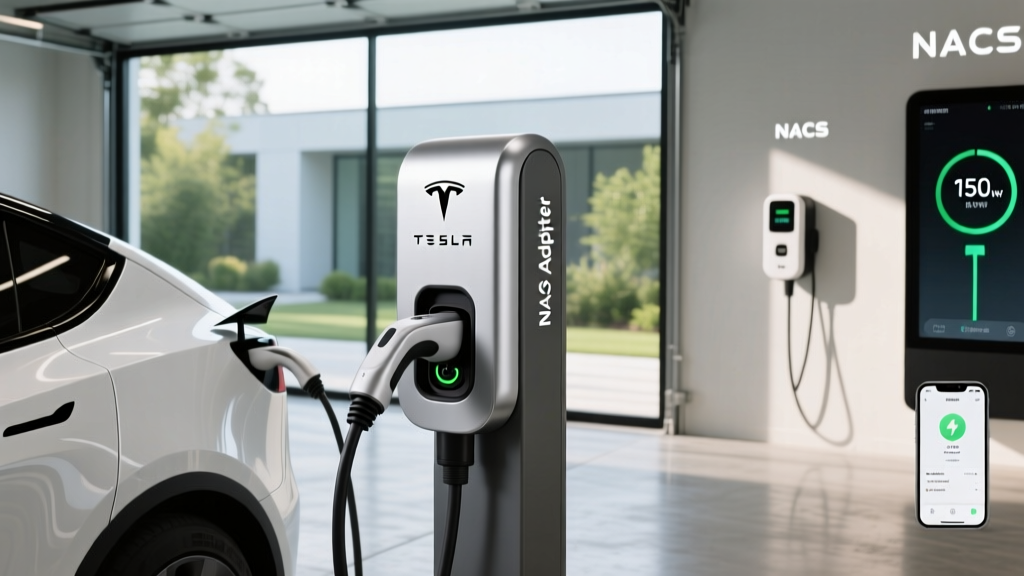
The connector landscape shifted dramatically between 2023 and 2026. Tesla opened its Supercharger network to non-Tesla EVs, and nearly every major automaker adopted the North American Charging Standard (NACS) for new vehicles starting with 2025 model year. Here's where things stand now:
| Connector | Used By (2026 models) | DC Fast Network Access | Adapter Notes |
|---|---|---|---|
| NACS (Tesla-style) | Tesla (all), Ford, GM, Rivian, Volvo, Polestar, Hyundai/Kia (2025+), most new 2026 models | Tesla Supercharger + NACS-equipped Electrify America, EVgo, ChargePoint stalls | CCS1→NACS adapters available (~$200) for older CCS vehicles to access Superchargers |
| CCS1 (Combo) | Legacy 2022–2024 EVs (VW ID.4, older Bolt, early Ioniq 5, BMW i4) | Electrify America, EVgo, ChargePoint, most non-Tesla networks | NACS→CCS1 adapters (~$250) let new NACS vehicles use legacy CCS stations |
| CHAdeMO | Nissan Leaf (discontinued in US after 2025), Mitsubishi Outlander PHEV (legacy) | Shrinking network; few new installations | No practical adapter path to NACS or CCS for DCFC |
| J1772 (AC Level 1/2) | All non-Tesla EVs for AC charging | N/A — AC only | Tesla Mobile Connector includes J1772 adapter; Tesla Wall Connector uses NACS plug but works on non-Tesla EVs with J1772-to-NACS adapter |
Which charger is compatible with my EV? For home Level 2 charging, buy a unit with the native plug your car uses (NACS for Tesla and most 2025+ models, J1772 for older non-Tesla EVs). For road trips, check your car's DC port and plan routes around networks that support it. The U.S. Department of Energy's Alternative Fuels Data Center maps every public charger by connector type.
The Real Cost to Charge an EV vs. Gasoline
Electricity pricing varies enormously — by utility, time of day, and whether you're at home or on a public DCFC network. Here's the realistic 2026 landscape:
| Charging Scenario | Typical $/kWh | Cost for 30 kWh (≈100 mi in an efficient EV) | Cost per Mile |
|---|---|---|---|
| Home, off-peak (time-of-use rate) | $0.08 – $0.14 | $2.40 – $4.20 | $0.024 – $0.042 |
| Home, standard flat rate | $0.13 – $0.20 | $3.90 – $6.00 | $0.039 – $0.060 |
| Public Level 2 (workplace, retail) | $0.20 – $0.35 | $6.00 – $10.50 | $0.060 – $0.105 |
| DC Fast Charging (Electrify America, EVgo, Tesla Supercharger) | $0.32 – $0.55 | $9.60 – $16.50 | $0.096 – $0.165 |
| Gasoline comparison (30 MPG @ $3.40/gal) | — | $3.40 (per gallon, ≈33 mi) | $0.113 |
The math is clear: home off-peak charging delivers fuel costs roughly one-quarter to one-third of gasoline. Even expensive DC fast charging is typically on par with or cheaper than gas on a per-mile basis for efficient EVs (3–4 mi/kWh). The economics flip only if you exclusively use the most expensive urban DCFC networks with a large, inefficient electric truck.
For a driver covering 12,000 miles per year in a Hyundai Ioniq 6 (~3.8 mi/kWh), annual fuel costs range from ~$315 (home off-peak) to ~$1,260 (heavy DCFC reliance), compared to ~$1,360 in a comparable 30 MPG gas car. Over five years, home-centric EV charging saves $3,500–$5,200 in fuel alone.
2026 Equipment Recommendations: Home Level 2 Chargers Worth Buying
We tested and cross-referenced reliability data, UL certification, smart features, and support quality. These are the units we'd install in our own garages.
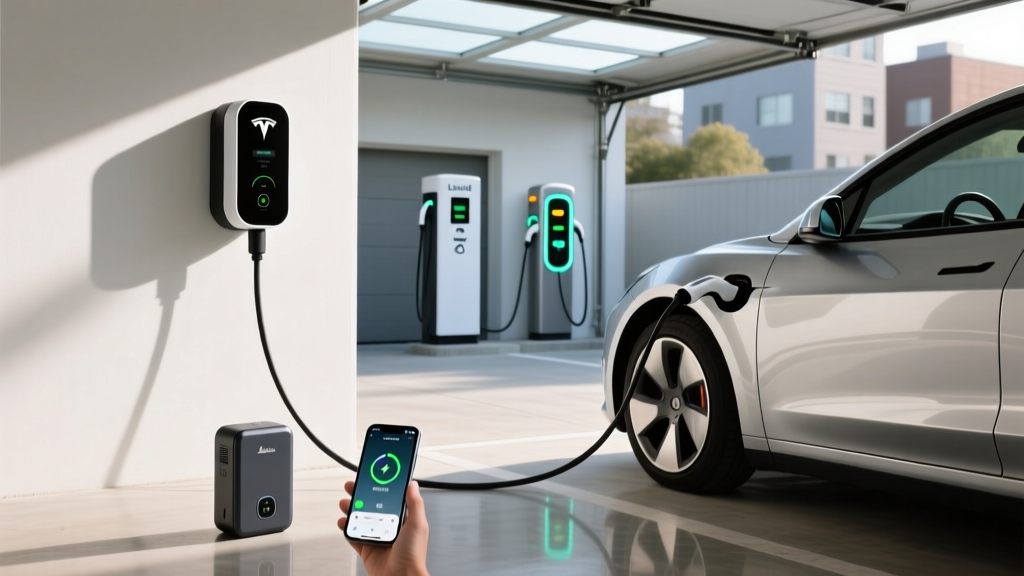
Best Overall: Tesla Wall Connector (Gen 4, NACS)
- Power output: up to 11.5 kW (48A) on a 60A circuit; also configurable down to 16A
- Connector: NACS (native for Tesla and 2025+ Ford/GM/Rivian/Hyundai/Kia EVs)
- Cable length: 24 ft standard
- Smart features: Wi-Fi, OTA updates, load-sharing with up to 6 units on one circuit, Power Meter integration
- Price: ~$475
- Why: Best-in-class reliability, compact, works with non-Tesla EVs via a J1772-to-NACS adapter for AC charging
Best for CCS/J1772 EVs: ChargePoint Home Flex (J1772)
- Power output: up to 12 kW (50A) on a 60A circuit; dip-switch configurable from 16A–50A
- Connector: J1772 (all non-Tesla AC charging)
- Cable length: 23 ft
- Smart features: Wi-Fi, app scheduling, Alexa integration, utility demand-response programs
- Price: ~$550–$650
- Why: UL-listed, flexible amperage, excellent app, widely compatible
Best Value with Energy Monitoring: Emporia Level 2 Smart Charger
- Power output: up to 11.5 kW (48A) on 60A circuit
- Connector: J1772 (NACS version announced for late 2026)
- Cable length: 24 ft
- Smart features: Real-time energy monitoring via Emporia Vue integration, solar-aware scheduling, load management
- Price: ~$399
- Why: Lowest-cost smart charger with genuine energy visibility and solar integration
Best Portable / Dual-Voltage: Grizzl-E Smart (United Chargers)
- Power output: up to 10 kW (40A) on 50A circuit
- Connector: J1772 (NACS adapter available)
- Cable length: 24 ft
- Smart features: Bluetooth + Wi-Fi, OCPP-compatible for commercial use, extreme cold-rated (-40°F)
- Price: ~$509
- Why: Canadian-built, rugged, ideal for cold climates and renters who need portability
Whichever unit you choose, verify it is UL-listed (not just "CE" or "FCC" marked — those don't certify electrical safety in the U.S.). Non-listed chargers may not pass inspection and can void insurance.
Safety, Code, and Outdoor Installation Considerations
The National Electrical Code (NEC) treats EV charging as a continuous load, which triggers specific requirements beyond a typical appliance circuit:
- Dedicated circuit: The EVSE must have its own breaker — no sharing with outlets or lights.
- GFCI protection: NEC 2020 and later require GFCI protection for outdoor receptacles used for EV charging. Hardwired EVSE units often bypass this requirement (and avoid nuisance trips), which is one reason hardwired installs are preferred outdoors.
- Outdoor rating: Any charger mounted outside must carry a NEMA 4 (weatherproof) or NEMA 4X rating. All four units recommended above meet this standard.
- Cable management: NEC requires that the charging cable not create a tripping hazard. Plan for a wall-mount holster or retractable reel, especially if the cable crosses a walkway.
- Disconnect: Some jurisdictions require a visible disconnect switch within sight of hardwired EVSE. Your electrician will know local amendments.
- Strain relief and conduit: Outdoor runs typically require conduit (EMT or PVC) from the panel to the charger location, adding to labor cost but protecting the wiring.
One often-overlooked safety item: don't use an extension cord with a portable EVSE (the "brick" chargers included with many EVs). If you must charge from a distant outlet, have an electrician install a dedicated 240V receptacle (NEMA 14-50 or 6-50) near the parking spot instead.
Public Charging Networks: What to Know Before You Plug In
Home charging covers 80–90% of most EV owners' needs. The remaining 10–20% — road trips, apartment dwellers, unexpected top-ups — falls to public infrastructure. Here's the 2026 landscape:
- Tesla Supercharger: ~30,000+ stalls in North America, now open to NACS-equipped non-Tesla EVs. Most reliable network by uptime (~97%+ per third-party audits). Pricing: $0.25–$0.45/kWh depending on location and time.
- Electrify America: Largest non-Tesla DCFC network, transitioning to NACS connectors alongside CCS1. Reliability has improved but still trails Tesla (~90% uptime). Membership plan reduces per-kWh cost.
- EVgo: Urban-focused DCFC, strong in metro areas. Adding NACS connectors. Pricing varies; often bundled with automaker free-charging programs.
- ChargePoint: Dominant in Level 2 (retail, workplace) with growing DCFC presence. App shows real-time availability.
Pro tips from years of public charging: precondition your battery (most EVs do this automatically when you navigate to a DCFC) for faster charge rates; avoid charging above 80% at a DCFC unless necessary, because the taper makes the last 20% painfully slow and expensive; and always have a backup station mapped in case your primary choice is occupied or out of service. According to fueleconomy.gov, preconditioning can improve DCFC speeds by 15–30% in cold weather.
Frequently Asked Questions
How much does it cost to install a home EV charger?
For a straightforward install with a 240V/60A circuit near the panel, expect $850–$1,850 total (equipment + electrician + permit). Complex installs requiring a panel upgrade, long wire runs, or trenching can reach $2,500–$8,000+. Always get 2–3 licensed electrician quotes.
How fast will each charging level add range?
Level 1 (120V) adds 3–5 miles per hour. Level 2 (240V) adds 12–75 miles per hour depending on amperage and your car's onboard charger. DC fast charging adds 150–1,200+ miles per hour at peak, but sessions are typically measured in minutes to 80%, not hours.
Which connector/charger is compatible with my EV?
Check your vehicle's charge port. Tesla and most 2025+ models from Ford, GM, Rivian, Hyundai, Kia, and Volvo use NACS. Older non-Tesla EVs (2022–2024) typically use CCS1. The Nissan Leaf uses CHAdeMO. For home Level 2, match the charger's plug to your car's port — or use a certified adapter.
How much does charging cost per mile vs gas?
Home off-peak charging costs $0.02–$0.04 per mile in an efficient EV. Public DCFC runs $0.10–$0.17 per mile. A 30 MPG gas car at $3.40/gallon costs ~$0.11 per mile. Home charging is roughly one-quarter the per-mile cost of gasoline.
What electrical upgrades might I need?
If your main panel is near capacity (common in all-electric homes or older 100A–150A services), you may need a load-management device ($100–$300), a subpanel ($500–$1,200), or a full service upgrade to 320A ($2,500–$5,000+). A licensed electrician's load calculation will determine which path is required.
Can I install an EV charger myself?
Legally, most jurisdictions require a licensed electrician for 240V circuit work and will inspect it under NEC Article 625. DIY installation risks failed inspections, voided home insurance, and serious shock/fire hazard. Portable 120V Level 1 charging into an existing outlet is the only true plug-and-play option.
Does frequent DC fast charging damage my battery?
Exclusively using DCFC can accelerate long-term degradation by a few percentage points over the battery's life, primarily due to heat. Modern thermal management systems mitigate this substantially. Best practice: charge at home Level 2 for daily use and reserve DCFC for road trips. Per the IRS §30D credit rules, your battery is also warranted by the manufacturer for at least 8 years/100,000 miles with a minimum 70% capacity retention threshold.
The right charger EV setup isn't one-size-fits-all — it's a combination of home hardware matched to your panel, a connector strategy matched to your vehicle, and a public-network plan matched to your driving. Start with a licensed electrician's assessment of your panel capacity, pick a UL-listed Level 2 unit sized to your car's onboard charger, and keep a DCFC app (PlugShare, A Better Routeplanner, or your automaker's native navigation) ready for the open road. That's the formula that makes EV ownership genuinely effortless.