If you've just ordered a Dodge Charger Daytona EV or you're evaluating the brand's electric lineup, one question dominates: which charger setup actually makes ownership practical? Dodge's transition to the STLA Large platform means buyers are navigating new battery sizes, new charging curves, and a shifting connector landscape (NACS adoption is in full swing for 2025–2026 models). This guide cuts through the noise with exact numbers — kW speeds, real install costs, connector compatibility, and the per-mile math that determines whether your Dodge EV saves you money or quietly drains your wallet.
Dodge EV Charging Levels: Speed, Power, and What You Actually Get
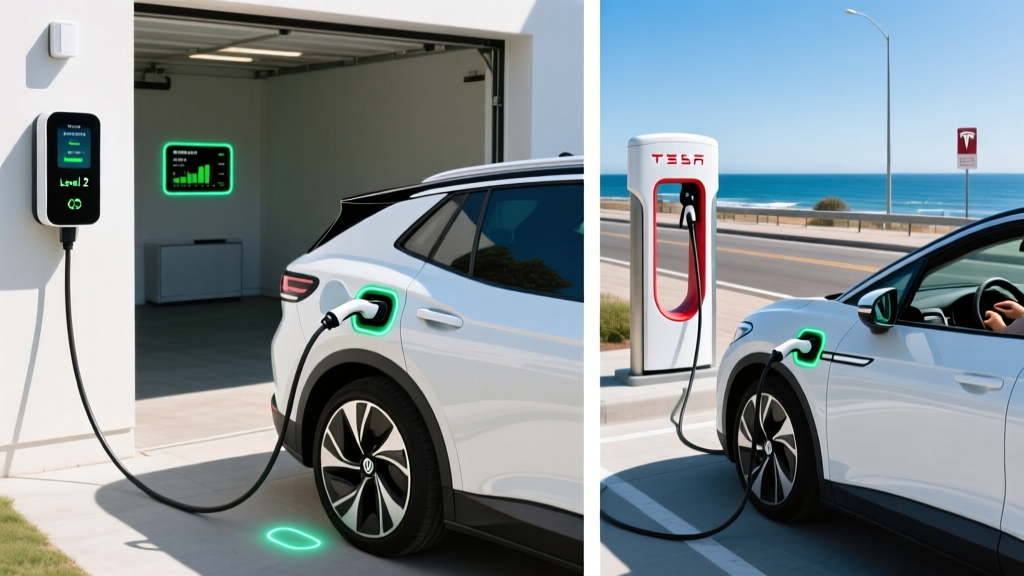
Before picking equipment, you need to understand the three charging tiers and how they translate into real miles on the road. The critical distinction: kW (kilowatts) measures power — how fast energy flows into the car. kWh (kilowatt-hours) measures energy — the total capacity of your battery. A 100-kWh battery charged at 10 kW takes roughly 10 hours from empty; at 150 kW, the same battery could theoretically fill in under an hour (though charge-curve taper makes the real number longer).
| Level | Voltage | Power (kW) | Miles of Range Added per Hour | Best Use Case |
|---|---|---|---|---|
| Level 1 (120V) | 120V / 12A | ~1.4 kW | 3–5 mi/hr | Overnight trickle; emergency backup |
| Level 2 (240V) | 240V / 32–48A | 7.7–11.5 kW | 22–38 mi/hr | Daily home charging; workplace |
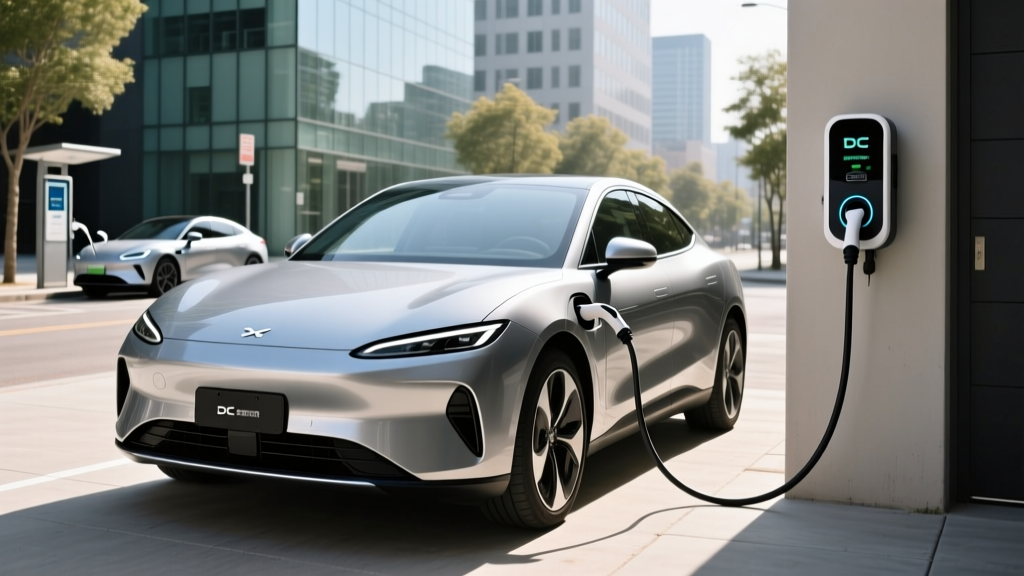
| DC Fast Charging | 400V–800V DC | 50–270+ kW | 150–600+ mi/hr (peak) | Road trips; quick top-ups |
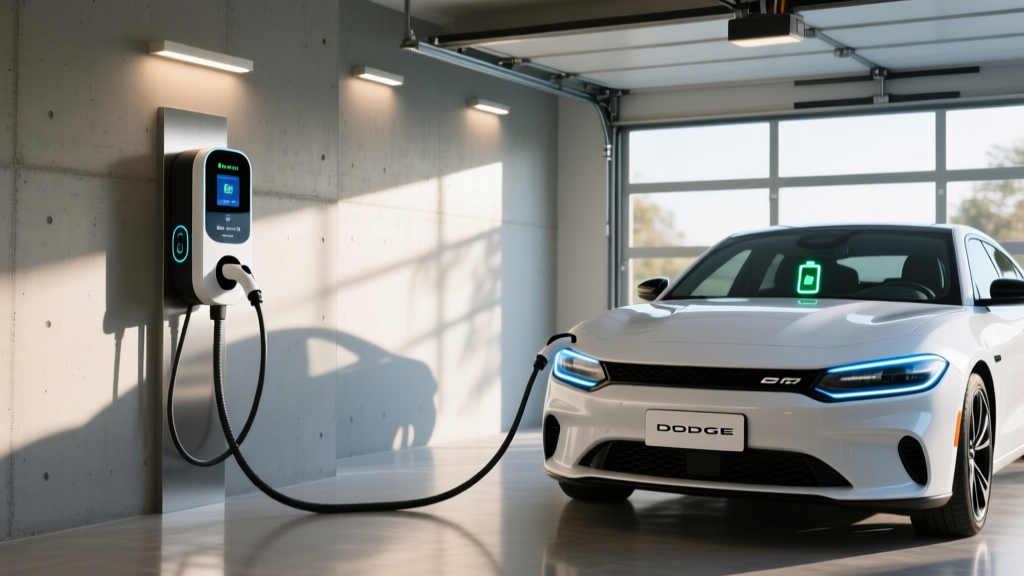
For a Dodge Charger Daytona R/T with its ~100 kWh (usable) battery pack, Level 1 is impractical as a primary method — you'd need 25+ hours for a full charge. Level 2 at 11.5 kW fills that pack in roughly 9–10 hours, which is ideal for overnight charging. DC fast charging on the STLA Large platform peaks around 270 kW on capable chargers, meaning a 10–80% session takes approximately 20–25 minutes under optimal thermal conditions.
Home Charger Installation: Electrical Requirements, Costs, and Panel Gotchas
A Level 2 home charger is the single biggest quality-of-life upgrade for any Dodge EV owner. But the sticker price of the charger itself is only part of the equation. Here's the full financial picture.
Electrical Requirements
Most Level 2 chargers for a Dodge EV require a 240V dedicated circuit on a 40A to 60A breaker. The National Electrical Code (NEC) requires continuous loads (like EV charging, which runs for 3+ hours) to use only 80% of a breaker's rated capacity. So a 48A charger needs a 60A breaker; a 32A charger needs a 40A breaker. Wire gauge typically runs 6 AWG copper (for 60A) or 8 AWG (for 40A), routed from your panel to the charger location.
Do You Need a Panel Upgrade?
This is the cost variable most guides gloss over. If your home has a 100A main panel — common in houses built before 1990 — adding a 60A EV circuit may exceed your panel's safe capacity, especially if you're already running central A/C, an electric dryer, and an electric range. A licensed electrician will perform a load calculation (NEC Article 220) to determine if your panel can handle it. If not, a panel upgrade to 200A typically costs $1,500–$3,000 on top of the charger install.
| Component | Low End | High End | Notes |
|---|---|---|---|
| Level 2 Charger (Equipment) | $300 | $700 | 32A–48A smart charger; hardwired or NEMA 14-50 plug |
| Electrician Labor | $400 | $1,200 | Depends on run length from panel to garage/driveway |
| Permit & Inspection | $50 | $250 | Varies by municipality; required in most jurisdictions |
| Panel Upgrade (if needed) | $1,500 | $3,000 | 100A → 200A service upgrade; not always required |
| Total (no panel upgrade) | $750 | $2,150 | Most homes with 200A panels fall in $800–$1,500 |
| Total (with panel upgrade) | $2,250 | $5,150 | Older homes; budget accordingly |
Before hiring an electrician, check for utility rebates. Many utilities offer $250–$500 rebates for Level 2 charger installations, and some states offer additional incentives on top of any federal provisions. Always get at least two quotes, and confirm your electrician will pull a permit — unpermitted work can void home insurance claims and cause issues at resale.
Connector Compatibility: NACS, CCS1, and What Your Dodge EV Needs
The connector landscape has shifted dramatically. Stellantis (Dodge's parent company) committed to adopting the North American Charging Standard (NACS) — the Tesla-designed connector — on new vehicles. For 2025–2026 Dodge EVs built on the STLA Large platform, expect NACS as the native charge port, though early-production models may still ship with CCS1. Always verify your specific vehicle's charge port before purchasing home equipment.
| Connector | Standard Used By | Dodge EV Status (2026) | Adapter Needed? |
|---|---|---|---|
| NACS (J3400) | Tesla, Ford, GM, Rivian, Stellantis (2025+) | Native on new STLA Large models | CCS→NACS adapter for older public CCS stations (~$200) |
| CCS1 (Combo) | Legacy standard; Electrify America, EVgo | May appear on early-production units | NACS→CCS adapter if using Tesla Superchargers (~$200–$250) |
| CHAdeMO | Nissan Leaf (legacy); largely deprecated | Not used on Dodge EVs | N/A |
Home charger tip: If your Dodge has a NACS port, buy a NACS-connector home charger (or a J1772 charger with a NACS adapter, since J1772 and NACS share the same AC pin geometry). If you have CCS1, any standard J1772 Level 2 charger will work — J1772 is the universal AC charging connector in North America and is physically integrated into both CCS1 and NACS DC connectors.
Cost to Charge: Home vs. Public vs. Gas — The Per-Mile Math
This is where EV ownership either shines or disappoints. The answer depends entirely on where and when you charge.
| Scenario | Rate | Cost per kWh | Cost per Mile* |
|---|---|---|---|
| Home (off-peak TOU rate) | ~$0.09–$0.13/kWh | $0.11 avg | $0.033 |
| Home (standard rate) | ~$0.14–$0.18/kWh | $0.16 avg | $0.048 |
| Public Level 2 (ChargePoint, etc.) | ~$0.25–$0.40/kWh | $0.32 avg | $0.096 |
| DC Fast (Electrify America, Tesla) | ~$0.35–$0.55/kWh | $0.45 avg | $0.135 |
| Gas car (25 MPG combined, $3.40/gal) | — | — | $0.136 |
*Based on Dodge Charger Daytona efficiency of ~3.3 mi/kWh (approximately 110 MPGe combined). Actual efficiency varies with driving style, temperature, and terrain.
The takeaway is stark: home off-peak charging costs roughly 75% less per mile than gasoline. But exclusive reliance on DC fast charging essentially matches gas costs — and repeated DC fast charging accelerates battery degradation. The economic case for a Dodge EV depends on installing a Level 2 home charger and using time-of-use (TOU) utility rates to charge overnight at the lowest per-kWh cost.
Best Level 2 Chargers for Your Dodge EV: 2026 Equipment Picks
Based on power output, build quality, smart features, and connector options, these are the chargers we recommend pairing with a Dodge EV. All support NACS or J1772 (which works with NACS via the shared pin layout).
ChargePoint Home Flex (NACS Edition)
- Power Output: Up to 11.5 kW (48A / 240V) — adjustable down to 16A for lower-capacity panels
- Connector: NACS native (2025+ revision); J1772 version also available
- Cable Length: 24 ft
- Smart Features: Wi-Fi, app scheduling, Alexa integration, energy tracking, TOU optimization
- Price: ~$550–$650
- Best For: Dodge owners wanting flexible amperage settings and robust app control
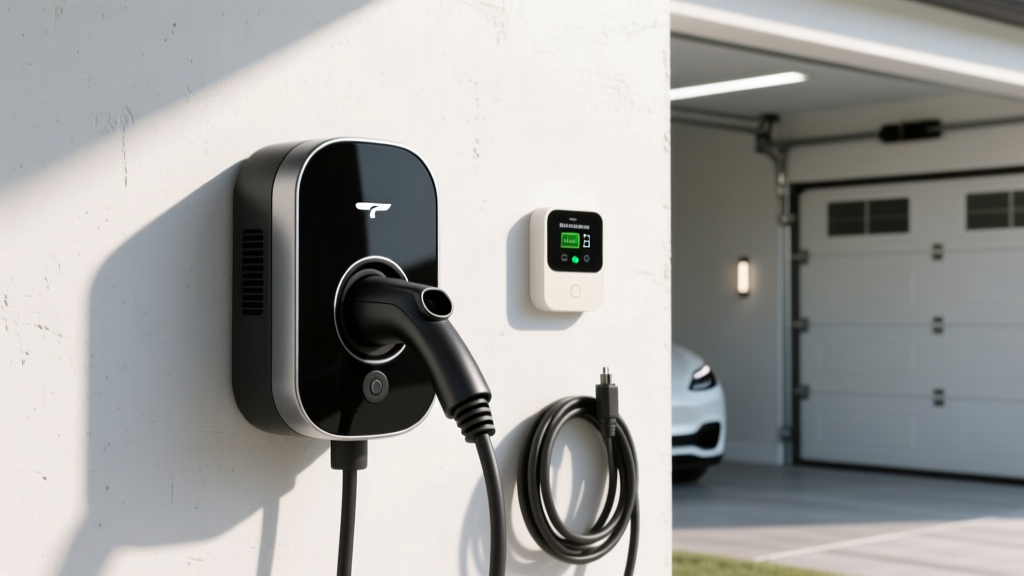
Tesla Wall Connector (J3400/NACS)
- Power Output: Up to 11.5 kW (48A / 240V)
- Connector: NACS native
- Cable Length: 24 ft
- Smart Features: Wi-Fi, over-the-air updates, load sharing (pair two units on one circuit), Power-Sharing
- Price: ~$425–$475
- Best For: Best value NACS charger; works with any NACS-equipped Dodge EV
Emporia Vue Level 2 Smart Charger
- Power Output: Up to 11.5 kW (48A / 240V)
- Connector: J1772 (NACS-compatible via adapter)
- Cable Length: 24 ft
- Smart Features: Integrated with Emporia home energy monitor, solar-aware charging, TOU scheduling, real-time cost tracking
- Price: ~$400–$500 (charger only); ~$700 with energy monitor bundle
- Best For: Solar-equipped homes; owners who want whole-home energy visibility
All three chargers are hardwired or NEMA 14-50 plug compatible. Hardwired installations are generally preferred for 48A units — a NEMA 14-50 outlet is rated for 50A but NEC continuous-load rules cap it at 40A, meaning a plug-in charger on a 14-50 outlet maxes out at 9.6 kW (40A). To get the full 11.5 kW, you need a hardwired connection on a 60A breaker.
Charging Time Examples: What to Expect With a Dodge EV Battery
The Dodge Charger Daytona EV's battery pack (approximately 100 kWh usable capacity) is one of the larger packs on the market. Here's how long common charging scenarios take:
- Level 1 (120V, 1.4 kW): 10–80% in ~50 hours. Essentially unusable as a primary method — only practical for maintaining charge or adding ~30 miles overnight.
- Level 2 (240V, 48A, 11.5 kW): 10–80% in ~6 hours. Full overnight fill on any schedule. This is the target setup.
- Level 2 (240V, 32A, 7.7 kW): 10–80% in ~9 hours. Adequate for overnight but tighter if you need a full turnaround.
- DC Fast (270 kW peak, CCS or NACS): 10–80% in ~20–25 minutes under optimal conditions. Expect 30+ minutes in cold weather or at lower-powered stations.
- DC Fast (150 kW station): 10–80% in ~35–40 minutes. Common at older Electrify America or EVgo sites.
- DC Fast (50 kW station): 10–80% in ~100 minutes. Avoid unless no other option is available.
According to fueleconomy.gov, the Charger Daytona's efficiency and charging profile place it in the upper tier of large EVs — comparable to other STLA Large vehicles. For road-trip planning, budget 25–30 minutes per DC fast stop and plan stops around 150–200 miles apart to stay within the optimal 10–80% charging window where speeds are highest.
Safety, Electrical Code, and Installation Best Practices
EV charging draws sustained high current for hours — this is not the same as plugging in a dryer for 45 minutes. Safety and code compliance are non-negotiable.
- Dedicated circuit: Your Level 2 charger must be on its own dedicated breaker — never shared with other appliances.
- GFCI protection: NEC 2020 and later require GFCI (Ground Fault Circuit Interrupter) protection for EV charging outlets. Hardwired chargers typically have GFCI built into the unit; if you use a NEMA 14-50 receptacle, your breaker or receptacle must be GFCI-rated. Note: some EV owners have reported nuisance GFCI trips with certain breaker-receptacle combinations — consult your electrician about compatible pairings.
- Outdoor rating: If your charger is mounted outside (driveway or exterior wall), it must carry a NEMA 4 or NEMA 4X weather-resistance rating. All three chargers recommended above are outdoor-rated.
- Cable management: A 24-foot cable drapes across a garage floor or driveway. Use a cable holster or retractor to prevent trip hazards and cable damage.
- Permit and inspection: Most jurisdictions require an electrical permit for a new 240V circuit. The inspection ensures proper wire gauge, breaker sizing, grounding, and GFCI compliance. Skipping the permit risks insurance denial in the event of an electrical fire.
The National Fire Protection Association's NEC guidelines are the baseline — your local jurisdiction may have additional requirements. Always hire a licensed electrician who is familiar with EV charger installations specifically; general electricians sometimes undersize wire or omit GFCI requirements.
Public Charging Networks: Where Dodge EV Owners Can Plug In
For road trips and apartment dwellers without home charging access, public infrastructure is essential. Here's how the major networks map to your Dodge EV:
- Tesla Supercharger Network (now open to non-Tesla EVs): With NACS adoption, Dodge EVs equipped with native NACS ports can access Supercharger stalls directly. As of 2026, Stellantis vehicles are gaining access through the Stellantis-Tesla access agreement. Check your vehicle's infotainment or app for current network compatibility.
- Electrify America: Primarily CCS1-equipped stations. If your Dodge has NACS, you'll need a NACS-to-CCS adapter (available from Dodge or third-party suppliers for ~$200–$250). EA stations typically offer 150 kW and 350 kW stalls.
- EVgo: Mix of CCS1 and NACS connectors as they update their fleet. Check the EVgo app for connector availability at your target station.
- ChargePoint: Predominantly Level 2 public chargers (J1772/NACS) with some DC fast locations. Useful for destination charging at shopping centers and workplaces.
Pro tip: download multiple network apps before a road trip. Charger availability, real-time status, and payment all happen through network-specific apps. A PlugShare or A Better Routeplanner (ABRP) account helps you plan routes with charger stops optimized for your battery size and charging curve.
Frequently Asked Questions
How much does it cost to install a home EV charger for a Dodge EV?
Expect $750–$2,150 for a standard installation (equipment, electrician labor, and permit) if your home already has a 200A electrical panel. If you need a panel upgrade from 100A to 200A, add $1,500–$3,000, bringing the total to $2,250–$5,150. Get a load calculation from a licensed electrician before committing.
How fast will each charging level add range to my Dodge EV?
Level 1 (120V) adds about 3–5 miles per hour — too slow for daily use. Level 2 (240V, 48A) adds roughly 32–38 miles per hour, enough for a full overnight charge. DC fast charging at 270 kW can add 150+ miles in 10 minutes at peak rates, though real-world speeds taper significantly above 60% state of charge.
Which connector and charger is compatible with my Dodge EV?
2025–2026 Dodge EVs on the STLA Large platform are expected to use the NACS (J3400) connector. Verify your specific vehicle's charge port before buying equipment. For home Level 2 charging, a NACS charger or a J1772 charger with a NACS adapter will work. For DC fast charging on CCS1-only public stations, you may need a NACS-to-CCS adapter.
How much does charging cost per mile compared to gas?
Home off-peak charging costs roughly $0.03–$0.05 per mile for a Dodge Charger Daytona — about 75% less than a comparable gas car at $0.14 per mile. Public DC fast charging at $0.35–$0.55/kWh costs roughly $0.11–$0.16 per mile, which is comparable to or slightly more than gasoline. The economics strongly favor home Level 2 charging.
What electrical upgrades might I need for a home charger?
The most common upgrade is a panel capacity increase from 100A to 200A, needed in older homes that can't safely support a new 60A circuit alongside existing loads. Your electrician will perform a load calculation to determine this. Other potential upgrades include adding a sub-panel (if your charger is far from the main panel), upgrading wire from aluminum to copper, or replacing an outdated meter base. Budget $1,500–$3,000 for a panel upgrade if required.
Can I use a Tesla Supercharger with my Dodge EV?
If your Dodge EV has a native NACS charge port, yes — Tesla's Supercharger network is opening to NACS-equipped non-Tesla vehicles. Stellantis has been working on access agreements, and availability is expanding through 2026. If your Dodge has a CCS1 port, you'll need a CCS-to-NACS adapter and should check Tesla's app for compatible stations with the "Magic Dock" adapter built in.
Does repeated DC fast charging damage my Dodge EV battery?
Exclusive reliance on DC fast charging accelerates battery degradation compared to Level 2 charging. Most manufacturers, including Stellantis, warranty their EV batteries for 8 years/100,000 miles with a capacity retention threshold (typically 70% of original capacity). To maximize longevity, use Level 2 for daily charging and reserve DC fast charging for road trips. Avoid routinely charging to 100% — setting a daily charge limit of 80% reduces stress on the battery cells.
For current federal incentive information related to home charger installation, consult the IRS clean vehicle and energy credits page, as provisions for residential charging equipment have specific eligibility requirements that vary by tax year and location.