If you own or are shopping for an EV, one decision dominates everything else: how you'll charge it. The right charger electric car setup at home transforms ownership from a daily chore into something you barely think about — plug in at night, wake up to a full battery. But choosing the wrong equipment, skipping a needed panel upgrade, or misunderstanding charging speeds can cost you thousands and leave you stranded on a road trip.
This guide breaks down the exact numbers behind every charging level, what a real home installation costs in 2026 (including the electrical panel gotcha that blinds many buyers), which connector your EV actually uses, and what you'll pay per mile compared to gasoline. Every figure below comes from manufacturer specs, EPA data, and real-world ownership experience.
Charging Levels Explained: Speed, Power, and Real-World Range Gains
The single most important distinction in EV charging is the difference between kW (kilowatts) and kWh (kilowatt-hours). A kilowatt measures the rate of power delivery — how fast electricity flows into your car. A kilowatt-hour measures total energy stored — the size of your battery. Think of kW as the width of a hose and kWh as the bucket you're filling. A wider hose (higher kW) fills the bucket faster, but the bucket size stays the same.
Every EV sold in the US charges at one of three levels. Here's what each delivers:
| Level | Voltage | Power (kW) | Miles of Range Per Hour | Typical Use Case |
|---|---|---|---|---|
| Level 1 | 120V AC | 1.0–1.4 kW | 3–5 miles | Overnight top-up, PHEV owners, emergency backup |
| Level 2 | 240V AC | 3.3–19.2 kW | 12–75 miles | Home daily charging, workplace, destination charging |
| DC Fast Charge | 400–800V DC | 50–350 kW | 150–1,000+ miles (equivalent) | Road trips, highway corridors, rapid top-up |
Level 1 uses a standard household 120V outlet. It's included with most EVs via a mobile charging cord. At 1.4 kW, you'll recover roughly 4 miles of range per hour of charging. That means an overnight session (10 hours) adds about 40 miles — enough for a short commute or a plug-in hybrid, but inadequate for a full battery electric vehicle (BEV) with a 250+ mile battery.
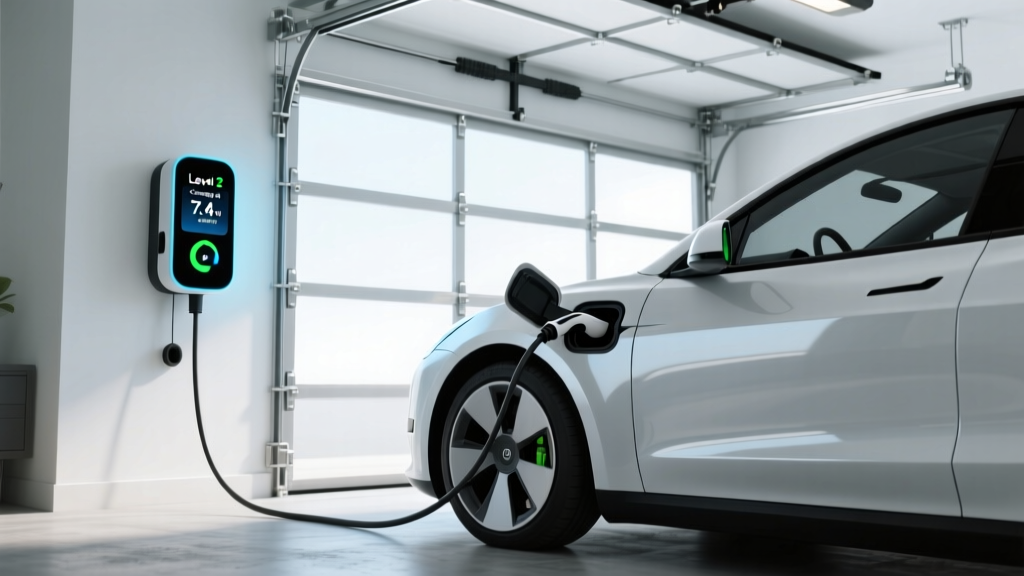
Level 2 requires a dedicated 240V circuit — the same voltage your electric dryer or oven uses. This is where real home charging happens. At 11.5 kW (a common 48-amp circuit), you'll add roughly 40–45 miles of range per hour. A 75 kWh battery (like a Tesla Model Y Long Range) charges from 10% to 80% in about 5–6 hours, perfect for overnight replenishment.
DC Fast Charging bypasses the car's onboard AC-to-DC converter and feeds direct current straight into the battery. Speeds vary enormously by vehicle and charger. A Hyundai Ioniq 5 at a 350 kW charger can go from 10% to 80% in roughly 18 minutes, adding over 200 miles. But not every EV can accept that rate — a Chevy Equinox EV, for example, peaks around 150 kW and takes about 30 minutes for the same 10–80% session.
Home Charger Installation: Electrical Requirements and Real Costs
Installing a Level 2 home charger is an electrical project, not just a hardware purchase. The total cost depends on your home's electrical panel capacity, the distance from panel to charger location, and local permit requirements.
What Your Electrical System Needs
A typical Level 2 charger draws between 16 and 48 amps at 240 volts. The National Electrical Code (NEC) requires that a continuous load (which EV charging qualifies as) not exceed 80% of a circuit's rated capacity. That means:
- A 40-amp charger (9.6 kW) requires a 50-amp dedicated circuit
- A 48-amp charger (11.5 kW) requires a 60-amp dedicated circuit
- A 32-amp charger (7.7 kW) requires a 40-amp dedicated circuit
Your home's main electrical panel must have enough spare capacity to add this circuit. Most modern homes with 200-amp service can accommodate a 50–60 amp EV circuit without issue. Older homes with 100-amp or 150-amp panels may need a panel upgrade to 200 amps — a significant added cost.
| Component | Basic Install (Short Run, Adequate Panel) | Complex Install (Long Run or Panel Upgrade) |
|---|---|---|
| Level 2 Charger (Equipment) | $350–$700 | $350–$700 |
| Electrical Permit | $50–$200 | $50–$250 |
| Electrician Labor (2–4 hrs basic) | $400–$1,000 | $1,000–$2,500 |
| Wire, Conduit, Breaker | $100–$300 | $300–$800 |
| Panel Upgrade (if needed) | $0 | $1,500–$3,500 |
| Total Estimated Cost | $900–$2,200 | $3,200–$7,750 |
The wide range reflects real variability. A homeowner with a 200-amp panel and a garage wall directly behind the panel might pay under $1,200 total. A homeowner in a 1970s house with a 100-amp panel, needing a 60-foot conduit run to a detached garage, could easily spend $5,000+.
Key code requirements to expect:
- Dedicated circuit (no sharing with other appliances)
- GFCI protection for outdoor installations (required by NEC 2020 and later)
- NEMA 14-50 outlet or hardwired connection (hardwired is preferred for 48A+ chargers and avoids the ~$75 outlet cost)
- Outdoor-rated enclosure (NEMA 4 or NEMA 4X) for exterior installations
- Proper wire gauge: 6 AWG copper for 50A circuits, 4 AWG for 60A circuits
Connector Compatibility: NACS, CCS, and CHAdeMO in 2026
The connector landscape has consolidated significantly. As of 2026, nearly every new EV sold in North America uses the North American Charging Standard (NACS) — originally developed by Tesla and now adopted industry-wide. Here's where each brand stands:
| Connector Type | Brands Using It | Adapter Needed? |
|---|---|---|
| NACS (Tesla / SAE J3400) | Tesla, Ford, GM, Rivian, Hyundai, Kia, Volvo, Polestar, Mercedes-Benz, BMW (new models), Subaru, Lucid | No (native). CCS-to-NACS adapters available for legacy CCS chargers (~$200–$300) |
| CCS1 (Combined Charging System) | Remaining Stellantis models, some VW ID.4 (prior model years), older Hyundai/Kia models pre-2025 | NACS-to-CCS adapter needed for Tesla Superchargers (~$200–$250) |
| CHAdeMO | Nissan Leaf (legacy only — discontinued new sales) | CHAdeMO-to-NACS/CCS adapters rare; rely on CHAdeMO public stations |
For home Level 2 charging, the connector situation is simpler. All home chargers use the J1772 standard (which NACS incorporates for AC charging) or a NACS plug. If you buy a NACS-equipped home charger, it will work natively with any 2025+ NACS vehicle. For older CCS vehicles, a J1772-to-CCS adapter is typically included with the car or costs under $100.
Before purchasing a home charger, confirm your vehicle's inlet type and buy accordingly. Most major charger brands now offer both J1772 and NACS connector options at the same price point.
Home Charger Equipment: What to Buy in 2026
Not all Level 2 chargers are equal. The critical specs to compare are maximum power output (kW), cable length, smart features (Wi-Fi, scheduling, energy tracking), and connector type. Here are four proven options across different budgets:
Tesla Wall Connector (Gen 4)
- Max Output: 11.5 kW (48A)
- Connector: NACS native
- Cable Length: 24 ft
- Smart Features: Wi-Fi, OTA updates, power sharing (pair two on one circuit), load management
- Price: ~$475
- Best For: Tesla and NACS-equipped EV owners wanting native integration
ChargePoint Home Flex
- Max Output: 12 kW (50A) — configurable down to 16A
- Connector: J1772 (NACS adapter available)
- Cable Length: 23 ft
- Smart Features: Wi-Fi, app scheduling, Alexa integration, energy reports
- Price: ~$550–$650
- Best For: Multi-EV households, CCS/J1772 vehicles, renters wanting flexible amperage
Emporia Level 2 EV Charger
- Max Output: 11.5 kW (48A)
- Connector: J1772 or NACS
- Cable Length: 24 ft
- Smart Features: Wi-Fi, solar integration (pairs with Emporia Vue energy monitor), time-of-use scheduling
- Price: ~$399–$449
- Best For: Budget-conscious buyers, solar homes, energy monitoring enthusiasts
Grizzl-E Smart (United Chargers)
- Max Output: 10 kW (40A)
- Connector: J1772 or NACS
- Cable Length: 24 ft
- Smart Features: Wi-Fi, OCPP compatibility, adjustable amperage, extreme cold rated (-40°F)
- Price: ~$449–$549
- Best For: Cold-climate owners, outdoor installations, buyers wanting Canadian-built durability
What to look for: Choose a charger rated at least 40 amps (9.6 kW) to future-proof for larger batteries. If your panel can support a 60-amp circuit, a 48-amp charger (11.5 kW) charges roughly 20% faster and is worth the modest price premium. Hardwired installations are more reliable than plug-in NEMA 14-50 outlets for 48A+ chargers and eliminate the outlet as a potential failure point.
Cost to Charge: Per-Mile Economics vs. Gasoline
Electricity prices vary widely by state, utility, and time of day. Here's what charging actually costs in three common scenarios, calculated for a mid-size EV averaging 3.0 miles per kWh (roughly 33 kWh/100 miles — typical for a Tesla Model Y, Ford Mustang Mach-E, or Hyundai Ioniq 5):
| Charging Scenario | Rate ($/kWh) | Cost Per Mile | Full Charge Cost (75 kWh battery) |
|---|---|---|---|
| Home Off-Peak (Time-of-Use plan) | $0.08–$0.12 | $0.027–$0.040 | $6.00–$9.00 |
| Home Standard Rate (no TOU) | $0.14–$0.18 | $0.047–$0.060 | $10.50–$13.50 |
| Public Level 2 (ChargePoint, etc.) | $0.25–$0.49 | $0.083–$0.163 | $18.75–$36.75 |
| DC Fast Charge (Electrify America, Tesla Supercharger) | $0.35–$0.55 | $0.117–$0.183 | $26.25–$41.25 |
| Gasoline Baseline (30 MPG, $3.50/gal) | — | $0.117 | ~$43.75 (equivalent energy) |
The takeaway is clear: home charging on an off-peak rate is 3–4x cheaper per mile than gasoline. Even standard home rates deliver roughly half the fuel cost of a 30 MPG gas car. Public DC fast charging, however, narrows the gap considerably — at $0.45–$0.55/kWh, you're paying close to gas-equivalent costs per mile. This is why home charging access is the single biggest economic factor in EV ownership.
If your utility offers a time-of-use (TOU) rate plan, scheduling your charger to run between 11 PM and 6 AM can cut your charging costs by 40–60% compared to peak afternoon rates. Most smart chargers (all four recommended above) support scheduled charging via their apps.
Charging Time Examples: What to Expect with Common Battery Sizes
Charging speed depends on both the charger's output and the vehicle's onboard charger capacity (for Level 2) or battery management system (for DC fast charging). Here are real-world benchmarks for popular 2026 EVs:
| Vehicle | Battery (kWh usable) | Level 2 at 11.5 kW (10–80%) | DC Fast Peak kW | DC Fast 10–80% |
|---|---|---|---|---|
| Tesla Model Y Long Range | 75 kWh | ~5 hrs | 250 kW | ~25 min |
| Hyundai Ioniq 5 (Long Range AWD) | 77.4 kWh | ~5.5 hrs | 240 kW (800V) | ~18 min |
| Ford Mustang Mach-E Extended Range | 91 kWh | ~6.5 hrs | 150 kW | ~36 min |
| Chevy Equinox EV 3RS | 85 kWh | ~6 hrs | 150 kW | ~30 min |
| BMW iX xDrive50 | 105.2 kWh | ~7.5 hrs | 200 kW | ~34 min |
Two patterns emerge. First, Level 2 home charging always takes 5–8 hours for a 10–80% session regardless of vehicle — this is why overnight charging is the standard pattern. Second, DC fast charging times vary by more than 2x between vehicles. The Ioniq 5's 800-volt architecture allows it to sustain higher charge rates longer than 400V vehicles, giving it a meaningful road-trip advantage even though peak kW figures look similar on paper.
Which Charger Electric Car Setup Is Right for You?
Choose Level 1 (120V) if:
- You drive a PHEV with less than 40 miles of electric range
- Your daily driving is under 30 miles and you can charge 10+ hours overnight
- You rent and cannot install a 240V circuit
- You're waiting on your Level 2 installation and need a temporary solution
Choose Level 2 Home (240V) if:
- You drive a BEV with 200+ miles of range as your primary vehicle
- You own your home (or have landlord permission) and have a garage or driveway
- Your daily driving exceeds 40 miles
- You want the lowest per-mile cost and maximum convenience
Rely on DC Fast Charging if:
- You're on a road trip and need 150+ miles of range in 20–30 minutes
- You lack home charging access but have reliable public fast-charging infrastructure nearby
- You're supplementing home Level 2 for occasional long-distance travel
For the vast majority of EV owners, a Level 2 home charger is the baseline requirement for satisfying daily ownership. DC fast charging handles road trips and emergencies. Level 1 is a backup or PHEV-only solution.
Frequently Asked Questions
How much does it cost to install a home EV charger?
A straightforward Level 2 installation in a home with an adequate 200-amp panel and a short wire run typically costs $900–$2,200 including equipment, labor, and permit. If your home needs a panel upgrade from 100A to 200A, expect total costs of $3,200–$7,750. Always get at least two quotes from licensed electricians and verify they pull a permit — unpermitted work can void homeowner's insurance and create safety hazards.
How fast will each charging level add range?
Level 1 (120V) adds 3–5 miles per hour. Level 2 (240V at 48A/11.5 kW) adds roughly 40–45 miles per hour for a typical mid-size EV. DC fast charging adds the equivalent of 150–1,000+ miles per hour at peak rates, but is measured in minutes for a 10–80% session (typically 18–40 minutes depending on the vehicle).
Which connector and charger is compatible with my EV?
For 2025–2026 model-year vehicles from Tesla, Ford, GM, Hyundai, Kia, Rivian, Volvo, and most other major brands, the NACS connector is standard. Older CCS-equipped vehicles (pre-2025 models from some brands) can use NACS chargers with a ~$200 adapter, or you can buy a J1772/CCS home charger. Check your vehicle's charging port before purchasing equipment. The Nissan Leaf remains the last holdout on CHAdeMO, but new Leaf production has ended.
How much does charging cost per mile compared to gas?
Home charging on off-peak electricity ($0.08–$0.12/kWh) costs roughly $0.03–$0.04 per mile — about one-third the cost of gasoline at $3.50/gallon in a 30 MPG vehicle ($0.117/mile). Even at standard residential rates ($0.14–$0.18/kWh), EVs cost roughly $0.05–$0.06 per mile. Public DC fast charging ($0.35–$0.55/kWh) approaches gas parity at $0.12–$0.18 per mile, which is why minimizing public charging maximizes savings.
What electrical upgrades might I need?
The most common and expensive upgrade is a panel replacement from 100A to 200A service ($1,500–$3,500). You may also need: a new 50A or 60A double-pole breaker ($30–$75), properly sized wire and conduit for the run length ($2–$8 per foot for 6 AWG, more for longer runs), and a GFCI breaker for outdoor installations ($80–$150). An electrician's load calculation will determine if your panel can handle the additional circuit — this is the first step before any installation.
Can I claim a tax credit for my home charger?
The federal Alternative Fuel Vehicle Refueling Property Credit (IRS Form 8911) covers 30% of home charger equipment and installation costs, up to $1,000. However, this credit is only available in qualifying census tracts (low-income or non-urban areas) as of current IRS rules. Check your eligibility by census tract before assuming you'll receive the credit. Some states and utilities offer additional rebates — check your local utility's EV programs.