Why Durango SUV Owners Are Eyeing the Dodge Charger Daytona EV's Charging Setup
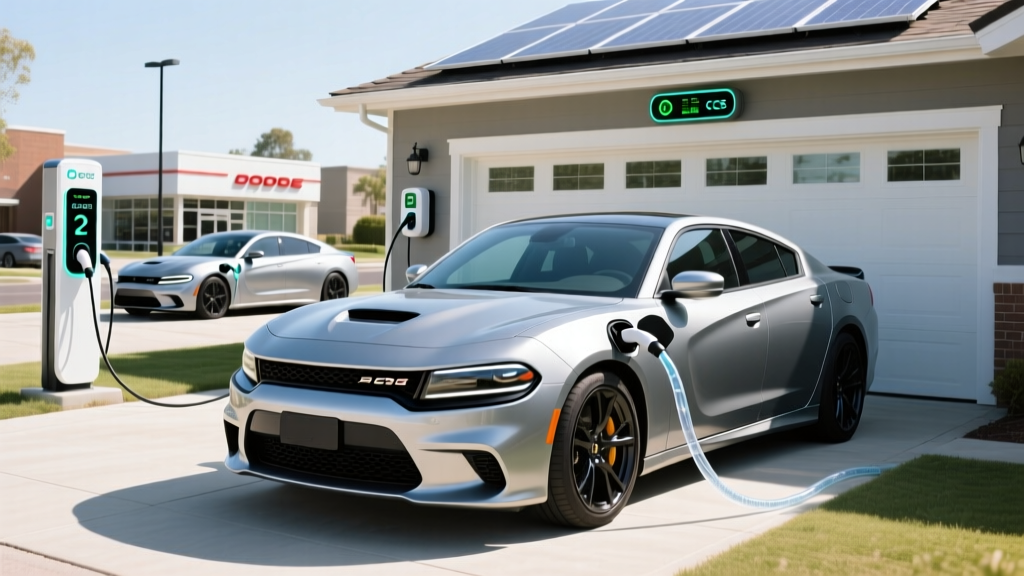
If you currently drive a Dodge Durango and are considering the all-electric Dodge Charger Daytona (the first all-electric muscle car from Stellantis), one of the first questions is practical: how do I charge it at home, and what does that actually cost? The Charger Daytona — available in R/T (496 hp) and Scat Pack (670 hp) trims — uses a 100.6 kWh (gross) battery pack and supports DC fast charging at up to 260 kW. That means the charging infrastructure you set up at home, and the networks you rely on publicly, will define your ownership experience far more than horsepower figures.
This guide walks through every charging scenario Charger Daytona buyers (and Durango owners transitioning to electric) need to understand: charging levels, home installation costs, connector standards, per-mile costs, and specific equipment recommendations for 2026.
Charging Levels Explained: Level 1, Level 2, and DC Fast Charging
Before buying any equipment, you need to understand the three charging tiers and what each delivers in real-world miles per hour. The critical distinction: kW (kilowatts) measures power — the rate of energy delivery — while kWh (kilowatt-hours) measures energy capacity, the size of the battery itself. Confusing them is the single most common EV mistake.
| Level | Voltage / Amps | Power (kW) | Miles of Range Added per Hour | Typical Use Case |
|---|---|---|---|---|
| Level 1 | 120V / 12A | ~1.4 kW | ~3–5 mi/hr | Emergency / overnight trickle (adds ~35–50 mi in 10 hrs) |
| Level 2 | 240V / 32–48A | 7.7–11.5 kW | ~22–38 mi/hr | Primary home charging; full charge in ~9–13 hrs |
| DC Fast Charge | 400–800V DC | 50–260 kW (peak) | ~150–650 mi/hr (at peak) | Road trips; 10–80% in ~26 min (Charger Daytona at 260 kW) |
How Much Does It Cost to Install a Home EV Charger?
Home Level 2 installation is where most Charger Daytona owners will do 85–95% of their charging. The total cost depends on your electrical panel's capacity, the distance from panel to charger location, and local permit fees. Here's a realistic breakdown for a typical 240V / 48A hardwired installation:
| Component | Low End | High End | Notes |
|---|---|---|---|
| Level 2 Charger (Equipment) | $400 | $750 | 40A–48A smart charger, 240V, NACS or CCS |
| Electrician Labor | $600 | $2,000 | Depends on run length, conduit, drywall work |
| Electrical Permit | $50 | $250 | Varies by municipality |
| Panel Upgrade (if needed) | $1,500 | $4,000 | 100A→200A service upgrade for older homes |
| Total (No Panel Upgrade) | $1,050 | $3,000 | Most newer homes with 200A service |
| Total (With Panel Upgrade) | $2,550 | $7,000 | Older homes, 100A or 150A panels |
Which Connector Does the Charger Daytona Use? NACS, CCS, and Adapter Compatibility
The 2025–2026 Dodge Charger Daytona ships with a CCS1 (Combined Charging System) port as standard. However, Stellantis has confirmed that future model years will adopt the NACS (North American Charging Standard) connector — the Tesla-designed standard now embraced by Ford, GM, Rivian, and most major automakers.
Here's what that means for your charging access:
| Connector | Native Support? | Network Access | Adapter Needed? |
|---|---|---|---|
| CCS1 | Yes (standard) | Electrify America, EVgo, ChargePoint, Ionity (EU) | No |
| NACS (Tesla) | No (not yet on Charger Daytona) | Tesla Supercharger network (17,000+ US stalls) | Yes — CCS-to-NACS adapter (~$200–$250) |
| CHAdeMO | No | Largely legacy (Nissan Leaf); being phased out | Not recommended |
Practical recommendation: If you plan to use Tesla Superchargers — the most reliable and widespread DC fast-charging network in the US — invest in a CCS-to-NACS adapter. Tesla's official NACS DC adapter or a certified third-party option will let you access Supercharger stalls at up to the vehicle's peak acceptance rate. For home Level 2 charging, you can order a charger with either a CCS (J1772+DC pins) or NACS plug — just match it to your vehicle's port.
Cost to Charge: Per-Mile Cost vs. Your Durango's Gas Bill
One of the strongest arguments for switching from a Durango (EPA combined 19 MPG for the V6 AWD) to the Charger Daytona is fuel cost. Here's a side-by-side comparison using national averages:
| Scenario | Cost per kWh / Gallon | Cost per Mile | Annual Cost (12,000 mi) |
|---|---|---|---|
| Home Level 2 (off-peak utility rate) | $0.13/kWh | $0.037 | $444 |
| Home Level 2 (national avg residential) | $0.17/kWh | $0.049 | $588 |
| Public DC Fast (Electrify America, EVgo) | $0.43/kWh | $0.123 | $1,476 |
| Dodge Durango V6 AWD (gas, 19 MPG combined) | $3.35/gal | $0.176 | $2,112 |
Charger Daytona efficiency estimated at ~3.5 mi/kWh (approx. 118 MPGe combined). Durango fuel economy per fueleconomy.gov. Electricity rates per EIA 2025 data. Actual costs vary by utility, state, and driving pattern.
Recommended Home Level 2 Chargers for the Charger Daytona
With a 100.6 kWh battery, you want a Level 2 unit that can deliver a meaningful overnight charge. A 48A charger (11.5 kW) will add roughly 250+ miles in a 10-hour overnight session — enough to replenish most daily driving and then some. Here are three proven options for 2026:
ChargePoint Home Flex (NACS or J1772)
- Power Output: Up to 11.5 kW (48A at 240V); adjustable down to 16A for lower-capacity panels
- Connector: Available in NACS or J1772 (CCS-compatible with adapter)
- Cable Length: 23 feet
- Smart Features: Wi-Fi, scheduling, energy tracking, Alexa integration
- Price: ~$550–$650
- Best For: Flexible amperage settings; ideal if your panel can't support a full 48A circuit
Emporia Level 2 EV Charger
- Power Output: Up to 11.5 kW (48A at 240V)
- Connector: J1772 (NACS version available)
- Cable Length: 24 feet
- Smart Features: Wi-Fi, real-time energy monitoring, solar integration, scheduling
- Price: ~$400–$500
- Best For: Budget-conscious buyers who want smart features and energy monitoring without premium pricing
Wallbox Pulsar Plus (48A)
- Power Output: Up to 11.5 kW (48A at 240V)
- Connector: J1772 or NACS
- Cable Length: 25 feet
- Smart Features: Wi-Fi + Bluetooth, Power Sharing (daisy-chain two units on one circuit), load balancing
- Price: ~$550–$700
- Best For: Two-EV households; Power Sharing lets you run two chargers on a single 60A circuit
Safety, Electrical Code, and Installation Requirements
A Level 2 charger is a high-draw, continuous-load appliance. The National Electrical Code (NEC) treats it seriously, and so should you. Here are the non-negotiable installation requirements:
- Dedicated Circuit: Your charger must be on its own dedicated breaker — no sharing with other outlets or appliances. A 48A charger requires a 60A breaker (NEC 125% continuous-load rule).
- GFCI Protection: NEC 2020 and later requires GFCI (Ground Fault Circuit Interrupter) protection for EV charging outlets. Hardwired units with built-in ground-fault protection may satisfy this — check with your electrician and local inspector.
- Outdoor Rating: If mounting outside (garage exterior, driveway post), ensure the charger carries a NEMA 4 or IP65 weatherproof rating. All three units recommended above are outdoor-rated.
- Wire Gauge: A 60A circuit typically requires 6 AWG copper wire (THHN in conduit) or 4 AWG NM-B (Romex). Your electrician will size based on run length and local code.
- Permit and Inspection: Virtually all jurisdictions require a permit for a new 240V circuit. The inspection ensures code compliance and protects your homeowner's insurance coverage. Skipping the permit risks claim denial if an electrical fire occurs.
Charging Time Examples: How Long to Charge the Charger Daytona's 100.6 kWh Battery
Here's what charging sessions look like across different scenarios, using the Charger Daytona's ~100 kWh usable battery capacity:
| Charging Method | Power Delivered | 10–80% Time | Miles Added (approx.) |
|---|---|---|---|
| Level 1 (120V / 12A) | 1.4 kW | ~50 hours | ~185 mi |
| Level 2 (240V / 32A) | 7.7 kW | ~9 hours | ~230 mi |
| Level 2 (240V / 48A) | 11.5 kW | ~6.1 hours | ~230 mi |
| DC Fast (150 kW station) | ~120 kW avg | ~37 min | ~230 mi |
| DC Fast (350 kW station, 260 kW peak) | ~175 kW avg | ~26 min | ~230 mi |
Charger Daytona EPA range: 317 miles (R/T), 260 miles (Scat Pack). Real-world highway range at 75 mph: expect ~240–270 mi (R/T), ~200–225 mi (Scat Pack). Cold-weather (below 32°F) range loss: 15–30% depending on conditions and heat-pump usage. Source: fueleconomy.gov.
Frequently Asked Questions
Can I use a Tesla Supercharger with the Dodge Charger Daytona?
Not natively. The 2025–2026 Charger Daytona uses a CCS1 port. You'll need a CCS-to-NACS adapter (approximately $200–$250) to access Tesla Supercharger stalls. Stellantis has indicated future model years will adopt NACS natively, but for now, an adapter is required.
What electrical upgrades might I need for a home charger?
The most common upgrade is a panel capacity increase from 100A or 150A to 200A service — costing $1,500–$4,000 depending on your utility and local rates. Other potential needs: replacing a Federal Pacific or Zinsco panel (known fire hazards, often required by inspectors), adding a sub-panel if the charger is far from the main panel, or upgrading the meter base. A licensed electrician's load calculation will determine exactly what's needed.
Is there a federal tax credit for home charger installation?
The federal Alternative Fuel Vehicle Refueling Property Credit (§30C) was available for home charger equipment and installation, covering up to 30% (max $1,000). However, eligibility depends on census-tract requirements (the charger must be installed in a qualifying low-income or non-urban census tract) and the credit's current authorization status. Check the IRS §30C page for current-year rules. Some states and utilities also offer rebates — check your local provider.
How much does charging cost per mile compared to my Durango?
At the national average residential electricity rate of ~$0.17/kWh, the Charger Daytona costs roughly $0.049 per mile to charge at home. Your Durango V6 AWD at 19 MPG combined with gas at $3.35/gallon costs approximately $0.176 per mile. That's a 72% reduction in per-mile fuel cost when charging at home.
Do I need a smart charger, or is a basic unit fine?
A basic (non-connected) Level 2 charger works perfectly for charging. However, smart chargers offer scheduling (charge during off-peak hours for lower rates), energy monitoring (track your EV's electricity cost separately), and utility demand-response integration (some utilities offer rebates for smart chargers). Given the small price difference ($50–$100 more), a smart charger is recommended for most buyers.