What Is a 'Charger Demon' and Why Does It Matter?
Every EV owner eventually meets the charger demon — that frustrating moment when you're staring at a public charging stall that's out of service, sitting on a Level 1 outlet adding 3 miles per hour, or watching your bank account drain at a DC fast charger charging $0.65/kWh. The charger demon isn't a single problem; it's the accumulated friction of misunderstanding charging levels, overpaying for electricity, buying the wrong home equipment, or skipping a panel upgrade you actually needed.
This guide is built to exorcise that demon. We'll walk through exact charging speeds in kilowatts (kW — the rate of power delivery), battery capacity in kilowatt-hours (kWh — the energy stored), real installation costs with electrician line items, connector compatibility across every major brand sold in 2026, and the actual cost-per-mile math versus gasoline. No marketing fluff, no vague "charges fast" claims — just the numbers you need to spec a home setup and navigate public networks confidently.
The Three Charging Levels: Speeds, kW, and Real-World Range Added
EV charging is categorized into three levels based on power delivery. The critical distinction: kW (kilowatts) measures power — how fast energy flows into your battery. kWh (kilowatt-hours) measures energy — the total capacity of your battery pack. A 75 kWh battery charged at 7.5 kW takes roughly 10 hours from empty to full. A 250 kW DC fast charger can push significant energy in minutes, but only up to a point (more on charge-curve taper below).
| Level | Voltage | Power (kW) | Miles of Range Added/Hour | Typical Use Case |
|---|---|---|---|---|
| Level 1 | 120V AC | 1.0–1.9 kW | 3–5 mi/hr | Overnight top-up, PHEVs, emergencies |
| Level 2 | 240V AC | 3.3–19.2 kW | 12–75 mi/hr | Home daily charging, workplace, hotels |
| DC Fast Charge (Level 3) | 400–800V DC | 50–350 kW | 150–1,200+ mi/hr (peak) | Road trips, highway corridors, quick stops |
Real-world caveat: Those "miles per hour" figures assume average efficiency (~3–4 mi/kWh for a typical crossover EV). A heavy electric truck like the Rivian R1T or Ford F-150 Lightning will add fewer miles per kWh, while a sleek sedan like the Hyundai Ioniq 6 (140 MPGe combined per fueleconomy.gov) will add more. Always calculate based on your specific vehicle's kWh/100mi rating.
Why DC Fast Charging Slows Above 80% (The Charge Curve)
DC fast chargers don't sustain peak power for the full session. A charger rated at 250 kW might deliver that rate only between 10–40% State of Charge (SoC). Above 80%, the battery management system (BMS) tapers current to protect cell health. A "10–80% in 18 minutes" claim might become 80–100% in another 25 minutes. For road trips, plan to charge to 80% and move on — the last 20% is painfully slow and rarely worth the wait.
Home Charger Installation: Costs, Electrical Requirements, and Panel Upgrades
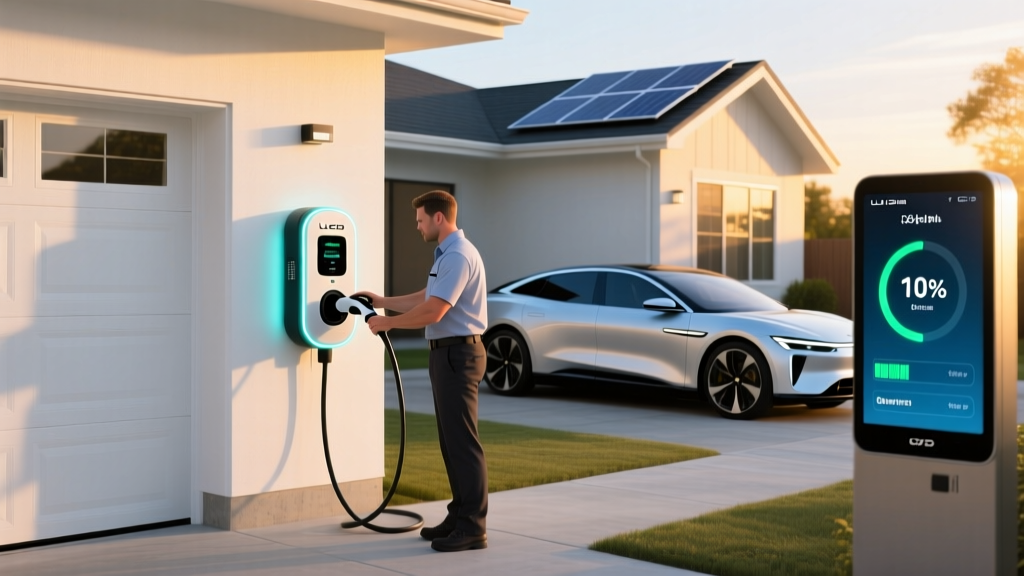
Installing a Level 2 home charger is the single highest-impact upgrade an EV owner can make. You'll need a dedicated 240V circuit, the right amperage for your charger, and potentially a panel upgrade if your home's electrical service is maxed out. Here's the honest cost breakdown — not the "$500 install" some manufacturers advertise, which assumes a panel right next to your garage with spare capacity.
Electrical Requirements for Level 2 Charging
Most Level 2 home chargers run on 240V (the same voltage as your electric dryer or oven) and draw between 16A and 80A. The National Electrical Code (NEC) requires that continuous loads (like EV charging, which runs for hours) use no more than 80% of a circuit's rated capacity. So a 48A charger needs a 60A circuit; a 32A charger needs a 40A circuit. Common configurations:
- 40A circuit / 32A charger: 7.7 kW — adequate for most daily driving (adds ~25–30 mi/hr)
- 60A circuit / 48A charger: 11.5 kW — the sweet spot for most homes (adds ~35–45 mi/hr)
- 100A circuit / 80A charger: 19.2 kW — maximum Level 2 speed, requires robust panel capacity
Installation Cost Breakdown
| Cost Component | Simple Install (Short Run) | Complex Install (Long Run / Panel Upgrade) |
|---|---|---|
| Level 2 Charger Equipment | $350–$700 | $500–$800 |
| Electrician Labor (2–8 hours) | $300–$800 | $1,200–$3,000 |
| Wiring / Conduit (per foot) | $100–$300 | $400–$1,200 |
| Permit & Inspection | $50–$200 | $100–$300 |
| Electrical Panel Upgrade (if needed) | $0 (not needed) | $1,500–$4,000 |
| Total Estimated Cost | $800–$2,000 | $3,700–$9,300 |
Panel upgrade reality check: Homes built before 2000 often have 100A or 150A main service. Adding a 60A EV circuit to an already-loaded 100A panel is a code violation and a fire risk. If your panel is at capacity, expect a $2,000–$4,000 upgrade to 200A service. Always have a licensed electrician perform a load calculation before committing to a charger amperage. The National Electrical Code (NFPA 70) governs these requirements — your electrician will pull a permit and schedule an inspection, which protects your homeowner's insurance coverage.
Connector Compatibility: NACS, CCS, and CHAdeMO in 2026
The connector landscape has consolidated significantly since 2023, when Ford, GM, Rivian, and others adopted Tesla's North American Charging Standard (NACS). Here's where each connector stands for 2026 model-year vehicles:
| Connector | Brands Using It (Factory) | Adapter Needed? |
|---|---|---|
| NACS (Tesla / SAE J3400) | Tesla, Ford, GM, Rivian, Volvo, Polestar, Mercedes-Benz, Nissan, Honda, Fisker, Lucid (new models) | CCS-to-NACS adapter for legacy CCS stations (~$200–$300) |
| CCS1 (Combined Charging System) | Hyundai, Kia, BMW, Volkswagen, Audi, Porsche, Subaru, remaining Stellantis models | NACS-to-CCS adapter for Tesla Superchargers (~$200–$250) |
| CHAdeMO | Discontinued for new vehicles (legacy Nissan Leaf, Mitsubishi Outlander PHEV) | No reliable adapter to NACS/CCS; use CHAdeMO stations while available |
Adapter note for home charging: Most Level 2 home chargers sold in 2026 ship with a NACS connector or offer both NACS and J1772/CCS options at purchase. If you drive a CCS-equipped vehicle (like the Hyundai Ioniq 5) and buy a NACS home charger, you'll need a NACS-to-CCS adapter (~$200). For public DC fast charging, networks like Electrify America and EVgo are adding NACS cables alongside CCS, but CCS-only stalls remain common — carry the appropriate adapter on road trips.
Cost to Charge: Home vs. Public vs. Gas — The Per-Mile Math
The economic argument for EVs hinges on fuel cost savings, but those savings vary dramatically depending on where you charge. Here's a realistic breakdown using national average electricity rates and 2026 gas prices.
| Scenario | Avg $/kWh | Cost/Mile (at 3.5 mi/kWh) | Annual Cost (12,000 mi) |
|---|---|---|---|
| Home — Off-Peak TOU Rate | $0.08–$0.14 | $0.023–$0.040 | $275–$480 |
| Home — Standard Residential Rate | $0.15–$0.22 | $0.043–$0.063 | $515–$755 |
| Public Level 2 (ChargePoint, etc.) | $0.25–$0.49 | $0.071–$0.140 | $855–$1,680 |
| DC Fast Charge (Electrify America, EVgo) | $0.35–$0.65 | $0.100–$0.186 | $1,200–$2,230 |
| Gasoline Vehicle (25 MPG avg, $3.40/gal) | N/A | $0.136 | $1,632 |
The takeaway: Home charging on an off-peak time-of-use (TOU) rate delivers the best economics — roughly 70–80% cheaper per mile than gasoline. But if you rely exclusively on DC fast charging, your per-mile cost can actually exceed a fuel-efficient gas car. This is why home Level 2 installation isn't optional for most EV owners — it's where the savings live.
Many utilities offer TOU plans that drop rates to $0.06–$0.10/kWh between 10 PM and 6 AM. Check your utility's EV-specific rate plans; some (like PG&E's EV2-A or SCE's TOU-D-PRIME) offer dedicated EV charging rates with significant off-peak discounts. According to the U.S. Energy Information Administration, the national average residential electricity rate is approximately $0.17/kWh as of early 2026.
Charging Time Examples: 10–80% for Common Battery Sizes
Here's how long it takes to charge from 10% to 80% SoC — the practical road-trip charging window — for popular 2026 EVs at various charger power levels. Remember: these times assume optimal battery temperature (preconditioned) and peak charge-curve conditions. Cold batteries or high SoC starting points will extend these times.
- Tesla Model Y (75 kWh battery, NACS): 250 kW Supercharger — 10–80% in ~18 minutes; 48A Level 2 (11.5 kW) — ~5.5 hours
- Hyundai Ioniq 5 (77.4 kWh battery, CCS, 800V architecture): 350 kW DCFC — 10–80% in ~18 minutes; 48A Level 2 — ~6 hours
- Ford F-150 Lightning Extended Range (131 kWh battery, NACS): 250 kW DCFC — 10–80% in ~38 minutes; 80A Level 2 (19.2 kW) — ~7 hours
- Chevrolet Equinox EV (85 kWh battery, NACS): 150 kW DCFC — 10–80% in ~28 minutes; 48A Level 2 — ~6.5 hours
- BMW i4 eDrive40 (81.5 kWh battery, CCS): 200 kW DCFC — 10–80% in ~25 minutes; 48A Level 2 (11.5 kW) — ~6 hours
Cold-weather charging note: Battery chemistry slows ion transfer at low temperatures. In sub-freezing conditions, expect 10–80% DC fast charge times to increase by 20–40% unless your vehicle actively preconditioned the battery during navigation to the charger. Tesla, Hyundai/Kia, and Ford all include automatic battery preconditioning when a charger is set as your navigation destination — always use it.
Best Home EV Chargers for 2026: Equipment Picks
Emporia Vue Level 2 Smart Charger
- Power Output: 48A / 11.5 kW (requires 60A circuit)
- Connector: NACS (J1772 adapter included)
- Cable Length: 24 ft
- Smart Features: Wi-Fi, app scheduling, solar integration, TOU rate optimization, energy monitoring
- Price: ~$399
- Best For: Budget-conscious buyers who want smart scheduling and solar-export charging
ChargePoint Home Flex (2nd Gen)
- Power Output: Configurable 16A–80A / up to 19.2 kW (requires up to 100A circuit)
- Connector: NACS or J1772 (select at purchase)
- Cable Length: 23 ft
- Smart Features: Wi-Fi, Alexa/Google Home, app scheduling, detailed session history, load sharing (two chargers on one circuit)
- Price: ~$649–$799 depending on amperage configuration
- Best For: Flexibility — adjustable amperage lets you match your panel's capacity without buying a new unit
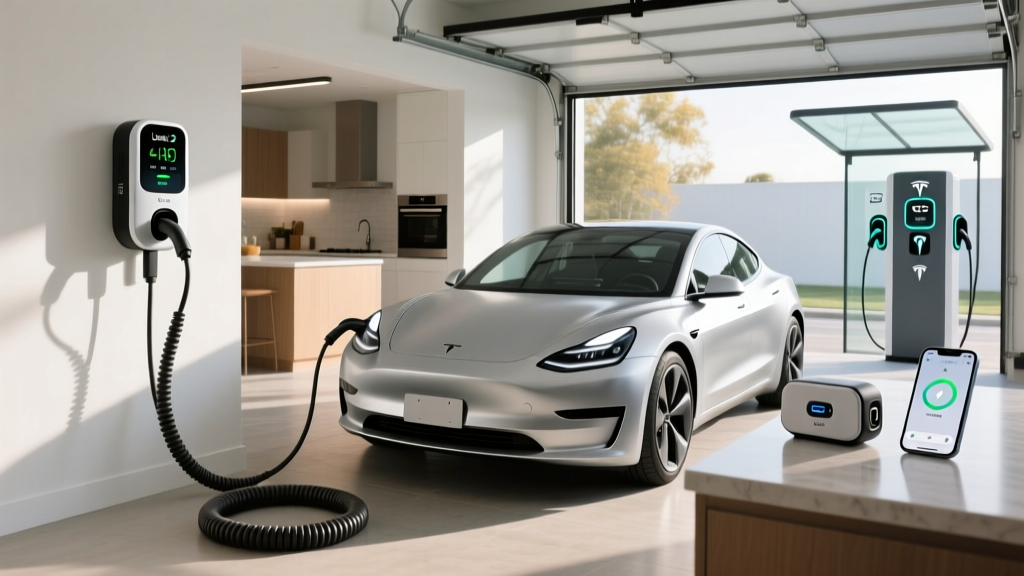
Tesla Wall Connector (Gen 4)
- Power Output: 48A / 11.5 kW (requires 60A circuit)
- Connector: NACS native (J1772 adapter sold separately)
- Cable Length: 24 ft
- Smart Features: Wi-Fi, over-the-air updates, Tesla app integration, power sharing between multiple units, vehicle charging authorization
- Price: ~$475
- Best For: Tesla owners who want seamless ecosystem integration and clean wall-mounted design
Grizzl-E Smart Level 2 Charger
- Power Output: 40A / 9.6 kW (requires 50A circuit)
- Connector: NACS or J1772 (select at purchase)
- Cable Length: 24 ft
- Smart Features: Wi-Fi, app control, OCPP compatibility, outdoor-rated (NEMA 4), extreme cold tested to -40°F
- Price: ~$449
- Best For: Outdoor installations in cold climates — built in Canada, extremely durable housing
Safety, Code, and Permit Considerations
EV charging is a high-amperage, continuous-load application. Cutting corners on electrical work risks fire, voided insurance, and failed home inspections when you sell. Here are the non-negotiable safety requirements:
- Dedicated circuit: Your Level 2 charger must have its own dedicated breaker — never share a circuit with other appliances. A 48A charger on a 60A breaker should have no other loads on that breaker.
- GFCI protection: The 2020 NEC (and subsequent 2023/2026 updates) requires GFCI protection for EV charging outlets in garages and all outdoor locations. Hardwired chargers often have built-in GFCI; if you use a NEMA 14-50 receptacle, your electrician must install a GFCI breaker (~$50–$100 additional).
- Outdoor rating: If your charger is mounted outside, it must carry a NEMA 4 (or higher) weather-resistance rating. All four chargers recommended above are outdoor-rated.
- Permit and inspection: Most jurisdictions require an electrical permit for EV charger installation ($50–$300 depending on locality). The inspection verifies wire gauge, breaker sizing, grounding, and GFCI compliance. Skipping the permit can void your homeowner's insurance in the event of an electrical fire.
- Wire gauge: 60A circuits require 6 AWG copper wire (or 4 AWG aluminum); 100A circuits require 3 AWG copper. Your electrician will size this correctly — don't let a handyman shortcut this with undersized wire.
The NHTSA doesn't regulate home charging equipment directly, but UL certification (UL 2594 or UL 2202) is the relevant safety standard. All major chargers sold in the US carry UL or equivalent ETL listing — avoid uncertified imports from marketplace sellers.
Frequently Asked Questions
How much does it cost to install a home EV charger?
A straightforward Level 2 installation with a short wire run and adequate panel capacity typically costs $800–$2,000 total (equipment + electrician + permit). If your home needs an electrical panel upgrade from 100A to 200A service, expect the total to reach $3,700–$9,300. Always get at least two quotes from licensed electricians and verify they pull a permit.
How fast will each charging level add range?
Level 1 (120V) adds 3–5 miles per hour — suitable only for PHEVs with small batteries or emergency top-ups. Level 2 (240V) at 48A adds roughly 35–45 miles per hour, enough to fully recharge overnight. DC fast charging at 150–350 kW adds 150–1,200+ miles per hour at peak, but tapers significantly above 80% SoC — plan for 10–80% sessions of 18–40 minutes depending on battery size and charger power.
Which connector is compatible with my EV?
For 2026 models: Tesla, Ford, GM, Rivian, Volvo, Polestar, and several others use NACS. Hyundai, Kia, BMW, and VW use CCS1. CHAdeMO is discontinued on new vehicles. For home charging, buy a charger matching your vehicle's native connector. For public DC fast charging on road trips, carry a NACS-to-CCS or CCS-to-NACS adapter (~$200–$300) depending on your vehicle.
How much does charging cost per mile vs. gas?
Home charging on an off-peak TOU rate costs $0.02–$0.04 per mile — about 70–80% less than a 25 MPG gas car at $3.40/gallon ($0.136/mile). Standard residential rates ($0.15–$0.22/kWh) still deliver $0.04–$0.06/mile. Public DC fast charging at $0.48–$0.65/kWh can cost $0.14–$0.19/mile, which sometimes exceeds gasoline. Home charging is where the economic case for EVs is won or lost.
What electrical upgrades might I need?
The most common upgrade is a panel replacement from 100A to 200A service ($1,500–$4,000), required when your existing panel lacks capacity for a new 60A circuit. Older homes may also need service-line upgrades from the utility. Some utilities offer free or subsidized panel upgrades for EV adopters — check with your local provider. A load calculation by a licensed electrician (typically $100–$200) will determine whether your panel can handle the new circuit before you commit to equipment.