What Is the Charger Demon 170 and Who Is It For?
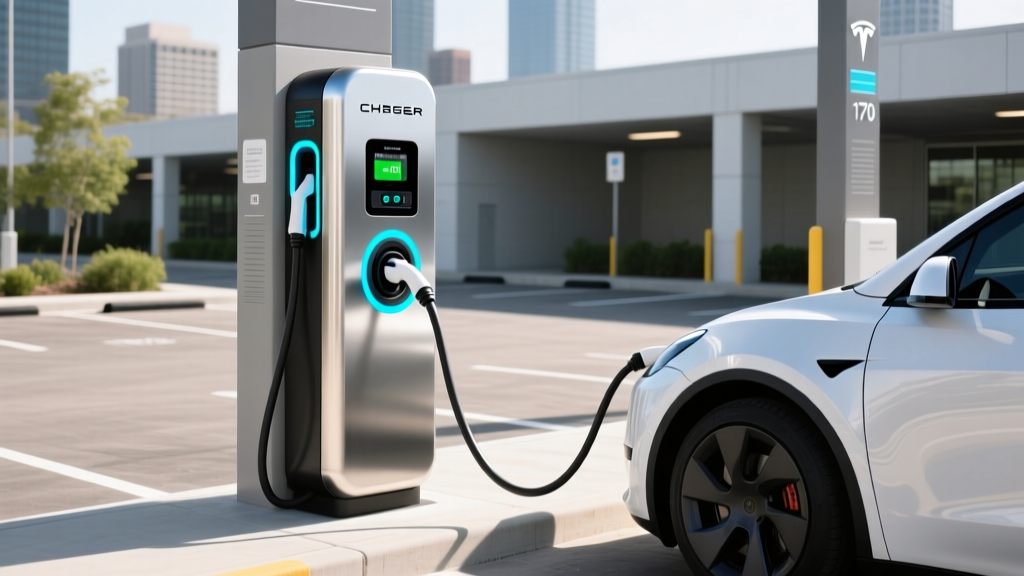
The Charger Demon 170 is a 170 kW DC fast charging unit designed for commercial sites, fleet depots, and high-end residential installations where Level 2 charging simply isn't fast enough. While most home EV owners rely on Level 2 (7–19 kW) wall-box chargers, the Demon 170 targets a different use case: apartment-building charging hubs, workplace parking structures, dealership service bays, and rural highway-adjacent charging plazas where pulling in 170 kW of direct-current power can add 200+ miles of range in roughly 15–20 minutes on compatible vehicles.
Before we break down specs, costs, and compatibility, let's establish a foundational EV literacy point that trips up even seasoned car buyers: kW (kilowatts) measures power — the rate of energy delivery. kWh (kilowatt-hours) measures energy — the total amount stored in your battery. A 170 kW charger can theoretically deliver 170 kWh in one hour, but your car's battery management system (BMS) will throttle that rate based on state of charge, temperature, and battery chemistry. Peak kW is not sustained kW — and understanding that distinction is the single most important thing you can know before spending five figures on DC fast charging equipment.
Charging Levels Explained: Where 170 kW Fits
Understanding the Charger Demon 170 requires context across all three EV charging tiers. Here's how each level performs in real-world conditions:
| Level | Voltage / Phase | Power (kW) | Miles of Range Added per Hour | Typical Use Case |
|---|---|---|---|---|
| Level 1 | 120V / single-phase | 1.0–1.4 kW | 3–5 mi/hr | Overnight trickle; emergency top-up |
| Level 2 | 240V / single-phase | 3.3–19.2 kW | 12–75 mi/hr | Home daily charging; workplace; hotels |
| DC Fast (Demon 170) | 208–480V / 3-phase | 50–170 kW (peak) | 180–650 mi/hr (at peak) | Highway corridors; fleet depots; commercial hubs |
At 170 kW peak, the Demon 170 can add roughly 500–650 miles of range per hour to an efficient sedan like the Hyundai Ioniq 6 (140 MPGe combined, ~3.6 mi/kWh). But "per hour" is misleading for DC fast charging — you'll typically charge from 10–80% in 18–28 minutes depending on your vehicle's battery size and charge-curve acceptance. Here are real-world 10–80% estimates on a 170 kW unit:
- Hyundai Ioniq 5 (77.4 kWh battery, 800V architecture): ~18 minutes (sustains near-peak power longer thanks to E-GMP platform)
- Tesla Model Y Long Range (75 kWh, NMC): ~22–26 minutes (tapers sharply above 55% SoC)
- Ford F-150 Lightning Extended Range (131 kWh): ~35–41 minutes (larger battery = longer session even at high kW)
- Chevrolet Equinox EV (85 kWh, Ultium): ~28–33 minutes
Connector Compatibility: NACS, CCS1, and CHAdeMO
The Charger Demon 170 is available in multiple connector configurations, and choosing the right one depends on which vehicles will use it. As of 2026, the North American Charging Standard (NACS, originally Tesla's proprietary connector) has become the dominant plug, with Ford, GM, Rivian, Volvo, Polestar, and others having transitioned. CCS1 remains on legacy models and some commercial fleet vehicles, while CHAdeMO is effectively orphaned outside older Nissan Leaf and Mitsubishi Outlander PHEV units.
| Connector | Brands Using It (2026) | Max Power Supported | Adapter Needed? |
|---|---|---|---|
| NACS (J3400) | Tesla, Ford, GM, Rivian, Volvo, Polestar, Hyundai/Kia (2025+), BMW, Mercedes | Up to 350 kW (CCS protocol over NACS plug) | No — native on new vehicles |
| CCS1 | Legacy VW ID.4, older Hyundai/Kia, Audi e-tron (pre-2025), Honda Prologue (early build) | Up to 350 kW | CCS-to-NACS adapter (~$150–$250) for NACS-equipped chargers |
| CHAdeMO | Nissan Leaf (discontinued 2025), Mitsubishi Outlander PHEV (legacy) | Up to 100 kW (CHAdeMO 2.0) | Rare adapters available; not recommended for new installs |
For new Charger Demon 170 installations in 2026, we recommend ordering the NACS-native configuration with an optional CCS1 tether adapter stored on-site. This future-proofs the unit for the overwhelming majority of EVs on the road while maintaining backward compatibility. According to the SAE J3400 standard documentation, NACS connectors now support full CCS communication protocols at power levels up to 900 kW for future heavy-duty applications.
Installation Cost Breakdown: Equipment, Electrical Work, and Permits
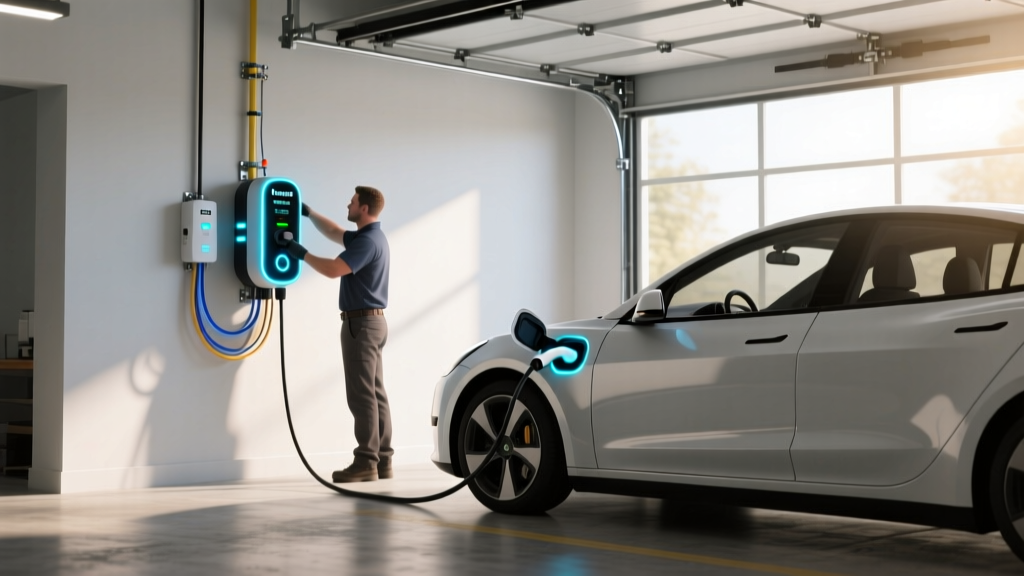
The Charger Demon 170 is not a plug-and-play home unit. It requires 480V three-phase commercial electrical service, which most residential properties do not have. Here's the full cost picture for both commercial and high-end residential scenarios:
| Cost Component | Commercial Site (Existing 480V) | Commercial Site (New Service) | Residential (Rare — Requires Upgrade) |
|---|---|---|---|
| Demon 170 unit (hardware) | $28,000–$38,000 | $28,000–$38,000 | $28,000–$38,000 |
| Electrician labor (mounting, wiring, conduit) | $4,000–$8,000 | $8,000–$18,000 | $12,000–$25,000 |
| Transformer / switchgear upgrade | $0 (if existing) | $15,000–$45,000 | $20,000–$60,000 |
| Utility demand-charge setup / metering | $1,000–$5,000 | $3,000–$12,000 | $5,000–$15,000 |
| Permitting and inspections | $500–$2,000 | $1,500–$4,000 | $2,000–$5,000 |
| Concrete pad / bollards / signage | $2,000–$5,000 | $2,000–$5,000 | $1,500–$3,000 |
| TOTAL ESTIMATED RANGE | $35,500–$58,000 | $57,500–$122,000 | $68,500–$146,000 |
Panel upgrade reality check: Most US homes have 100A or 200A single-phase 240V service. A 170 kW DC fast charger requires 480V three-phase service drawing approximately 200–250A at that voltage. Upgrading a residential property to commercial-grade three-phase service involves utility coordination, a new transformer, new metering, and potentially new service drops from the pole. This can cost $20,000–$60,000+ before the charger itself is installed. For this reason, the Demon 170 is overwhelmingly a commercial and fleet product, not a residential one.
Commercial site hosts should investigate the Alternative Fuel Vehicle Refueling Property Credit (IRS §30C), which offers up to 30% of hardware and installation costs (capped at $100,000 per item of property) for qualifying charging equipment placed in service in eligible census tracts. Consult a tax professional for current-year eligibility.
Cost to Charge: Per-Mile Economics at 170 kW vs. Level 2 vs. Gas
DC fast charging is the most expensive way to power an EV per kWh, but it buys time savings that matter for road trips and fleet turnaround. Here's how costs stack up across scenarios:
| Charging Scenario | Avg. $/kWh | Cost per Mile (3.5 mi/kWh EV) | Full 75 kWh Battery Fill |
|---|---|---|---|
| Home Level 2 (off-peak utility rate) | $0.08–$0.14 | $0.023–$0.040 | $6.00–$10.50 |
| Home Level 2 (standard residential rate) | $0.13–$0.18 | $0.037–$0.051 | $9.75–$13.50 |
| Public Level 2 (ChargePoint, Blink) | $0.20–$0.35 | $0.057–$0.100 | $15.00–$26.25 |
| DC Fast — Demon 170 (Electrify America, EVgo, Tesla Supercharger) | $0.30–$0.55 | $0.086–$0.157 | $22.50–$41.25 |
| Gasoline baseline (25 MPG combined, $3.40/gal) | — | $0.136/mile | $40.80 (equiv. 12 gal) |
Key takeaway: Even at premium DC fast charging rates ($0.48/kWh national average at major networks per fueleconomy.gov efficiency data), an efficient EV still costs roughly the same or less per mile than a 25 MPG gas car. But home Level 2 charging at off-peak rates is 3–5x cheaper than gas on a per-mile basis. The Demon 170's value proposition is speed, not cost savings — it's the EV equivalent of paying premium for convenience-store gas because you're in a hurry.
Safety, Electrical Code, and Site Requirements
Installing a 170 kW DC fast charger involves serious electrical infrastructure and strict code compliance. Here's what site hosts and electrical contractors need to know:
- Dedicated circuit: The Demon 170 requires its own dedicated 3-phase breaker, typically 250A at 480V. It cannot share a circuit with other equipment.
- Ground-fault protection: NEC Article 625 requires ground-fault protection of equipment (GFPE) for all EVSE rated over 150V to ground. At 480V three-phase, this is mandatory.
- Outdoor rating: The Demon 170 carries a NEMA 4 (outdoor, weatherproof) enclosure rating. It operates in temperatures from -22°F to 122°F (-30°C to 50°C). In coastal or high-salinity environments, specify the optional NEMA 4X corrosion-resistant enclosure.
- Cable management: The 25-foot liquid-cooled DC cable weighs approximately 12 lbs and requires a retractor system to prevent ground contact and trip hazards. ADA compliance requires cable reach to all designated accessible parking spots.
- Emergency disconnect: NEC 2023 (Section 625.40) requires an emergency disconnect within sight of the charger and no more than 25 feet away. Budget $300–$800 for the disconnect switch and installation.
- Utility demand charges: Commercial sites will likely face demand charges from their utility based on peak kW draw. A single Demon 170 pulling 170 kW can trigger $10–$25/kW monthly demand charges depending on your utility — that's $1,700–$4,250/month in demand fees alone, even if the charger sits idle most of the time. Battery-buffered installations (pairing the charger with an on-site battery storage system) can mitigate this by drawing power slowly from the grid and discharging quickly to the vehicle.
Alternative Equipment: When 170 kW Isn't the Right Fit
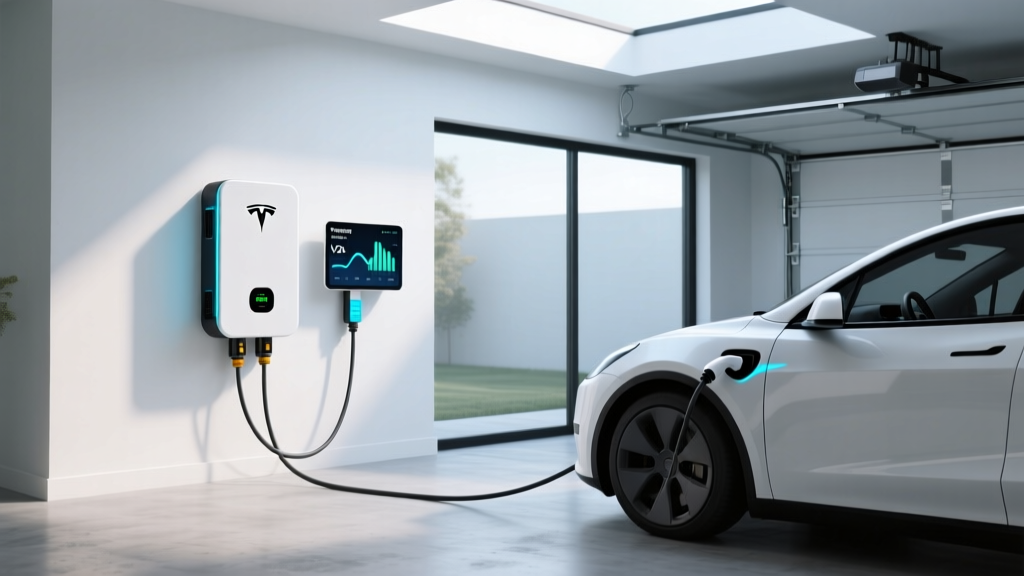
For most EV owners reading this guide, the Charger Demon 170 is overkill. If you're charging at home, here's what actually makes sense — and what we recommend based on power output, connector type, cable length, and smart features:
Emporia Vue Level 2 (Home Pick)
- Power: 11.5 kW (48A) / 19.2 kW (80A model)
- Connector: NACS (J3400) native, CCS1 adapter included
- Cable: 24 ft
- Smart features: Wi-Fi, app scheduling, solar integration, energy monitoring
- Price: $399–$599 (before potential §30D / §25E residential energy credit)
- Install: 240V / 60A dedicated circuit; $500–$1,500 electrician cost typical
ChargePoint Home Flex (Flexible Pick)
- Power: Adjustable 16A–50A (3.8–12 kW at 240V)
- Connector: NACS or CCS1 (configurable at purchase)
- Cable: 18 ft or 23 ft options
- Smart features: Wi-Fi, Alexa, app-based amperage adjustment, utility demand-response programs
- Price: $549–$699
- Install: 240V / 40–60A circuit; $600–$2,000 electrician cost
Tesla Wall Connector (Tesla Owners)
- Power: 11.5 kW (48A)
- Connector: NACS native
- Cable: 24 ft
- Smart features: Wi-Fi updates, power sharing (up to 6 units on one circuit), load management
- Price: $420
- Install: 240V / 60A circuit; $400–$1,800 electrician cost
For commercial sites that don't need the full 170 kW, consider the ABB Terra 124 (120 kW, dual-port CCS/NACS, ~$45,000–$55,000 installed) or the Tritium RTM75 (75 kW, compact footprint, ~$30,000–$42,000 installed). These units pair well with standard 208V/480V three-phase service and carry lower demand-charge penalties.
Frequently Asked Questions
How much does it cost to install the Charger Demon 170?
Total installed cost ranges from approximately $35,500 to $146,000 depending on whether your site already has 480V three-phase service. Sites with existing commercial power (warehouses, dealerships, fleet yards) land in the $35,000–$58,000 range. Sites requiring new utility service, transformer upgrades, and extended conduit runs can exceed $100,000. The unit itself costs $28,000–$38,000; the rest is electrical infrastructure, permitting, and site prep.
How fast will each charging level add range to my EV?
Level 1 (120V household outlet) adds 3–5 miles per hour — overnight charging yields 30–50 miles. Level 2 (240V home charger) adds 12–75 miles per hour depending on amperage and your vehicle's onboard charger capacity. DC fast charging at 170 kW can add 180–650 miles per hour at peak, but real-world sessions average 90–120 kW, yielding 10–80% charges in 18–40 minutes depending on battery size. Check your vehicle's EPA efficiency rating at fueleconomy.gov to calculate your specific miles-per-kWh.
Which connector is compatible with my EV?
If your EV is a 2025 or newer model from Tesla, Ford, GM, Rivian, Hyundai, Kia, Volvo, BMW, or Mercedes, it almost certainly uses NACS (J3400). If it's a 2024 or older non-Tesla, it likely uses CCS1. The Nissan Leaf uses CHAdeMO. The Charger Demon 170 can be ordered with NACS or CCS1 tethers, and adapters are available for cross-compatibility. Always verify your vehicle's charge port before specifying connector type.
How much does charging cost per mile compared to gasoline?
Home Level 2 charging at off-peak rates costs $0.02–$0.04 per mile — roughly 4–5x cheaper than a 25 MPG gas car at $3.40/gallon ($0.136/mile). Public DC fast charging at $0.40–$0.55/kWh costs $0.11–$0.16 per mile, which is comparable to or slightly above gas. The economic advantage of EVs is maximized with home charging; DC fast charging is a convenience premium you pay for speed on road trips.
What electrical upgrades might I need for a DC fast charger?
Residential properties almost always need a full service upgrade: new 480V three-phase utility connection, new transformer ($15,000–$60,000), new metering, and potentially new underground conduit or overhead service drops. Commercial properties may need a panel upgrade if existing capacity is near its limit, plus a dedicated 250A breaker and emergency disconnect. Always have a licensed electrician perform a load calculation before committing to a DC fast charger purchase. Many site hosts find that installing two or three Level 2 chargers (19.2 kW each) delivers better economics and easier permitting than a single DC fast unit.
Can I install the Charger Demon 170 at my home?
Technically yes, but practically it's rarely advisable. The electrical upgrade cost alone ($20,000–$60,000 for three-phase service) exceeds the cost of a new EV. Monthly utility demand charges can add hundreds to your electric bill even with minimal usage. Unless you operate a home-based fleet business, run a rideshare operation with multiple vehicles, or have existing three-phase service (some rural properties with heavy agricultural equipment do), a high-amperage Level 2 charger (11.5–19.2 kW) is the correct home solution.