Understanding EV Charging Levels: Speed, Power, and Real-World Range Added
The single most important distinction in EV charging is between kW (kilowatts), which measures power — how fast energy flows into your battery — and kWh (kilowatt-hours), which measures energy capacity — how much total energy the battery stores. Think of kW as the width of a pipe and kWh as the size of the tank. A 10 kW charger fills a 75 kWh battery faster than a 2 kW charger, but both ultimately deliver the same kWh.
Every charger carro you consider will fall into one of three categories. Here is how they compare in measurable terms:
| Level | Voltage | Max Power (kW) | Miles of Range Added per Hour | Typical Use Case |
|---|---|---|---|---|
| Level 1 | 120V AC | 1.2–1.9 kW | 3–5 miles | Overnight top-up, PHEVs, low daily mileage |
| Level 2 | 240V AC | 3.3–19.2 kW | 12–75 miles | Home daily charging, workplace, hotels |
| DC Fast Charging | 400–900V DC | 50–350 kW | 150–1,200+ miles (peak) | Road trips, highway corridors, rapid top-ups |
Real-world context: A Level 2 charger carro rated at 11.5 kW (48A on a 60A circuit) will add roughly 40–44 miles of range per hour to a vehicle averaging 3.5–4.0 miles per kWh — sufficient to fully replenish most EVs overnight. A 350 kW DC fast charger can add 200 miles in under 15 minutes to a compatible vehicle like the Hyundai Ioniq 5 or Porsche Taycan, though peak speeds are never sustained for the entire session due to charging-curve taper above 80% state of charge.
How Much Does It Cost to Install a Home EV Charger?
Home Level 2 installation is where most EV owners spend the majority of their charging time — and where costs vary the most. The total price depends on your home's electrical panel capacity, the distance from panel to charger location, and local permit fees.
| Cost Component | Typical Range | Notes |
|---|---|---|
| Level 2 Charger Equipment | $350–$800 | Smart Wi-Fi chargers (ChargePoint, Wallbox, Emporia); dumb units from $250 |
| Electrician Labor (standard install) | $500–$1,500 | 240V/50A circuit, NEMA 14-50 outlet or hardwired; shorter runs = lower cost |
| Electrical Panel Upgrade (if needed) | $1,500–$3,500 | Required if panel is 100A or maxed out; upgrade to 200A service |
| Permit & Inspection | $50–$300 | Varies by municipality; some utilities bundle permits |
| Conduit & Wiring Materials | $100–$400 | Longer runs from panel to garage/driveway increase cost |
| Total (no panel upgrade) | $900–$2,700 | Most homes with 200A service fall in this range |
| Total (with panel upgrade) | $2,500–$5,500 | Older homes with 100A panels or high existing loads |
Panel upgrade reality: If your home has a 100-amp electrical panel that is already near capacity (common in homes built before 1990), adding a 40A or 50A dedicated circuit for EV charging may exceed your panel's headroom. An electrician will perform a load calculation per NEC Article 220 to determine if an upgrade to 200A service is required. This is the single biggest variable in charger carro installation cost, and it is non-negotiable for safety.
Electrical Requirements for a Level 2 Charger Carro
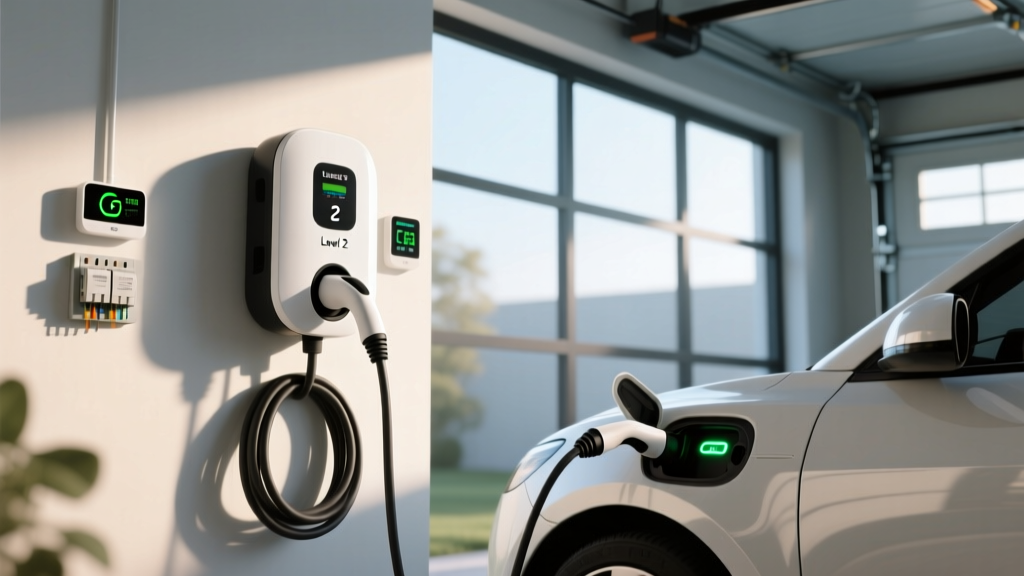
A standard Level 2 home charger requires:
- 240V dedicated circuit — typically 40A to 60A breaker (NEC requires the continuous load to be 80% of breaker rating, so a 48A charger needs a 60A breaker)
- NEMA 14-50 receptacle (for plug-in units) or hardwired connection (for units above 48A or where local code requires it)
- GFCI protection — required by NEC 2020 and later for EV receptacles in garages and outdoor locations; many modern chargers have built-in GFCI, which can avoid nuisance tripping with breaker-panel GFCIs
- Outdoor-rated enclosure (NEMA 4 or 4X) if the charger is mounted outside or in an exposed carport
Connector Compatibility: NACS, CCS1, and CHAdeMO Explained
The connector landscape has consolidated significantly as of 2026. Here is what fits what:
| Connector | Vehicles Using It | AC Level 2 | DC Fast Charging | Notes |
|---|---|---|---|---|
| NACS (J3400) | Tesla (all), Ford, GM, Rivian, Hyundai, Kia, Volvo, Polestar (2025+) | Yes | Yes (Tesla Supercharger network + others) | Industry standard by 2026; compact design |
| CCS1 | Pre-2025 Ford/GM/Hyundai/Kia/VW/BMW; still on some 2026 models | Yes (via J1772) | Yes (Electrify America, EVgo, ChargePoint) | Being phased out; adapters to NACS available |
| CHAdeMO | Nissan Leaf (legacy), Mitsubishi Outlander PHEV (older) | No (uses J1772) | Yes (limited stations) | Effectively discontinued; declining infrastructure |
| J1772 | All non-Tesla EVs for AC Level 1/2 (pre-NACS transition) | Yes | No (AC only) | J1772-to-NACS adapters included with many new EVs |
Adapter guidance: If you own a CCS1-equipped EV (e.g., a 2024 Ford Mustang Mach-E or 2023 Hyundai Ioniq 5), you will need a CCS1-to-NACS adapter (approximately $150–$250) to access Tesla Superchargers, which now number over 30,000 stalls in North America. Ford, GM, and Rivian provide these adapters to owners. Conversely, NACS-equipped vehicles can use a NACS-to-CCS1 adapter to access Electrify America and other CCS networks. Always verify adapter compatibility with your specific model year before purchasing.
Charging Time Examples: 10–80% for Common Battery Sizes
Charging times depend on battery capacity (kWh), the vehicle's onboard charge acceptance rate, and the charger's output. Here are real-world estimates for popular configurations:
| Vehicle (Example) | Battery (kWh usable) | Level 2 (11.5 kW / 48A) | DC Fast (150 kW peak) | DC Fast (250/350 kW peak) |
|---|---|---|---|---|
| Tesla Model Y LR (2026) | ~75 kWh | ~6.5 hours (0–100%) | 10–80% in ~28 min | 10–80% in ~18 min |
| Hyundai Ioniq 5 (84 kWh pack) | ~77.4 kWh | ~7 hours (0–100%) | 10–80% in ~25 min | 10–80% in ~18 min (800V architecture) |
| Ford F-150 Lightning (extended) | ~131 kWh | ~11.5 hours (0–100%) | 10–80% in ~45 min | 10–80% in ~35 min |
| Chevrolet Equinox EV (2026) | ~85 kWh | ~7.5 hours (0–100%) | 10–80% in ~30 min | 10–80% in ~22 min |
| Toyota Prius Prime (PHEV) | ~13.6 kWh | ~1.2 hours (0–100%) | N/A (no DC fast) | N/A |
Key insight: Vehicles with 800V battery architecture (Hyundai/Kia E-GMP, Porsche Taycan, Lucid Air) can accept higher sustained DC fast-charge power because higher voltage means lower current for the same kW, reducing heat and taper. On a 350 kW charger, an Ioniq 5 sustains over 200 kW well past 55% SoC, while a 400V vehicle typically drops below 150 kW by 40–45% SoC. This translates to a meaningful 5–8 minute advantage on road trips.
Cost Per Mile: Home Charging vs. Public vs. Gasoline
The economics of EV charging depend heavily on where you charge. Here is a realistic cost breakdown using 2026 electricity and fuel prices:
| Charging Scenario | Cost per kWh | Vehicle Efficiency | Cost per Mile | Equivalent Gas Price (at 30 MPG) |
|---|---|---|---|---|
| Home (off-peak utility rate) | $0.08–$0.14 | 3.5 mi/kWh | $0.023–$0.040 | $0.69–$1.20/gal |
| Home (national avg. residential) | $0.17 | 3.5 mi/kWh | $0.049 | $1.47/gal |
| Public Level 2 (ChargePoint, etc.) | $0.25–$0.49 | 3.5 mi/kWh | $0.071–$0.140 | $2.13–$4.20/gal |
| DC Fast Charging (EA, EVgo, Tesla) | $0.32–$0.56 | 3.5 mi/kWh | $0.091–$0.160 | $2.73–$4.80/gal |
| Gasoline (national avg. 2026) | — | 30 MPG | $0.107–$0.123 | $3.20–$3.70/gal |
The bottom line: Home charging on a standard residential rate costs roughly $0.04–$0.05 per mile — about half the per-mile cost of a 30 MPG gas car at $3.40/gallon. However, exclusive reliance on DC fast charging at $0.48/kWh pushes per-mile costs to $0.14, which can exceed gasoline costs. This is why home Level 2 access is the economic foundation of EV ownership.
For the latest utility rates by state, the U.S. Energy Information Administration publishes monthly average electricity prices by region.
Best Charger Carro Equipment Picks for 2026
Based on power output, connector support, build quality, smart features, and real-world reliability, here are the top Level 2 home chargers currently available:
Emporia Vue Level 2 EV Charger
- Power Output: 11.5 kW (48A) on a 60A circuit
- Connector: J1772 (NACS adapter available)
- Cable Length: 24 feet
- Smart Features: Wi-Fi, energy monitoring, solar integration, scheduling via app, load management
- Price: ~$399
- Best For: Budget-conscious buyers who want full smart features and energy tracking
ChargePoint Home Flex (2nd Gen)
- Power Output: Up to 12 kW (50A) — configurable via dip switch from 16A to 50A
- Connector: NACS (J1772 adapter included)
- Cable Length: 23 feet
- Smart Features: Wi-Fi, Alexa/Google integration, ChargePoint network access, flexible amperage for panel-constrained homes
- Price: ~$649
- Best For: Flexibility — adjustable amperage lets you match your circuit capacity without buying a new unit
Wallbox Pulsar Plus (48A)
- Power Output: 11.5 kW (48A) on 60A circuit
- Connector: J1772 (NACS version available for 2025+ vehicles)
- Cable Length: 25 feet
- Smart Features: Wi-Fi + Bluetooth, Power Sharing (two units on one circuit), Eco-Smart solar mode, compact form factor
- Price: ~$599
- Best For: Multi-EV households (Power Sharing allows two cars on one 60A circuit) and tight mounting spaces
Tesla Wall Connector (Gen 4)
- Power Output: Up to 11.5 kW (48A)
- Connector: NACS native; J1772 adapter included
- Cable Length: 24 feet
- Smart Features: Wi-Fi, over-the-air updates, power sharing with other Wall Connectors, integrated cable management
- Price: ~$420
- Best For: Tesla owners or NACS-equipped vehicles seeking the lowest-cost premium charger
Selection framework: Choose the Emporia if you want the best value with energy monitoring. Choose the ChargePoint Home Flex if your panel capacity may change or you want adjustable amperage. Choose the Wallbox if you have two EVs and one circuit. Choose the Tesla Wall Connector if you drive a NACS vehicle and want a clean, affordable, reliable unit. All four are UL-listed and support outdoor installation with appropriate weatherproofing.
Safety, Code, and Installation Best Practices
EV charging involves sustained high-current draw — often 8+ hours at 40–48 amps — which places more continuous load on your electrical system than any other household appliance. Proper installation is not optional.
- Dedicated circuit required: Your charger carro must be on its own dedicated breaker — never shared with other loads. A 48A charger requires a 60A breaker per NEC 210.20 (continuous loads limited to 80% of breaker rating).
- Wire gauge: 6 AWG copper for 50A circuits; 4 AWG copper for 60A circuits. Aluminum wire requires larger gauge.
- GFCI protection: NEC 625.54 requires GFCI protection for EV receptacles in garages and outdoors. Hardwired chargers may be exempt in some jurisdictions — confirm with your local AHJ (Authority Having Jurisdiction).
- Outdoor rating: If mounted outside, the charger must carry a NEMA 4 (splash-resistant) or NEMA 4X (corrosion-resistant) rating. All picks above qualify.
- Permit and inspection: Most jurisdictions require an electrical permit for a new 240V circuit. The inspection ensures wire gauge, breaker sizing, grounding, and GFCI compliance. Do not skip this — unpermitted work can void home insurance claims.
The National Electrical Code (NFPA 70) governs EV charging installations. Your licensed electrician will be familiar with Article 625 (EV charging system requirements).
Federal Tax Credit for Home Charging Equipment
Under the IRS §30C Alternative Fuel Vehicle Refueling Property Credit, homeowners may claim a tax credit of up to 30% of the cost of EV charging equipment and installation, capped at $1,000. Key requirements:
- The charger must be installed at your primary residence
- The property must be located in an eligible census tract (low-income or non-urban area, per IRA provisions)
- The credit applies to both equipment and installation labor costs
- You must have sufficient tax liability to claim the credit (it is non-refundable)
This credit is separate from the §30D new EV purchase credit. Consult a tax professional to confirm eligibility for your specific address and tax situation, as census-tract eligibility maps are updated periodically.
Frequently Asked Questions
How much does it cost to install a home EV charger?
A typical Level 2 home charger carro installation costs between $900 and $2,700 when your electrical panel has sufficient capacity. This includes the charger unit ($350–$800), electrician labor ($500–$1,500), wiring materials ($100–$400), and a local permit ($50–$300). If your home requires a panel upgrade from 100A to 200A service, add $1,500–$3,500, bringing the total to $2,500–$5,500.
How fast will each charging level add range?
Level 1 (120V) adds 3–5 miles of range per hour. Level 2 (240V, 48A/11.5 kW) adds 35–44 miles per hour depending on vehicle efficiency. DC fast charging adds 150–1,200+ miles per hour at peak power, though sessions typically last 18–40 minutes (10–80%) rather than running for a full hour.
Which connector/charger is compatible with my EV?
If you own a 2025 or newer Tesla, Ford, GM, Rivian, Hyundai, Kia, or Volvo EV, your vehicle uses the NACS (J3400) connector natively. If you own a 2024 or older non-Tesla EV, you likely have CCS1 and will need an adapter for Tesla Superchargers. CHAdeMO is limited to legacy Nissan Leaf and Mitsubishi models. For home Level 2 charging, all vehicles can use a J1772 or NACS connector (adapters are widely available).
How much does charging cost per mile vs gas?
Home charging at the national average rate of $0.17/kWh costs approximately $0.049 per mile for a vehicle averaging 3.5 mi/kWh. Gasoline at $3.40/gallon in a 30 MPG vehicle costs $0.113 per mile — more than double. However, DC fast charging at $0.48/kWh costs $0.137/mile, which exceeds gasoline. The economic advantage of EVs is maximized with consistent home charging.
What electrical upgrades might I need?
The most common upgrade is a panel capacity increase from 100A to 200A, required when your existing panel lacks headroom for a new 40–60A dedicated circuit. Your electrician will perform a NEC Article 220 load calculation. Other potential upgrades include adding a sub-panel (if the charger is far from the main panel), upgrading the meter base, or replacing outdated wiring (e.g., knob-and-tube or aluminum branch circuits near the installation path).
Can I charge my EV with a regular 120V outlet?
Yes — this is Level 1 charging. It delivers 1.2–1.9 kW and adds 3–5 miles of range per hour. For a PHEV with a 13–18 kWh battery, a full overnight charge is feasible. For a BEV with a 75+ kWh battery, Level 1 is only practical as emergency top-up or for vehicles driven fewer than 30 miles per day.
Do I need a smart charger or is a basic unit fine?
A basic ("dumb") Level 2 charger works perfectly for charging. Smart features — Wi-Fi scheduling, energy monitoring, utility demand-response integration — add convenience and can reduce costs if your utility offers time-of-use rates or EV-specific demand-response programs. For most owners, the $50–$150 premium for a smart charger pays for itself through off-peak scheduling alone.