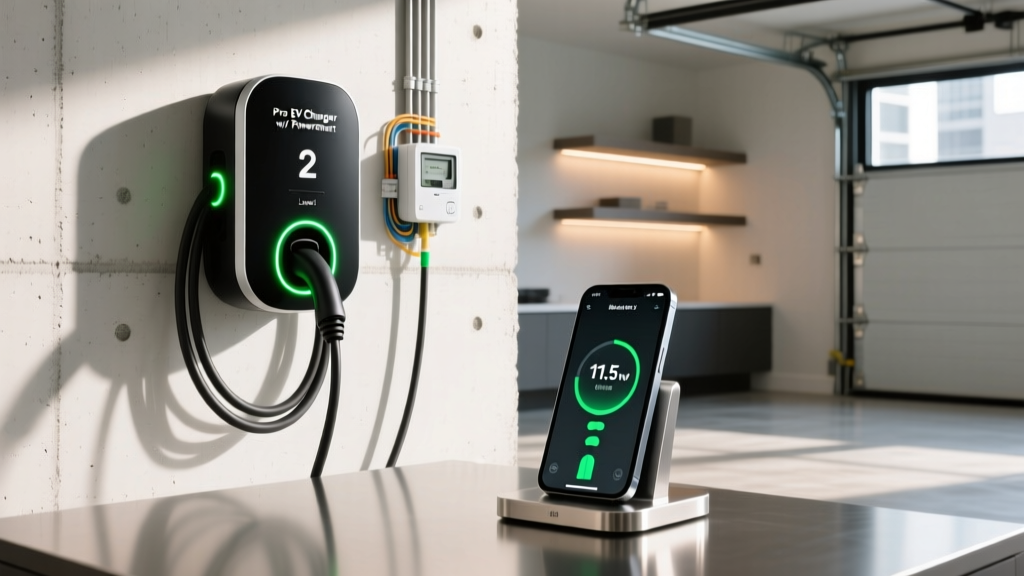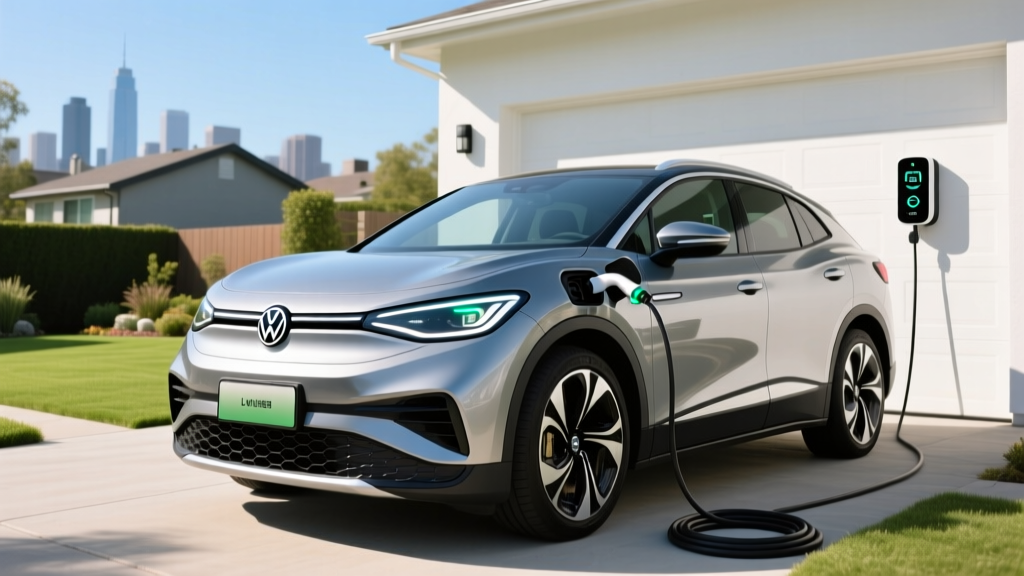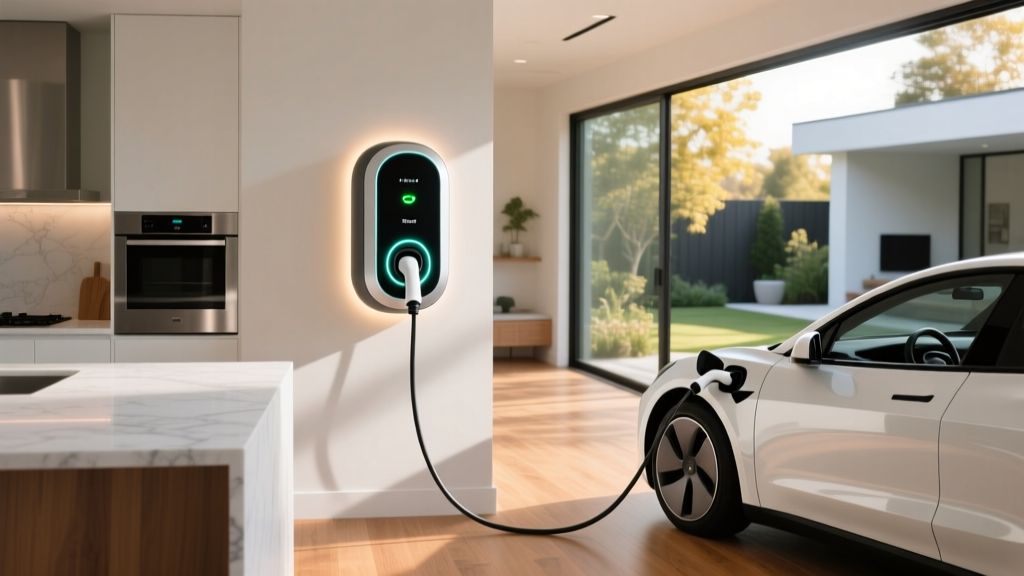
If you have roughly $2,000 to spend on a complete home EV charging setup — charger, wiring, permit, and electrician labor — you are in a strong position. That budget covers a premium smart Level 2 wall connector and a straightforward 240V circuit installation in most modern homes. But if your electrical panel needs an upgrade or your garage sits far from the breaker box, that same $2,000 can disappear before you plug in for the first time.
This guide maps out exactly where your money goes, what charging speed you can expect, which connector your EV needs, and how to avoid the panel-upgrade surprise that pushes budgets past $3,000. All figures reflect 2026 equipment pricing and typical U.S. electrician rates.
How the $2,000 Charger + Car Install Budget Breaks Down
A home Level 2 charging setup has two cost centers: the equipment (the charger itself) and the electrical installation (circuit, wiring, conduit, permit, and labor). Here is a realistic range for each component:
| Component | Budget Range | Notes |
|---|---|---|
| Level 2 smart charger (hardwired or plug-in) | $400 – $750 | 40A–48A units from ChargePoint, Emporia, Wallbox, or Tesla |
| 240V / 50A dedicated circuit (electrician labor + materials) | $600 – $1,400 | Assumes panel has capacity; 20–40 ft wire run in conduit |
| Electrical permit | $50 – $200 | Varies by municipality; some bundle with inspection |
| Panel upgrade (if needed) | $1,500 – $3,500+ | Upgrading from 100A to 200A service; blows past the $2,000 budget |
| Total (no panel upgrade) | $1,050 – $2,350 | Most homes built after 2000 with 200A service fall here |
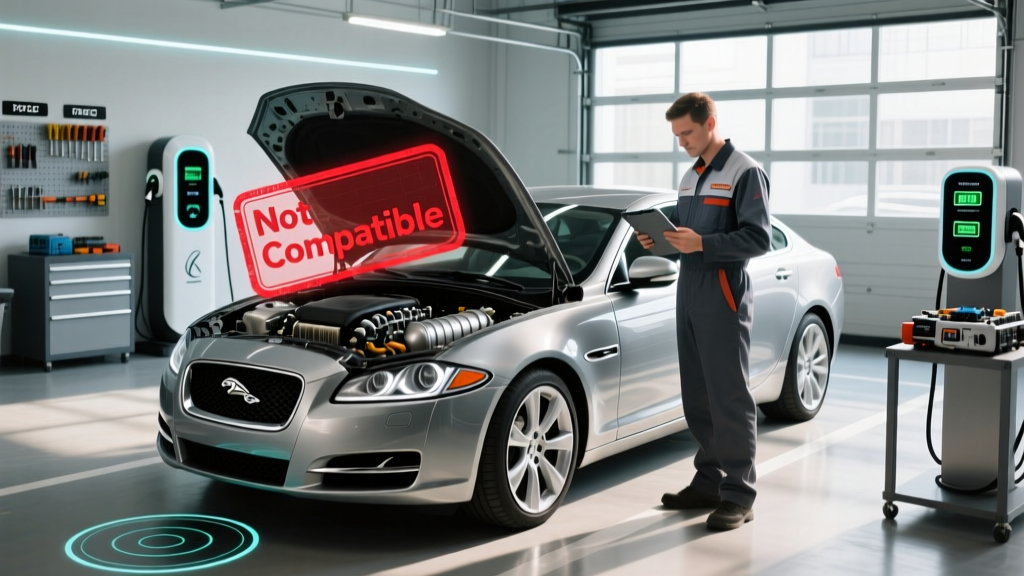
The critical variable is your electrical panel. A 200-amp panel with spare breaker slots can usually accommodate a 50A EV circuit without issue. A 100-amp panel in an older home may already be near capacity with existing appliances, requiring a service upgrade that alone can cost $1,500 to $3,500. Before purchasing any equipment, have a licensed electrician perform a load calculation to confirm your panel can handle the additional draw.
Charging Levels Explained: Speed in kW and Miles Per Hour
EV charging is measured in kW (kilowatts — the rate of power delivery), while your battery capacity is measured in kWh (kilowatt-hours — the total energy stored). Think of kW as the flow rate of a hose and kWh as the size of the bucket. Here is what each level delivers:
| Level | Voltage | Max Power (kW) | Miles of Range Added Per Hour | Typical Use Case |
|---|---|---|---|---|
| Level 1 | 120V AC | 1.4 – 1.9 kW | 3 – 5 mi/hr | Overnight trickle; PHEVs with small batteries |
| Level 2 (home/public AC) | 240V AC | 7.2 – 11.5 kW | 20 – 44 mi/hr | Daily home charging; workplace; shopping centers |
| DC Fast Charging | 400V–800V DC | 50 – 350 kW | 150 – 1,200 mi/hr (peak) | Road trips; 10–80% in 15–40 minutes |
For a $2,000 home setup, you are targeting Level 2. A 48-amp (11.5 kW) charger adds roughly 35–44 miles of range per hour for a mid-size EV like the Tesla Model Y or Hyundai IONIQ 5, which translates to a full overnight replenishment for nearly any daily commute. Level 1, by contrast, would need 20+ hours to fill a 75 kWh battery — adequate for plug-in hybrids with 30–40 miles of electric range, but not for a BEV driver covering 40+ miles daily.
Charging Time Examples: 10–80% for Common Battery Sizes
Most EV owners charge between 10% and 80% state of charge (SoC) to preserve long-term battery health. Here is how long that takes at various Level 2 power levels:
| Battery Size (kWh usable) | At 7.2 kW (32A) | At 9.6 kW (40A) | At 11.5 kW (48A) |
|---|---|---|---|
| 58 kWh (e.g., VW ID.4 Standard) | ~5 hr 40 min | ~4 hr 15 min | ~3 hr 30 min |
| 75 kWh (e.g., Tesla Model Y LR) | ~7 hr 15 min | ~5 hr 30 min | ~4 hr 35 min |
| 84 kWh (e.g., Ford F-150 Lightning Ext.) | ~8 hr 10 min | ~6 hr 10 min | ~5 hr 10 min |
| 100 kWh (e.g., Lucid Air, Rivian R1S Max) | ~9 hr 45 min | ~7 hr 20 min | ~6 hr 5 min |
All of these fit comfortably within an overnight window (8–10 hours). The key takeaway: a 48A / 11.5 kW charger is the sweet spot for most EV owners and fits within a 50A breaker circuit, which is what a $2,000 install budget typically funds.
Which Connector Does Your EV Need?
The connector landscape shifted dramatically between 2023 and 2026, with the North American Charging Standard (NACS) — originally Tesla's proprietary plug — now adopted by Ford, GM, Rivian, Hyundai, Kia, BMW, and most major automakers. CCS1 remains on many 2022–2025 models, and CHAdeMO is effectively legacy (Nissan Leaf).
| Connector | Brands Using It (2026 Models) | Adapter Needed? |
|---|---|---|
| NACS (Tesla / J3400) | Tesla (all), Ford, GM, Rivian, Hyundai, Kia, BMW, Volvo, Polestar, Mercedes (2025+) | No — native NACS port on new models |
| CCS1 | VW, Audi (2025 and earlier), older BMW i4/iX, some Stellantis models | NACS-to-CCS adapter (~$200) if using Tesla Superchargers |
| CHAdeMO | Nissan Leaf (legacy); no new models since ~2023 | Limited public availability; plan for CCS/NACS adapter |
For a home Level 2 charger, the plug end is less critical than it is for DC fast charging, because most Level 2 units use the J1772 connector (which NACS vehicles accept via a small adapter included with most new EVs). If you own a newer NACS-equipped vehicle, several charger manufacturers now offer native NACS connectors on their Level 2 units — eliminating the adapter entirely.
Equipment Picks: Best Chargers Within a $2,000 Total Budget
With $400–$750 allocated for the charger itself, these units deliver the best combination of power, reliability, and smart features for 2026:
Emporia Vue Level 2 EV Charger
- Power: 48A / 11.5 kW (hardwired) or 40A / 9.6 kW (NEMA 14-50 plug)
- Connector: J1772 (NACS adapter included with most EVs)
- Cable length: 24 ft
- Smart features: Wi-Fi, scheduling, energy monitoring via Emporia app, solar integration
- Price: ~$400
- Verdict: Best value; leaves maximum budget for electrical work
ChargePoint Home Flex
- Power: Up to 50A / 12 kW (hardwired) or 40A (plug-in); amperage configurable via DIP switches
- Connector: J1772 (NACS version available 2025+)
- Cable length: 23 ft
- Smart features: Wi-Fi, Alexa/Google integration, ChargePoint network access, scheduled charging
- Price: ~$550–$650
- Verdict: Strong ecosystem; adjustable amperage fits panels with limited headroom
Tesla Wall Connector (Gen 4)
- Power: 48A / 11.5 kW (hardwired, 60A circuit)
- Connector: NACS native (J1772 adapter included for non-Tesla EVs)
- Cable length: 24 ft
- Smart features: Wi-Fi updates, Tesla app integration, power sharing between two units
- Price: ~$475
- Verdict: Ideal for Tesla owners or mixed-Tesla households; clean native NACS connection
Wallbox Pulsar Plus
- Power: 48A / 11.5 kW (hardwired)
- Connector: J1772
- Cable length: 25 ft
- Smart features: Wi-Fi + Bluetooth, load balancing, myWallbox app, Eco-Smart solar mode
- Price: ~$600–$700
- Verdict: Compact form factor; excellent solar-home integration
Cost Per Mile: Charging at Home vs. Gas
One of the strongest financial arguments for home Level 2 charging is the per-mile fuel cost. Here is a comparison using 2026 average U.S. electricity and gas prices:
| Scenario | Cost per kWh or Gallon | Vehicle Efficiency | Cost Per Mile |
|---|---|---|---|
| Home Level 2 (off-peak utility rate) | $0.09 – $0.14/kWh | 3.5 mi/kWh (typical BEV) | $0.026 – $0.040 |
| Home Level 2 (standard rate, no TOU) | $0.16 – $0.22/kWh | 3.5 mi/kWh | $0.046 – $0.063 |
| Public Level 2 (ChargePoint, EVgo AC) | $0.25 – $0.49/kWh | 3.5 mi/kWh | $0.071 – $0.140 |
| DC Fast Charging (EA, Tesla Supercharger) | $0.30 – $0.55/kWh | 3.0 mi/kWh (highway) | $0.100 – $0.183 |
| Gas car (30 MPG combined) | $3.20/gal (2026 avg) | 30 mi/gal | $0.107 |
| Gas car (22 MPG combined, truck/SUV) | $3.20/gal | 22 mi/gal | $0.145 |
At home off-peak rates, an EV costs roughly 3–4 cents per mile to fuel — one-quarter to one-third the cost of a gas vehicle. Even at standard residential rates without time-of-use optimization, you are paying 5–6 cents per mile. The savings widen further if your utility offers dedicated EV rates or if you pair charging with rooftop solar.
However, exclusive reliance on DC fast charging erases much of the cost advantage. If you cannot charge at home and depend entirely on public DC chargers at $0.40–$0.55/kWh, your per-mile cost rises to $0.13–$0.18 — comparable to or exceeding a fuel-efficient gas car. Home charging access is the single biggest factor in EV operating economics.
Electrical Upgrades: When $2,000 Is Not Enough
The $2,000 budget works when your home's electrical service can absorb a new 50A or 60A circuit. Here is when it might not:
- 100-amp service panels — Common in homes built before the 1990s. A load calculation may show insufficient capacity for a 48A EV charger alongside existing electric appliances (dryer, range, HVAC). A panel upgrade to 200A typically costs $1,500–$3,500 on top of the charger circuit.
- Long wire runs — If your parking spot is 80+ feet from the panel, the electrician may need to use thicker (and more expensive) wire to prevent voltage drop, adding $300–$800 in materials.
- Conduit through finished walls — Running conduit through an unfinished garage or basement ceiling is straightforward. Drilling through finished walls, concrete, or underground adds labor hours.
- Utility transformer upgrade — In rare cases, your utility may need to upgrade the transformer serving your home, particularly in older neighborhoods. This can take weeks and may carry a fee.
Pro tip: If you are already paying for an electrical upgrade, consider installing a 60A or even 80A circuit with extra capacity. The incremental cost is modest ($100–$300 more in wire), and it future-proofs your setup for larger-battery EVs or a second charger.
Safety, Code, and Permit Requirements
Level 2 EV charger installation is regulated by the National Electrical Code (NEC) and enforced by your local building department. Key requirements include:
- Dedicated circuit: Your EV charger must be on its own breaker — not shared with other outlets or appliances. For a 48A charger, NEC Article 625 requires a breaker rated at 125% of the continuous load, meaning a 60A breaker on 6 AWG copper wire.
- GFCI protection: NEC 2020 and later require GFCI (ground-fault circuit interrupter) protection for all EV charging outlets. Hardwired units typically have GFCI built into the charger itself; plug-in units on a NEMA 14-50 receptacle require a GFCI breaker.
- Outdoor rating: If your charger is installed outside (carport, driveway), it must carry a NEMA 4 or NEMA 4X weather rating. All four chargers recommended above meet this standard.
- Permit and inspection: Nearly all U.S. jurisdictions require a permit for a new 240V circuit. The inspection ensures correct wire gauge, breaker sizing, grounding, and GFCI compliance. Budget $50–$200 for the permit; skipping it risks insurance denial if an electrical fire occurs.
Never use an extension cord or outlet splitter for EV charging. The sustained high-current draw (hours at 40–48 amps) generates heat that standard household wiring and cords are not designed to handle.
Frequently Asked Questions
How much does it cost to install a home EV charger?
For a standard Level 2 (240V, 48A) installation in a home with a 200A panel and a short wire run, expect $1,050–$2,350 total including the charger ($400–$750), electrician labor and materials ($600–$1,400), and permit ($50–$200). If your panel needs an upgrade from 100A to 200A, add $1,500–$3,500. Always get a load calculation first.
How fast will each charging level add range?
Level 1 (120V) adds 3–5 miles per hour — suitable only for PHEVs or very low-mileage drivers. Level 2 (240V, 48A / 11.5 kW) adds 35–44 miles per hour, enough to fully replenish most EVs overnight. DC fast charging adds 150–1,200+ miles per hour at peak power, enabling 10–80% top-ups in 15–40 minutes on a road trip.
Which connector is compatible with my EV?
If your EV is a 2025+ model from Tesla, Ford, GM, Rivian, Hyundai, Kia, BMW, or Volvo, it almost certainly has a NACS (J3400) port. Older CCS1-equipped EVs can use a NACS-to-CCS adapter (~$200) at Tesla Superchargers. For home Level 2 charging, a J1772-connector charger works with all EVs (NACS vehicles include a J1772 adapter in the trunk).
How much does charging cost per mile vs. gas?
Home Level 2 charging at off-peak utility rates ($0.09–$0.14/kWh) costs roughly 3–4 cents per mile. A comparable gas car at 30 MPG and $3.20/gallon costs about 11 cents per mile. That is a 65–75% fuel savings. However, exclusive reliance on public DC fast charging ($0.35–$0.55/kWh) pushes EV costs to 10–18 cents per mile, erasing much of the advantage.
What electrical upgrades might I need?
The most common upgrade is a panel capacity increase from 100A to 200A ($1,500–$3,500). Other potential costs include longer wire runs ($300–$800 for 80+ ft), conduit through finished walls, or a GFCI breaker for plug-in installations ($50–$120). A licensed electrician's load calculation — typically $100–$200 or free with a quote — will identify all required upgrades before you commit.
Can I claim a tax credit for home charger installation?
The federal Alternative Fuel Vehicle Refueling Property Credit (IRC §30C) covers 30% of home charger equipment and installation costs, up to $1,000. Eligibility depends on your census tract meeting certain low-income or non-urban criteria. Check the IRS guidance for your ZIP code and consult a tax professional before claiming.