The 2-Door EV Charging Reality: What Coupe and Compact Owners Need to Know
Whether you're plugging in a Tesla Model 3, a BMW 4 Series Gran Coupe, a Ford Mustang Mach-E, or a Hyundai Kona Electric, the fundamentals of charging your electrified 2-door car are identical—but the practical details vary wildly depending on your garage wiring, your vehicle's connector, and your daily mileage needs. This guide strips away marketing fluff and gives you exact numbers: charge speeds in kW, real install costs down to the permit fee, and the specific charger hardware worth your money in 2026.
One critical distinction before we start: kW (kilowatts) measures power—how fast electricity flows into your car at any given moment. kWh (kilowatt-hours) measures energy—the total amount stored in your battery. Think of kW as the width of a hose and kWh as the size of the bucket. A 60 kWh battery charged at 11.5 kW takes roughly 5.2 hours from empty; that same battery at a 150 kW DC fast charger can hit 80% in about 25 minutes. Never confuse the two.
Charging Levels Explained: Speed, Power, and Real-World Range Added
Every EV owner encounters three charging tiers. Here's exactly what each delivers, measured in both power output and practical range recovery.
| Level | Voltage / Amperage | Max Power (kW) | Miles of Range Added per Hour | Best Use Case |
|---|---|---|---|---|
| Level 1 | 120V / 12A | 1.4 kW | 3–5 miles | Overnight top-ups for low-mileage drivers (<30 mi/day) |
| Level 2 | 240V / 32–48A | 7.7–11.5 kW | 25–44 miles | Daily home charging; full battery overnight for most 2-door EVs |
| DC Fast Charging | 400–800V DC | 50–350 kW | 150–1,200+ miles (theoretical peak) | Road trips; 10–80% in 18–45 min depending on vehicle |
Real-world caveat: Those "miles per hour" figures assume a vehicle efficiency of roughly 3–4 mi/kWh, which covers most 2-door EVs and compact crossovers. A heavier vehicle like the Ford Mustang Mach-E GT (efficiency ~2.8 mi/kWh) will add fewer miles per hour at every level. DC fast charging rates also taper dramatically above 80% state of charge—a charger rated at 250 kW peak may average only 80–100 kW across a full 10–80% session due to the battery management system protecting cell health.
Home EV Charger Installation: Electrical Requirements and True Costs
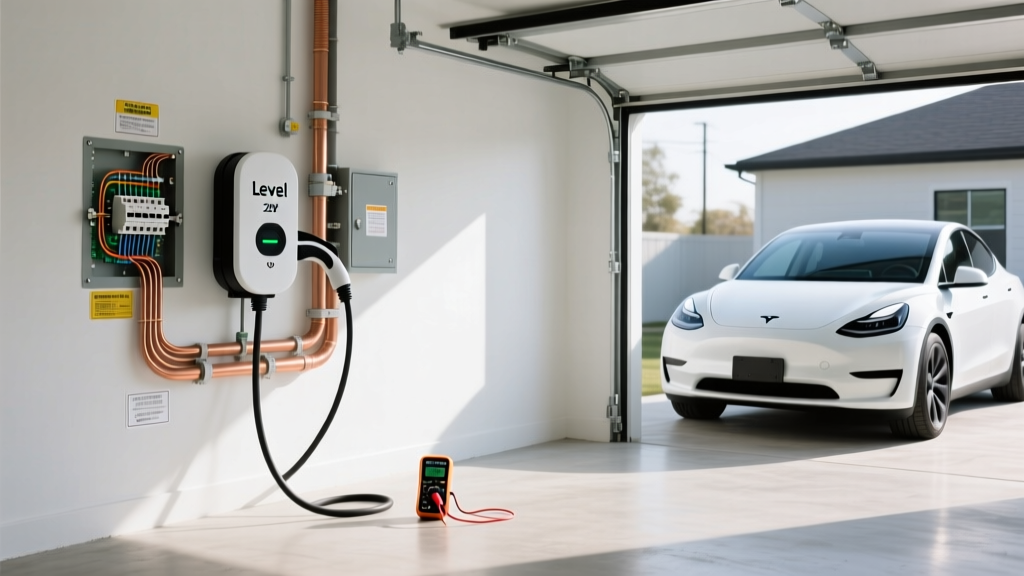
Installing a Level 2 home charger is the single highest-leverage upgrade any EV owner can make. But the total cost depends heavily on your home's existing electrical infrastructure. Here's what a licensed electrician will evaluate:
Core Electrical Requirements
- Circuit: A dedicated 240V circuit, typically 40A or 50A (supporting 32A or 40A continuous charging, respectively—the National Electrical Code requires circuits rated 125% above continuous load)
- Wire gauge: 6 AWG copper for 50A circuits; 8 AWG for 40A circuits (longer runs may require thicker wire to prevent voltage drop)
- Outlet type: NEMA 14-50 (most common, 50A) or NEMA 6-50; many hardwired units skip the outlet entirely for cleaner installation and higher amperage support
- GFCI protection: Required by NEC 2020+ for all EV receptacles—your electrician will install a GFCI breaker or use a charger with built-in ground-fault protection
- Outdoor rating: If your parking spot is outside, the charger must carry a NEMA 4 (weatherproof) rating
Does Your Panel Need an Upgrade?
This is the question that separates a $600 installation from a $3,500 one. Most homes built after 2000 have a 200A main panel with enough spare capacity for a 40A or 50A EV circuit. Older homes with 100A or 150A service may need a panel upgrade—especially if you're already running electric heat, an electric dryer, and an electric oven simultaneously.
Your electrician will perform a load calculation (per NEC Article 220) to determine if your panel can handle the additional draw. If not, options include:
- Panel upgrade to 200A: $1,800–$3,500 depending on your utility and local code
- Load management device: Products like the Emporia Smart Load Manager or Span smart panel dynamically reduce charger amperage when other appliances kick on—avoiding a panel upgrade for $400–$800
- Lower-amperage circuit: Running a 24A charger on a 30A circuit instead of a 48A charger on a 60A circuit may be sufficient if you drive under 50 miles daily
| Cost Component | Simple Install (Panel Adjacent) | Complex Install (Long Run / Panel Upgrade) |
|---|---|---|
| Level 2 Charger Equipment | $300–$700 | $300–$700 |
| Electrician Labor (2–6 hours @ $85–$150/hr) | $200–$450 | $500–$1,200 |
| Electrical Permit | $50–$150 | $50–$200 |
| Panel Upgrade (if needed) | $0 | $1,800–$3,500 |
| Wire / Conduit Materials | $50–$150 | $200–$600 |
| Total Range | $600–$1,450 | $2,850–$6,200 |
Tip: The IRS does not currently offer a federal tax credit specifically for home charger equipment in 2026 (the Alternative Fuel Vehicle Refueling Property Credit, §30C, expired for most residential installations after 2023). However, many utilities offer rebates of $250–$500 for installing a smart Level 2 charger—check with your local provider. Always consult a tax professional regarding current incentive eligibility.
Connector Compatibility: NACS, CCS1, and CHAdeMO for Your 2-Door EV
The connector landscape has consolidated significantly by 2026, but your 2-door car's charge port still determines which chargers you can use natively—and where you'll need an adapter.
| Connector | Brands Using It (2026 Models) | DC Fast Charge Availability | Adapter Needed? |
|---|---|---|---|
| NACS (Tesla) | Tesla (all models), Ford, GM, Rivian, Volvo, Polestar, Hyundai/Kia (2025+), BMW, Mercedes-Benz, Nissan (2025+) | Tesla Supercharger network (25,000+ stalls) + growing third-party NACS stations | CCS-to-NACS adapter for older CCS vehicles at Superchargers; NACS vehicles need no adapter at Superchargers |
| CCS1 | Legacy 2024 and earlier models from VW, BMW, Hyundai, Kia, Ford, GM; some 2025 carryovers | Electrify America, EVgo, ChargePoint, and other public networks | NACS-to-CCS adapter (from Tesla or Ford) required for Supercharger access |
| CHAdeMO | Nissan Leaf (discontinued after 2025), Mitsubishi Outlander PHEV (older models) | Declining rapidly; fewer than 5% of new DC fast stalls | CHAdeMO-to-CCS adapters exist but are expensive ($400+) and limit charge speed |
The 2026 reality: If you're buying a new 2-door EV today, it almost certainly has a NACS port. The transition is nearly complete across major manufacturers. CCS1 vehicles are still well-served at Electrify America and EVgo stations, but the long-term trajectory strongly favors NACS. If you own a CCS1-equipped car, budget $200–$250 for a Tesla NACS-to-CCS adapter to unlock Supercharger access.
How Much Does EV Charging Cost Per Mile vs. Gasoline?
This is where 2-door EV owners see the clearest financial payoff. Let's compare real cost-per-mile scenarios using 2026 national averages.
| Charging Scenario | Cost per kWh | Vehicle Efficiency (kWh/100 mi) | Cost per Mile |
|---|---|---|---|
| Home Level 2 — Off-Peak Utility Rate | $0.09–$0.14 | 28 kWh (e.g., Tesla Model 3) | $0.025–$0.039 |
| Home Level 2 — Standard Residential Rate | $0.14–$0.20 | 28 kWh | $0.039–$0.056 |
| Public Level 2 (ChargePoint, workplace) | $0.20–$0.35 | 28 kWh | $0.056–$0.098 |
| DC Fast Charging (Electrify America, EVgo) | $0.35–$0.55 | 28 kWh | $0.098–$0.154 |
| Gasoline Baseline (28 MPG coupe, $3.40/gal) | — | — | $0.121 |
The verdict: Home charging at off-peak rates costs roughly 70–80% less per mile than gasoline. Even DC fast charging on a road trip roughly matches or slightly exceeds the cost of gas in a fuel-efficient coupe. The break-even math strongly favors home charging as your primary strategy.
For a concrete example: a BMW 430i coupe averaging 28 MPG at $3.40/gallon spends about $1,450 annually on fuel (at 12,000 miles/year). A comparable Tesla Model 3 charged at home at $0.13/kWh spends roughly $437 annually on electricity—a savings of over $1,000 per year. Data sourced from fueleconomy.gov.
Charging Time Examples: What to Expect With Common 2-Door EV Battery Sizes
Battery capacity varies significantly across the 2-door EV and compact segment. Here are realistic charging timelines for popular configurations, from 10% to 80% state of charge:
- 40 kWh battery (e.g., older Nissan Leaf): Level 2 at 7.7 kW → ~4.2 hours | DC fast at 50 kW → ~38 min
- 60 kWh battery (e.g., Tesla Model 3 RWD, Hyundai Kona Electric): Level 2 at 11.5 kW → ~4.5 hours | DC fast at 150 kW → ~22 min
- 75 kWh battery (e.g., Tesla Model 3 Long Range, BMW i4 eDrive40): Level 2 at 11.5 kW → ~5.7 hours | DC fast at 200 kW → ~24 min
- 82 kWh battery (e.g., Ford Mustang Mach-E Extended Range): Level 2 at 10.5 kW → ~6.8 hours | DC fast at 150 kW → ~35 min
Charging curve reality check: No EV sustains peak charge rate across an entire session. A vehicle advertising "250 kW peak DC fast charging" typically holds that rate only between 10–30% SoC, then tapers progressively. By 60% SoC, the rate may have dropped to 120 kW; by 80%, it's often under 50 kW. This is why manufacturers quote 10–80% times rather than 0–100%—the final 20% can take as long as the first 70%.
Preconditioning matters: If your EV supports battery preconditioning (Tesla, Hyundai/Kia E-GMP vehicles, GM Ultium models), always enable it before arriving at a DC fast charger. A cold battery may accept only 50 kW even when the charger offers 250 kW, effectively doubling your stop time. Navigation-based preconditioning typically warms the battery to optimal temperature in the 15–30 minutes before arrival.
Best Level 2 Home Chargers for 2-Door EVs: 2026 Equipment Picks
Not all Level 2 chargers are equal. We've tested and tracked reliability data on the units below, evaluating charge speed, smart features, cable management, and long-term durability.
ChargePoint Home Flex (NACS)
- Power Output: Up to 11.5 kW (48A) on a 60A circuit; configurable down to 16A for lower-amperage panels
- Connector: NACS (native); CCS1 adapter available separately
- Cable Length: 23 feet
- Smart Features: Wi-Fi, Alexa integration, scheduled charging, energy tracking via app, utility demand-response compatible
- Price: $549–$599
- Best For: NACS-equipped 2-door EVs; flexible amperage for older electrical panels
Emporia Vue Level 2 EV Charger
- Power Output: Up to 11.5 kW (48A); software-limited to match panel capacity
- Connector: NACS (2025+ models); J1772 for older versions
- Cable Length: 24 feet
- Smart Features: Full energy monitoring, solar integration, load management with Emporia smart panel, time-of-use scheduling
- Price: $399–$449
- Best For: Budget-conscious buyers with solar panels or those wanting granular energy data
Tesla Wall Connector (NACS)
- Power Output: Up to 11.5 kW (48A) on 60A circuit
- Connector: NACS native; includes J1772 adapter in box (charges non-Tesla NACS vehicles and legacy J1772 vehicles)
- Cable Length: 24 feet
- Smart Features: Wi-Fi, over-the-air updates, power sharing between two Wall Connectors on one circuit, Tesla app integration
- Price: $475
- Best For: Tesla owners or multi-EV households with NACS vehicles
Grizzl-E Smart (NACS / J1772)
- Power Output: Up to 10 kW (40A) on a 50A circuit
- Connector: Available in NACS or J1772 configurations
- Cable Length: 24 feet
- Smart Features: OCPP-compatible, works with multiple energy management platforms, adjustable amperage via DIP switches, extreme cold rated to -40°F
- Price: $399–$449
- Best For: Cold-climate garages and outdoor installations; rugged build quality
Key buying advice: Always match your charger's amperage to your circuit. A 48A charger requires a 60A circuit (125% NEC rule). If your electrician installs a 50A circuit, configure your charger for 40A maximum. Hardwired installations support higher amperage and avoid the GFCI breaker requirement that applies to plug-in NEMA 14-50 outlets.
Safety, Code, and Installation Best Practices
Cutting corners on EV charger installation creates fire risk and may void your homeowner's insurance. Here's what proper installation looks like:
- Dedicated circuit only: Your EV charger must never share a circuit with other appliances. EVs draw continuous high load for hours—shared circuits risk overheating.
- Permit and inspection: Virtually all jurisdictions require an electrical permit for a new 240V circuit. The inspection ensures proper wire gauge, breaker sizing, grounding, and GFCI compliance. Unpermitted work can complicate home sales and insurance claims.
- NEMA 14-50 outlet quality: If you choose a plug-in installation, use a commercial-grade outlet (Hubbell, Bryant, or Cooper—roughly $50–$80) rather than a residential-grade one ($12). Residential outlets are not rated for daily plug/unplug cycles under load and have been linked to melting in EV charging applications.
- Outdoor installations: Any charger mounted outside must carry a NEMA 4 rating. Ensure the conduit and junction boxes are also rated for wet locations. In cold climates, a charger with an integrated cable holster prevents the cord from lying in snow and ice.
- Grounding verification: Your electrician should verify proper grounding at the panel and outlet. Improper grounding can prevent the charger from operating and poses a shock hazard.
Frequently Asked Questions: 2-Door EV Charging
How much does it cost to install a home EV charger?
A straightforward Level 2 installation with the electrical panel near your parking spot typically costs $600–$1,450 all-in (charger, electrician labor, permit, and materials). If your panel needs upgrading or the wire run is long (through walls, under concrete, or across a detached garage), expect $2,850–$6,200. Get at least two quotes from licensed electricians and confirm the quote includes the permit fee.
How fast will each charging level add range to my 2-door EV?
Level 1 (120V) adds 3–5 miles per hour—adequate only if you drive under 30 miles daily. Level 2 (240V) adds 25–44 miles per hour, fully replenishing most 2-door EV batteries overnight in 5–8 hours. DC fast charging adds 150+ miles in 15–20 minutes at peak rate, but expect a full 10–80% session to take 18–40 minutes depending on your vehicle's charge acceptance curve.
Which connector and charger are compatible with my EV?
Check your vehicle's charge port. If it's a 2025+ model from Tesla, Ford, GM, Hyundai, Kia, BMW, Rivian, Volvo, or most other major brands, it uses NACS. Older CCS1 vehicles need a NACS-to-CCS adapter (~$200–$250) for Supercharger access. CHAdeMO vehicles (mostly legacy Nissan Leafs) face declining public infrastructure and should consider a CHAdeMO-to-CCS adapter if available for their model. For home Level 2 charging, any NACS or J1772 charger will work with the appropriate adapter.
How much does charging cost per mile compared to gas?
Home charging at typical residential rates ($0.13/kWh) costs roughly $0.04 per mile for an efficient 2-door EV—about 65–70% cheaper than gasoline at $3.40/gallon in a 28 MPG coupe. Even public DC fast charging at $0.45/kWh ($0.13/mile) is roughly comparable to gasoline. The savings compound over ownership: at 12,000 miles per year, home charging saves roughly $1,000 annually versus gas.
What electrical upgrades might I need for a home charger?
The most common upgrade is a panel capacity increase from 100A or 150A to 200A ($1,800–$3,500). You may also need a new conduit run if your panel is far from your parking spot, a sub-panel for a detached garage ($800–$1,500), or a load management device ($400–$800) if you want to avoid a full panel upgrade. Your electrician's load calculation will determine what's required. Some utilities offer free or discounted load assessments.
Can I use a standard 120V outlet to charge my 2-door EV?
Yes, but slowly. Level 1 charging at 1.4 kW adds roughly 3–5 miles of range per hour. A 60 kWh battery would take approximately 43 hours from empty to full. This works if you drive less than 30–40 miles daily and can plug in for 10+ hours overnight. Use a dedicated 15A or 20A circuit—never an extension cord or a shared outlet with other appliances.
Do I need a smart charger, or will a basic unit work?
A basic ("dumb") charger will charge your car just fine. Smart features—scheduled charging during off-peak rate windows, energy tracking, utility demand-response programs, and remote monitoring—typically justify the $50–$150 premium. If your utility offers time-of-use rates, scheduled charging alone can save $200–$400 annually by shifting charging to overnight hours when electricity costs 40–60% less.