Why a 1968 Charger Car EV Swap Changes the Charging Equation
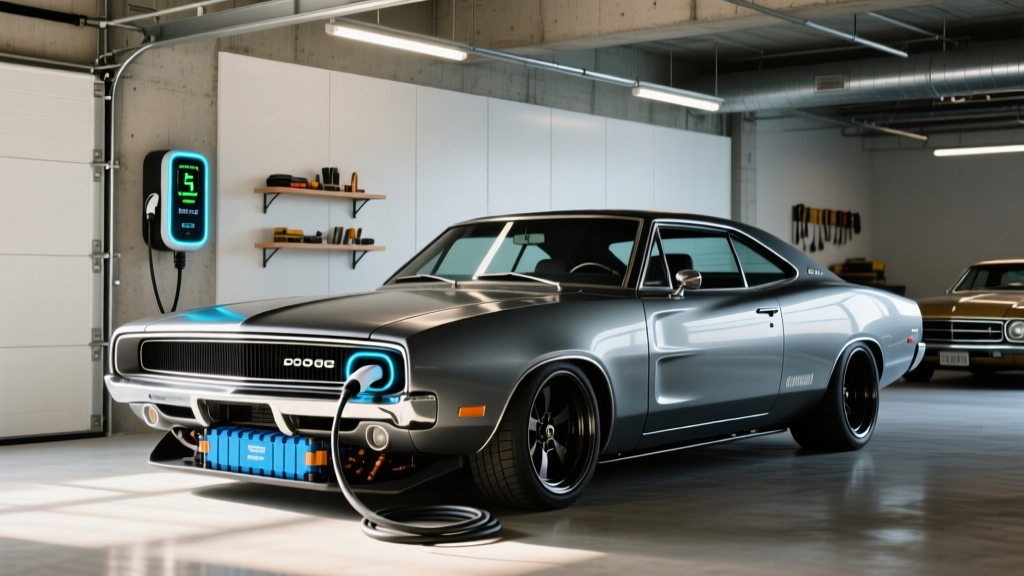
Classic muscle car electrification is no longer a fringe hobby. Shops like Electric GT and Zelectric Motors have proven that a 1968 Dodge Charger can be converted to a battery-electric drivetrain delivering 400+ horsepower, 200+ miles of range, and zero tailpipe emissions — all while preserving the iconic long-hood silhouette. But once the wrenches are down, a new question emerges: how do you actually charge a one-off EV conversion at home, and what infrastructure do you need?
The answer depends on the battery pack size your builder installs (typically 60–100 kWh for a Charger-class conversion), the onboard charger capacity, and the connector standard chosen during the build. This guide walks through every charging decision you'll face with an electrified 1968 Charger — from Level 1 trickle charging to DC fast-charging logistics, home installation costs, and per-mile economics versus the original V8.
Charging Levels Explained: Speeds, kW, and Miles Per Hour
Before evaluating equipment, you need a firm grasp of the three charging tiers. Power is measured in kW (kilowatts) — the rate of energy flow. Energy stored in the battery is measured in kWh (kilowatt-hours) — the total capacity. Confusing the two is the single most common EV literacy mistake. Think of kW as the width of a pipe and kWh as the size of the tank.
| Level | Voltage | Power (kW) | Miles of Range Added Per Hour | Typical Use Case |
|---|---|---|---|---|
| Level 1 | 120V AC | 1.0–1.4 kW | 3–5 mi/hr | Overnight top-off, emergency |
| Level 2 | 240V AC | 3.3–19.2 kW | 12–75 mi/hr | Home daily charging, workplace |
| DC Fast | 400–800V DC | 50–350 kW | 150–1,200 mi/hr (peak) | Road trips, rapid replenishment |
For a 1968 Charger conversion with an 80 kWh battery pack and roughly 2.5–3.0 mi/kWh efficiency (realistic for a 4,200-lb muscle car body), you're looking at approximately 200–240 miles of usable range. A Level 1 outlet would take 3+ days to fully replenish that pack — impractical for daily use. Level 2 is the home-charging standard, and DC fast charging is viable only if your builder installed a CCS or NACS DC charge port.
Home Charger Installation: Electrical Requirements and Costs
A 1968 Charger conversion will typically feature an onboard AC charger rated between 6.6 kW and 11.5 kW. To maximize that onboard capacity, you'll want a Level 2 home station on a dedicated 240V circuit. Here's what the electrical infrastructure looks like:
- 40A circuit / 32A continuous: Delivers 7.7 kW — sufficient for most conversion onboard chargers. Requires 6 AWG copper wire.
- 50A circuit / 40A continuous: Delivers 9.6 kW — ideal if your builder installed an 11.5 kW onboard charger.
- 60A circuit / 48A continuous: Delivers 11.5 kW — matches the upper limit of most aftermarket onboard chargers used in conversions.
Panel Capacity and Upgrade Considerations
Most homes built before 2000 have 100A or 150A main electrical panels. Adding a 40–60A dedicated EV circuit may push total calculated load beyond 80% of panel capacity — the threshold the National Electrical Code (NEC Article 220) requires for continuous loads. If your panel is already near capacity (common with electric dryers, HVAC, and electric ranges), a panel upgrade to 200A may be required.
Some municipalities now allow load-management devices (e.g., Span smart panels or Emporia smart breakers) that dynamically throttle the charger when other high-draw appliances activate, potentially avoiding a full panel upgrade.
| Component | Low Estimate | High Estimate | Notes |
|---|---|---|---|
| Level 2 EVSE equipment | $350 | $750 | 32A–48A smart charger |
| Electrician labor (standard install) | $600 | $1,500 | Panel to garage, <50 ft run |
| Electrical permit | $50 | $200 | Varies by municipality |
| Panel upgrade (if needed) | $1,500 | $3,500 | 100A→200A service upgrade |
| Conduit/wire for long runs | $200 | $800 | >50 ft from panel to charger |
| Total (no panel upgrade) | $1,000 | $2,450 | |
| Total (with panel upgrade) | $2,500 | $5,950 |
Safety and Code Requirements
The 2023 NEC (adopted by most states by 2026) mandates specific protections for EV charging circuits:
- GFCI protection: Required for all outdoor receptacles and recommended (though not universally mandated) for indoor EVSE installations on 240V circuits. Hardwired EVSE units often bypass the GFCI requirement, which is why many electricians prefer hardwiring over NEMA 14-50 receptacles.
- Dedicated circuit: The EV charger must be on its own breaker — no sharing with other appliances.
- Outdoor rating: If your Charger lives in an uncovered carport or driveway, the EVSE must carry a NEMA 4 (weatherproof) rating. Look for UL or ETL listing marks — uncertified units may void homeowner's insurance coverage in the event of an electrical fire.
Connector Compatibility: NACS, CCS1, CHAdeMO, and Conversion Adapters
Production EVs ship with a standardized connector, but a custom 1968 Charger conversion uses whatever charge port the builder selects. This is one of the most consequential decisions in the build — it determines where you can charge publicly.
| Connector | AC Level 2 | DC Fast Charge | Network Availability | Conversion Suitability |
|---|---|---|---|---|
| NACS (Tesla/J3400) | Yes | Yes (up to 350 kW) | Tesla Supercharger (20,000+ stalls), growing open networks | Excellent — most new conversions spec NACS |
| CCS1 (Combo) | Yes | Yes (up to 350 kW) | Electrify America, EVgo, ChargePoint | Good — widely available hardware |
| CHAdeMO | No | Yes (up to 62.5 kW typical) | Declining — limited new installs | Poor — legacy only, avoid for new builds |
| J1772 (AC only) | Yes | No | All public Level 2 stations | Limited — AC-only, no road-trip capability |
For a 1968 Charger conversion in 2026, NACS is the recommended connector. Tesla's Supercharger network remains the most reliable DC fast-charging infrastructure in the US, and the J3400 standard has been adopted by Ford, GM, Rivian, Volvo, and others. If your builder chose CCS1, a CCS-to-NACS adapter (approximately $200–$300) can provide Supercharger access, though charge speeds may be limited by adapter throughput and Tesla's software authentication requirements.
Equipment Recommendations: Level 2 Chargers for a Conversion Garage
The chargers below are selected for their compatibility with custom EV builds, robust power output, and smart features that help manage energy costs. All are UL or ETL listed.
ChargePoint Home Flex
- Power output: Up to 11.5 kW (48A) on a 60A circuit; configurable down to 16A
- Connector: J1772 (NACS vehicles use adapter, commonly included)
- Cable length: 23 feet
- Smart features: Wi-Fi, scheduling, energy tracking, Alexa integration
- Price: ~$549
- Best for: Conversions with J1772 or NACS charge ports; flexible amperage for older panels
Tesla Wall Connector (Gen 4)
- Power output: Up to 11.5 kW (48A) on a 60A circuit
- Connector: NACS native
- Cable length: 24 feet
- Smart features: Wi-Fi, over-the-air updates, power sharing between multiple units, integrated cable management
- Price: ~$450
- Best for: NACS-equipped Charger conversions; cleanest installation with native Tesla port
Emporia Vue EV Charger
- Power output: Up to 11.5 kW (48A)
- Connector: J1772 (NACS adapter available)
- Cable length: 24 feet
- Smart features: Whole-home energy monitoring integration, solar-aware charging, time-of-use scheduling
- Price: ~$399
- Best for: Budget-conscious builds; ideal if you also run an Emporia home energy monitor
Grizzl-E Smart
- Power output: Up to 10 kW (40A) on a 50A circuit
- Connector: J1772 or NACS (configurable at order)
- Cable length: 24 feet
- Smart features: OCPP-compatible, adjustable amperage, rugged aluminum enclosure
- Price: ~$449
- Best for: Outdoor/carport installs in extreme climates; Canadian-built, rated to -40°F
Charging Time Examples: How Long to Replenish a Conversion Battery
Assuming an 80 kWh usable battery pack (a common spec for a 200-mile Charger conversion) and an 11.5 kW onboard charger:
- Level 1 (1.4 kW): 10% to 80% (56 kWh) takes approximately 40 hours — useful only for trickle maintenance.
- Level 2 at 7.7 kW (40A circuit): 10% to 80% takes approximately 7.3 hours — overnight ready.
- Level 2 at 11.5 kW (60A circuit): 10% to 80% takes approximately 4.9 hours — fastest AC option.
- DC Fast at 50 kW: 10% to 80% takes approximately 65 minutes (charge curve tapering above 80% SoC extends full charge significantly).
- DC Fast at 150 kW: 10% to 80% takes approximately 28 minutes — if the conversion's battery management system (BMS) supports that charge rate. Many conversion packs are limited to 50–80 kW DC to protect cell longevity.
Cost Per Mile: Charging Your Electrified Charger vs. the Original 440 V8
The original 1968 Dodge Charger with a 440 Magnum V8 averaged roughly 10–12 MPG. At $3.50/gallon (2026 national average), that's $0.29–$0.35 per mile in fuel alone. Here's how electrified charging costs compare:
| Charging Scenario | Cost per kWh | Cost per Mile | Annual Cost (12,000 mi) |
|---|---|---|---|
| Home Level 2 — off-peak utility rate | $0.08–$0.12 | $0.03–$0.04 | $360–$480 |
| Home Level 2 — standard residential rate | $0.14–$0.18 | $0.05–$0.06 | $600–$720 |
| Public Level 2 (ChargePoint, etc.) | $0.20–$0.35 | $0.07–$0.13 | $840–$1,560 |
| DC Fast Charging (Electrify America, EVgo) | $0.35–$0.55 | $0.13–$0.20 | $1,560–$2,400 |
| Tesla Supercharger (NACS) | $0.25–$0.40 | $0.09–$0.14 | $1,080–$1,680 |
| Original 440 V8 at 11 MPG | $3.50/gallon | $0.32 | $3,840 |
Even at the most expensive DC fast-charging rates, the electrified Charger costs less per mile than the original V8. For a garage-kept classic driven 5,000 miles per year on home off-peak charging, annual "fuel" cost drops to roughly $150–$200 — an 80%+ reduction versus gasoline. According to fueleconomy.gov, electricity costs per mile for EVs are consistently 50–70% lower than gasoline equivalents across all US regions.
Federal and State Incentives for Home Charger Installation
The IRS §30C Alternative Fuel Vehicle Refueling Property Credit provides a tax credit of up to 30% of the cost of home EV charging equipment and installation, capped at $1,000. Key eligibility requirements for 2026:
- The charger must be installed at your primary residence.
- The property must be located in an eligible census tract (generally low-income or non-urban areas — check the IRS eligibility tool).
- The credit covers both equipment and installation labor costs.
- You must have sufficient tax liability to claim the non-refundable credit.
Many states and utilities offer additional rebates. California's CC4A program, New York's Charge Ready NY, and various utility TOU (time-of-use) programs can offset $200–$1,500 of installation costs. Always confirm current program availability with your local utility and consult a tax professional regarding credit eligibility.
Frequently Asked Questions
How much does it cost to install a home EV charger for a classic car conversion?
For a typical 40A–60A Level 2 installation without a panel upgrade, expect $1,000–$2,450 including equipment, electrician labor, and permits. If your home's electrical panel needs an upgrade from 100A to 200A service, add $1,500–$3,500. The total with a panel upgrade ranges from $2,500 to $5,950.
How fast will each charging level add range to my conversion?
Level 1 (120V) adds roughly 3–5 miles of range per hour. Level 2 (240V, 40A–60A) adds 20–40 miles per hour depending on your onboard charger's kW rating. DC fast charging can add 150–400 miles per hour at peak rates, but only if your conversion's BMS and battery pack support the charge rate — many conversions cap DC input at 50–80 kW.
Which connector should my builder install in a 1968 Charger EV conversion?
In 2026, NACS (J3400) is the strongest choice. It provides native access to Tesla's Supercharger network (the largest and most reliable DC fast-charging system in the US) and is now the standard adopted by most major automakers. CCS1 is a viable second choice with broad Electrify America and EVgo compatibility. Avoid CHAdeMO for any new build — the standard is being phased out.
How much does charging cost per mile compared to the original V8?
Home Level 2 charging at off-peak rates costs roughly $0.03–$0.04 per mile for a Charger conversion achieving 2.8 mi/kWh. The original 440 V8 at 11 MPG costs approximately $0.32 per mile at $3.50/gallon. That's an 85–90% reduction in per-mile fuel cost when charging at home.
What electrical upgrades might my home need?
The most common upgrade is a main panel increase from 100A or 150A to 200A service, which costs $1,500–$3,500. You'll also need a dedicated 240V circuit (40A–60A breaker) run from the panel to your garage or parking area. Homes with long distances between the panel and the charger location (>50 feet) may require larger-gauge wire and conduit, adding $200–$800. A licensed electrician can perform a load calculation per NEC Article 220 to determine whether your existing panel has sufficient headroom.
Can I use a portable Level 2 charger instead of a hardwired unit?
Yes. Portable Level 2 chargers (e.g., the Tesla Mobile Connector or Lectron V-BOX) plug into a NEMA 14-50 receptacle and deliver up to 9.6 kW (40A). However, NEC 2023 code requires GFCI protection on 14-50 receptacles used for EV charging, and GFCI breakers for 240V/50A circuits can nuisance-trip with some EVSE units. A hardwired station avoids this issue and is generally preferred for daily charging.
Does my conversion's battery chemistry affect charging behavior?
Yes. Most conversions use NMC (nickel-manganese-cobalt) cells, which tolerate DC fast charging well but degrade faster if routinely charged to 100% SoC. If your builder used LFP (lithium iron phosphate) cells — increasingly common for their longevity and thermal stability — you can safely charge to 100% regularly, and LFP's flatter voltage curve means more consistent charge speeds across the SoC range. Always follow your builder's BMS configuration guidelines for optimal battery lifespan. See the NHTSA resources on aftermarket EV safety for additional guidance.